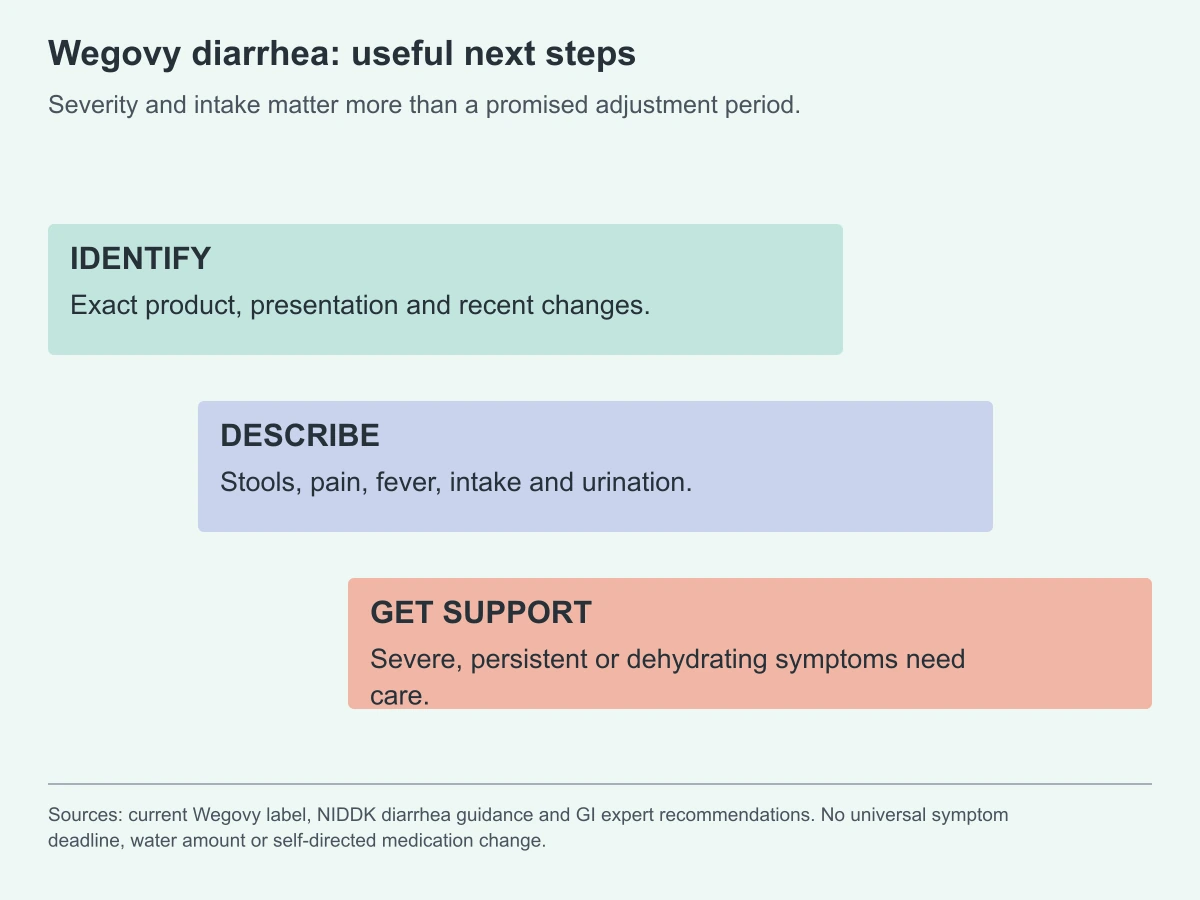
Diarrhea can occur with Wegovy, especially during dose escalation, but there is no guaranteed day when it will stop for everyone. Mild symptoms may improve, while severe, persistent, or dehydrating diarrhea needs medical advice. Check your exact Wegovy product and tell the care team about the timing, bowel pattern, food and fluid intake, and other medicines.
How common is diarrhea with Wegovy?
The current U.S. label reports diarrhea in 30% of adults receiving Wegovy 2.4 mg once-weekly injection versus 16% receiving placebo in the pooled weight-reduction trials summarized in Table 3. These figures describe those trial groups, not the risk at every starting dose, for every semaglutide product, or for every person. Wegovy prescribing information
The current label also includes other presentations and datasets, including oral tablets, 7.2 mg injection, and pediatric injection use. Rates should not be transferred across routes, doses, indications, or populations. A lower dose is not a guarantee that diarrhea will not occur, and the adult 2.4 mg figure is not an estimate for a compounded formulation.
| Label context | Diarrhea information | How to interpret it |
|---|---|---|
| Pooled adult 2.4 mg injection weight-reduction trials | 30% with Wegovy versus 16% with placebo | A group-level trial observation |
| Pediatric 2.4 mg injection obesity trial, ages 12 and older | 22% versus 19% with placebo | A separate population; not an adult prediction |
| Oral tablet or 7.2 mg injection use | Separate label sections and trial context apply | Do not borrow the adult pooled 2.4 mg rate |
| Your own symptoms | Frequency, severity, intake, and timing need review | A percentage cannot decide whether waiting is safe |
Source: current label, adverse-reaction section. This guide focuses on practical adult questions and does not give pediatric treatment instructions.
Why can it happen?
Wegovy contains semaglutide, a GLP-1 receptor agonist with effects on appetite and gastrointestinal function. The label describes gastrointestinal adverse reactions, including diarrhea, and notes that these reactions were most frequently reported during dose escalation. A gastrointestinal symptom is not proof that treatment is working better.
There may also be another explanation. Infection, another medicine, a new supplement, food intolerance, or an underlying bowel condition can cause diarrhea. If the symptoms started after a change, the timing helps the assessment but does not establish the cause by itself. Wegovy label, NIDDK diarrhea causes
Our Wegovy side-effect guide provides broader context. Keep the discussion focused on your actual symptoms rather than assuming every digestive change is an expected medication effect.
Does Wegovy diarrhea go away?
It may improve for some people, but the course varies. The label’s observation that gastrointestinal reactions commonly occur during escalation does not supply a personal symptom deadline. Neither a trial average nor another person’s experience tells you how long your episode should last.
If symptoms are mild and you can eat and drink, you can record the pattern and contact the prescribing team for guidance. If they are continuing, recurring, becoming more severe, or interfering with intake, do not keep waiting simply because you read that the body “gets used to it.”
There is also no universal recovery schedule after stopping or missing a dose. Ongoing diarrhea may have another cause, and changing treatment does not replace assessment. Ask the prescriber what to do with the next scheduled dose when symptoms are significant; do not independently speed up, repeat, reduce, or restart a dose to test a theory.
When should you get medical advice?
Seek prompt advice for signs of dehydration, severe abdominal or rectal pain, blood or black stools, high fever, inability to keep fluids down, or diarrhea that persists. NIDDK advises adults to seek care for diarrhea lasting more than two days or six or more loose stools in a day. Depending on age, pregnancy, immune status, and other conditions, assessment may be needed sooner. NIDDK warning signs
Dehydration can include marked thirst, reduced urination, dark urine, dizziness, dry mouth, and unusual tiredness. Fainting, confusion, severe weakness, or other serious symptoms warrant urgent care. Do not use a lower scale reading as reassurance that fluid loss is acceptable.
Wegovy’s label warns about acute kidney injury due to volume depletion, with many reported cases occurring in people who had gastrointestinal reactions leading to dehydration. It also contains warnings about pancreatitis and gallbladder disease. Severe or persistent abdominal pain, particularly with vomiting or pain radiating to the back, needs urgent evaluation rather than routine dietary troubleshooting. Wegovy safety information
What should you drink?
The goal is to avoid or address fluid loss appropriately for your circumstances. There is no universal number of glasses suitable for every person. Kidney disease, heart conditions, fluid restrictions, diabetes, and other medicines can change the advice.
Tell the care team what you can actually keep down, how often you are urinating, and whether vomiting accompanies the diarrhea. Ask whether an oral rehydration product or other approach is suitable. Do not assume every sports drink, flavored water, or electrolyte powder has the same ingredients or is appropriate for you.
If you cannot maintain intake or have symptoms of dehydration, seek care rather than relying on a beverage plan. Our water before bed guide discusses ordinary hydration and sleep questions, but nighttime drinking advice is not a treatment plan for ongoing diarrheal fluid losses.
For Wegovy tablets, the medication’s dosing instructions and water limits at the time of administration are separate from overall daily hydration needs. Do not turn a product-specific administration rule into a restriction on needed fluids throughout the day. Exact product label

What should you eat during mild symptoms?
Choose foods you can tolerate and avoid forcing a large meal. Gastrointestinal expert guidance for GLP-1 therapies discusses eating slowly, using smaller portions when appropriate, and tailoring food choices to symptoms. It does not establish one required menu or support prolonged under-eating. Expert gastrointestinal guidance
Notice whether large or rich meals, a particular drink, dairy ingredients, or another food seems to worsen symptoms. The purpose of a short record is to identify a pattern for review, not to remove increasingly large groups of food indefinitely. A familiar simple meal may be more manageable than a complicated “side-effect diet.”
If you rely on a shake or yogurt because eating feels difficult, check the ingredients and whether you are still getting enough intake across the day. Our protein shake meal guide and yogurt guide offer food-planning questions. Neither product category is a guaranteed treatment for diarrhea.
Persistent symptoms that prevent adequate food or fluid intake require follow-up. The joint nutrition advisory emphasizes monitoring nutrition and physical function during GLP-1 therapy. A small appetite does not make poor intake safe. Joint nutrition advisory
Should you take an antidiarrheal medicine?
Ask a clinician or pharmacist before adding one, particularly when symptoms are severe, ongoing, bloody, associated with fever or significant pain, or occurring alongside other conditions and medicines. The cause matters. An over-the-counter product does not replace evaluation of dehydration or another serious problem.
Give the pharmacist the exact Wegovy presentation and the rest of your medication list. Include laxatives, magnesium products, herbal products, and recent antibiotics. Medicines used to manage one symptom may complicate another bowel problem.
This article does not provide a routine antidiarrheal schedule or tell you to continue treatment through severe symptoms. The prescribing team can decide whether symptom treatment, investigation, or a change in the medication plan is appropriate.
What about the next dose or a planned increase?
Contact the prescriber when diarrhea is significant or continuing, particularly before a planned increase. The label contains product-specific escalation and interruption instructions, but applying them requires the correct presentation and clinical context. Do not copy an injection plan for tablets or another semaglutide product.
Our Wegovy dosage guide helps readers identify initiation, escalation, and maintenance questions. The semaglutide missed-dose and restart guide explains why interruptions deserve exact-product instructions. Neither article should be used to improvise a symptom-driven dose adjustment.
If you use insulin or a medicine that can cause low blood sugar, reduced eating or illness may also affect diabetes management. Follow your individual monitoring and sick-day plan and seek advice when needed. Do not independently reduce or omit essential diabetes treatment because you have diarrhea. Wegovy label
Can diarrhea start after months of treatment?
Yes, a person can develop diarrhea later, but it should not automatically be attributed to Wegovy. Review new medicines, dose changes, illness, food exposures, supplements, and other symptoms. A period of prior tolerability does not establish the cause of a new episode or make persistent symptoms harmless.
NIDDK describes several possible causes of acute and persistent diarrhea. The care team may ask about travel, sick contacts, recent antibiotics, duration, stool features, and underlying digestive conditions. NIDDK causes and symptoms
For comparison, our Ozempic diarrhea article covers the same active ingredient in a different named product, while Zepbound diarrhea concerns tirzepatide. Do not transfer their trial rates or directions to Wegovy.
Is diarrhea part of weight loss?
Diarrhea is a symptom, not a desirable treatment outcome. A rapid scale drop can reflect fluid loss, less intestinal material, or reduced intake. It does not establish useful loss of body fat. Our bowel movements and weight guide explains this distinction.
Do not pursue repeated diarrhea, skip needed food, or add a cleanse to accelerate a result. Successful follow-up includes tolerable treatment, adequate nutrition and hydration, and daily function. The semaglutide protein and muscle guide discusses why preserving these matters.
If you are considering a different treatment, the semaglutide and tirzepatide product pages can support a clinician discussion. Switching should follow assessment of the symptoms and exact product rather than a promise that another medicine will eliminate diarrhea.

A short record helps the appointment
Note your product and presentation, current prescription, recent changes, when diarrhea began, how often it occurs, and whether vomiting, fever, blood, or pain is present. Include what you can eat and drink and any change in urination or everyday function.
Also list other medicines and supplements, even ones used only occasionally. Bring questions about the next dose, nutrition, rehydration, and when urgent care is appropriate. You do not need to prove that the symptom came from Wegovy before asking for help.
Frequently asked questions
Is diarrhea after every dose normal?
Recurring symptoms deserve review, even if diarrhea is a known adverse reaction. The severity, duration, and effect on eating and drinking matter. A known side effect is not automatically something you should tolerate indefinitely.
How many days should I wait?
There is no guaranteed adjustment period. NIDDK advises adult medical assessment for diarrhea lasting more than two days and several other warning signs; serious symptoms require earlier care. Use those signs and your individual circumstances rather than a promised internet deadline.
Can I eat only toast until it stops?
A simple tolerated food may be useful temporarily, but a very limited diet can leave gaps if continued. If symptoms make varied intake difficult, contact the care team or a dietitian. Do not let a short-term food choice become prolonged restriction.
Should I stop drinking water if it seems to trigger a bowel movement?
Do not use fluid restriction as a diarrhea strategy. Explain the pattern to a clinician, especially if you cannot maintain hydration. Existing medical fluid restrictions require individualized advice rather than an improvised change.
Does stopping Wegovy cause a diarrhea withdrawal syndrome?
The cited label does not establish a predictable diarrhea withdrawal syndrome or a fixed recovery timeline. Continuing symptoms after a change still need assessment for medication effects and other causes. Ask for a plan rather than relying on that explanation.
Will a lower dose or a different medicine solve it?
Possibly different treatment decisions will be considered, but no article can guarantee the result or select the change for you. Discuss the exact product, symptoms, and goals with the prescriber before changing the regimen.
Educational information for adults; individual treatment decisions require a qualified clinician. Sources reviewed October 1, 2026. Original AI-generated article images depict fictional people and objects, not patient outcomes. Other editorial images are illustrative. Graphics summarize the cited sources.