Wegovy or Ozempic injection and gabapentin may appear in the same person’s treatment plan for different health needs. The combination requires a review of the actual prescriptions, kidney function, daytime alertness, other sedating medicines, and any vomiting or poor intake. The reviewed prescribing information does not provide a universal hour-based separation or a combination-specific side-effect rate.
If you already take both, make sure the prescribing clinicians and pharmacist know the full regimen. Do not abruptly stop gabapentin, add extra tablets because a dose seems delayed, or change weekly semaglutide on your own. New symptoms need their own assessment rather than a guess about which medicine caused them.
Why the exact product names matter
Semaglutide is an ingredient used in different branded products and formulations. Ozempic injection and Wegovy injection have different labeled indications and dosing plans. Oral semaglutide has separate instructions. A prescription described only as “sema” leaves important information out of a medication review. Ozempic label; Wegovy label.
Gabapentin also needs its exact formulation and directions identified. This article uses the Neurontin prescribing information as a source for immediate-release oral gabapentin precautions. Do not automatically apply its administration details to a different extended-release product or another medicine with a similar name. Neurontin label.
Bring the packages or a current pharmacy list. Include why gabapentin is being used, who prescribes it, how long the regimen has been stable, and whether a semaglutide product or dose changed recently. Our oral semaglutide versus injections guide explains the formulation question in more detail.
What do the labels say about oral medicines?
Ozempic delays gastric emptying and therefore has the potential to affect oral medicine absorption. Its label also says the oral medicines studied in clinical pharmacology trials were not affected to a clinically relevant degree, while retaining a caution for concurrent oral treatment. These are qualified findings, not proof that every oral medicine has been studied. Ozempic section 7.2.
Wegovy labeling likewise discusses delayed gastric emptying and advises monitoring the effects of oral medicines. It calls for particular attention to medicines with a narrow therapeutic index or those requiring clinical or laboratory monitoring. The label contains both injection and tablet information, so the route of a cited interaction study matters. Wegovy section 7.2.
The reviewed sources do not establish that semaglutide predictably raises or lowers gabapentin exposure in every patient. A reasonable clinical inference is that a changed response or difficulty taking oral treatment deserves review. It is not a basis for independently increasing gabapentin or setting a new injection schedule.
Can spacing gabapentin away from the injection solve the problem?
The reviewed labels do not establish a special interval between gabapentin and a weekly semaglutide injection. Semaglutide has a long elimination half-life, approximately one week. A gap of a few hours does not remove it from the body or prove that any overlapping effects have been avoided. Ozempic pharmacokinetics.
Follow the actual prescribed gabapentin schedule. If sleepiness, meals, work hours or other medicines make that schedule difficult, have the prescriber or pharmacist review it. A schedule used for a different indication or formulation should not be copied from another person.
An antacid interaction is a separate question. The Neurontin label recommends taking gabapentin at least two hours after the aluminum-and-magnesium antacid used in its interaction study. That specific instruction should not be renamed a two-hour rule for Ozempic, Wegovy, every supplement or every reflux medicine. Neurontin interactions.
Why kidney function belongs in the conversation
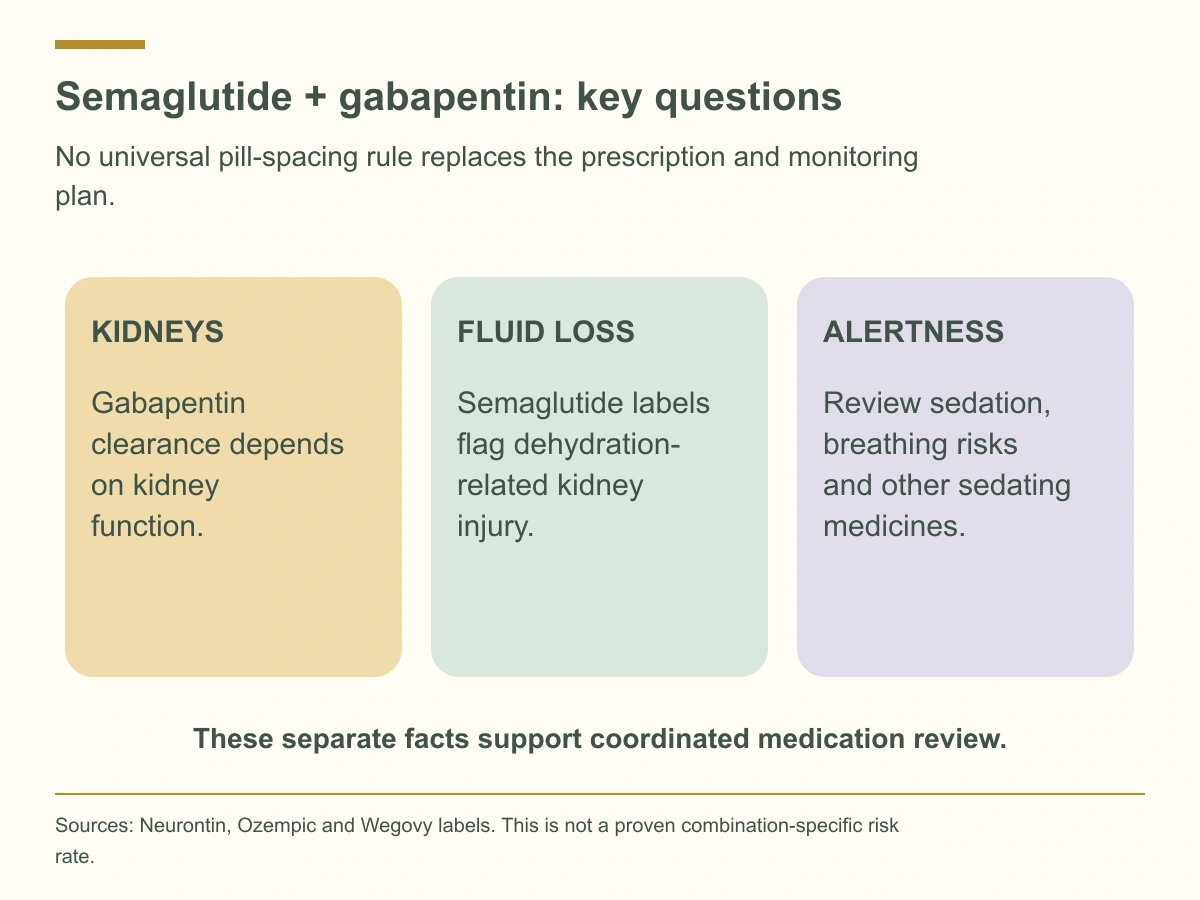
Gabapentin is eliminated through the kidneys as unchanged medicine. The Neurontin label recommends dosage adjustment when kidney function is impaired, and describes reduced clearance in that setting. The prescriber needs the relevant kidney history and laboratory information when choosing and reviewing the regimen. Neurontin renal dosing and pharmacokinetics.
Semaglutide labels separately warn about acute kidney injury associated with gastrointestinal reactions leading to dehydration, such as nausea, vomiting or diarrhea. That warning is especially relevant when symptoms affect fluid intake or persist during treatment initiation or increases. Ozempic warnings; Wegovy warnings.
These facts support coordination: a significant illness or fluid-loss episode can be a reason to reassess the overall medicine plan, including a kidney-cleared drug. They do not prove that everyone taking both develops kidney injury or that semaglutide directly blocks gabapentin clearance.
Tell the team about chronic kidney disease, dialysis, recent illness, markedly reduced urination or a change in prescribed monitoring. Do not calculate a new gabapentin dose from an online kidney table. Renal dosing involves the actual product, indication, clinical status and the prescriber’s assessment.
Drowsiness, dizziness and balance changes
Gabapentin can cause sleepiness, dizziness and coordination problems. The label warns that people may not reliably judge their own degree of impairment and should not drive or operate complex machinery until they have enough experience to assess the effect. Other sedating medicines may add to these problems. Neurontin precautions.
Describe symptoms specifically. Falling asleep unexpectedly, feeling faint on standing, having a spinning sensation, and feeling unsteady when walking are not identical. A report that includes timing and functional impact is more useful than “the combination makes me feel weird.”
Poor intake, dehydration, low blood glucose in a relevant diabetes regimen, another illness or another prescription may also matter. Our Ozempic dizziness guide explains related questions. Avoid driving while impaired, and arrange prompt review for new or worsening symptoms, falls or difficulty carrying out ordinary activities.

When breathing risk becomes especially important
Neurontin labeling warns about serious respiratory depression when gabapentin is used with other central nervous system depressants, including opioids, or in people with underlying respiratory impairment. This warning should be discussed using the full medicine list and health history. It is not a claim that semaglutide itself is an opioid-like sedative. Neurontin respiratory warning.
Include opioid pain medicines, sleep medicines, alcohol use and other potentially sedating products in the conversation. Also tell the clinician about breathing conditions and sleep-related breathing problems. A medicine being taken only occasionally still belongs on the list.
Severe breathing difficulty, unusually slow or shallow breathing, inability to wake normally, or collapse requires emergency help. Do not wait for the next routine appointment or try to manage a suspected serious reaction by changing the injection site. The sleep-apnea and weight-management discussion addresses a separate treatment topic; weight-management care does not automatically replace an existing breathing-treatment plan.
What if nausea makes gabapentin hard to take?
Contact the pharmacist or prescriber if you cannot keep prescribed oral medicines down. The response depends on the reason for gabapentin, the formulation, what was taken and when, and the severity of the illness. Vomiting does not tell you precisely how much of a tablet or capsule was absorbed.
Do not automatically repeat a dose or stop several medicines while waiting for symptoms to settle. If gabapentin is part of seizure care, interruptions deserve especially clear instructions from the treating team. The Neurontin label advises gradual reduction when the medicine is reduced, discontinued or replaced, and warns against abrupt antiepileptic discontinuation. Neurontin administration and withdrawal precautions.
Our semaglutide nausea and vomiting guide explains when digestive symptoms call for follow-up. Repeated vomiting, inability to drink, very little urine, fainting or severe persistent abdominal pain needs prompt assessment, with urgent care when symptoms are severe.
Can gabapentin-related weight changes cancel semaglutide’s effect?
The Neurontin label includes weight gain and peripheral edema among reported reactions in relevant clinical-trial tables. A change on the scale therefore deserves context, especially when swelling is also present. It does not prove that body-fat gain has occurred or that semaglutide is no longer effective. Neurontin adverse reactions.
Assess the trend, timing, fluid changes, appetite, intake, activity and treatment goals together. A rapid unexplained change with swelling, breathlessness or reduced urination needs clinical attention rather than a stricter diet. A longer-term weight concern can be reviewed during planned follow-up.
Do not increase semaglutide to “counteract” another medicine without assessment. The semaglutide plateau guide distinguishes short fluctuations from a sustained pattern and explains why tolerability and adequate nutrition matter alongside the scale.
Mood changes and allergic symptoms also deserve attention
Gabapentin’s label includes monitoring for new or worsening depression, suicidal thoughts or unusual changes in mood or behavior. Report those concerns promptly; immediate danger requires emergency assistance. Do not assume that a change in mood is simply frustration with weight or poor sleep. Neurontin mood warning.
The label also describes serious hypersensitivity reactions, including DRESS, a reaction that can involve several organs, and anaphylaxis or angioedema. Fever, rash or swollen glands may need immediate assessment, and some early serious reactions can occur before an obvious rash. Difficulty breathing or swelling of the mouth or throat requires emergency care.
These warnings are part of understanding the medicine itself. They do not establish that using semaglutide makes each reaction more likely. Keep the actual drug information available and ask which symptoms should trigger a same-day call versus emergency help.

A practical review checklist
Before an appointment, assemble a short record. Do not delay urgent care to complete it.
| Review area | Information to bring |
|---|---|
| Semaglutide | Brand or preparation, route, strength, last dose and recent changes |
| Gabapentin | Exact formulation, directions, indication and prescribing clinician |
| Kidney health | Known kidney disease, dialysis, recent tests or fluid-loss illness |
| Alertness and breathing | Sleepiness, falls, driving concerns, opioids and other sedating products |
| Digestive symptoms | Vomiting, diarrhea, fluid intake and difficulty keeping medicines down |
| Ongoing benefit | The intended treatment outcome and what has changed |
Ask who should receive symptom updates and who will coordinate any medicine changes. Our GLP-1 supplement guide can help identify nonprescription products that may otherwise be omitted.
Frequently asked questions
Is the answer different for Wegovy and Ozempic?
They share semaglutide, but their indications, presentations and schedules are not identical. The oral-medicine and symptom questions overlap, while the actual label and prescription remain product-specific. Do not substitute one brand, formulation or dose without the prescribing team’s instructions.
Can I stop gabapentin because I am starting weight treatment?
Do not stop it abruptly. The condition it treats still needs a plan, and discontinuation may require a gradual clinician-directed change. Starting another medicine is a reason to reconcile the regimen, not proof that gabapentin is no longer needed.
Does moving the injection to the thigh reduce sleepiness?
There is no established injection-site switch that guarantees relief from gabapentin-related sedation or another cause of fatigue. Use a permitted site and correct technique, and have the symptoms reviewed. Our GLP-1 injection-sites guide addresses the separate administration question.
What about compounded semaglutide?
A compounded preparation is not FDA-approved and should not be assumed equivalent to branded Wegovy or Ozempic. Concentration, pharmacy instructions and the reason for compounding need their own review. FDA information.
CoreAge Rx semaglutide information can help you prepare questions about assessment and the actual preparation offered. Bring gabapentin and the full medicine list into that assessment, and confirm how follow-up will be coordinated with your existing clinicians.
Educational information for adults; individual treatment decisions require a qualified clinician. Sources reviewed October 6, 2026. Original AI-generated article images depict fictional people and objects, not patient outcomes. Other editorial images are illustrative. Graphics summarize the cited sources.