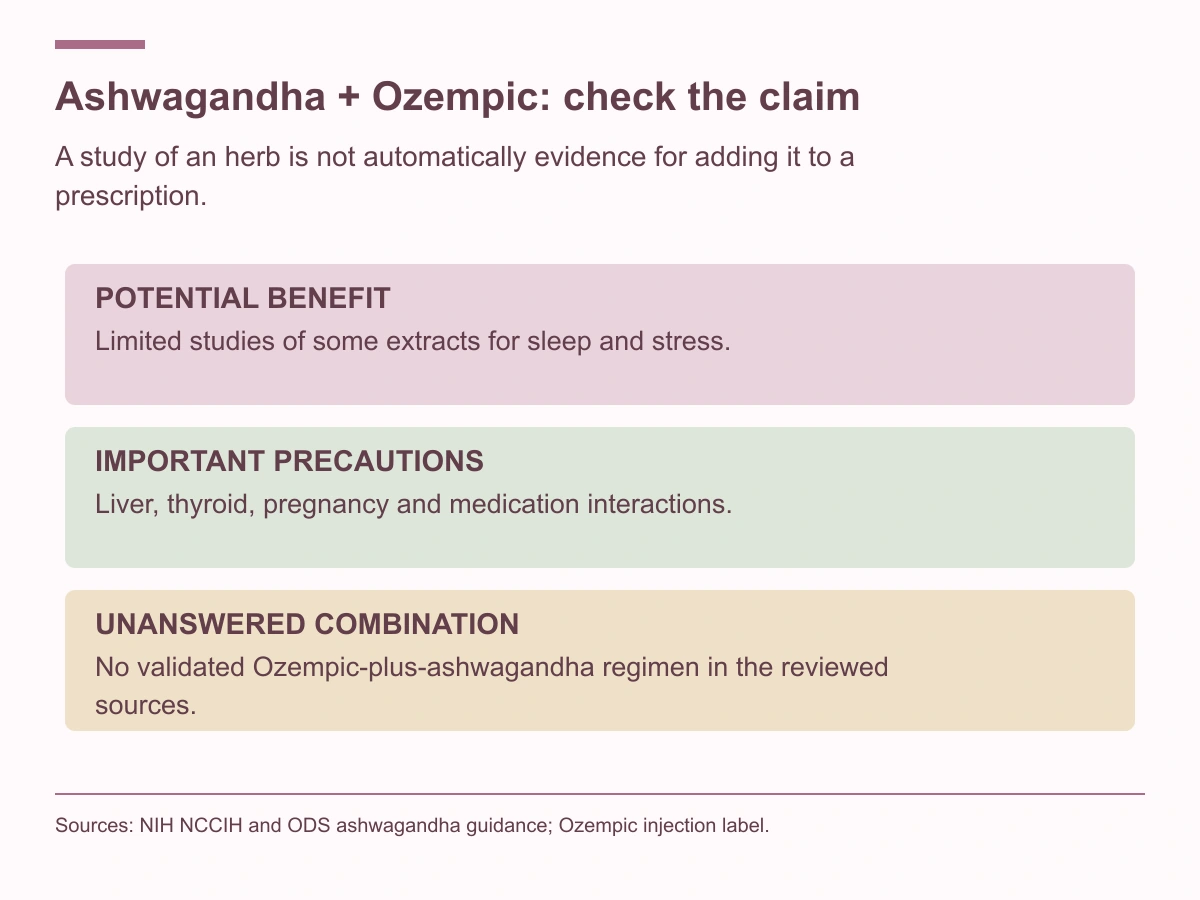
Do not assume that adding ashwagandha to Ozempic is safe or useful simply because the herb is sold without a prescription. NIH guidance describes possible interactions with diabetes medicines and other drug categories, as well as concerns involving the liver, thyroid, pregnancy and sedation. The reviewed sources do not establish a validated Ozempic-plus-ashwagandha regimen or a proven weight-loss benefit from combining them.
The practical next step is to show the actual supplement label to your pharmacist or prescribing clinician. Explain why you want to take it, what symptoms you hope to improve, and all medicines and supplements you already use. Keep the prescription and the supplement questions connected rather than treating them as separate shopping decisions.
What is ashwagandha, and what is in a supplement?
Ashwagandha is the common name for Withania somnifera, a plant used in traditional medicine. Commercial products may contain root extract, leaf extract, a combination, or other ingredients. NIH’s Office of Dietary Supplements notes that the chemical composition of the root and leaf differs and that research preparations vary. NIH ODS fact sheet.
A capsule, gummy, powder and multi-ingredient “stress blend” are not necessarily equivalent. The front-label milligram amount does not describe every difference in extract composition or standardization. A study of one preparation cannot automatically validate every product bearing the plant’s name.
Bring a photograph of the complete label or the package itself. Include the serving size, amount you actually take, how often you take it, and other active ingredients. “One natural supplement” leaves too much out of an interaction review.
What benefits have actually been studied?
NCCIH states that some ashwagandha preparations may help with insomnia and stress, while evidence about anxiety is less clear. It emphasizes that many studies are small and use different preparations. It does not establish ashwagandha as a treatment for diabetes or a broad range of other promoted conditions. NCCIH ashwagandha guidance.
The ODS review describes short clinical studies of stress and sleep, with differences in participants, extracts, amounts and measured outcomes. Some findings are encouraging, but those differences make a universal product or amount difficult to recommend. The evidence should remain attached to the studied outcome. ODS evidence review.
These are not trials proving that adding ashwagandha to Ozempic improves weight loss, prevents semaglutide side effects or makes diabetes treatment safer. A reported change in cortisol, stress rating or sleep score should not be renamed a proven benefit for the combination.
Our natural GLP-1 foods and supplements guide explains a similar evidence problem: a biological mechanism or a marketing phrase does not establish a medication-like clinical result.
Why might diabetes medicines need extra review?
NCCIH lists diabetes medicines among categories with which ashwagandha might interact. This is a reason to discuss the complete regimen, not proof of a quantified Ozempic-specific interaction or an instruction to reduce a prescription independently. NCCIH safety information.
Ozempic injection’s label separately warns about increased hypoglycemia risk when used with insulin or an insulin-releasing medicine such as a sulfonylurea. Reduced food intake, illness and other treatment changes can complicate glucose management. Tell the clinician what else you take and whether you already have a monitoring and low-glucose plan. Ozempic prescribing information.
Shakiness, sweating, weakness or dizziness should not automatically be attributed to a relaxing herb or expected semaglutide effects. Follow your existing glucose-checking and treatment instructions when relevant. Severe confusion, seizure or loss of consciousness requires emergency help and the established rescue plan.
The Ozempic dizziness article covers related assessment questions. Do not use a supplement to replace diabetes treatment or adjust insulin based on an online claim that ashwagandha “balances blood sugar.”
Overlapping stomach symptoms can make the cause unclear
Ashwagandha can cause stomach upset, diarrhea, vomiting and drowsiness in some people. Ozempic also commonly causes gastrointestinal symptoms, and its label warns about severe reactions and kidney injury associated with fluid loss. A person taking both may have more than one plausible explanation for new symptoms. NCCIH guidance; Ozempic label.
That overlap does not prove an interaction. It does mean that starting several products at once can make a symptom history harder to interpret. Record when each was started or changed, what the symptoms are, whether meals and fluids are manageable, and what else was taken.
Contact the care team for persistent or substantial vomiting or diarrhea, difficulty drinking, markedly reduced urination or significant dizziness. Severe persistent abdominal pain needs urgent assessment. Do not cover up a concerning symptom by adding more “gut support” supplements. Our semaglutide nausea and vomiting guide offers more focused questions.
What is the liver concern?
NCCIH describes rare reports linking ashwagandha supplements to liver injury. ODS discusses reported cases, including symptoms such as jaundice, itching, nausea, lethargy and abdominal discomfort. It also notes that some products were combinations and their contents were not independently verified in every case. NCCIH safety; ODS liver discussion.
The reports do not establish a reliable risk percentage for every commercial product, and they should not be exaggerated into a claim that every user develops liver damage. They also should not be dismissed because the ingredient is traditional or natural.
Yellowing of the skin or eyes, dark urine with illness, or other concerning symptoms warrants prompt clinical assessment. Stop taking a suspected supplement and seek advice; do not restart it to see whether the same symptoms recur. Bring the bottle and lot information if available so the clinician can identify the exposure.
Tell the professional about existing liver disease and all other products before considering ashwagandha. A reassuring review of Ozempic alone cannot clear an added supplement with a separate safety history.

Why do thyroid conditions matter?
NCCIH does not recommend ashwagandha for people with thyroid disorders. ODS describes research and case reports suggesting effects on thyroid hormone levels, as well as possible interaction with thyroid hormone medicines. These findings require caution; they do not establish a safe way to self-treat low thyroid function. NCCIH precautions; ODS thyroid evidence.
Explain any thyroid diagnosis, thyroid surgery and prescribed thyroid hormone. Do not add ashwagandha to improve fatigue or weight concerns without reviewing whether thyroid treatment, sleep, nutrition or another condition needs attention.
This issue is distinct from Ozempic’s boxed warning about thyroid C-cell tumors in rodents and its contraindications involving medullary thyroid carcinoma and MEN2. The categories should not be collapsed into a single claim about “thyroid safety.” Ozempic label.
Our Ozempic after thyroid-removal guide addresses the importance of the exact diagnosis and treatment history. It does not establish that ashwagandha is appropriate after an operation or while taking levothyroxine.
Drowsiness and other medicines deserve their own check
Ashwagandha may cause drowsiness, and NIH guidance identifies possible interactions with sedatives, anticonvulsants, blood-pressure medicines and immunosuppressants, among other categories. A sleep or stress goal should therefore be reviewed alongside the full medicine list. NCCIH interaction guidance.
Include alcohol, OTC sleep aids and medicines taken only occasionally. Do not assume a supplement can safely be layered onto several sedating products because each individual item is familiar. Avoid driving if you feel impaired, and seek urgent help for serious breathing difficulty or inability to wake normally.
If trazodone or gabapentin is already prescribed, our Ozempic and trazodone guide and semaglutide and gabapentin article discuss their separate medication precautions. Those articles do not endorse adding ashwagandha to either regimen.
Who should avoid it or obtain specific advice first?
NCCIH advises avoiding ashwagandha during pregnancy and not using it while breastfeeding. It also does not recommend it for people about to have surgery or those with autoimmune or thyroid disorders. People with hormone-sensitive prostate cancer should avoid it because of concern about possible testosterone effects. NCCIH safety guidance.
These are ashwagandha-specific concerns; they should not be replaced by a generic “ask about supplements” footnote. Tell the clinician about pregnancy plans, breastfeeding, planned procedures, cancer history and immune-related conditions before use.
Ozempic injection has its own pregnancy-planning instructions, including discontinuation at least two months before a planned pregnancy. Diabetes treatment still needs a clinician-led plan if pregnancy is possible or occurs. Do not treat stopping one product as a complete pregnancy-care plan. Ozempic pregnancy guidance.
For a planned procedure, disclose the supplement as well as semaglutide to the procedural team. Our semaglutide and anesthesia guide explains why the actual product, symptoms and procedure should guide instructions.
Is there a safe amount or time of day for the combination?
The reviewed sources do not establish a universal ashwagandha amount to use with Ozempic. Research amounts from selected stress or sleep trials are not a prescription for someone with different medicines, health conditions or a different extract. Long-term supplement safety is also not established by a short trial. ODS implications for use.
NCCIH and ODS describe short-term experience, generally up to about three months, while noting insufficient information about long-term safety. That is an evidence limit, not an instruction that every product is safe for three months or that taking periodic breaks removes all risk.
There is also no validated hour-based spacing rule in the reviewed sources that makes the combination safe. Ozempic delays gastric emptying and has a long half-life. Changing the clock time does not resolve thyroid, liver, glucose or sedation concerns. Ozempic label.

How should you evaluate a supplement claim?
Ask what the claim actually promises and whether the cited study measured it. Then compare the studied preparation and participants with the product and situation in front of you.
| Claim or label detail | Useful question |
|---|---|
| “Supports sleep” | Was sleep measured in people, and which extract was studied? |
| “Balances cortisol” | Did the study show a meaningful health outcome, or only a laboratory change? |
| “Works with GLP-1s” | Was the actual prescription-and-supplement combination studied? |
| A milligram amount | Which plant part, extract and other ingredients does it describe? |
| “Natural” | What are the relevant warnings, interactions and quality checks? |
Dietary supplements are regulated differently from medicines and are not approved by FDA for safety and effectiveness before sale in the same way as drugs. A quality claim does not demonstrate a clinical benefit or remove an interaction concern. NCCIH supplement guidance.
Our supplements during GLP-1 treatment guide provides a broader framework for deciding whether there is a specific nutritional or clinical reason to add a product.
Frequently asked questions
Can ashwagandha prevent Ozempic side effects?
The reviewed sources do not establish that it prevents semaglutide nausea, vomiting or other adverse effects. It can cause some overlapping symptoms itself. Persistent treatment problems should be reviewed with the prescriber instead of adding an unproven countermeasure.
Is tea or a gummy automatically gentler than an extract capsule?
The form alone does not establish safety. Ingredients, concentration, serving size and frequency can differ. Review the actual product, especially when it contains multiple botanicals or added sleep ingredients.
What if I already take both and feel well?
Include the supplement in your next medication review and seek advice sooner if any relevant warning or new symptom applies. Feeling well does not establish long-term safety or show that a thyroid or liver concern has been assessed. Do not abruptly change essential prescription treatment because of a supplement question.
Where does prescription weight-management care fit?
CoreAge Rx semaglutide information is a starting point for assessment and preparation-specific questions. Disclose supplements during that assessment. A compounded preparation is not FDA-approved or branded Ozempic, and a supplement does not establish its equivalence or improve its regulatory status. FDA compounded GLP-1 guidance.
If sleep, stress or fatigue is the reason you are considering ashwagandha, discuss that concern directly. Identifying the problem and choosing evidence-based care is more useful than assuming that every prescription needs an herbal companion.
Educational information for adults; individual treatment decisions require a qualified clinician. Sources reviewed October 6, 2026. Original AI-generated article images depict fictional people and objects, not patient outcomes. Other editorial images are illustrative. Graphics summarize the cited sources.