
Ozempic before-and-after stories can make treatment results look simple: start a weekly injection, wait a few months, and compare two photographs. The evidence is more specific. Ozempic injection was studied in people with type 2 diabetes, and its weight findings need to be read alongside the dose, study duration, other medicines, and treatment goals.
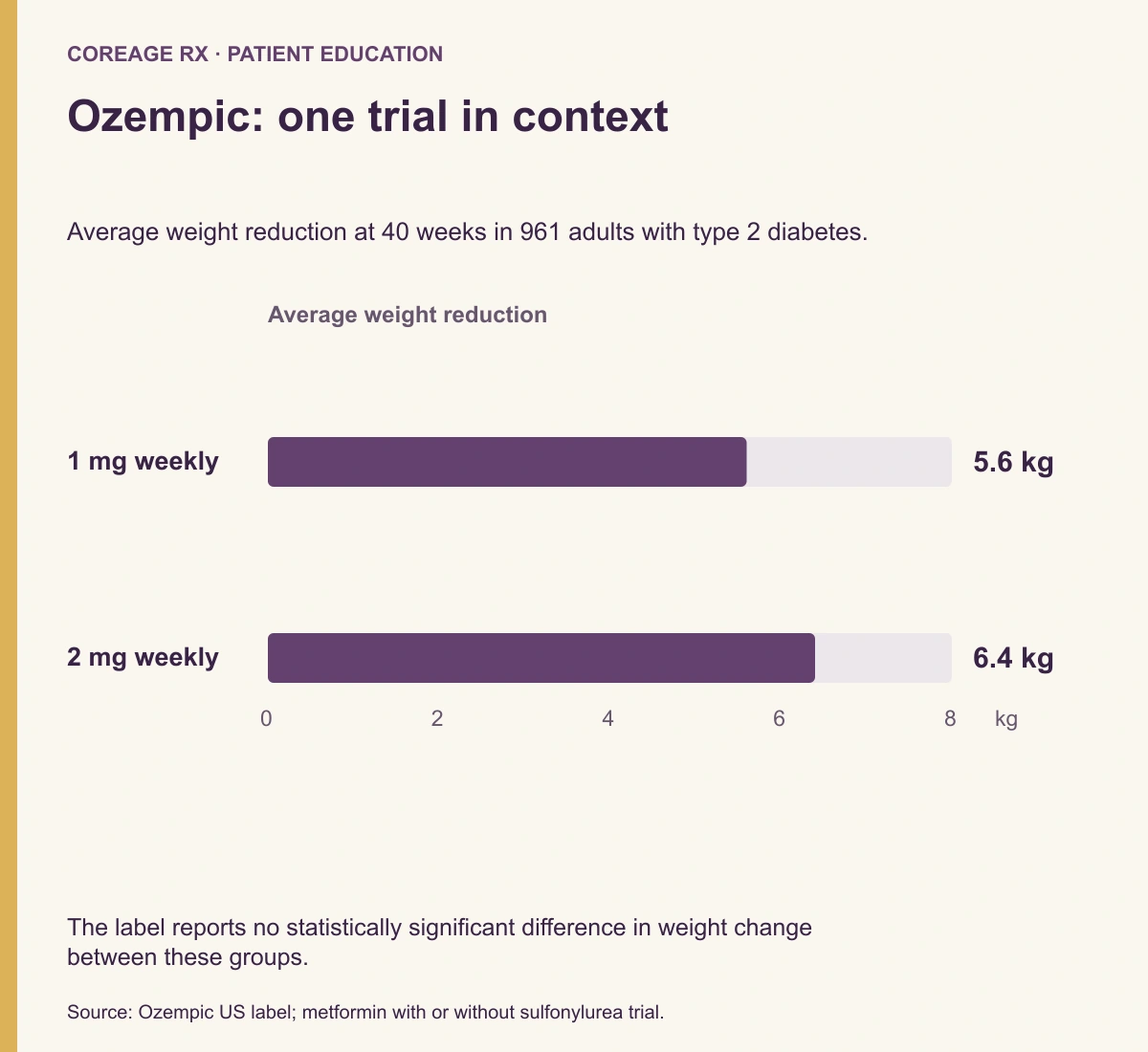
In one 40-week trial of 961 adults with type 2 diabetes, average weight reductions were 5.6 kg with Ozempic 1 mg and 6.4 kg with Ozempic 2 mg. The current U.S. label states that the difference in weight change between those groups was not statistically significant. Neither number predicts an individual’s outcome, and neither should be replaced with a Wegovy obesity-trial result simply because both brands contain semaglutide.
What Ozempic is approved to treat
Ozempic injection has approved uses in adults with type 2 diabetes. These include improving blood-glucose control, reducing specified cardiovascular risks in adults with established cardiovascular disease, and reducing specified kidney and cardiovascular risks in adults with chronic kidney disease. The exact populations and outcomes are described in the Ozempic prescribing information.
Ozempic is not the semaglutide brand approved specifically for weight management. Wegovy has weight-management indications and its own doses, formulations, and supporting trials. A clinician may consider off-label treatment in a particular situation, but that does not change the FDA-approved indication or establish insurance coverage.
Our semaglutide versus Ozempic guide explains why an ingredient name and a brand name answer different questions. Before comparing results, identify the actual prescribed product and the condition it is intended to treat.
A closer look at the 40-week trial
The trial comparing Ozempic 1 mg with 2 mg involved adults with type 2 diabetes who were taking metformin, with or without a sulfonylurea. Participants had lived with diabetes for an average of about 9.5 years. Their mean BMI was 34.6, and the main comparison concerned blood-glucose control.
| Measure | Ozempic 1 mg weekly | Ozempic 2 mg weekly |
|---|---|---|
| Randomized participants | 481 | 480 |
| Average starting weight | 98.6 kg | 100.1 kg |
| Average weight change at week 40 | −5.6 kg | −6.4 kg |
| Approximate weight change in pounds | −12.3 lb | −14.1 lb |
The pounds are rounded conversions of the label’s kilogram values. These are group averages, not a target range that everyone should reach. Some people lost more, some less, and the group average does not describe each person’s course.
The trial showed a statistically significant difference in its HbA1c comparison, but the label says the weight-change difference was not statistically significant. It would be misleading to turn the two weight averages into proof that moving from 1 mg to 2 mg guarantees additional weight loss. Read the trial results in the current label with the outcome being discussed clearly identified.
Why other websites may show different numbers
A clinical study can report more than one analysis. One may estimate the effect in the randomized population, including the consequences of stopping treatment or using rescue treatment. Another may focus on what happened while people remained on treatment. Those approaches answer related but different questions.
An article should identify the analysis rather than selecting the largest-looking percentage. It should also distinguish the total change from baseline from the difference between treatment groups. A reduction of six kilograms is not the same quantity as six kilograms more than a comparator.
For this guide, the example above uses the results reported in the current U.S. Ozempic injection label. It is not a pooled estimate across every dose, a prediction for someone without diabetes, or a measure of a compounded formulation’s performance.
Ozempic results are not interchangeable with Wegovy results
Both products contain semaglutide, but that shared ingredient does not make every dose, route, or indication equivalent. Wegovy’s weight-management studies involve specific populations and regimens. Oral semaglutide and injected semaglutide also have different administration requirements and milligram strengths.
For example, a result from a trial using weekly semaglutide 2.4 mg for weight management should not be labeled as the expected result of an Ozempic starting dose. Likewise, a tablet study is not automatically evidence for an injection with a similar brand name.
The Wegovy label, semaglutide dosage guide, and oral semaglutide versus injections guide help keep those distinctions clear. If you are considering a different medicine entirely, use a study designed for that comparison rather than placing unrelated photographs side by side.

How much weight can you lose per week on Ozempic?
There is no reliable universal weekly loss rate. The group weight changes in the cited 40-week diabetes trial describe the endpoint in that study population; dividing them by 40 does not establish a linear weekly trajectory or a personal promise. Dose escalation, food intake, other medicines, illness and fluid changes can affect an individual record. Review a trend and clinical goals with the care team rather than increasing a dose to meet a weekly number.
What the first four weeks can tell you
Ozempic injection starts at 0.25 mg weekly for four weeks before moving to 0.5 mg. The initiation period is intended to help reduce gastrointestinal adverse effects; it is not the time point used for the 40-week results above.
Some people notice a change in appetite early, while others describe a gradual change. Neither experience alone establishes the eventual outcome. A short-term scale change can also reflect hydration and bowel patterns, so avoid interpreting a single reading as proof that treatment has succeeded or failed.
During the first month, useful goals include learning the device, following the prescription accurately, understanding how to report symptoms, and establishing a sustainable eating routine. Our semaglutide first-month guide addresses those practical steps.
Do not accelerate dose increases because another person’s first-month result looks larger. The Ozempic dosage guide explains the labeled schedule and why clinical need matters.
What about results after three or six months?
The 40-week average cannot be divided evenly into monthly installments. Weight change is not necessarily linear, and patients may spend different amounts of time at a dose because of tolerance, clinical decisions, or interruptions.
A three-month review should consider the treatment you have actually received, the diagnosis being treated, glucose results when relevant, side effects, food intake, and the trend over time. If the scale has slowed, the answer is not automatically a higher dose or a more restrictive diet.
Ask whether a plateau reflects a normal change in trajectory, a practical issue with taking the medicine, a new medication, or a need to reassess the plan. Our semaglutide plateau guide provides questions to bring to that discussion.
If doses were missed or treatment stopped for a while, be specific about the dates. A prolonged gap can require a new restart plan; it is not simply lost time to make up with extra medicine.
What a useful personal progress record includes
Agree with your clinician on the measures that matter for your treatment. Weight may be one measure, but glucose control, blood pressure, kidney-related monitoring, function, nutrition, and tolerance can be important depending on the indication.
If you weigh yourself, use a consistent routine and a frequency that supports care without becoming distressing. A trend is usually more informative than reacting to each daily fluctuation. Bring your questions about the trend to follow-up rather than changing the prescription independently.
Also record whether you can eat adequately, maintain fluids, and continue ordinary activities. Reduced appetite is not a reason to ignore strength, energy, or nutrition. Our semaglutide protein and muscle guide discusses food and activity questions to raise with the care team.
Progress can include managing a chronic condition more effectively even when photographs show little change. Conversely, a striking appearance change does not establish that a treatment is safe or appropriate.
Our guide to appearance, Ozempic speculation and medical privacy explains why a weight change or photograph cannot identify someone’s prescription, and offers respectful ways to discuss support without pressuring disclosure.
How to evaluate before-and-after photographs
A credible story should identify the time period, medicine, relevant diagnosis, other changes, and any commercial relationship. It should also acknowledge side effects, interruptions, and what happened after the pictured result.
Photographs have limitations even when they are authentic. Clothing, posture, lighting, camera distance, and image selection can alter the apparent difference. A photograph does not measure blood glucose or prove that a medicine caused every visible change.
Published success stories also leave out people who had little response or stopped treatment. Without knowing how many people started, you cannot calculate the likelihood of a similar outcome from the selected examples.
The illustrations in this article are educational artwork, not patient testimonials or generated transformations. They are intended to support the explanation, not to imply that a particular body shape is an expected result.

Side effects are not a measure of success
Nausea, vomiting, diarrhea, constipation, and abdominal discomfort can occur with Ozempic. More nausea does not mean a better weight response, and having no nausea does not mean the medicine is inactive.
A pooled analysis of injected semaglutide 2.4 mg weight-management trials found that gastrointestinal effects explained little of the overall weight-loss benefit. That analysis concerns a different regimen from Ozempic and should not be used as an Ozempic-specific estimate. It does reinforce that feeling sick is not a treatment goal. See the STEP tolerability analysis.
Report persistent symptoms and difficulty maintaining food or fluids. Severe or persistent abdominal pain, repeated vomiting with dehydration, or serious allergic symptoms require prompt medical assessment. The Ozempic side-effects guide covers important warning signs and questions for the prescriber.
Plan for maintenance and changes in treatment
A before-and-after story often ends at the lowest recorded weight. Real care continues. Discuss what long-term treatment might involve, how costs will be handled, and what to do if availability, pregnancy plans, side effects, or another health issue changes the plan.
Do not assume a result will remain unchanged after medication stops, or that a previous dose can always be restarted after an interruption. Our semaglutide maintenance guide explains why ongoing care and follow-up matter.
If you are exploring CoreAge Rx’s semaglutide care information, confirm the exact formulation and treatment objective during the clinical assessment. You can also review Ozempic alternatives when cost, route, or treatment fit is the main concern. The most useful expectation is an individualized plan measured over time, with benefits and tolerability assessed together.
Educational information for adults; individual treatment decisions require a qualified clinician. Sources checked September 27, 2026. Original AI-generated article illustrations depict fictional people and objects, not patient outcomes. Other editorial images are illustrative. Graphics summarize the cited sources.