
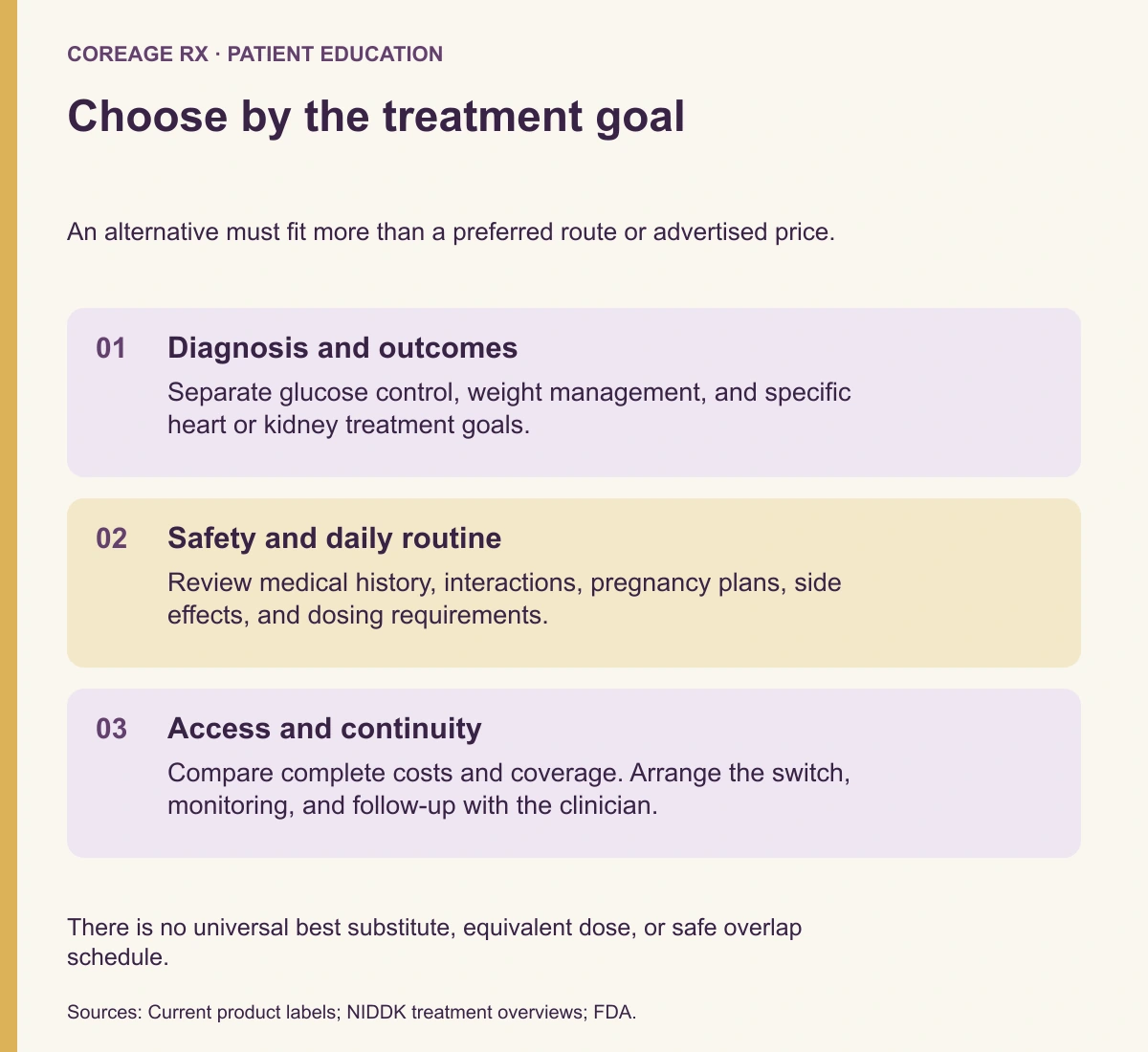
The right alternative to Ozempic depends on what you need treatment to do. Replacing a medicine for type 2 diabetes, cardiovascular or kidney protection, weight management, cost, or difficulty with injections involves different decisions. There is no single substitute that preserves every benefit, has the same risks, and works at an equivalent dose.
Start by identifying the exact Ozempic product and the reason for changing. Then ask which options fit your diagnosis, other medicines, health history, budget, and daily routine. This guide organizes the main conversations without turning unrelated medications into a universal ranking or a self-directed switching chart.
First identify the job the current medicine is doing
Ozempic injection is approved for specified uses in adults with type 2 diabetes, including glucose control and particular cardiovascular and kidney outcomes in defined populations. A replacement should be assessed against the relevant treatment goal, not only its effect on appetite or weight. See the Ozempic prescribing information.
For example, an adult with type 2 diabetes and chronic kidney disease needs a different discussion from someone seeking weight treatment without diabetes. A medicine approved for obesity does not automatically have the same evidence for kidney outcomes. Likewise, a less expensive diabetes tablet may not reproduce every benefit of the current regimen.
If the initial treatment goal is unclear, review it before changing anything. Our guide to qualifying for Ozempic explains why diagnosis, prescribing judgment, and insurance eligibility are separate questions.
A map of the main options
| Main reason for considering a change | Options to discuss | Important distinction |
|---|---|---|
| Type 2 diabetes treatment | Another appropriate diabetes medicine or combination; options may include Mounjaro, oral semaglutide, metformin, or other classes | Glucose, heart, kidney, and low-blood-sugar considerations need separate review |
| Weight management in an eligible adult | Wegovy, Zepbound, Foundayo, or an appropriate non-GLP-1 treatment | Each product has its own approved population, evidence, and risks |
| Difficulty using injections | An approved oral option appropriate to the diagnosis | A tablet is not a milligram-for-milligram substitute for an injection |
| Gastrointestinal effects | Reassessment of the cause and current plan; a different treatment when appropriate | Another GLP-1 medicine may share similar digestive risks |
| Cost or access | Covered alternatives, valid savings options, or a different care plan | A prescription does not guarantee coverage or a particular price |
This table is a discussion map rather than a recommendation to select or combine a particular medicine. The options below explain why the reason for changing matters.
Mounjaro: a different ingredient for diabetes care
Mounjaro contains tirzepatide, which activates both GIP and GLP-1 receptors. Ozempic contains semaglutide, a GLP-1 receptor agonist. They are related treatment approaches but different active ingredients with different dose schedules.
The current Mounjaro label includes type 2 diabetes treatment in adults and children ages 10 and older, as well as reduction of major cardiovascular events in adults with type 2 diabetes at high risk. A clinician must still determine whether its indication and risks fit the patient. See the Mounjaro label.
Do not convert an Ozempic milligram dose directly into a Mounjaro dose. The decision depends on the current regimen, glucose control, tolerance, any treatment gap, and other medicines. Our tirzepatide versus semaglutide results guide explains relevant study comparisons without assuming that one outcome establishes every health benefit.
Wegovy and Zepbound: weight-management products
Wegovy contains semaglutide but has its own weight-management indications, formulations, and dose plans. Zepbound contains tirzepatide and is also approved for specified adult weight management. Its label additionally includes moderate to severe obstructive sleep apnea in adults with obesity.
A person seeking obesity treatment should discuss these approved indications directly rather than assuming a diabetes-brand prescription is the only route to care. The Wegovy label and Zepbound label describe the eligible populations and product-specific evidence.
Sharing an ingredient does not make two brands interchangeable at every strength or route. Nor does a large weight-loss percentage from one trial establish that it is the best medicine for every person. Trial populations, doses, duration, and discontinuation differ.
The Zepbound versus Mounjaro guide addresses the two tirzepatide brands, while our semaglutide and Ozempic comparison separates ingredient and product questions.
What if you prefer a pill?
Oral options have expanded, but the exact product remains important. Current U.S. labeling includes oral semaglutide products for type 2 diabetes and Wegovy tablets for specified adult weight-management use. Their strengths and administration instructions differ from injected semaglutide.
Oral semaglutide requires a particular morning routine: an empty stomach, a limited amount of plain water, and a waiting period before food, drink, or other oral medicines. A clinician and pharmacist should review how that routine fits your day and other prescriptions. See the oral semaglutide label and Wegovy label.
Foundayo is a newer oral option containing orforglipron, a different GLP-1 receptor agonist. Its current label covers weight management in specified adults and allows once-daily administration with or without food. It has its own dose escalation, interactions, warnings, and contraception guidance. It should not be described as simply a tablet version of Ozempic. See the Foundayo prescribing information.
A pill may solve a device preference while introducing a different routine or interaction concern. Our oral semaglutide versus injections guide can help you prepare those questions.

Non-GLP-1 medicines for weight management
Other approved weight-management medicines include phentermine/topiramate extended release, naltrexone/bupropion, and orlistat. They work differently and have their own eligibility and safety requirements. NIDDK provides an overview of prescription weight-management medicines.
Qsymia, the phentermine/topiramate combination, has a specific dose and response-assessment process. Pregnancy is a contraindication, and its label includes requirements for pregnancy testing and discussion of effective contraception, along with monitoring for other risks. Topiramate alone is not the same approved product. Our topiramate guide explains that distinction, supported by the Qsymia label.
Orlistat reduces the amount of dietary fat absorbed in the gut, which is a different approach from a GLP-1 medicine. Naltrexone/bupropion is another distinct combination requiring a review of medical history and interacting medicines. Neither should be chosen solely because it is oral or has an attractive advertised price.
A comparison should include practical tolerability, contraindications, monitoring, and the condition being treated. It should not assume that all weight medicines can be added to one another safely.
Metformin and other diabetes treatments
Metformin is a common treatment for type 2 diabetes. It reduces glucose production by the liver and helps the body use insulin more effectively. It may be associated with a modest weight change, but that does not make it an equivalent replacement for an obesity medication or every Ozempic indication. See NIDDK’s diabetes-treatment overview.
Some patients need combinations of diabetes medicines, and some need insulin. A change should therefore preserve a plan for glucose monitoring and treatment adjustment. Do not stop insulin because another medicine affects appetite or lowers glucose; GLP-1 medicines are not substitutes for necessary insulin.
Ask the clinician which parts of your current treatment an alternative would replace and which would remain. The metformin weight-loss guide explains why its role should be evaluated in the context of diagnosis rather than promoted as a universal inexpensive substitute.
When side effects are the reason for changing
Before switching, describe the symptoms and timing. Persistent nausea, vomiting, pain, constipation, or reflux may call for a review of dose, other causes, hydration, and nutrition. A different GLP-1 product may still cause gastrointestinal effects, so changing brands is not a guaranteed solution.
Do not assume an oral route removes the class’s important risks. Product labels require review of medical history, pregnancy plans, severe digestive disorders, other medicines, and relevant contraindications. Some risks or interactions differ between products, which makes an individual review essential.
Severe or persistent abdominal pain, inability to keep fluids down, fainting, or serious allergic symptoms need prompt assessment rather than an elective comparison appointment. For less urgent concerns, our Ozempic side-effects guide and GLP-1 nausea duration guide can help you communicate the pattern.
If cost is the main issue
Compare the exact product, dose, pharmacy, insurance terms, and recurring care fees. A consultation-only price is not comparable with a price that includes medicine, supplies, and follow-up. Introductory offers can also differ from later refill costs.
Ask the insurer about coverage for the actual diagnosis and product, including prior-authorization requirements. Manufacturer programs can have eligibility limits, and an advertised savings amount does not guarantee a particular final price.
Our Ozempic cost guide and tirzepatide versus semaglutide cost comparison help organize those details. Confirm current offers directly before changing treatment. A plan that is affordable for one month but cannot be maintained deserves further discussion.

Compounded products and supplements are separate categories
A compounded preparation is not an FDA-approved generic Ozempic. It requires its own clinical rationale and scrutiny of the pharmacy, ingredients, concentration, and handling. The compounded GLP-1 guide explains the FDA’s current concerns and why branded trial evidence cannot establish every compounded product’s performance.
Likewise, a supplement described as a “natural Ozempic” is not established as an equivalent prescription treatment by that marketing phrase. Do not replace a medicine needed for diabetes or another condition with a supplement without clinical review.
Make the switch a documented care plan
Before changing, confirm the last dose of the current medicine, when to start the next treatment, the prescribed starting dose, any monitoring changes, and who will respond to symptoms. There is no universal milligram conversion or overlap period across these options.
You can review CoreAge Rx’s semaglutide care information and tirzepatide care information before an assessment. Ask which exact formulation is proposed and how it fits your health goals. A useful alternative is one whose evidence, risks, cost, and day-to-day requirements fit a sustainable clinical plan.
A closer look at bupropion and weight
- Wellbutrin and weight change — Separate antidepressant treatment from the differently approved naltrexone/bupropion combination.
Educational information for adults; individual treatment decisions require a qualified clinician. Sources checked September 27, 2026. Original AI-generated article illustrations depict fictional people and objects, not patient outcomes. Other editorial images are illustrative. Graphics summarize the cited sources.