
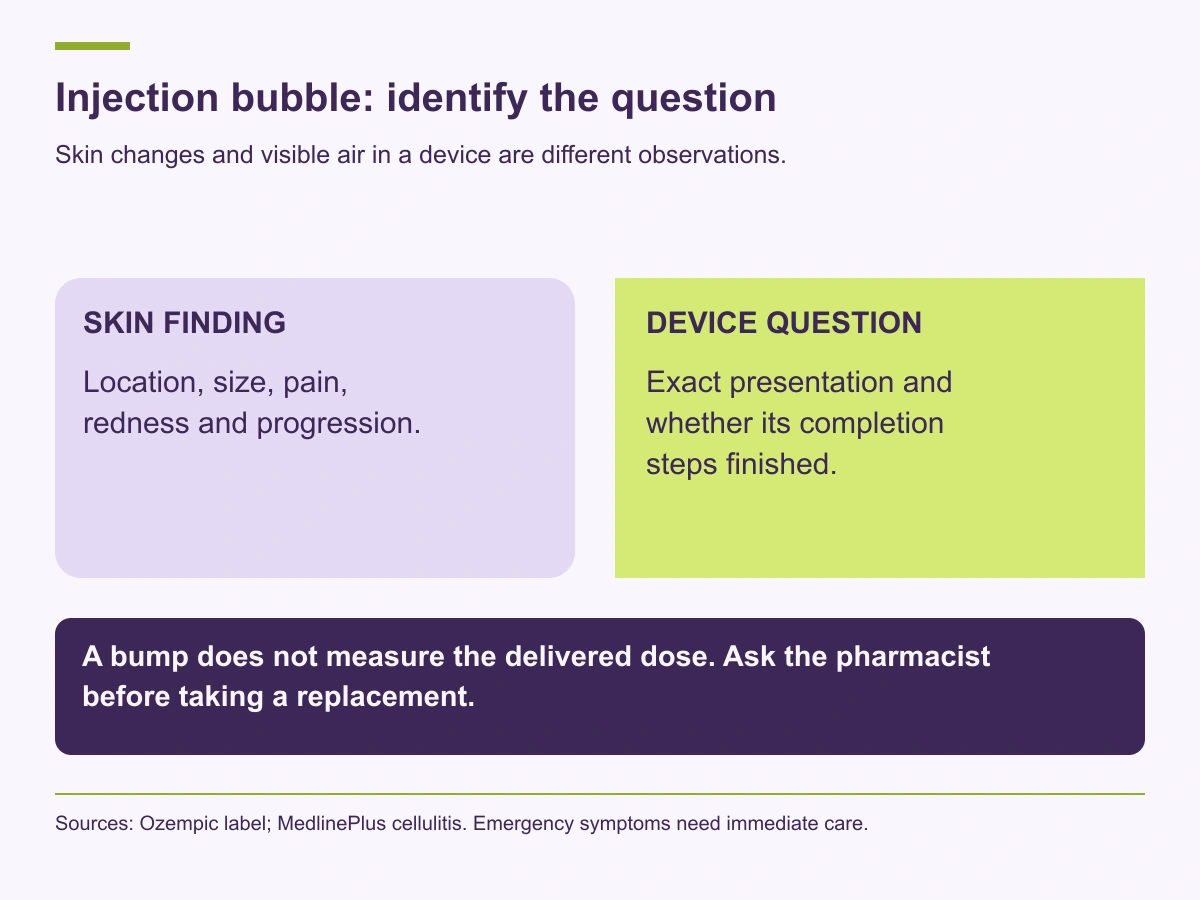
A bubble or lump under the skin after an Ozempic injection deserves a closer description. It is different from an air bubble inside the device. The size, appearance, associated symptoms, and whether you are certain the injection finished help your clinician decide what to check. A skin bump alone cannot tell you how much medicine entered your body.
Start by identifying what you can actually see. If you have trouble breathing, swelling of the lips or tongue, or feel faint with a widespread reaction, get emergency help. For an uncertain dose, contact your pharmacist or prescriber rather than injecting a replacement based on the bump’s appearance.
Is the bubble in your skin or in the device?
People use “bubble” for several different observations: a small raised area where the needle entered, swelling nearby, a droplet left on the skin, or air visible in the medicine. Those findings should not be treated as interchangeable.
Ozempic is injected under the skin. Its current prescribing information includes different presentations with their own Instructions for Use. A pen and a prefilled syringe do not have identical preparation or completion steps. The syringe instructions explicitly address visible air bubbles; that instruction should not be generalized into a way to troubleshoot a pen. Use the instructions supplied with your actual device. Ozempic prescribing information
If you are unsure which presentation you received, read the package name to your pharmacist. “Semaglutide” alone does not identify the device, concentration, or instructions. Our guide to Ozempic injection sites explains the approved body regions and rotation questions. The semaglutide vial guide covers a different set of pharmacy-label questions for vial products.
What does the Ozempic label say about injection-site reactions?
The label reports injection-site reactions, with examples including discomfort and redness, in 0.2% of Ozempic-treated participants in placebo-controlled trials. That is a trial category. It is not a measured rate for “bubbles under the skin,” and it does not establish the cause of your particular lump. Ozempic prescribing information
A percentage also cannot decide whether a current symptom needs attention. A relatively uncommon reaction can happen, and a symptom after an injection may have another explanation. The useful next questions are whether the area is changing, how painful it is, and whether you have symptoms beyond the injection site.
Avoid interpreting social-media photos as a diagnosis. Lighting, camera distance, skin tone, and the time since the injection affect how a spot looks. A clinician may ask for a clear photo, but they also need the history that the photo cannot provide.
A practical way to describe the finding
Make a short record while the details are fresh. This is especially helpful if the area changes before you can speak with the care team.
| What to note | Why it helps the conversation |
|---|---|
| Time of injection and time the bump appeared | Establishes the sequence without assuming causation |
| Exact location and approximate size | Makes later changes easier to describe |
| Redness, warmth, pain, itch, bruising, or drainage | Gives more information than “a bubble” |
| Whether the redness is spreading | Helps the clinician assess progression |
| Fever, chills, hives, breathing symptoms, or faintness | Identifies concerns beyond a local skin finding |
| Device name and what happened during injection | Helps the pharmacist assess delivery questions |
If you photograph the area, keep the lighting and distance similar for comparisons. Do not repeatedly press, squeeze, puncture, or rub a lump to test it. If you cannot see the location well, ask someone you trust to help describe it without manipulating the skin.
The goal is an accurate account, not a home experiment. You do not need to prove whether the medicine “stayed in a bubble” before contacting your care team.

Does a lump mean the dose did not work?
No skin finding can reliably answer that question by itself. The appearance of a bump is not a dose measurement, and appetite changes later that day are not a substitute for checking the device instructions.
Tell the pharmacist whether you noticed leakage, removed the device early, saw an unexpected indicator, or had difficulty completing the injection. Describe what happened rather than estimating a percentage of the dose. Product-specific completion indicators are more useful than a guess based on the spot.
Do not inject another dose simply because you are worried the first one did not go in. An uncertain delivery situation is different from a clearly missed scheduled dose. The missed semaglutide dose guide explains why timing and product identity matter, but it is not a replacement-dose rule for an interrupted injection.
If the pen, needle, or package seems damaged, retain the identifying information and ask the dispensing pharmacy how to report it. Keep sharps safely contained. You should not need to dismantle a used device to obtain help.
When should you contact the care team promptly?
Contact your clinician for a site that becomes increasingly painful, red, warm, swollen, or begins draining. Fever or chills alongside a skin change also need assessment. These findings can occur with skin infection, including cellulitis, but a description or photograph is not enough to diagnose it yourself. MedlinePlus: cellulitis
You should also seek advice if the finding recurs, grows, interferes with normal movement, or makes you reluctant to take your next scheduled injection. Ask what to do before the next dose, including whether the area needs examination and how to select an appropriate next site.
There is no universal number of hours after which every lump becomes normal or abnormal. The direction of change and accompanying symptoms matter. “It has been one day” is less informative than “the redness has spread and the pain is increasing.”
If you have a condition that affects healing or immunity, include it in the call. Do not assume a small-looking area can be ignored because another person’s injection bump resolved quickly.
What symptoms require emergency help?
Ozempic labeling warns about serious allergic reactions. Trouble breathing or swallowing, swelling of the face or throat, and a severe reaction with faintness require urgent action. Stop using the medicine and seek immediate medical help if a serious allergic reaction occurs, consistent with the label. Ozempic prescribing information
A localized itchy spot is not automatically the same as a severe systemic allergy. Equally, a small injection mark does not make breathing symptoms safe to watch at home. Describe the whole reaction, not just the skin area.
Our Ozempic side-effect guide organizes broader warning signs. A reaction to another injectable medicine also needs its own product information; the Zepbound rash and injection-reaction guide addresses tirzepatide rather than assuming every injection has the same safety profile.

How can you prepare for the next injection?
Once the current finding has been assessed, ask your pharmacist to watch you explain the steps for your exact device. This can reveal a misunderstanding more clearly than rereading a generic online checklist. Training should cover preparation, the approved body regions, rotation, completion, and sharps disposal.
The Ozempic label directs injection-site rotation. It also says that insulin and Ozempic must be given separately rather than mixed, and that injections in the same body region should not be adjacent. Ask for individualized instruction if you use more than one injectable medicine. Ozempic prescribing information
A different device can require new training even when the drug name is familiar. If your pharmacy changes the presentation, pause to confirm the instructions before using it. Avoid transferring instructions from an online demonstration that shows a different pen or syringe.
Questions people ask about an Ozempic injection bubble
Can I massage the lump so the medicine absorbs?
Do not use rubbing or massage as a way to correct a suspected dosing problem. The relevant questions are what happened during administration and what symptoms are developing. Ask the pharmacist or prescriber for advice about the site and device.
Does the bump prove I injected too shallowly?
It does not prove the depth of injection. A clinician or pharmacist can review your technique and presentation, but the bump alone cannot reconstruct exactly where the needle was or how much medicine entered.
Should I move the next injection to another body region?
Rotation is part of the labeled routine, but a concerning current site should first be assessed. Ask the care team how to choose the next location and whether the current symptoms change the plan. Do not use this question to bypass evaluation of spreading redness or systemic symptoms.
Can an air bubble in a syringe be treated like a skin lump?
No. One is an observation in a device; the other is a physical finding after injection. Follow your actual product’s Instructions for Use and ask the pharmacist when you are uncertain. Do not improvise air-removal steps from a different device.
What should I bring to an appointment?
Bring the product name, dose, device information, timing notes, and photos if available. Include other injections used that day and any skin or allergy symptoms. This makes the review more specific than asking whether injection bumps are generally common.
For broader treatment questions, start with our semaglutide questions guide. The CoreAge Rx semaglutide page describes a care option to discuss with a clinician; it does not diagnose an injection reaction or provide a replacement dose.
Educational information for adults; individual treatment decisions require a qualified clinician. Sources reviewed October 3, 2026. Original AI-generated article images depict fictional people and objects, not patient outcomes. Other editorial images are illustrative. Graphics summarize the cited sources.