
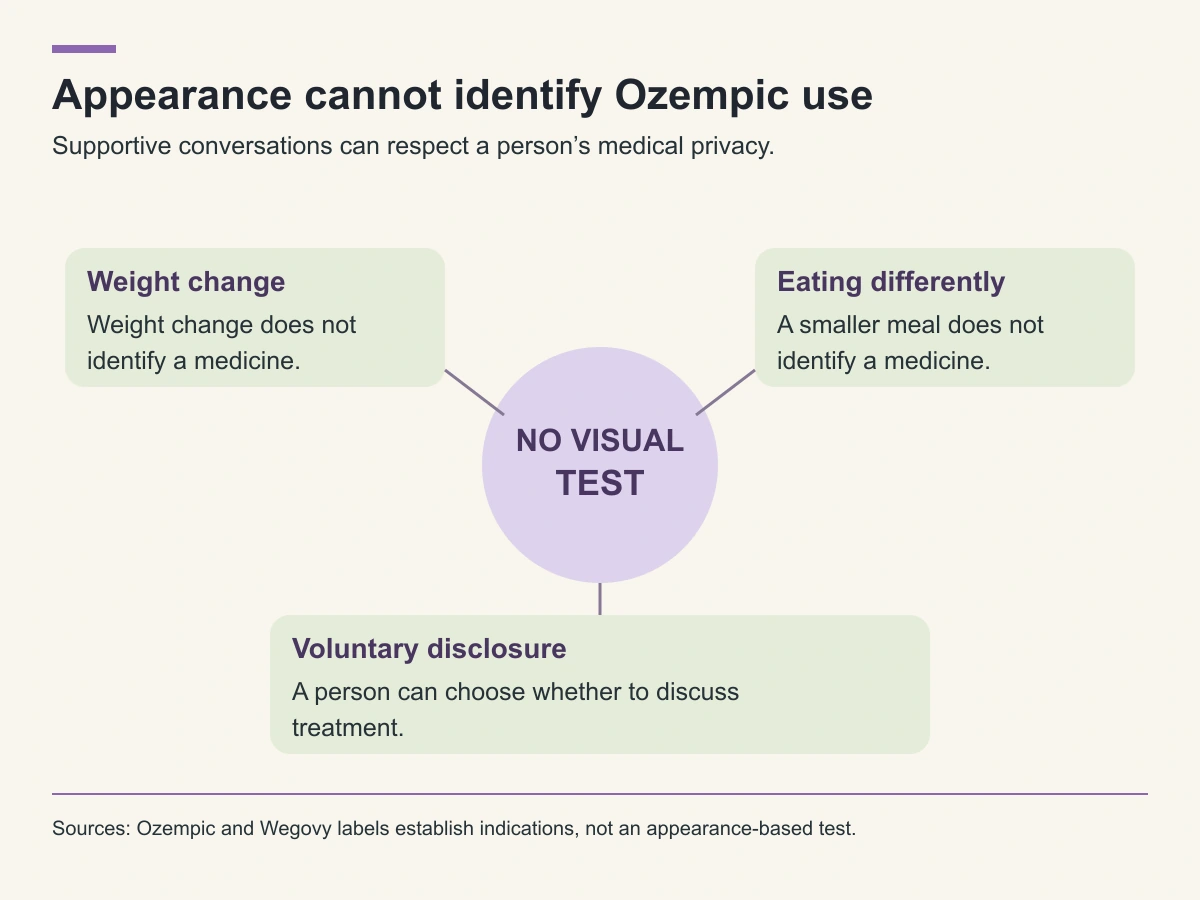
You cannot reliably tell whether someone is taking Ozempic by looking at their face, body, meals, or weight changes. Those observations do not identify a prescription. If someone chooses to share their treatment, believe their account without treating other people’s bodies as a comparison test.
The question often comes from curiosity rather than bad intentions. A friend looks different, a coworker leaves food on a plate, or a familiar public figure appears thinner. But turning a change into a medication claim can be inaccurate and uncomfortable for the person involved. A more useful approach is to separate what you have actually noticed from what you cannot know.
If you are researching treatment for yourself, the important questions concern your own medical history, goals, and follow-up. Our semaglutide questions guide explains how to prepare for that conversation.
Why there is no dependable visual test
Appearance is an observation; taking Ozempic is a specific fact about someone’s treatment. One does not establish the other. Even several observations together cannot provide the missing prescription information.
Ozempic is a particular semaglutide product with its own prescribing information. Wegovy is another semaglutide product, with different labeled treatment uses and presentations. Other weight-management medicines have different ingredients. Calling every visible weight change “Ozempic” collapses those distinctions before there is any evidence that a medicine was involved. Ozempic prescribing information, Wegovy prescribing information.
There is also no requirement that a person look a certain way while receiving treatment. A patient may have little visible change, may be early in treatment, or may be taking a medicine for a health goal that outsiders cannot see. A photograph cannot show blood glucose, the reason for a prescription, the exact product, or the clinician’s assessment.
This leaves two separate questions: whether someone looks different, and whether you know why. You may have an answer to the first without having an answer to the second.
What common observations do and do not tell you
The following examples explain the limits of everyday observations. They are not a checklist for investigating someone.
| What you notice | What you can reasonably say | What the observation cannot establish |
|---|---|---|
| Their weight appears to have changed | Their appearance seems different to you | A particular medicine, diagnosis, dose, or treatment date |
| Their face looks slimmer | The face looks different in that setting or photograph | That semaglutide caused the change |
| They eat a smaller meal | They ate less during that meal | Their usual intake or prescription list |
| They mention nausea | They have reported a symptom | The cause of that symptom |
| They voluntarily name a medicine | They have shared that treatment information | Permission to announce it to other people |
Context matters even before medicine enters the discussion. A single meal does not represent a person’s entire day. A picture taken under different lighting, with a different expression or camera angle, does not provide a standardized clinical comparison. Clothing can change how a body looks without any change in weight.
Treat the table as a reminder to avoid certainty where the necessary information is missing. It is not a reason to watch meals more closely or collect photographs.
Does a slimmer face mean someone is on Ozempic?
No. A slimmer-looking face does not identify a drug. The phrase “Ozempic face” is commonly used in conversation, but it is not a reliable method for determining a person’s prescription.
Even if weight loss has occurred, appearance cannot tell you which treatment, if any, contributed. It also cannot distinguish an intended change from an unwanted one. Making a medication guess may therefore miss the person’s actual experience.
Avoid comments that frame the face as evidence of wrongdoing or a shortcut. Someone can experience a change in appearance without wanting that change discussed. A face is also not a complete measure of health, nutritional adequacy, or how well a treatment is working.
If you want to understand what research actually measures, read Ozempic before-and-after results and expectations. Clinical results involve defined participants, treatment periods, and measured outcomes. They do not create a visual test that can be applied to an acquaintance.
Do smaller meals, nausea, or missed snacks give it away?
They do not. Ozempic’s prescribing information lists gastrointestinal effects such as nausea, vomiting, diarrhea, abdominal pain, and constipation. But a symptom being possible during treatment does not mean everyone with that symptom is taking the medicine. It also does not mean every symptom in a treated person was caused by it. Ozempic prescribing information.
A person might leave food because they are full, dislike the meal, feel unwell, or have another reason they have not shared. None of those possibilities can be settled by observing the plate. Asking repeatedly about portions can make eating together feel like an examination.
If someone says they are struggling to eat, respond to the difficulty they have described. For example: “Would it help to find something you can manage?” gives them a choice. “You must be on Ozempic” supplies an unsupported explanation.
For a person who has already told you they use semaglutide, nausea and vomiting questions may be a useful resource if they want it. Offer the information without taking over their care or interpreting the symptom yourself.

What if the person has lost weight quickly?
Speed does not identify the treatment. A visible change over several weeks still does not tell you the person’s starting weight, measured trend, medicine list, health history, or daily experience.
There is an additional reason to avoid automatic congratulations. You do not know whether the change was wanted. A comment meant as praise can create pressure to explain a private situation or maintain an appearance that was never the person’s goal.
If the person brings up a concern, focus on that concern. Persistent vomiting, severe abdominal pain, or difficulty maintaining fluids deserve medical attention in someone using semaglutide; the product labels contain specific warnings about serious gastrointestinal problems and dehydration-related kidney injury. The response should address symptoms rather than speculate about how the person obtained a slimmer body. Ozempic prescribing information, Wegovy prescribing information.
For your own weight tracking, our water weight versus fat loss guide explains why a scale trend needs context. It is intended to help you interpret your own measurements, not to estimate another person’s treatment from a photograph.
How to ask about someone’s well-being respectfully
Start with the relationship and the situation. A close friend who has invited health discussions is different from a colleague you see occasionally. Neither situation requires a medication question simply because appearance has changed.
Useful openings leave room for a short answer:
- “How have you been feeling lately?”
- “You mentioned treatment has been a lot to manage. Is there anything practical I can help with?”
- “Would you like to talk about it, or would you prefer a distraction?”
The second example fits only when the person has already brought up treatment. Avoid implying that you have identified a prescription through observation.
If they do not want to discuss it, accept that answer. You can remain supportive without knowing the medicine, dose, diagnosis, or reason for a change. Do not follow a refusal with a more detailed question or a story about someone else who “looks the same.”
Practical support can be ordinary: company during a walk, help with errands, or choosing a restaurant together. Let the person say what would help rather than assigning a health goal to them.
When someone voluntarily shares that they take Ozempic
Disclosure answers a question about their treatment, but it does not turn them into a source of instructions for everyone else. Their experience can be real while still differing from yours.
Ask what level of conversation they want. Some people are happy to discuss appointments and side effects; others share the fact once and prefer to move on. Also ask before sharing their information with a partner, another friend, or a group chat.
Avoid asking for leftover medicine, trying their pen, or treating their dose as a starting recommendation. Ozempic pens must never be shared between patients, even with a new needle, because sharing can transmit blood-borne pathogens. A prescription and device instructions belong to the individual patient’s care. Ozempic prescribing information.
If their story makes you interested in treatment, take that interest to a qualified clinician. Our first month on semaglutide guide gives examples of questions and observations relevant to your own follow-up.

Public figures, social posts, and treatment rumors
A social-media claim is not necessarily a first-person disclosure. A caption written by someone else, an edited video, or a comment thread cannot verify a public figure’s prescription.
Keep the source of a statement clear. “They said they use this medicine” is different from “people online think they do.” If no direct statement has been verified, there is no need to replace uncertainty with an appearance-based conclusion.
The same limit applies to population statistics. A survey may estimate how common GLP-1 medicine use is in a defined group. It cannot tell you whether a particular neighbor, actor, or coworker uses Ozempic. Broad class-use numbers also do not identify a specific brand.
Before-and-after posts can be interesting, but they rarely include all the information needed to assess treatment fit. Use them to recognize questions you want to ask, rather than to predict your own outcome or diagnose another person’s choices.
Questions readers often ask
Can you tell if someone is on Ozempic without asking?
There is no dependable appearance-based way to do that. Weight changes, meal sizes, and symptoms do not identify a prescription. Someone can choose to share treatment information, but they do not owe an explanation because their body looks different.
Is it rude to ask a friend whether they take it?
The relationship and invitation matter. A general question about how they feel is usually less intrusive than naming a drug based on appearance. If they have invited a treatment discussion, ask what they are comfortable sharing and accept their boundaries.
Does using Ozempic mean the person is only trying to lose weight?
No. Ozempic has specific labeled uses, and an observer cannot identify a patient’s treatment goal. Do not assume a weight-loss intention, a diagnosis, or eligibility from body size. Different semaglutide products have different labels. Ozempic prescribing information, Wegovy prescribing information.
Can I expect the same result as a friend?
A friend’s account is not a prediction for your treatment. The exact product, indication, medical history, tolerance, and follow-up matter. Our tirzepatide versus semaglutide evidence guide explains why studies and individual outcomes need separate interpretation.
Where should I begin if I am considering semaglutide myself?
Start with your own questions and a clinical assessment. You can review CoreAge Rx’s semaglutide service information alongside the education guides, then ask about the exact medicine, whether it fits your needs, potential effects, and the follow-up plan. Another person’s appearance is not evidence that treatment will suit you.
Educational information for adults; individual treatment decisions require a qualified clinician. Sources reviewed October 2, 2026. Original AI-generated article images depict fictional people and objects, not patient outcomes. Other editorial images are illustrative. Graphics summarize the cited sources.