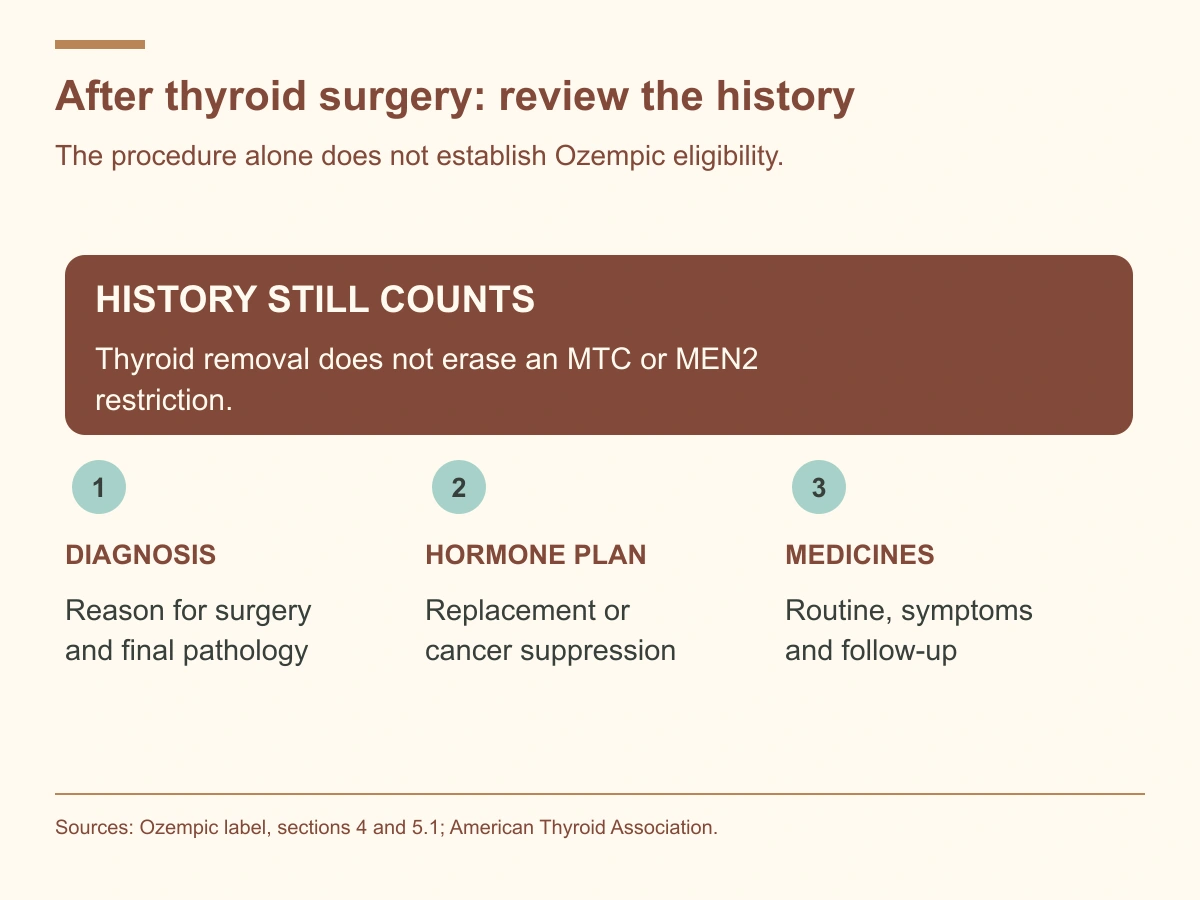
Having your thyroid removed does not, by itself, answer whether you can take Ozempic. The reason for surgery, any personal or family history of medullary thyroid carcinoma, your thyroid-hormone treatment, and the condition being treated all matter. Removing the gland does not erase a cancer-history contraindication.
Start with the reason for thyroid surgery
“Thyroid removal” describes a procedure, not a diagnosis. Someone may have surgery for a large benign goiter, Graves’ disease, an uncertain nodule, or a particular type of cancer. A total thyroidectomy removes the gland; a lobectomy removes one side. These differences affect follow-up and hormone replacement. The American Thyroid Association’s surgery guide explains those distinctions.
Before a medication assessment, locate the operative report and final pathology report if available. The final pathology diagnosis is more informative than remembering that a nodule was “suspicious.” If you do not know the cancer type, ask the surgeon or endocrinology team to clarify it. Do not guess on an online intake form.
For a total thyroidectomy, lifelong thyroid-hormone replacement is generally necessary. After partial removal, some people produce enough hormone from the remaining tissue and others need replacement. Neither situation automatically establishes eligibility for a GLP-1 medicine.
What the Ozempic thyroid warning actually says
The current U.S. Ozempic injection label lists a personal or family history of medullary thyroid carcinoma, or MTC, and multiple endocrine neoplasia syndrome type 2, or MEN2, as contraindications. A contraindication means the medicine should not be used in that circumstance. The label also contraindicates use after a serious hypersensitivity reaction to semaglutide or the product’s ingredients. Ozempic prescribing information, sections 4 and 5.1.
The boxed warning comes from thyroid C-cell tumors observed in rodents. Whether Ozempic causes these tumors in humans is unknown. That uncertainty should not be turned into either “it definitely causes thyroid cancer” or “there is no risk.” The label provides a specific clinical restriction despite the uncertainty.
Thyroid cancer includes different diseases. Papillary and follicular cancers are not the same diagnosis as MTC. However, being outside the named MTC/MEN2 restriction is only one part of a treatment assessment. Your cancer follow-up, other medical conditions, and proposed treatment still need review.
Does total thyroid removal remove the MTC restriction?
No. The restriction is written in terms of personal or family history, not simply the presence of a thyroid gland today. A person whose thyroid was removed because of MTC still has a personal history of MTC. Preventive surgery related to MEN2 does not make the syndrome disappear.
Do not rely on the argument that there is “nothing left for the medicine to affect.” That reasoning does not replace the prescribing information. Ask the treating endocrinologist and the clinician considering the medicine to coordinate before treatment is chosen.
Our Zepbound after thyroid removal guide explains the related question for a different product. Switching product names is not a way around a contraindication shared by both labels.
| History or situation | What it means for the discussion |
|---|---|
| Personal or family history of MTC | A named Ozempic contraindication, including after thyroid surgery. |
| MEN2 | A named contraindication; surgery does not erase the diagnosis. |
| Benign nodules, goiter, or Graves’ disease | Not the same as MTC; the full medical assessment still applies. |
| Papillary or follicular thyroid cancer | Clarify pathology and ongoing cancer care with the treating team. |
| Unknown reason for surgery | Obtain records before assuming that the warning does not apply. |
| Thyroid-hormone replacement | Review dose, routine, monitoring, and other medicines separately. |
Ozempic is not thyroid-hormone replacement
Ozempic contains semaglutide. It does not replace the thyroid hormones your body needs after total thyroidectomy. Feeling less hungry or losing weight would not show that levothyroxine is no longer necessary.
The American Thyroid Association’s hormone-treatment guidance distinguishes replacement therapy from suppression therapy used in some thyroid-cancer care. The target for someone receiving cancer-related suppression may differ from the target for uncomplicated hypothyroidism. A general online “normal TSH” rule cannot determine your individual target.
Continue the thyroid treatment your clinician prescribed unless the team changes it. Do not increase thyroid hormone to accelerate weight loss or reduce it because appetite has changed. The dose is selected and adjusted using the clinical situation and appropriate monitoring.
What if weight increased after surgery?
A weight change deserves assessment without assuming a single cause. Review the timing, thyroid-hormone routine, relevant laboratory results, medicines, appetite, sleep, movement, and recovery from surgery. Some people are also managing menopause, diabetes, pain, or a major change in daily activity.
The useful question is whether your current thyroid replacement and overall care are appropriate. A scale reading alone cannot establish that the thyroid dose is too low. Symptoms such as fatigue can have several causes, and increasing hormone without confirmation can create a different problem.
A balanced-meal plan and a manageable activity routine can support care while the cause is evaluated. If weight management needs additional treatment, discuss the available options on their own merits. There is no rule that everyone who gains weight after thyroidectomy needs semaglutide.

Can Ozempic affect levothyroxine?
The injection label says Ozempic delays gastric emptying and may affect absorption of oral medicines. It also reports that studied oral medicines were not affected to a clinically relevant degree in the evaluated pharmacology trials. This supports a medication review, not a claim that every person taking levothyroxine will develop an absorption problem. Ozempic interactions section.
Keep the actual formulation clear. Evidence about an oral semaglutide product and thyroid medicine should not automatically be applied to weekly Ozempic injection. Our oral semaglutide versus injections guide explains why route and product instructions matter.
Tell the team about repeated vomiting, a changed eating schedule, substantial weight change, missed thyroid doses, or a new supplement. Ask whether those changes warrant thyroid testing or a routine review. Do not invent an extra spacing interval between a weekly injection and levothyroxine without professional advice.
Keep the thyroid-medicine routine consistent
If you are considering a botanical supplement, our moringa and thyroid-medication guide reviews the limited evidence, complete-label checks, and why no universal moringa spacing rule is established.
Food and other products can affect thyroid-hormone absorption. The ATA emphasizes consistent use and discussion of timing with the clinician. Iron, calcium, certain antacids, and other medicines or supplements may matter. Bring the complete list, including products you buy without a prescription. ATA hormone-treatment guide.
For example, someone might start a breakfast shake containing calcium at the same time as changing weight treatment. Another person might begin taking levothyroxine with breakfast after previously taking it separately. Those practical changes belong in the review; it would be premature to blame the injection alone.
Ask for a written plan covering when to take thyroid medicine, what to do after a missed or vomited dose, and when testing is due. If several clinicians prescribe medicines, identify who will interpret the thyroid results and make any changes.
Does Ozempic have a special indication after thyroidectomy?
Thyroid removal itself is not an approved indication for Ozempic. Its injection label describes specific type 2 diabetes-related uses, including defined cardiovascular and kidney-risk indications. Wegovy is another semaglutide product with different approved uses and instructions. The name of the ingredient does not make the products interchangeable. Current Ozempic label.
Discuss what condition the proposed prescription would treat, why that product was chosen, and how benefit will be measured. Weight change, glucose control, and kidney-related care are related but distinct goals. Coverage rules may also depend on the actual indication.
Our semaglutide questions guide gives a broader overview. The Ozempic medication-interactions article helps organize the medicine-list discussion.
Symptoms that need attention
Report a new neck lump, persistent hoarseness, or trouble swallowing to a clinician. Breathing difficulty needs urgent help. These symptoms deserve assessment rather than an assumption that thyroid surgery makes them irrelevant. They do not, by themselves, establish a drug-related tumor. Ozempic thyroid-warning section.
Other Ozempic warnings also remain relevant after thyroidectomy. Severe or persistent abdominal pain, repeated vomiting, inability to retain fluids, or symptoms of a serious allergic reaction need prompt assessment. Review the Ozempic side-effects guide before starting so you know which symptoms should not wait for a routine appointment.
If you use insulin or a sulfonylurea, reduced intake can add to hypoglycemia concerns. Ask for a glucose-monitoring and low-glucose plan. Do not treat difficulty eating as evidence that a weight-loss medicine is working especially well.
What about compounded semaglutide?
A compounded preparation is not approved Ozempic or Wegovy. FDA does not review compounded drugs for safety, effectiveness, and quality before marketing in the way it reviews approved products. A thyroid history still needs careful evaluation; changing the source of the medicine does not make that history unimportant. FDA compounded GLP-1 information.
The CoreAge Rx semaglutide service page describes assessment-based compounded care. Ask about the exact proposed preparation, pharmacy, monitoring, and coordination with your thyroid clinician. A service page cannot determine individual eligibility or establish equivalence to an approved brand.

Questions to bring to the appointment
- What did my final pathology report show?
- Is there any personal or family MTC history or MEN2 diagnosis?
- Am I receiving replacement or cancer-related hormone suppression?
- What thyroid tests and target are appropriate for my situation?
- Could my current medicine or supplement routine affect thyroid treatment?
- What would the proposed weight or diabetes medicine treat?
- Who will coordinate follow-up if appetite, weight, or thyroid results change?
Common questions
Can I take Ozempic if I have no thyroid?
Some people may be considered after a full assessment. Having no thyroid is neither automatic clearance nor an automatic exclusion. The reason for surgery and the named contraindications are central.
Does a normal TSH rule out the cancer warning?
No. TSH helps assess thyroid-hormone regulation; it does not erase a personal or family MTC history or MEN2. Those are different questions.
Should everyone get calcitonin or an ultrasound first?
The Ozempic label says routine calcitonin testing or thyroid ultrasound has uncertain value for early MTC detection in treated patients. Your clinician may order tests for a specific clinical reason, but a general screening package is not a substitute for reviewing the history.
Educational information for adults; individual treatment decisions require a qualified clinician. Sources reviewed October 5, 2026. Original AI-generated article images depict fictional people and objects, not patient outcomes. Other editorial images are illustrative. Graphics summarize the cited sources.