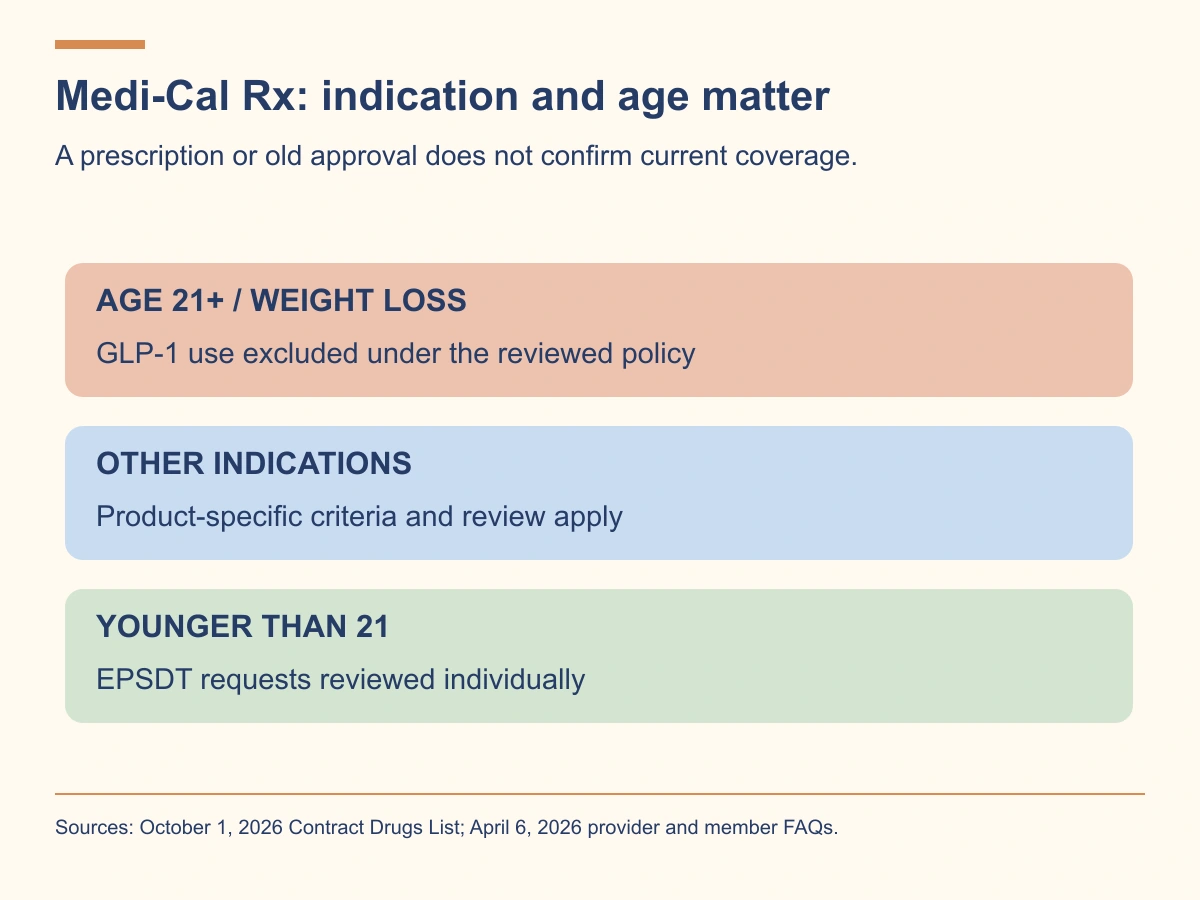
Medi-Cal Rx no longer covers GLP-1 drugs for weight loss or weight-loss-related indications for members age 21 and older under the policy effective January 1, 2026. Other indications and the rules for members younger than 21 require separate review. That is different from saying Medi-Cal covers no weight-management care or never covers Ozempic.
The current California rule
The October 1, 2026 Medi-Cal Rx Contract Drugs List repeats the adult GLP-1 weight-loss exclusion and describes exceptions for other approved indications and the federal benefit for members younger than 21. This article was checked against that edition and the program’s April 6, 2026 provider and member FAQs. Current Medi-Cal Rx Contract Drugs List, member FAQ.
For an adult age 21 or older, a high BMI alone does not create an exception to the GLP-1 weight-loss exclusion. The provider FAQ explicitly addresses that question. A prescription, medical recommendation, or older authorization does not independently establish payment under the current benefit.
Start by identifying the exact drug, formulation, prescribed indication, member age, and date of service. These details determine which part of the policy the pharmacy and prescriber should check. Our general Medicaid GLP-1 guide explains why a rule from another state cannot answer a California claim.
Does Medi-Cal cover Ozempic for weight loss?
For questions beyond the pharmacy benefit, the Ozempic access in California guide covers treating-clinician verification, telehealth arrangements, local quotes, and follow-up in Los Angeles, San Francisco, and elsewhere in the state.
For members age 21 and older using it for weight loss, the reviewed policy excludes that use. Ozempic’s injection labeling is also different from a general weight-management indication. It has specified type 2 diabetes-related uses. The reason for prescribing and the reason for coverage must be documented accurately. Medi-Cal provider FAQ, questions 10–20, Ozempic prescribing information.
The program continues to cover listed diabetes medicines, including Ozempic and Mounjaro, when used for type 2 diabetes with the required diagnosis information and applicable benefit rules. A person who has both obesity and diabetes should ask the prescriber and pharmacy to review the actual clinical indication and claim requirements.
Do not ask a clinic to enter a diagnosis that you do not have. A correct diagnosis code describes documented care; it is not a workaround for a benefit exclusion. Missing information and an excluded indication are different problems and should be resolved differently.
Which other GLP-1 uses may be considered?
The current documents distinguish several situations. For example, prior-authorization requests for Wegovy for cardiovascular disease and Zepbound for obstructive sleep apnea are reviewed case by case for medical necessity. The FAQ also describes Wegovy coverage for noncirrhotic metabolic dysfunction-associated steatohepatitis, or MASH, with appropriate diagnosis information effective April 1, 2026. Provider FAQ, October Contract Drugs List.
These are product- and indication-specific pathways. They do not mean every person with heart disease, liver disease, or snoring qualifies. The clinical record, applicable FDA-approved use, and benefit requirements still matter. A general symptom is not the same as a documented diagnosis.
| Situation | What to confirm with Medi-Cal Rx and the care team |
|---|---|
| GLP-1 for weight loss, age 21 or older | The reviewed policy excludes this use. |
| Listed medicine for type 2 diabetes | Required diagnosis information and current utilization rules. |
| Wegovy for cardiovascular disease | Case-by-case prior authorization and medical necessity. |
| Zepbound for obstructive sleep apnea | Case-by-case prior authorization and medical necessity. |
| Wegovy for noncirrhotic MASH | Correct diagnosis information and applicable listing requirements. |
| Member younger than 21 | Individual prior-authorization review under EPSDT. |
Our Ozempic and sleep-apnea article explains why Zepbound’s OSA indication should not be assigned to Ozempic or to every preparation containing tirzepatide.
What changes for members younger than 21?
The federal Early and Periodic Screening, Diagnostic, and Treatment benefit, usually shortened to EPSDT, creates a separate review pathway. Medi-Cal Rx reviews GLP-1 requests for members younger than 21 individually for medical necessity. Approval is required; age alone is not an approval. Medi-Cal member FAQ.
The current Contract Drugs List describes supporting information such as diagnoses, requested quantity and days’ supply, previous products and why they did not meet the member’s needs, contraindications, allergies, and clinical records. The treating pediatric or young-adult care team should identify what applies.
This article explains a benefit distinction, not a pediatric treatment recommendation. Medication eligibility, approved ages, growth, nutrition, and follow-up require the appropriate clinical team. The program’s under-21 definition should not be confused with a product’s FDA-approved age range.
What if you already had approval before 2026?
The member FAQ says existing prior authorizations for the affected weight-loss uses expired on December 31, 2025. Continuing-care provisions did not automatically preserve adult GLP-1 weight-loss coverage after the policy changed. Member FAQ, questions 5 and 9.
An old approval letter or a successful claim last year therefore cannot settle a current refill. Ask the pharmacy to identify the exact present rejection and ask the prescriber whether the treatment purpose or applicable clinical pathway needs clarification.
If treatment has already been interrupted, contact the clinical team about what to do next. The financial issue and the medication-restart issue need parallel attention. Do not resume a previous dose after a long gap based solely on finally obtaining another box. Our missed tirzepatide dose guide explains why longer gaps deserve individual review.

How to investigate a rejected claim
First, ask whether the problem is an excluded indication, missing diagnosis information, an authorization requirement, an incomplete submission, or another claim issue. Obtain the exact drug and formulation, the date of service, and the rejection explanation. “Insurance said no” leaves too many possibilities unresolved.
Second, identify who will act. The pharmacy can explain the claim response. The prescriber can provide accurate clinical information and submit a prior-authorization request when a pathway applies. Medi-Cal Rx can explain the status of the request and the relevant benefit rules.
Third, keep a short record of dates, reference numbers, requested information, and the next follow-up. Our GLP-1 insurance guide offers a general checklist, while the California documents determine the specific policy discussed here.
What if you receive a formal denial?
Read the Notice of Action and the hearing-rights information that comes with it promptly. The member FAQ says members have a right to a State Hearing and generally have 90 days from the notice date to request one. It also describes a shorter, generally 10-day timeframe for requesting continued disputed treatment while a hearing is pending, subject to stated conditions and limits. Medi-Cal member FAQ, question 8.
Use the deadline and instructions on your actual notice and seek help promptly if anything is unclear. This summary does not determine whether continued coverage applies to an individual case. Do not wait for a routine appointment if that would mean missing a stated deadline.
A hearing request also does not establish that the clinical plan should remain unchanged. Keep the prescriber informed about supply, symptoms, and interruptions while the coverage question is addressed.
Are other weight-loss medicines or services available?
The GLP-1 exclusion should not be expanded into a claim that all obesity care is unavailable. The provider FAQ encourages clinicians to review alternative drugs and treatment options and directs them to current approved-product information. The appropriate alternative depends on medical history and the actual benefit. Provider FAQ, question 20.
Ask about nutrition support, behavioral care, activity planning, other suitable medicines, or specialty evaluation. A different treatment may have different risks and contraindications; it should not be selected only because it appears easier to pay for.
Our Zepbound alternatives guide outlines treatment-comparison questions. It does not verify that a particular alternative is covered by Medi-Cal Rx for you. Have the pharmacy check the real prescription before making a financial commitment.
Can you pay out of pocket?
The member FAQ says members may pay for GLP-1 medicines themselves. It also states that Medi-Cal Rx will not reimburse a self-purchased GLP-1 used for excluded weight-loss care. Some discount cards may be usable if their terms allow Medi-Cal members; others exclude government-program beneficiaries. Member FAQ, question 10.
Do not assume a manufacturer savings offer and a general pharmacy discount have identical eligibility. Ask for the complete current price and written terms. Include medication, visits, follow-up, delivery, and renewal costs in the comparison.
The Ozempic cost guide and Zepbound cost guide separate these pricing questions. A cash quote is not evidence of an insurance benefit, and paying privately does not remove the need for an appropriate prescription and monitoring.
Does compounded care change the coverage answer?
Compounded semaglutide and tirzepatide are not FDA-approved generic versions of Ozempic, Wegovy, Mounjaro, or Zepbound. A brand’s benefit listing cannot establish approval, equivalence, or reimbursement for a compounded preparation. FDA information on unapproved GLP-1 drugs.
If you review CoreAge Rx’s tirzepatide service, confirm its assessment-based compounded scope, payment arrangements, pharmacy, and total cost directly. Do not assume that enrollment creates Medi-Cal coverage or that a denial makes a compounded prescription appropriate.
Keep the clinical choice and payment choice connected but distinct. A useful plan is one you understand medically and can sustain financially, with a clear contact route when either part changes.

A short call checklist
- What exact medicine, formulation, indication, and date of service are being reviewed?
- Which current policy applies to my age and documented condition?
- Is the problem a benefit exclusion or information missing from the claim?
- Is prior authorization available for this use, and has it been submitted?
- What does my Notice of Action say about review rights and deadlines?
- What clinically suitable covered alternatives can my team discuss?
- What is the plan if treatment stops while this is resolved?
Common questions
Does a very high BMI restore adult coverage?
The reviewed FAQ says the adult GLP-1 weight-loss exclusion applies regardless of BMI. Other indications and the under-21 EPSDT pathway require their own assessment.
Is Medi-Cal the same as Medicare?
No. Medicare announcements and programs should not be used to infer Medi-Cal Rx coverage. If you have both programs, ask which benefit handles the actual prescription.
Who can confirm my authorization status?
The member FAQ lists the Medi-Cal Rx Customer Service Center at 1-800-977-2273. Have your member and prescription details ready, and keep the pharmacy and prescriber involved in any required follow-up.
Educational information for adults; individual treatment decisions require a qualified clinician. Sources reviewed October 5, 2026. Original AI-generated article images depict fictional people and objects, not patient outcomes. Other editorial images are illustrative. Graphics summarize the cited sources.