Tell the team scheduling your colonoscopy that you take Mounjaro, and get written instructions for the medication, bowel preparation, food, fluids, and other diabetes medicines. There is no single Mounjaro hold interval that is appropriate for every patient and procedure. Current professional guidance supports continuing GLP-1 medicines for many patients, with individualized precautions and different fasting recommendations across guidance documents. ASA multisociety guidance. SPAQI consensus statement.
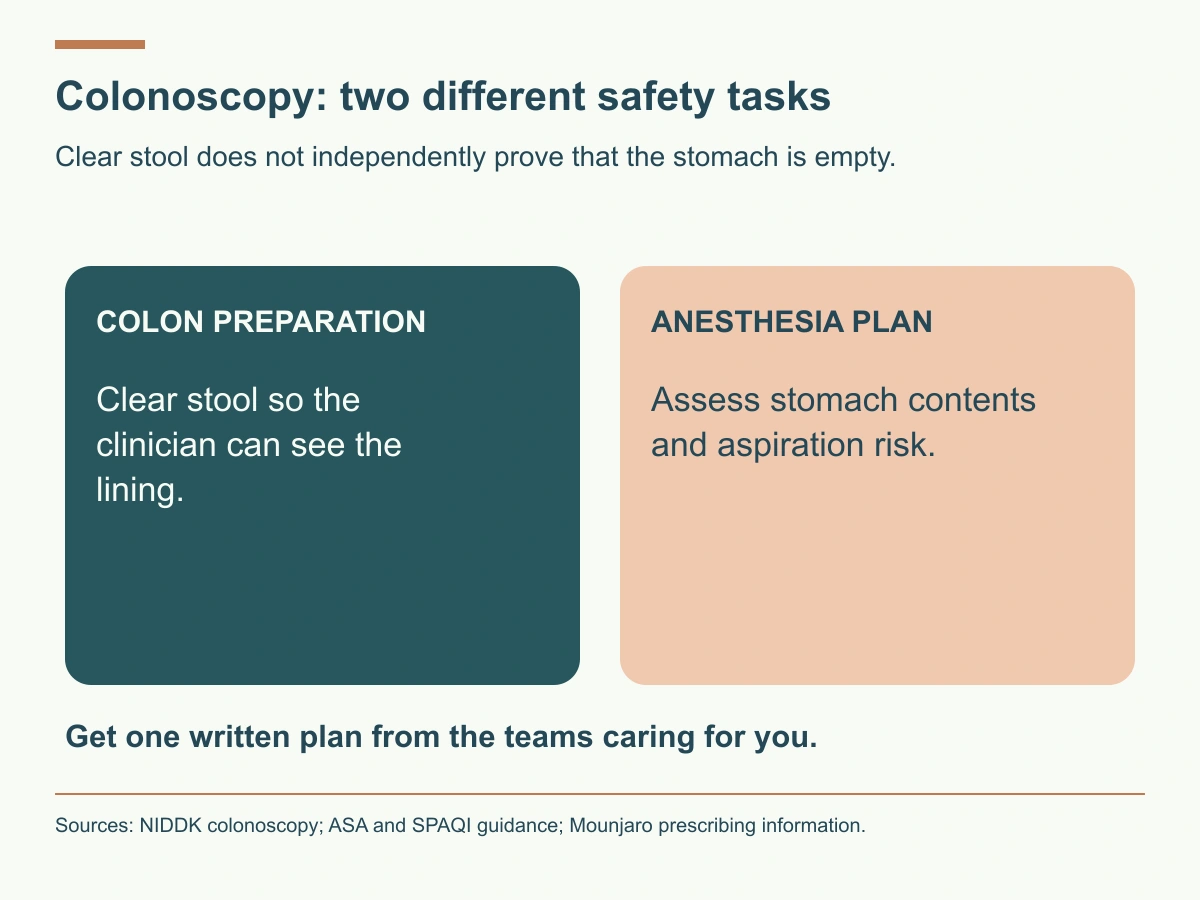
The important distinction is between cleaning the colon so the clinician can see its lining and managing stomach contents for sedation or anesthesia. Completing a bowel preparation does not independently prove that the stomach is empty.
Why Mounjaro matters before a colonoscopy
Mounjaro contains tirzepatide, which acts at GIP and GLP-1 receptors and delays gastric emptying. Its prescribing information describes rare postmarketing reports of aspiration during general anesthesia or deep sedation in patients taking GLP-1 receptor agonists, including cases in which patients reported following fasting instructions. Aspiration means stomach contents enter the airway or lungs. Mounjaro prescribing information
The label also says available data are insufficient to determine whether changing fasting instructions or temporarily stopping Mounjaro reduces retained stomach contents. That uncertainty is a reason for procedure-team planning, not a reason to ignore fasting instructions or invent a longer hold yourself.
Colonoscopy preparation has another purpose: clearing stool from the large intestine. NIDDK explains that inadequate preparation can prevent the clinician from seeing the lining clearly. The bowel-cleansing plan and the anesthesia plan need to work together. NIDDK colonoscopy preparation
Why older “stop for a week” advice may differ from your instructions
Earlier anesthesia guidance recommended holding weekly GLP-1 medicines before elective procedures. The 2024 multisociety guidance moved toward individualized assessment, with most patients able to continue treatment and additional measures for people at greater risk of delayed emptying. ASA’s patient information reflects that approach. ASA patient guidance
The 2025 SPAQI consensus statement also recommends continuing GLP-1 medicines in patients without significant gastrointestinal symptoms, but it recommends a longer solids fast and distinguishes fasting intervals for different clear liquids. Its recommendations are not identical to every other guidance document. SPAQI perioperative recommendations
Do not combine the most convenient parts of different documents into your own preparation schedule. The facility’s anesthesia and endoscopy teams need to give one coherent plan that accounts for your symptoms, medication history, procedure, and other medical needs. If two instructions conflict, ask the teams to resolve the conflict before preparation begins.
Contact the team before the next relevant injection
When the colonoscopy is booked, report the exact medication, current dose, usual injection day, and most recent injection. Say whether you are just starting, recently increased the dose, or have had a prolonged interruption. Include any nausea, vomiting, abdominal pain, constipation, bloating, or difficulty tolerating meals.
Tell the team why Mounjaro was prescribed and which other diabetes medicines you use. Stopping or changing treatment can affect blood glucose. Insulin, sulfonylureas, and other medicines may need separate instructions during reduced food intake or fasting; a Mounjaro instruction does not cover the entire regimen.
Use a practical question: “My injection is due on this date and my colonoscopy is on this date. What should I do, and who will confirm the plan?” That gives the team a concrete decision to address. Avoid waiting until the evening before the procedure to mention a weekly medicine.
The Mounjaro medication-interaction guide can help you prepare a complete medication list. Include supplements and nonprescription products, not only diabetes treatment.
Factors that may change the preparation plan
ASA guidance highlights periods of dose escalation, significant digestive symptoms, higher doses, and other conditions that can slow stomach emptying as relevant to risk assessment. The team may recommend additional dietary precautions, changes to the anesthesia plan, assessment of stomach contents, or delaying an elective procedure when appropriate. ASA guidance on risk factors
A symptom-free person still needs the team’s instructions. Conversely, having nausea does not automatically mean you should cancel the colonoscopy yourself. Report the symptom, its severity, and whether you can eat and drink; the team decides how it affects the procedure.
| Information to share | Why the team needs it |
|---|---|
| Current dose and date of last injection | Establishes the actual treatment schedule |
| Recent start, increase, or restart | Helps assess the period of treatment and tolerance |
| Vomiting, marked nausea, constipation, or inability to eat | May change preparation or procedural planning |
| Known delayed gastric emptying or other relevant conditions | Requires individualized assessment |
| Insulin, sulfonylureas, and other medicines | Supports a separate glucose and medication plan |
| Previous problems with bowel preparation or sedation | Helps plan around an existing difficulty |

Follow the facility’s bowel-preparation instructions
NIDDK describes preparation as a combination of dietary instructions, bowel-cleansing medicine, and arrangements for recovery. Depending on the prescribed regimen, the diet may change for several days and include a clear-liquid period. Use the exact written instructions from the facility rather than a preparation plan copied from another person’s procedure. NIDDK colonoscopy guide
Confirm what counts as a clear liquid and which colors or ingredients are restricted. A drink being liquid does not make it clear: milk, creamy drinks, and beverages with pulp are different from the options usually permitted. The stop time for drinking also needs to come from your team, especially when its GLP-1 protocol differs from general fasting advice.
Do not add extra laxative doses because you take Mounjaro or because you are worried the bowel is not clean. Call the facility if the preparation is not working as described, you cannot finish it, or vomiting prevents you from keeping it down. Ask for the after-hours contact before starting.
The Trulicity and stomach-emptying guide explains another useful distinction: a bowel symptom such as diarrhea does not directly tell you how quickly the stomach emptied. The same principle matters when interpreting bowel-prep results.
Make a glucose and hydration plan
Reduced intake, diarrhea from preparation, and changes to diabetes medicines can create a different day from your usual routine. Ask when to check glucose, which readings require contact, how to treat a low during preparation, and what to do if you cannot keep permitted fluids down.
NIDDK notes that fasting or missed meals can increase hypoglycemia risk in people using insulin or certain other diabetes medicines. Physical activity, alcohol, and illness may also affect the pattern. The plan should account for the whole regimen rather than assuming Mounjaro is the only relevant medicine. NIDDK low blood glucose guidance
Ask how to handle a low glucose reading when it conflicts with a fasting instruction. Treating an urgent medical problem takes priority, but the procedure team must know what you consumed and when so it can reassess the schedule. Do not hide food or drink taken to treat a low because you are afraid the procedure will be delayed.
Mounjaro’s label warns about kidney injury associated with volume depletion, often in the setting of vomiting or diarrhea. Seek advice promptly if you cannot maintain fluids, urinate much less, or feel faint. Severe weakness, confusion, collapse, or inability to swallow safely needs urgent help. Mounjaro warnings
The Mounjaro sweating guide explains why sweating and shakiness can be relevant to a glucose assessment. Those symptoms should not automatically be dismissed as anxiety about the procedure.
What to do if you already took the injection
Call the facility and give the actual date and dose. Do not assume the colonoscopy must be canceled, and do not assume nothing needs to change. Current guidance allows continuation for many patients, but the team still needs to assess your situation and its own protocol.
Do not compensate by extending fasting without instructions or by changing other medicines. A longer unsupervised fast can create additional problems, particularly for someone using insulin or struggling with hydration. Get a revised, written plan if the team changes the schedule.
On the day of the procedure, confirm the medication history again with the endoscopy and anesthesia staff. Include the last solid food, permitted drinks, bowel-prep completion, glucose concerns, and any new symptoms. Accurate information is more useful than trying to appear to have followed a plan perfectly.
Restarting Mounjaro after the colonoscopy
Ask for restart instructions before discharge. The SPAQI statement suggests that outpatients restart GLP-1 medicines when they resume their usual diet, but an individual’s symptoms, length of interruption, and treatment schedule still matter. This is not a universal instruction to inject immediately after returning home. SPAQI postoperative recommendations
If you are still vomiting, cannot tolerate food or fluids, or have significant abdominal symptoms, contact the team before restarting. If multiple doses were missed, the prescribing clinician should review the restart plan. Do not double a dose to make up for a procedure-related interruption.
The Mounjaro dose-splitting guide explains why improvised partial doses are not a substitute for a prescribed restart schedule. Ask the team for clear instructions tied to your actual product and dates.
A short checklist for the scheduling call
- Give the medication name, dose, injection day, and last dose date.
- Report recent dose changes and digestive symptoms.
- List every diabetes medicine and relevant medical condition.
- Request one written plan covering medicine, food, fluids, bowel preparation, and glucose checks.
- Confirm whom to contact if preparation fails or symptoms develop.
- Ask how restart instructions will be provided after the procedure.
For people exploring ongoing treatment, CoreAge Rx tirzepatide information can support questions about assessment and follow-up. Procedure preparation remains the responsibility of the prescribing and procedure teams coordinating your care; a general product page cannot clear you for sedation.
Frequently asked questions
Must everyone stop Mounjaro seven days before colonoscopy?
No universal seven-day rule fits every patient under current guidance. Follow the individualized instructions from your procedure and prescribing teams, and resolve conflicting instructions before preparation begins.
Does clear stool mean my stomach is empty?
No. Bowel cleansing concerns the colon. Stomach contents and aspiration risk are separate issues for the anesthesia plan.
Can I use a standard clear-liquid fasting time I found online?
Use your facility’s instructions. Current professional documents differ in their GLP-1-related fasting recommendations, and the type of liquid can matter. Ask for clarification instead of selecting a cutoff yourself.
What if I cannot finish the bowel prep?
Contact the endoscopy team using its provided number. Explain what you completed, any vomiting, and whether you can drink. Do not add extra preparation medicine without instructions.
Can I drive home afterward?
Arrange the transportation required by the facility. NIDDK advises arranging a ride because sedatives or anesthesia take time to wear off. Confirm the facility’s companion and discharge requirements when scheduling. NIDDK colonoscopy preparation
Educational information for adults; individual treatment decisions require a qualified clinician. Sources reviewed October 5, 2026. Original AI-generated article images depict fictional people and objects, not patient outcomes. Other editorial images are illustrative. Graphics summarize the cited sources.