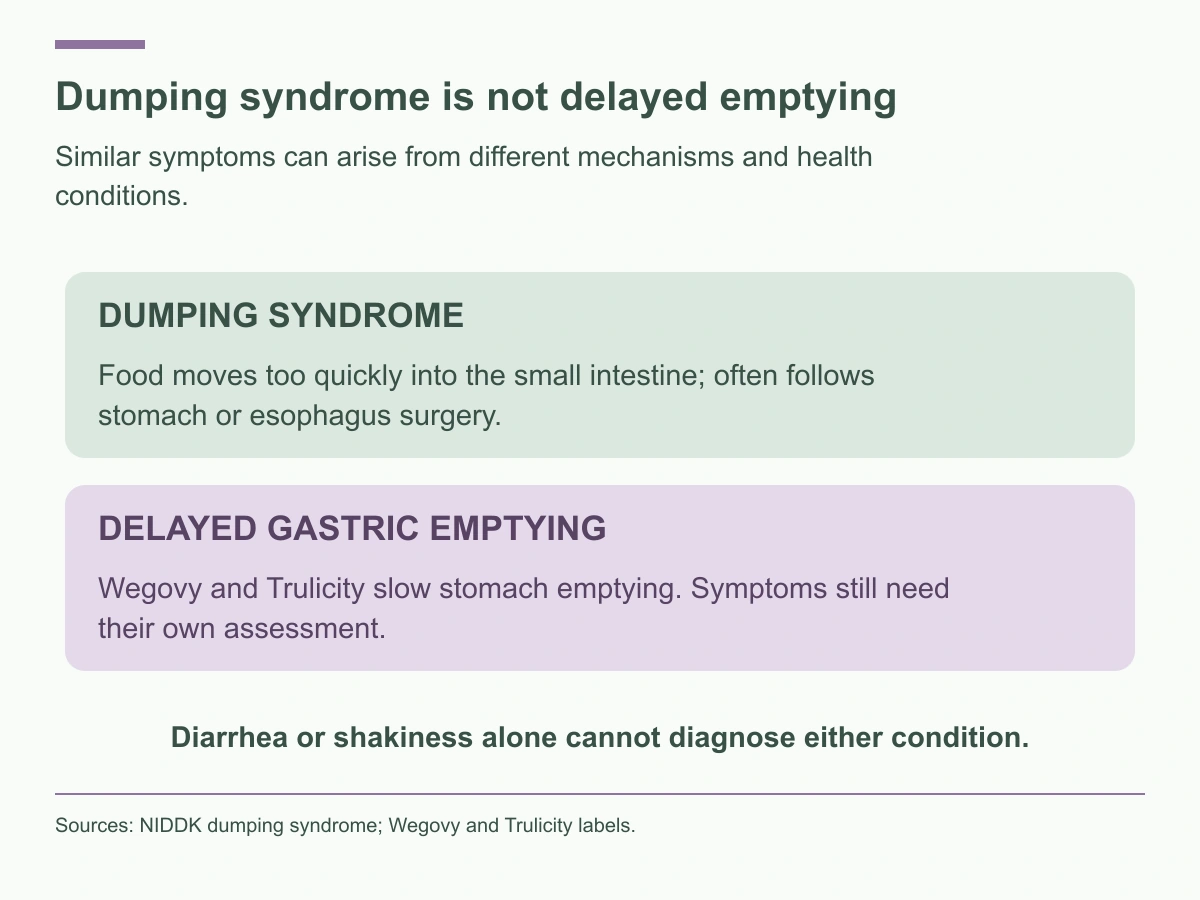
Wegovy and Trulicity slow stomach emptying, while dumping syndrome involves food moving too quickly from the stomach into the small intestine. Similar digestive symptoms can still have different causes. This guide explains the distinction, including Wegovy-specific questions, alongside symptoms, testing, and warning signs.
Trulicity and dumping syndrome involve different stomach-emptying concepts. Trulicity, which contains dulaglutide, delays gastric emptying. Dumping syndrome occurs when food moves too quickly from the stomach into the small intestine. Diarrhea, nausea, or sweating after a meal can overlap across several conditions, so symptoms alone do not establish dumping syndrome. Trulicity prescribing information. NIDDK dumping syndrome overview.
If symptoms started during Trulicity treatment, describe their timing, severity, associated glucose readings, and any history of stomach or esophageal surgery to your clinician. Do not assume every digestive problem is a routine side effect or stop and restart treatment as a diagnostic test.
Can Wegovy cause dumping syndrome?
Wegovy delays gastric emptying, while dumping syndrome involves food moving too rapidly from the stomach into the small intestine. Diarrhea, nausea, sweating or weakness during treatment does not by itself establish dumping syndrome or identify the speed at which your stomach is emptying. Wegovy label; NIDDK dumping syndrome.
The distinction matters because similar symptoms can require different assessment. A person may have medication-related digestive symptoms, hypoglycemia, a post-surgical problem, an unrelated illness, or more than one issue. Timing after a meal is useful information, but it is not a complete diagnostic test.
The reviewed Wegovy label does not establish a dumping-syndrome incidence or authorize its use as a treatment for dumping syndrome. Likewise, Trulicity’s gastric-emptying effect should not be turned into a claim that it cures rapid emptying. Both medicines require care for their actual prescribed indications.
Can you eat after a Wegovy injection?
Wegovy injection can be administered with or without meals according to its label. It does not create a universal waiting period before eating. That administration instruction is separate from advice a clinician may give for reflux, nausea, diabetes, or a diagnosed post-surgical condition. Wegovy administration.
Wegovy tablets have different requirements, including a morning empty-stomach routine and a wait before food, beverages or other oral medicines. Do not transfer those tablet instructions to an injection or assume that changing a meal interval will diagnose or prevent dumping syndrome. Our oral semaglutide versus injection guide explains the formulation distinction.
If meals repeatedly trigger symptoms, record when you ate, what you could tolerate, when symptoms began, and any glucose result obtained under your existing monitoring plan. The Wegovy heartburn and reflux guide addresses a different digestive pattern. Reflux and dumping syndrome are not interchangeable names for discomfort after food.
What changes if you have had stomach or esophagus surgery?
Tell the prescribing team the operation and approximate date, including gastric bypass, sleeve surgery, fundoplication, or another stomach/esophagus procedure. NIDDK identifies several of these operations as contexts in which dumping syndrome can occur. An operation years ago can still be relevant to the symptom history. NIDDK causes.
Describe any existing diagnosis, dietary plan, previous testing and treatment. New medication symptoms should be reviewed alongside that history, rather than assuming that either the surgery or Wegovy explains everything. The clinician may need to coordinate with the surgical team or a gastroenterologist.
Do not independently add another GLP-1 medicine to slow digestion further or stop essential diabetes treatment as a trial. If poor intake or vomiting is affecting medicines, arrange prompt advice. The semaglutide surgery guide covers a separate question about procedure planning and restarting treatment.
Why a symptom record should include more than the meal
For Wegovy, record the formulation, last dose, recent increase or interruption, and other medicines. The label warns about hypoglycemia in relevant circumstances, severe gastrointestinal reactions and kidney injury with fluid loss. Those issues may require attention even when you also have a history suggesting dumping syndrome. Wegovy warnings.
A useful note might say that symptoms began shortly after lunch, explain what the symptoms were, and state whether vomiting, diarrhea, low glucose or reduced fluid intake occurred. It should not label the episode “dumping” before the cause has been assessed.
The Trulicity sections below explain the shared mechanism distinction, early versus late dumping symptoms, clinical testing and urgent warning signs. Keep the medicine-specific label alongside that general guidance, because doses, indications and instructions differ across products.
What is dumping syndrome?
Dumping syndrome is a group of symptoms associated with rapid movement of food into the small intestine. It most often follows surgery involving the stomach or esophagus, although it can also occur without surgery. The timing of symptoms after eating helps distinguish its early and late forms. NIDDK symptoms and causes
Early dumping symptoms generally occur within 30 minutes after a meal. They can include abdominal discomfort, nausea, bloating, diarrhea, flushing, a racing heartbeat, sweating, or feeling faint. Late symptoms generally occur one to three hours after eating and are associated with low blood glucose following an excessive insulin response.
These time windows help organize a history; they are not a home diagnostic test. A person can have post-meal diarrhea for other reasons, and someone using glucose-lowering medicines can have hypoglycemia without dumping syndrome. The clinician needs the broader picture.
What does Trulicity do to stomach emptying?
Trulicity is a GLP-1 receptor agonist used for type 2 diabetes and specified cardiovascular risk reduction in eligible adults. Its prescribing information states that dulaglutide delays gastric emptying. The delay is greatest after the first dose and becomes smaller with subsequent doses. Trulicity clinical pharmacology
Delayed gastric emptying is movement in the opposite direction from the rapid emptying involved in dumping syndrome. That distinction is why it is misleading to describe any diarrhea after Trulicity as “the medicine dumping food through the stomach.” A bowel symptom does not directly measure how fast the stomach emptied.
The label also warns about sometimes severe gastrointestinal adverse reactions and says Trulicity is not recommended in people with severe gastroparesis. Gastroparesis concerns delayed emptying and requires appropriate diagnosis. Neither that diagnosis nor dumping syndrome can be established from a symptom checklist alone.
The Mounjaro side-effect guide discusses digestive effects of a different incretin-based medicine. Similar symptom words across drugs do not make the products interchangeable or prove that the same mechanism explains a particular person’s experience.

Why can the symptoms look similar?
Nausea, diarrhea, vomiting, abdominal pain, reduced appetite, and indigestion appear among the common adverse reactions in Trulicity’s clinical-trial information. Sweating, shakiness, or faintness may instead raise a question about low glucose, particularly with other diabetes medicines. Trulicity adverse reactions and warnings
A symptom can also have more than one contributing factor. For example, an adult may have a history of stomach surgery, take insulin as well as Trulicity, and eat less because of nausea. That history needs an individualized review; assigning all symptoms to one medicine may miss an important part of the problem.
Do not use the appearance of stool, an episode of belching, or the speed of an urgent bowel movement as proof of rapid gastric emptying. Those observations can still be useful to report, but they answer a different question from a formal assessment of stomach function.
| Possibility being considered | Relevant pattern | What still needs assessment |
|---|---|---|
| Early dumping syndrome | Symptoms soon after eating, often with relevant surgery history | Whether rapid emptying explains the symptoms |
| Late dumping syndrome | Symptoms one to three hours after eating with low glucose | The cause of the low glucose and the broader history |
| Trulicity digestive adverse effects | Nausea, vomiting, diarrhea, indigestion, or abdominal discomfort | Severity, hydration, dose history, and other causes |
| Medication-associated hypoglycemia | Low reading or compatible symptoms, especially with insulin or a sulfonylurea | The full regimen, food intake, activity, and individual treatment plan |
| Another digestive or medical condition | A pattern that may overlap with any of the above | Appropriate examination and targeted testing |
Low blood glucose needs its own action plan
Trulicity can increase the risk of hypoglycemia when used with insulin or medicines that stimulate insulin release, such as sulfonylureas. A clinician may need to adjust those medicines. Do not make the adjustment yourself based only on sweating after meals. Trulicity hypoglycemia warning
For many people with diabetes, a reading below 70 mg/dL is low, although individual targets may differ. NIDDK advises prompt treatment with 15 to 20 grams of glucose or fast-acting carbohydrate, followed by another check after 15 minutes and repeat treatment if still low. Follow the plan provided by your diabetes team. NIDDK hypoglycemia treatment
These oral steps are for a person who is awake and can swallow safely. Severe confusion, a seizure, unconsciousness, or inability to swallow requires emergency help. A trained person should use prescribed rescue glucagon when available and call emergency services. Do not put food or drink into the mouth of someone who cannot swallow safely.
The Ozempic sweating guide explains a similar symptom-assessment issue for another medicine. It should not be used to transfer dosing or treatment instructions between products.
How clinicians investigate possible dumping syndrome
The assessment begins with symptoms, medical history, and examination. A history of stomach or esophageal surgery can be particularly relevant. Depending on the situation, a clinician may use tests such as a monitored oral glucose tolerance test or a gastric-emptying study. NIDDK dumping syndrome diagnosis
Do not try to recreate a diagnostic test by drinking a large sugar load at home. A test performed with monitoring has a specific purpose and interpretation. Deliberately provoking symptoms can create an unsafe situation without giving a reliable diagnosis.
Ask what question a proposed test is intended to answer. Is the team looking for rapid emptying, delayed emptying, low glucose, another digestive condition, or a combination? Understanding that question can make the results discussion clearer and reduce confusion about similarly named conditions.
Bring the exact medication list, including dose changes, insulin, diabetes tablets, supplements, and nonprescription products. Include when symptoms occurred before treatment, if they did. A timeline that begins only with the latest injection may leave out useful evidence.
Prepare a useful food-and-symptom record
For each episode, note when you began eating and when symptoms started. Describe the meal in ordinary terms and record the symptoms separately: cramping, diarrhea, nausea, sweating, palpitations, weakness, or confusion. Include a glucose reading if you obtained one and the action you took.
Also record whether the episode happened after a medication change, during illness, or after unusually low food intake. You do not need to reconstruct every ingredient perfectly. The aim is to show the pattern clearly enough for the clinician to decide what matters.
If you are changing meal habits, avoid imposing a complex dumping-syndrome diet before the diagnosis is clear. Advice appropriate for one condition may not address another, and your diabetes medicines may need coordination with any substantial change in carbohydrate intake. The corn and evening meals guide illustrates why a food’s place in the whole meal matters more than labeling it simply good or bad.
When symptoms should not wait
Seek prompt care for repeated vomiting, inability to keep fluids down, marked dizziness, or much less urination. Trulicity’s label warns that fluid loss from gastrointestinal effects can contribute to acute kidney injury. Severe or persistent symptoms need assessment even if you have had mild digestive side effects before. Trulicity warnings
Severe persistent abdominal pain, especially with vomiting or pain extending to the back, raises a different concern, including pancreatitis. The label instructs patients to discontinue Trulicity and contact their healthcare provider when pancreatitis is suspected. Breathing difficulty, facial or throat swelling, collapse, or severe hypoglycemia requires emergency help.
Do not wait for an upcoming routine refill appointment when the symptom pattern has changed substantially. Tell the care team if you cannot complete meals, are repeatedly missing work or sleep, or are losing weight because you cannot eat. The number on the scale does not make severe intolerance an acceptable treatment outcome.
Can a different medication solve the problem?
That depends on what is causing it. A switch should follow assessment of the treatment goal, glucose control, other medicines, and the suspected condition. Another GLP-1-related product may have its own digestive effects, so changing names is not a guarantee that symptoms will resolve.
If you are exploring treatment options, CoreAge Rx semaglutide information and tirzepatide information can support a conversation about the service’s assessment and follow-up. Confirm the exact preparation and instructions. These services should not be interpreted as treatments for undiagnosed dumping syndrome.

Frequently asked questions
Is Trulicity a GLP-1 medicine?
Yes. Dulaglutide is a GLP-1 receptor agonist. Its effect on stomach emptying is a delay, which is different from the rapid emptying central to dumping syndrome.
Does diarrhea after an injection mean dumping syndrome?
No. Diarrhea is a documented Trulicity adverse reaction, but it also has other possible causes. The timing after meals, surgery history, glucose readings, severity, and other symptoms help determine the next steps.
Can dumping syndrome occur without stomach surgery?
Yes, although surgery is the most common cause described by NIDDK. Lack of surgery does not establish or exclude the diagnosis. A clinician should interpret the full history.
Should I skip the next dose to see what happens?
Ask the prescriber for instructions if symptoms are persistent or disruptive. Do not use unsupervised stopping and restarting as a diagnostic test. Urgent warning signs require immediate assessment and the product’s safety instructions.
What is the most useful first step?
Address any urgent symptoms or low glucose first. Then give the clinician a clear timeline with meal timing, symptoms, glucose readings, medication changes, and surgery history. That is more useful than arriving with a diagnosis based only on an online symptom match.
References reviewed for this update
Wegovy PI; Trulicity prescribing information; Symptoms & Causes of Dumping Syndrome – NIDDK; Diagnosis of Dumping Syndrome – NIDDK; Low Blood Glucose (Hypoglycemia) – NIDDK.
Educational information for adults; individual treatment decisions require a qualified clinician. Sources reviewed October 6, 2026. Original AI-generated article images depict fictional people and objects, not patient outcomes. Other editorial images are illustrative. Graphics summarize the cited sources.