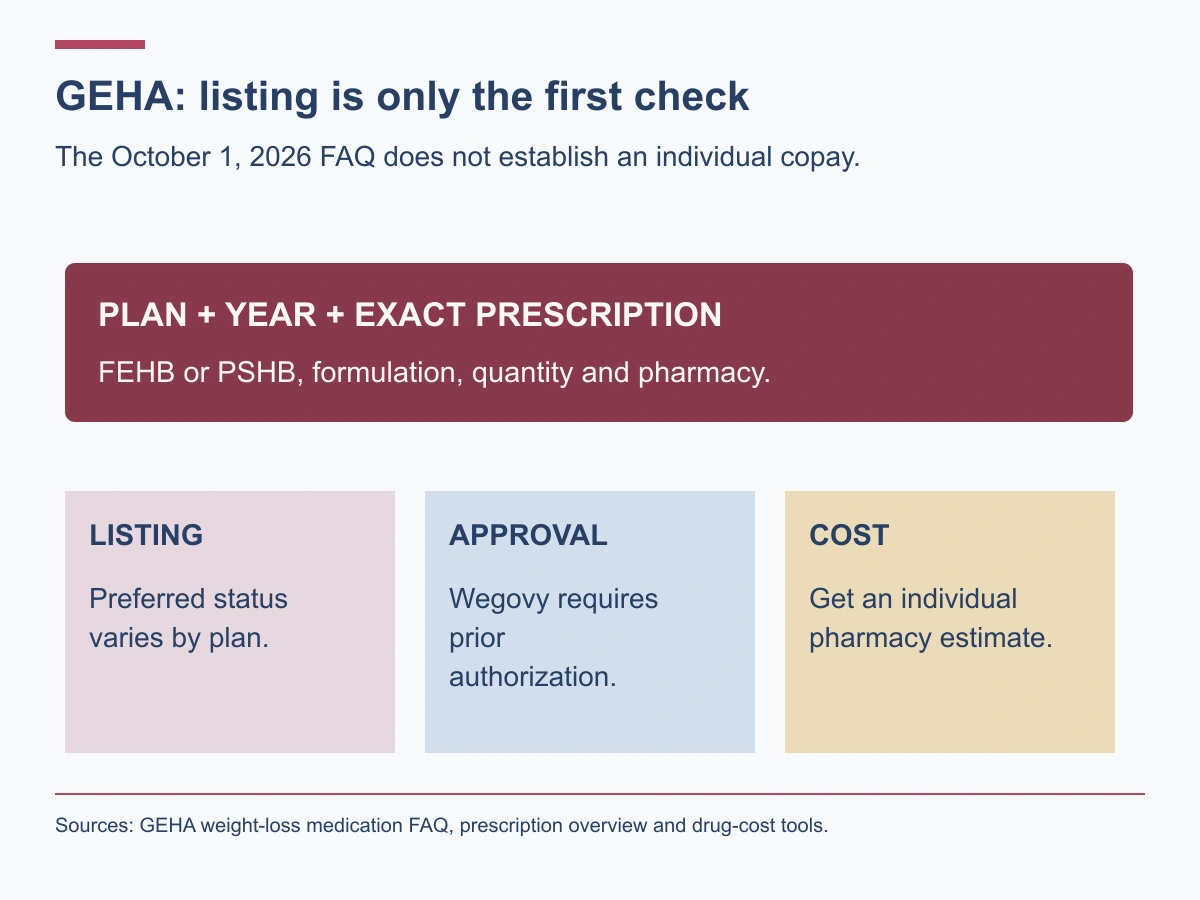
GEHA’s current weight-loss medication FAQ lists Wegovy with prior authorization requirements, but the formulary position differs by plan option. In the document updated October 1, 2026, Wegovy is non-preferred for High, Standard, HDHP, and Elevate Plus, and preferred for Elevate. Neither listing guarantees approval or a particular out-of-pocket cost for an individual member. GEHA weight-loss medication FAQ
To get a useful answer, identify your exact plan, benefit year, FEHB or PSHB enrollment, prescribed Wegovy product, and pharmacy. Then check coverage criteria and cost through the appropriate GEHA/CVS Caremark route. A general statement that “GEHA covers it” leaves too many of those details unresolved.
What the October 2026 document says
The reviewed FAQ groups the plan options as follows. This is a summary of that document’s weight-loss medication information, not a member-specific benefit determination. Confirm the current document and the applicability to your enrollment before making a treatment or plan-selection decision.
| Plan options named in the FAQ | Wegovy listing | Requirement noted |
|---|---|---|
| High, Standard, HDHP, Elevate Plus | Non-preferred | Prior authorization |
| Elevate | Preferred | Prior authorization |
The FAQ also lists other weight-loss medicines with their own formulary positions. That does not mean every listed drug is appropriate for you or that a clinician should change treatment solely to match a preferred tier. Ask which alternatives are clinically reasonable and what requirements apply. GEHA pharmacy coverage FAQ
GEHA’s prescription overview states that weight-loss medication coverage depends on prior authorization or a formulary exception approval. Those are separate issues from receiving a prescription. A clinician may consider a drug appropriate while the plan still needs documentation before it will pay. GEHA prescription overview
Start with the exact plan and benefit year
Use the full plan name from your enrollment materials. “GEHA,” “federal insurance,” or “the high-deductible plan” may not be enough to select the correct cost tool or brochure. GEHA’s drug-cost page provides separate routes for FEHB and PSHB members and then for the available plan options. GEHA drug-cost tools
The benefit year matters too. A current-year approval or webpage does not establish the next year’s terms. During open enrollment, compare the documents for the year you are choosing, rather than combining a current pharmacy quote with a future-year premium or deductible.
If your household is changing plans, ask how an existing authorization will be handled. Do not assume it transfers automatically. Request the steps and timing for any new review, and coordinate with the prescriber so a coverage transition does not become an unplanned medication interruption.
Keep the source date with your notes. A screenshot from a discussion group may have been accurate for a different year, option, pharmacy, or formulation. The GLP-1 insurance coverage guide explains the difference between a drug appearing on a formulary and an individual claim being approved.
Specify the Wegovy product and the reason for treatment
Current U.S. Wegovy labeling includes injection and tablet products with product-specific instructions and indications. Do not assume that a brand-name listing answers every route, strength, quantity, or clinical-use question. Ask the pharmacy and benefit team to check the actual prescription. Wegovy prescribing information
Wegovy and Ozempic both contain semaglutide, but their labeled uses and product instructions differ. A benefit decision for one is not automatically a decision for the other. Similarly, a coverage rule for weight management may differ from the review pathway for another labeled indication.
The diagnosis submitted should accurately reflect the clinician’s assessment. Do not ask a prescriber to use an inaccurate diagnosis to obtain approval. If a request is denied, the useful next step is to understand the reason and the applicable evidence requirements.
For an explanation of injection schedules and product-specific issues, see the Wegovy dosage guide. It provides educational context and should not be used to alter a prescription to fit an insurance quantity limit.
What prior authorization usually requires you to clarify
Prior authorization is the plan’s review before coverage is approved under its rules. The exact criteria must come from your current benefit documents and the team processing your request. Do not substitute a generic internet list of BMI thresholds, prior medicines, or required visits for the actual policy.
Ask the prescriber which records are needed and who will submit them. Useful categories to clarify include the treatment indication, relevant measurements or medical history, previous therapies where required, and any continuation criteria. The plan may distinguish an initial request from renewal; ask about both before assuming approval lasts indefinitely.
Make sure the pharmacy and prescriber are discussing the same product, quantity, and days’ supply. An administrative mismatch can look like a clinical denial from the patient’s perspective. Ask for the exact rejection or request status rather than relying on “insurance won’t cover it.”
| Question to ask | Information to write down |
|---|---|
| Which policy applies to this prescription? | Plan, benefit year, formulation, and indication |
| Is this an initial authorization, renewal, or exception? | Correct process and required documents |
| Who submits the request? | Prescriber office, benefit team, and contact route |
| Has the request been received and is anything missing? | Submission date, reference number, and outstanding items |
| If approved, when does it expire? | Approval dates, covered product, and renewal requirements |
Avoid sending the same incomplete request repeatedly. A short conversation identifying the missing item may be more useful than another submission that reaches the same result.

How to get a meaningful cost estimate
GEHA’s drug-cost page notes that costs vary with plan, pharmacy, and drug type. For HDHP members, the displayed tool cost is after the deductible. That qualification matters: an after-deductible figure should not be presented as what every member pays at the beginning of the year. GEHA cost-tool guidance
Use the correct plan link and enter the prescription details carefully. Then confirm the amount with the dispensing pharmacy after any required authorization is in place. A search result, manufacturer list price, cash-discount advertisement, and processed insurance claim represent different payment routes.
Ask whether the quote is for the initial fill or a typical refill, and whether it assumes a deductible has been met. If the quantity or formulation changes, request a new estimate. Record the date, pharmacy, and prescription details alongside the number so you can compare like with like later.
This article does not provide a universal GEHA Wegovy copay because no member-specific claim or quote was obtained. A single attractive price would be misleading without the conditions that produce it. The plan’s current tool and pharmacy claim are the appropriate places to resolve your amount.
If coverage is denied, identify the type of problem
A denial may involve benefit rules, missing documentation, an unmet clinical criterion, an excluded product, or a request sent through the wrong process. Ask for the written reason and the policy used. The next step depends on that reason; not every rejection calls for the same appeal letter.
GEHA’s appeal FAQ describes appeal options for claim denials, adverse benefit determinations, and prior authorizations. It also explains documentation and review routes. For a prescription decision, follow the specific denial notice and confirm the appropriate pharmacy-benefit process and deadline rather than assuming a general medical-appeal address is correct. GEHA appeal guidance
Keep copies of the denial, submitted records, clinician’s explanation, and any reference numbers. If a deadline is approaching, contact the responsible benefit team promptly. Ask whether an expedited pathway applies to your situation rather than labeling a routine request urgent without clinical support.
An appeal is a request for review, not a guaranteed approval. If the decision stands, discuss medically appropriate alternatives and their actual coverage with your clinician. Avoid an unsupervised switch, a borrowed prescription, or a change in dosing intended to stretch a supply.
Plan for follow-up and renewals
An approval is only one part of ongoing treatment. Ask how often the clinician will review response, tolerability, nutrition, and other medicines. Keep the authorization expiration date separate from the prescription expiration and the date your next refill is due.
If digestive symptoms limit food or fluid intake, contact the care team instead of pushing through treatment to preserve an insurance approval. Our Wegovy side-effect guide explains which symptoms deserve attention. Coverage should support appropriate care; it does not make an unsuitable treatment safe.
If treatment is interrupted by a coverage delay, ask for restart instructions. Do not assume the previous dose remains appropriate after an extended gap. The semaglutide storage and travel guide also addresses product handling when supplies, travel, and refill timing overlap.

Where CoreAge Rx information fits
CoreAge Rx semaglutide information can help you ask about the service’s assessment, preparation, fees, dispensing pharmacy, and follow-up. It does not establish that GEHA pays for that service or for a particular preparation. Confirm those questions directly before enrolling.
If compounded medication is discussed, distinguish it from an FDA-approved branded product. FDA states that compounded drugs are not FDA-approved and are not the same as approved generics. A GEHA listing for Wegovy should not be treated as automatic coverage for compounded semaglutide. FDA compounding questions and answers
Frequently asked questions
Does preferred mean no prior authorization?
No. The October 1 GEHA FAQ lists prior authorization for Wegovy even in the plan group where it is preferred. Formulary tier and authorization are different parts of the benefit.
Does non-preferred mean it is never covered?
Not necessarily. The current FAQ lists non-preferred Wegovy with prior authorization requirements for several options. Your eligibility, approval, and cost still require an individual check.
Can I use another member’s reported copay?
Treat it as that person’s experience. Their plan, year, deductible, pharmacy, product, and approval may differ from yours. Obtain a quote tied to your actual prescription.
Who can help with the pharmacy benefit?
The reviewed GEHA FAQ lists CVS Caremark at 1-844-443-4279. Have your member information and prescription details ready. Use the contact information on your current member materials if it differs. GEHA pharmacy FAQ
What is the first step before choosing a plan?
Identify the benefit year and available options, then check the exact prescription under each option’s current documents and cost tool. Consider the whole health benefit and your other care needs, not only one advertised medication price.
Educational information for adults; individual treatment decisions require a qualified clinician. Sources reviewed October 5, 2026. Original AI-generated article images depict fictional people and objects, not patient outcomes. Other editorial images are illustrative. Graphics summarize the cited sources.