
Medicaid may cover Ozempic or another GLP-1 medicine in some circumstances, but there is no single coverage answer for every state, plan, product and diagnosis. The exact medicine and reason for treatment matter. An approval for type 2 diabetes does not automatically establish payment for weight management.
This guide explains how to check your own Medicaid prescription benefit, read state drug lists and distinguish current policy from older notices. It includes dated North Carolina and federal examples reviewed September 30, 2026. Those examples illustrate the process; they do not verify any individual’s eligibility, approval or pharmacy charge.
Start with three details
Identify your state program, the plan administering your benefit, and the exact prescription. If you use a Medicaid managed-care plan, its member and pharmacy information is important as well as the state’s general website. A federal article about GLP-1 access is not a substitute for your plan’s answer.
For the medicine, record the name, formulation and clinical indication discussed with your prescriber. Ozempic injection, Wegovy and Zepbound are not interchangeable benefit entries. A tablet, pen and vial may also have different rules.
Our GLP-1 insurance guide explains the broader checks. The medicine-selection guide helps you prepare for the clinical conversation before treating coverage as the only reason to choose a prescription.
Does Medicaid cover Ozempic for diabetes?
Ask your own program about Ozempic injection for the actual prescribed indication. Its current label includes defined adult type 2 diabetes-related uses, including cardiovascular and kidney-risk indications in specified populations. That is different from a blanket weight-management indication. Ozempic injection prescribing information.
A state or plan may require prior authorization, particular records or use of a preferred option. The existence of an approved diabetes indication does not itself confirm that a member’s claim will be paid. Your prescriber and pharmacy can help identify the rule that applies to the actual prescription.
Do not infer approval from another member’s experience. Their diagnosis, plan, dates, product or previous treatment may differ. A useful answer includes the applicable policy and whether your own request meets its requirements.
What about Ozempic for weight loss?
The clinical use and the payment rule are separate questions. If Ozempic is being considered outside its approved injection indications, ask the prescriber about the reasoning and the plan about whether that use is covered. Do not assume coverage simply because another semaglutide product has weight-management labeling.
Wegovy’s labeling includes weight management in specified populations, while Zepbound has its own weight-management and other defined indications. Their policies should be checked by product and use. Wegovy prescribing information, Zepbound prescribing information.
The Wegovy prescription guide explains preparation for a clinical assessment. A clinician’s prescription is important, but it is not the same document as a plan’s authorization to pay.
How can a state drug list help?
A preferred drug list identifies products and their preferred or nonpreferred status. It may also direct prescribers to clinical criteria or a prior-approval process. The listing is a starting point, not a guarantee that every member can receive every listed medicine without review.
Check the date carefully. Drug lists can be revised between regular releases. Use the official index to find the latest applicable document and ask the plan whether another change affects the date of your prescription.
| Item to verify | Question it helps answer |
|---|---|
| State and plan | Which program and pharmacy benefit apply to me? |
| Exact drug and formulation | Which listing and approval rule should the team check? |
| Effective or revision date | Is this the document applicable now? |
| Preferred status | Is another product normally considered first? |
| Clinical criteria | What indication and records are required? |
| Claim and authorization status | Has my actual request been approved and processed? |
Keep the document name and any call reference number. These details make a later conversation with the prescriber or pharmacy more specific than “I read that Medicaid covers it.”
North Carolina illustrates why dates matter
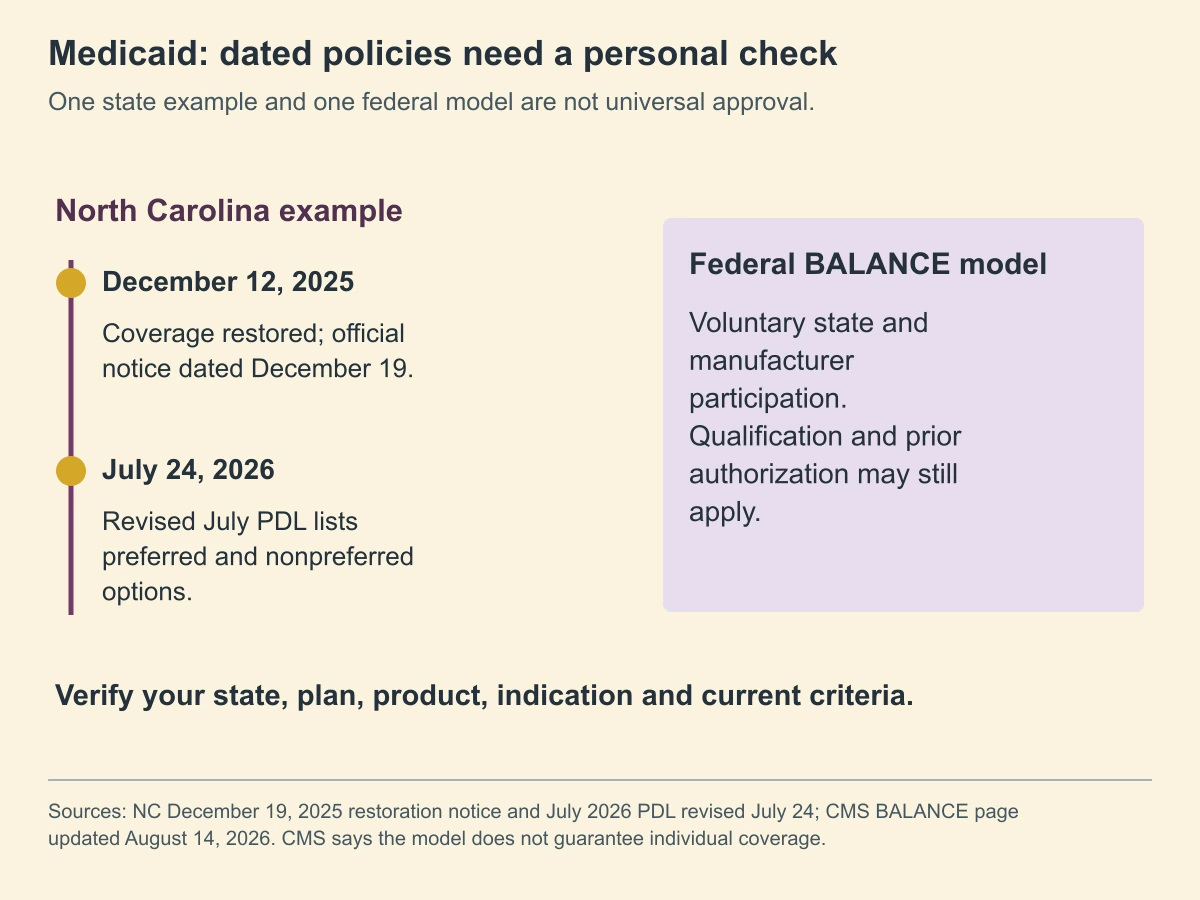
An official North Carolina notice dated December 19, 2025 states that GLP-1 coverage for obesity was reinstated effective December 12, 2025. It applies to NC Medicaid Direct and NC Medicaid Managed Care and discusses restored criteria, preferred status and prior-authorization submissions. North Carolina reinstatement notice.
The reviewed July 2026 preferred drug list, revised July 24, lists Wegovy pen/tablet as preferred in the GLP-1 weight-management class, with Zepbound pen/vial and Saxenda in the nonpreferred column. The list and clinical requirements must be read together. Dated North Carolina preferred drug list.
This is a North Carolina example, not a statement about every state. It also shows why an older article or notice cannot settle the current answer. The official PDL index should be checked for later revisions, and a member should confirm applicable plan requirements.
What is the federal BALANCE model?
CMS describes BALANCE as a voluntary model intended to expand access to selected GLP-1 medicines and lifestyle support through negotiated pricing and coverage terms. Participation by manufacturers and state Medicaid agencies matters. The official page states that the model does not guarantee coverage for an individual. CMS BALANCE information, updated August 14, 2026.
The page describes states joining the Medicaid model beginning in May 2026 through January 1, 2027. That timeline should not be read as proof that every state is participating or that every member already has access. Ask your state or plan whether the model affects your current benefit and what qualifications apply.
A new program announcement can be encouraging, but a member still needs a product-specific, indication-specific answer. Avoid making a treatment purchase based only on a national headline about broader access.

Medicaid and Medicare information should be kept separate
The same CMS page discusses the Medicare GLP-1 Bridge, a separate program for eligible Medicare Part D beneficiaries, extended through December 31, 2027. That program’s dates and access rules should not be copied into a general Medicaid coverage answer. CMS explanation of the separate programs.
If you have both Medicare and Medicaid, ask which benefit handles the prescription and how the programs interact for your circumstances. Do not assume that an offer or approval under one program automatically applies under the other.
Use the name on your actual prescription-benefit documents when contacting the plan. A general search result that mentions both programs can otherwise lead you to the wrong process.
What records can prior authorization require?
The exact requirements come from the applicable policy. Depending on that policy, the clinical team may need diagnosis information, baseline measurements, previous treatment details or other records. Ask which information is necessary rather than collecting an unrelated bundle of tests.
Your prescriber’s office can identify the clinical facts and submit them through the appropriate channel. You can help by supplying the correct plan details and existing records. Do not create a diagnosis or guess historical measurements because a criterion appears difficult to meet.
Ask how the office tracks the request and whether the plan needs more information. A pharmacy rejection may indicate an incomplete authorization, a claim-processing issue or another reason. Find out which problem occurred before assuming the medicine is never covered.
What if the prescription is denied?
Obtain the written reason. A benefit exclusion, a nonpreferred product requirement, missing documentation and a renewal issue are different problems. Ask the plan which process applies to the stated reason and what deadlines or information appear in the notice.
Discuss clinically suitable alternatives with the prescriber when appropriate. If the requested medicine is unsuitable or unavailable, the answer should still be based on your health needs. An appeal or alternative-treatment discussion is not a reason to change medicine on your own.
Keep a short record of the decision, next step and responsible office. If treatment is interrupted, ask the clinician how to manage the interruption and any restart. Do not use an old dosing plan after a gap without review.
How much would you pay?
Coverage and member cost are separate questions. Ask the plan and pharmacy what charge applies to the actual prescription after the applicable benefit and authorization are processed. This article does not assign a nationwide Medicaid GLP-1 copayment.
A public cash price, discount advertisement or another member’s receipt does not verify your charge. Savings offers also have their own eligibility rules and should not be assumed to apply to government coverage. Check the exact offer rather than subtracting a headline discount from an insurance estimate.
The Ozempic cost, Wegovy cost and Zepbound cost guides separate those financial questions. Use them to prepare questions, then obtain a real quote for your prescription.
Does a compounded prescription follow the same rules?
Compounded semaglutide or tirzepatide is a separate product category. FDA explains that compounded GLP-1 medicines are not FDA approved and do not undergo the same premarket review as approved products. A branded drug’s listing, trial or authorization should not be treated as proof of a compounded product’s coverage or equivalence. FDA compounded GLP-1 information.
CoreAge Rx’s semaglutide and tirzepatide service pages describe assessment-based compounded options for eligible adults. Review their actual clinical scope, medication source, total price and payment arrangements directly. Those pages do not verify a Medicaid reimbursement benefit.

Questions for your plan and care team
- Which state program and pharmacy benefit apply to this prescription?
- Is this exact product and formulation covered for my actual indication?
- Which dated list and clinical criteria should the prescriber use?
- Is another medicine preferred, and what exceptions are available under the policy?
- What information is missing from my request, if any?
- What is the actual authorization status and period?
- What will the pharmacy charge be after processing?
- What renewal, denial-review or interruption process applies?
Common questions
Does a preferred listing mean automatic approval?
No. It identifies a product’s status within that list; clinical criteria and claim requirements may still apply. Confirm the member-specific result.
Does one state’s coverage apply everywhere?
No. Use your own state and plan documents. A dated state example helps explain the process, not determine another program’s benefit.
Can an online clinic guarantee Medicaid payment?
A service can explain what it provides, but a public promise does not replace your plan’s authorization and pharmacy processing. Separate prescribing, service charges and insurance payment before committing.
The most useful answer is a current, documented response about your plan, product and indication. That approach avoids treating a national announcement, an old state notice or another person’s approval as proof of your own coverage.
Educational information for adults; individual treatment decisions require a qualified clinician. Sources reviewed September 30, 2026. Original AI-generated article images depict fictional people and objects, not patient outcomes. Other editorial images are illustrative. Graphics summarize the cited sources.