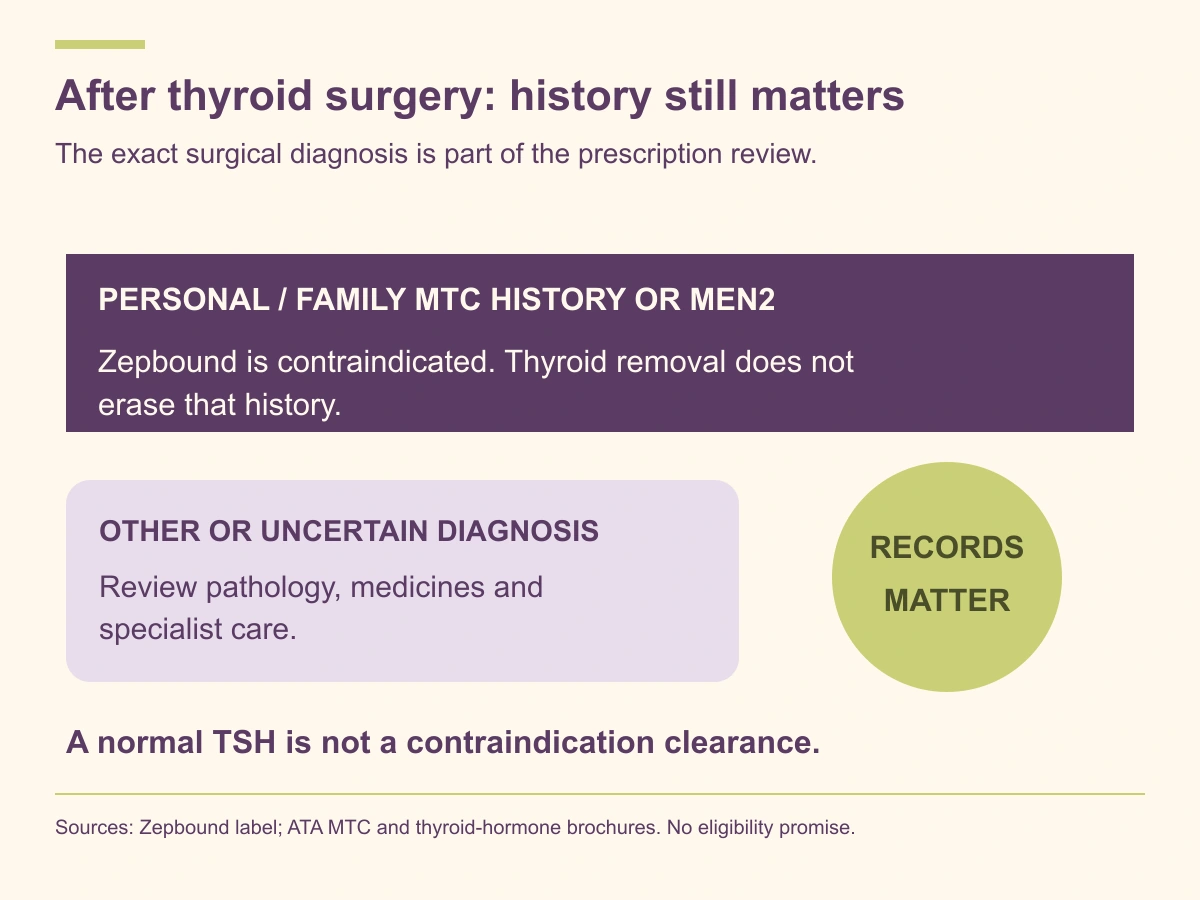
Having the thyroid removed does not automatically make Zepbound appropriate. The Zepbound label contraindicates use in people with a personal or family history of medullary thyroid carcinoma, or MTC, and in people with multiple endocrine neoplasia type 2, or MEN2. A thyroidectomy does not erase that history. The reason for surgery and the exact diagnosis need to be reviewed before a prescription decision. Zepbound prescribing information
If surgery was for another reason, the prescriber still needs to assess the complete health history, current thyroid treatment, other medicines, and the indication for Zepbound. “My thyroid is gone” is useful information, but it is not a complete eligibility assessment.
Why the reason for thyroid surgery matters
If you are comparing medicines, our guide to Ozempic after thyroid removal explains semaglutide-specific thyroid-history and replacement-hormone questions.
Thyroidectomy means removal of all or part of the thyroid gland. A record saying only “thyroid surgery” may not identify the diagnosis, extent of surgery, or follow-up needs. Ask for the operative report and pathology result if you do not know the details.
Medullary thyroid cancer is different from papillary and follicular thyroid cancers. The American Thyroid Association explains that MTC arises from the thyroid’s parafollicular C cells, whereas the other types discussed in its brochure arise from follicular cells. These distinctions are important when reading a drug warning that specifically names MTC. American Thyroid Association MTC information
Do not replace the exact diagnosis with “thyroid cancer” or “not thyroid cancer” when the report is available. If it names a type you do not understand, ask the endocrinologist or treating specialist to explain its relevance to the prescription review.
What does the Zepbound thyroid warning say?
Zepbound’s boxed warning describes thyroid C-cell tumors in rats and says it is unknown whether tirzepatide causes these tumors, including MTC, in humans. The human relevance of the animal findings has not been determined. Zepbound boxed warning and section 5.1
The label then sets a clear restriction: Zepbound is contraindicated with a personal or family history of MTC or MEN2. “Contraindicated” means the labeling says the medicine should not be used in that circumstance. This is more specific than a general statement that every thyroid condition carries the same restriction.
At the same time, the specificity does not provide automatic clearance for someone with a different thyroid diagnosis. Other health conditions, medicines, treatment goals, and risks still need review. Absence of one named contraindication is not a complete finding that treatment is suitable.
For ingredient and brand context, see Mounjaro versus Zepbound. Both contain tirzepatide, and a different brand name does not resolve a relevant tirzepatide contraindication.
Does total thyroid removal remove the MTC restriction?
No. The label uses personal or family history, rather than saying the restriction applies only while a thyroid gland is present. A past MTC diagnosis remains part of the medical history after surgery. Likewise, surgery does not remove a family history or a MEN2 diagnosis. Zepbound contraindications
The American Thyroid Association explains that follow-up remains essential after MTC treatment because cancer can recur, sometimes years later. Its brochure describes ongoing assessment and tumor-marker monitoring in the appropriate MTC follow-up setting. ATA MTC follow-up information
Do not interpret an undetectable marker, a successful surgery, or a reassuring scan as permission to override the drug label. Those results belong to the cancer-care plan. Discuss any conflicting prescription advice with the endocrinologist or specialist before using the medicine.
What if surgery was for a benign condition or a different cancer type?
Bring the exact diagnosis and current follow-up plan. The reviewed Zepbound restriction specifically names MTC, family history of MTC, and MEN2. It does not say that every person who has undergone thyroidectomy is automatically excluded. It also does not say that every other surgical history is automatically approved. Zepbound contraindications
A prescriber may need to coordinate with the treating thyroid specialist, especially when the diagnosis is unclear, cancer surveillance is ongoing, or thyroid-hormone treatment is being adjusted. Ask what information is required before the decision can be made.
| History or uncertainty | What to clarify | What should not be assumed |
|---|---|---|
| Personal history of MTC | Confirm diagnosis and discuss the labeled contraindication | Surgery erased the restriction |
| Family history of MTC or MEN2 | Give the exact family or genetic history | A normal current thyroid test removes the restriction |
| Papillary or follicular cancer history | Pathology, specialist follow-up, current treatment | All thyroid cancers have identical implications |
| Benign thyroid surgery | Reason, extent, replacement treatment, other conditions | Thyroidectomy alone establishes eligibility |
| Uncertain diagnosis | Obtain records or specialist clarification | An informal description is enough |
This table supports a records review. It is not a prescribing algorithm or a substitute for specialist advice.

Thyroid-hormone replacement is a separate part of care
People whose thyroid cannot provide sufficient hormone may need replacement treatment. The American Thyroid Association describes levothyroxine as replacement for missing thyroid hormone and emphasizes monitoring to keep levels at the appropriate goal. ATA thyroid-hormone treatment information
The replacement dose can require periodic review. The ATA lists factors such as weight, age, other conditions, medicines, and consistency of administration as relevant. Do not change a thyroid-hormone dose because you start Zepbound or because weight changes on the scale.
Cancer care may involve a different thyroid-hormone goal from routine replacement. Ask the treating specialist which goal applies to you and who is responsible for monitoring it. An ordinary normal-range TSH discussion cannot replace an individualized cancer follow-up plan.
The CoreAge Rx thyroid-replacement information page introduces care questions. It does not replace oncology or endocrinology follow-up, diagnose a surgical history, or establish that a specific replacement product is appropriate.
Could Zepbound affect oral thyroid medicine?
Zepbound delays gastric emptying, and its label advises caution with oral medicines because absorption may be affected. It recommends monitoring medicines whose effect depends on threshold concentrations or those with a narrow therapeutic index. Zepbound oral-medicine interaction section
That passage does not establish that every levothyroxine dose will need to change or provide a universal Zepbound-and-levothyroxine timing gap. Ask the pharmacist and thyroid clinician whether your regimen needs additional review or monitoring.
The ATA emphasizes taking thyroid hormone consistently and discussing timing when other medicines are used. It identifies calcium, iron, some antacids, and other products as potential absorption concerns. Give the team the actual names and timing of those products. ATA administration and medication information
Do not stop replacement therapy to avoid a hypothetical interaction. Ask for written instructions if the team changes anything. Report refill-related brand or manufacturer changes and any difficulty keeping oral medicine down.
Which neck symptoms should be reported?
Zepbound’s labeling lists symptoms of thyroid tumors such as a mass in the neck, difficulty swallowing, difficulty breathing, and persistent hoarseness. Report these symptoms for assessment. A person who has had surgery should not assume that every new neck symptom is harmless scar-related discomfort. Zepbound thyroid warning
Severe breathing or swallowing difficulty needs urgent medical attention. Do not wait for a routine prescription visit or a scheduled surveillance appointment if symptoms are acute or worsening.
The label says routine calcitonin monitoring or thyroid ultrasound is of uncertain value for early MTC detection in people treated with Zepbound. That statement is different from a specialist’s surveillance plan after a known cancer diagnosis. Continue the follow-up your treating specialist prescribed rather than using a general medication passage to cancel it. Zepbound monitoring statement, ATA MTC follow-up
Weight results cannot settle thyroid eligibility
An appealing weight-loss average does not remove a contraindication or establish that a particular treatment fits your history. Read Mounjaro weight-loss results for the distinction between diabetes trials and Zepbound obesity trials, and weight-loss percentage for the limits of a scale calculation.
For someone already receiving an appropriate prescription, follow-up should include tolerability and other health measures as well as weight. The Zepbound side-effects guide and long-term side-effect questions provide broader topics for that discussion.
If Zepbound is unsuitable, ask the clinician which alternatives should be evaluated for your circumstances. Do not substitute another GLP-1 medicine without reviewing its own label and your complete history. A contraindication review is not solved by shopping between product pages.

Prepare a thyroid-history review
Bring the pathology report, surgery date, whether removal was partial or total, family history, any MEN2 or genetic-testing information, replacement prescription, recent relevant results, and the specialist follow-up plan.
Ask these questions:
- What was the exact diagnosis leading to surgery?
- Does my personal or family history meet a labeled contraindication?
- Does my thyroid specialist need to review the treatment choice?
- What thyroid-hormone goal and monitoring plan apply to me?
- Do my oral medicines or supplements need a timing review?
- Which new symptoms should prompt an urgent call?
Make clear which practice will coordinate the plan. If the weight-management prescriber and thyroid specialist give different instructions, request reconciliation before changing medicines.
Frequently asked questions
Can I take Zepbound if I have no thyroid gland?
The answer depends on the diagnosis and complete history. Thyroid removal does not erase the contraindication for personal or family history of MTC or MEN2. Zepbound contraindications
Is hypothyroidism the same as medullary thyroid cancer?
No. They describe different conditions. Give the prescriber the actual diagnosis, surgery history, and treatment rather than substituting one term for another.
Does a normal TSH prove I do not have MTC risk?
No. The ATA notes that thyroid function tests such as TSH are usually normal even when MTC is present. TSH does not replace the history and diagnosis needed for a contraindication review. ATA MTC information
Where can I learn about tirzepatide care?
The CoreAge Rx tirzepatide information page introduces treatment questions. It does not clear a thyroid-history contraindication or promise a prescription.
Educational information for adults; individual treatment decisions require a qualified clinician. Sources reviewed October 4, 2026. Original AI-generated article images depict fictional people and objects, not patient outcomes. Other editorial images are illustrative. Graphics summarize the cited sources.