Heartburn and reflux can occur during Ozempic treatment. The prescribing information reports gastroesophageal reflux disease among gastrointestinal adverse reactions in the reviewed trial pool. If symptoms persist, become severe, or occur with warning signs, contact a clinician instead of assuming every episode is an ordinary medication effect. Ozempic prescribing information, NIDDK reflux symptoms
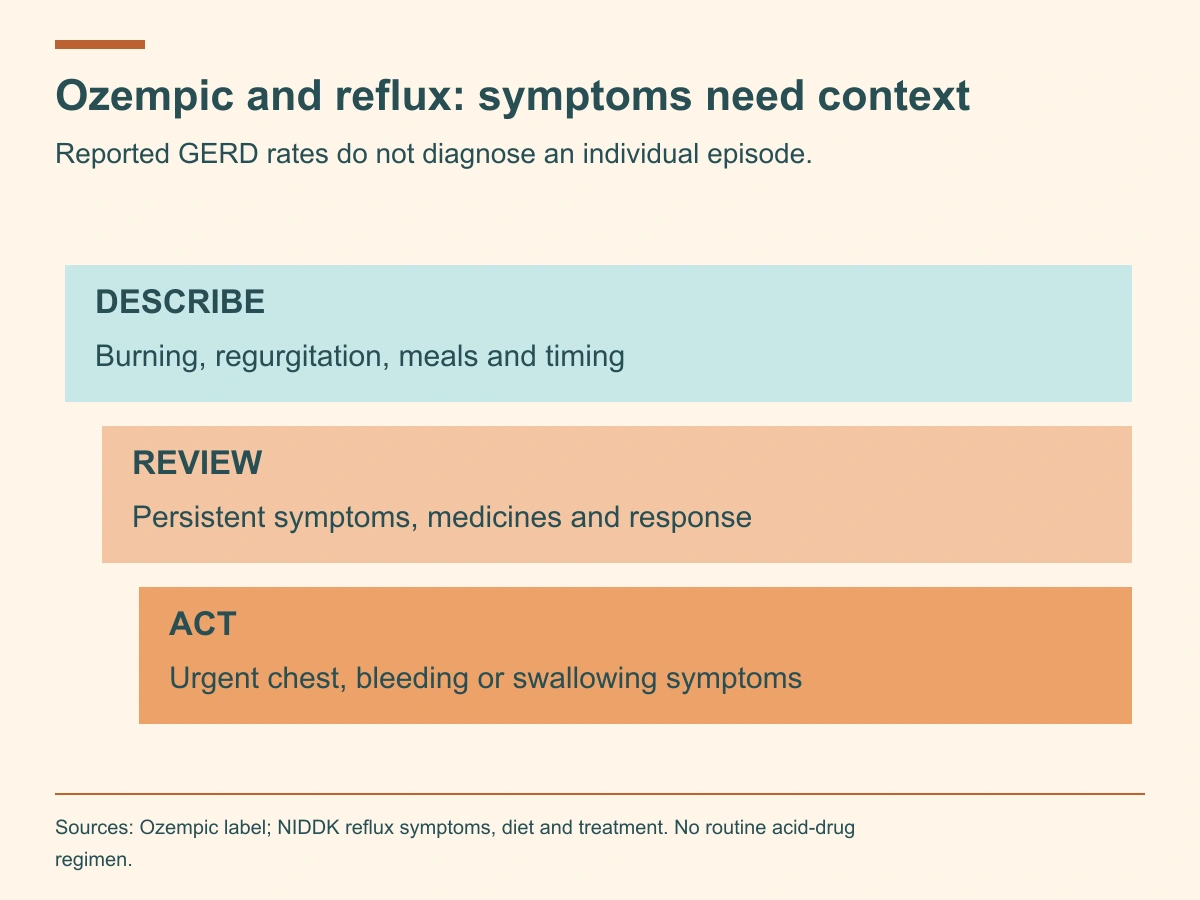
The useful next step is to describe the symptom, timing, meals, other medicines, and any recent treatment change. A drug label can identify a reported reaction; it cannot diagnose the cause of an individual episode of chest or abdominal discomfort.
What are heartburn, reflux, and GERD?
For soreness, voice changes or other throat symptoms, our Ozempic sore-throat guide separates infection and reflux questions from symptoms that require urgent assessment.
Gastroesophageal reflux, or GER, means stomach contents move back into the esophagus. Gastroesophageal reflux disease, or GERD, is a condition that requires clinical assessment and management. Heartburn commonly feels like burning behind the breastbone that may rise toward the throat. Regurgitation means stomach contents return toward the throat or mouth. NIDDK GER and GERD symptoms and causes
Some people with GERD do not have typical heartburn. Symptoms can include nausea, swallowing problems, chest pain, cough, or hoarseness. These descriptions overlap with other conditions, so it is important to explain exactly what you mean by “reflux.”
Write whether the sensation is burning, pressure, pain, sour-tasting regurgitation, fullness, or something else. Note whether it occurs after meals, while lying down, during activity, or at another time. Do not use “heartburn” as a catch-all label for new chest pain.
What does Ozempic’s label report?
In the Ozempic adverse-reaction section reviewed here, GERD was reported at 0% with placebo, 1.9% with Ozempic 0.5 mg, and 1.5% with Ozempic 1 mg in the pooled placebo-controlled adult type 2 diabetes trials described there. It appears in the additional gastrointestinal-reaction paragraph, rather than the main table of reactions reported by at least 5% of treated participants. Ozempic section 6.1
These are trial-pool frequencies for the specified doses and context. They are not a personalized probability, a comparison of all semaglutide products, or evidence that a higher dose must produce more reflux. The label cautions that adverse-reaction rates from different trials cannot simply be compared.
For broader symptoms, see Ozempic side effects. The Wegovy heartburn and reflux guide addresses related questions for another product; its dosing instructions and evidence should not be substituted for Ozempic’s.
Does delayed stomach emptying explain every episode?
If gastritis has been diagnosed or raised as a possibility, our Ozempic and gastritis guide distinguishes stomach-lining inflammation from reflux, delayed emptying, and overlapping symptoms.
Ozempic delays gastric emptying. That is a labeled effect and also the reason for caution with oral medicines. It does not establish the cause of every episode of reflux or prove a particular change in the lower esophageal sphincter in each patient. Ozempic oral-medicine interaction section
NIDDK explains that GERD can involve weakness or inappropriate relaxation of the lower esophageal sphincter, and lists factors such as obesity, pregnancy, smoking, some medicines, and hiatal hernia. Those general causes should not be rewritten as proof that Ozempic directly caused a specific sphincter change. NIDDK reflux causes
A recent dose change can be useful chronology. It is still only part of the history. Report symptoms that existed before treatment, other medicines, illness, and changes in meals or sleep position. Avoid assuming that the latest prescription explains everything.
What meal and timing questions are worth discussing?
NIDDK says that, for people with GERD symptoms at night or while lying down, eating at least three hours before lying down or going to bed may improve symptoms. It also lists foods and drinks commonly linked to symptoms, including acidic foods, alcohol, chocolate, coffee or other caffeine sources, high-fat foods, mint, and spicy foods. NIDDK eating and nutrition for GERD
That is not a requirement to remove every item from every person’s diet. Look for a repeatable pattern and discuss it with the clinician. A blanket restriction list can unnecessarily complicate eating, especially if appetite or intake is already reduced.
Record what happened after a meal without assuming the food was the sole cause. Include portion, timing, lying down, symptoms, and any medicine taken. If you cannot eat enough because of nausea or fear of reflux, raise that directly at follow-up.
For related ingredient questions, see peppermint tea versus green tea. A drink promoted for wellness may still be relevant to an individual symptom pattern; a marketing claim does not establish that it will relieve reflux.

Should you change the injection time?
Ozempic’s injection instructions allow once-weekly administration on the same day each week, at any time of day, with or without meals. They do not provide a universal morning-versus-evening reflux solution. Ozempic administration instructions
If symptoms seem to follow a pattern around the injection, describe the pattern and ask whether any change is appropriate. Do not inject extra medicine, escalate early, or use another product to test a theory.
The Ozempic dosage guide explains routine schedule questions. It should not be used as a substitute for assessing persistent heartburn, vomiting, or swallowing symptoms. If treatment is interrupted, ask for a specific restart plan.
What about antacids, H2 blockers, or PPIs?
NIDDK describes several reflux-medicine categories. Antacids may help mild symptoms; H2 blockers and proton pump inhibitors, or PPIs, reduce stomach acid. Choosing a product and duration depends on the symptoms and clinical situation. NIDDK advises discussing daily antacid use or use for severe symptoms with a clinician. NIDDK GERD treatment information
Do not treat the availability of an over-the-counter medicine as proof that it is appropriate for indefinite use. Ask the pharmacist about your full regimen, kidney history, other conditions, and the actual product label. Persistent symptoms despite self-care or over-the-counter treatment need review.
| Question | Why it matters | What to tell the clinician or pharmacist |
|---|---|---|
| Is this typical reflux? | Chest, abdominal, and swallowing symptoms have other causes | Exact sensation, location, onset, warning symptoms |
| Is a nonprescription medicine suitable? | Choice depends on the full health history | Other medicines, kidney history, prior reactions |
| How long should I use it? | Persistent symptoms need reassessment | Frequency, response, symptoms returning after use |
| Could another medicine contribute? | Ozempic is only part of the regimen | Prescription, nonprescription, and supplement list |
| Should Ozempic care change? | Tolerability and treatment goals need review | Dose history, intake, vomiting, symptom timing |
A symptom that improves after an antacid still does not prove every future episode has the same cause. Keep the clinician informed if the pattern changes.
Review other medicines and conditions
NIDDK lists some medicines that can cause or worsen GERD symptoms, including NSAIDs, certain asthma medicines, calcium channel blockers, benzodiazepines, and tricyclic antidepressants. Give the team the exact names rather than assuming all antidepressants or all blood-pressure medicines have the same effect. NIDDK medicine-related reflux information
If an antibiotic or antidepressant was recently added, disclose it. See antibiotics with Ozempic and Ozempic with Lexapro or Zoloft for why the complete medicine list matters. Those articles do not replace an individual interaction check.
Tell the team if you have previously diagnosed GERD, swallowing difficulties, a history of digestive bleeding, or symptoms before Ozempic began. Also report a planned procedure involving anesthesia or sedation so the procedural team can review the actual medication instructions.
Which symptoms should not be managed as ordinary heartburn?
New or severe chest pain, especially with breathing difficulty, fainting, sweating, or pressure, needs urgent medical assessment. Do not delay emergency care while testing whether a reflux medicine helps.
NIDDK advises medical review for persistent vomiting, trouble or pain with swallowing, digestive bleeding, unexplained weight loss, and other concerning symptoms. Blood in vomit, vomit resembling coffee grounds, or black tarry stool should not be dismissed as a routine side effect. NIDDK warning symptoms
Ozempic separately warns about persistent severe abdominal pain, sometimes radiating to the back, with or without vomiting; severe gastrointestinal problems; and dehydration-related kidney injury. Report these symptoms promptly. Serious allergic symptoms also need immediate help. Ozempic warnings
If the scale falls while you cannot eat or drink, do not count that as uncomplicated progress. The weight-loss percentage guide explains why arithmetic cannot establish the safety or composition of a weight change.

Prepare a useful reflux record
For several representative episodes, record the date and time, symptom description, meal context, whether you lay down, medicines taken, and what changed afterward. Add the Ozempic dose and any recent prescription change.
Keep the record practical. The purpose is to help identify a pattern and decide whether examination, testing, medicine review, or an eating-plan change is appropriate. It is not to diagnose yourself from a single meal.
Ask who should receive the record if the Ozempic prescriber and primary-care clinician are different people. Request a clear plan for what to continue, what to change, when to reassess, and which symptoms should trigger earlier contact.
Frequently asked questions
Is heartburn a reported Ozempic side effect?
GERD is reported in the reviewed adverse-reaction section. The specified trial rates above provide context, but they do not diagnose an individual episode. Ozempic adverse reactions
Should I avoid every possible reflux-trigger food?
No universal restriction fits everyone. NIDDK recommends discussing foods or drinks that seem to worsen your symptoms and whether reducing them helps. NIDDK GERD eating guidance
Can I take an acid-reducing medicine indefinitely?
Ask the clinician or pharmacist about the actual product, indication, duration, and follow-up. Symptoms that persist despite over-the-counter treatment deserve assessment. NIDDK GERD treatment
Where can I learn about semaglutide care?
The CoreAge Rx semaglutide information page introduces treatment questions. It does not diagnose reflux, prescribe an acid-reducing regimen, or establish equivalence to Ozempic.
Educational information for adults; individual treatment decisions require a qualified clinician. Sources reviewed October 4, 2026. Original AI-generated article images depict fictional people and objects, not patient outcomes. Other editorial images are illustrative. Graphics summarize the cited sources.