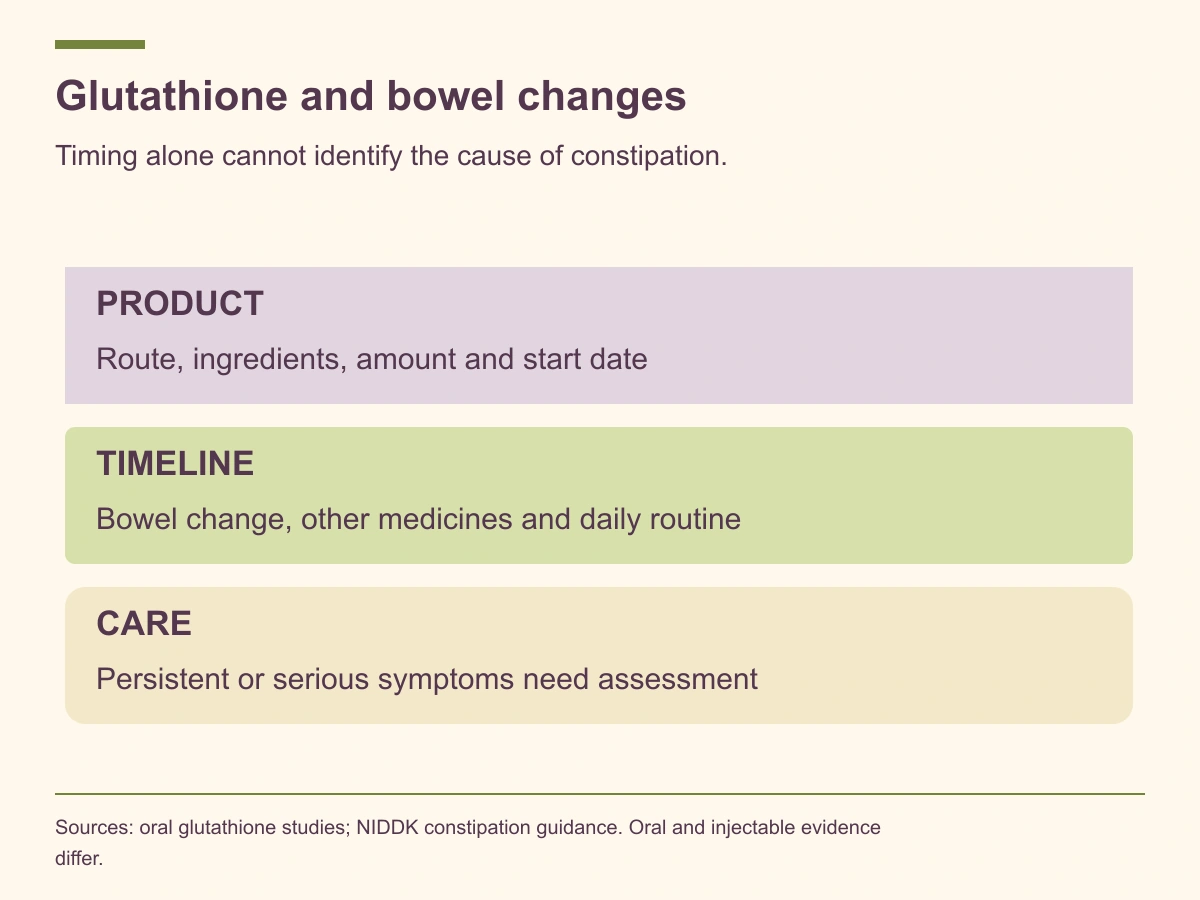
Constipation that starts after a new glutathione product deserves attention, but timing alone does not show that glutathione caused it. The available human studies do not establish a reliable constipation rate for every oral supplement, and evidence about oral products cannot clear an injectable product. The most useful next step is to identify exactly what you used, describe the bowel change, and review other medicines and recent changes with your care team.
People often search this question after adding several wellness products at once. A supplement, a prescription, a smaller appetite, and a different eating routine can all appear on the same timeline. That makes a careful review more useful than choosing a culprit from the newest bottle.
The short answer: possible symptoms need a product-specific review
The oral glutathione studies reviewed here are limited. A small liposomal study followed 12 healthy adults for one month and reported no serious treatment-attributed adverse effects. A separate randomized study evaluated a combination containing glutathione and other ingredients for skin-lightening outcomes. Neither establishes that constipation cannot occur, nor supplies a dependable percentage for all glutathione users. Liposomal glutathione pilot study, combination-product randomized trial.
A person can have a genuine bowel problem even when a study does not report that particular symptom. Equally, a symptom appearing after a supplement does not establish a glutathione-specific mechanism. Product ingredients, route, health history, and concurrent treatment all matter.
If you also take a GLP-1 medicine, our guide to constipation on GLP-1 medications explains why that prescription belongs in the review. Do not assume that a new supplement explains symptoms from the rest of the regimen.
What counts as constipation?
Constipation is more than missing your usual daily bowel movement. Hard or difficult-to-pass stool, straining, incomplete emptying, and less frequent movements can all be relevant. Your usual pattern helps interpret the change. NIDDK constipation symptoms and causes.
For example, someone who normally passes a comfortable stool every other day may have a different baseline from someone who normally goes twice a day. A new painful stool or several days of increasing discomfort is meaningful even when a frequency cutoff alone is not crossed.
Describe what changed in ordinary language. “I went less often” is useful; “I have had hard stool and pain for three days, beginning after this product change” is more useful. Include whether you can pass gas, whether eating or drinking has become difficult, and whether there is bleeding. Those details help determine urgency.
Oral, liposomal, topical, and injectable products are different questions
The word glutathione does not identify a complete product. A capsule, a liposomal liquid, a skin preparation, and an intravenous infusion differ in ingredients, route, preparation, and the evidence needed to assess them.
| What you used | What to bring to the review | What should not be assumed |
|---|---|---|
| Oral capsule or tablet | Full label, ingredients, amount used, and start date | Another brand’s study applies to your product |
| Liposomal oral liquid | Label, serving tool, amount actually measured, and storage instructions | “Liposomal” proves fewer digestive symptoms |
| Combination supplement | Every active and added ingredient | A symptom is attributable to glutathione alone |
| Injection or infusion | Pharmacy, route, lot, treatment date, and all added ingredients | Oral supplement evidence establishes injectable safety |
Keep the bottle or a clear label photo. If a clinic administered an infusion, ask for the product and treatment record. A receipt that only says “wellness drip” leaves important questions unanswered.
For comparison, our NAD+ fatigue and energy guide also explains why a wellness goal does not replace product identification and an evaluation of symptoms. Different substances should still be assessed separately.
What the studies can tell us—and what they cannot
The liposomal pilot was small, short, and conducted in healthy adults. Its main focus was biological measurements, rather than establishing the frequency of uncommon digestive reactions in a broad patient population. A reassuring finding in that setting is useful context, but it is not a guarantee for someone with chronic constipation or several prescriptions.
The combination trial involved glutathione alongside vitamin C, alpha-lipoic acid, and zinc. Mild symptoms occurred in both study groups. Because it examined a specific mixture and a particular population, it cannot isolate every possible effect of glutathione in every formulation.
These limits matter when an online article presents a precise constipation percentage, a “safe” threshold, or a claim that glutathione routinely changes gut movement. The sources reviewed here do not support a universal constipation rate or a dose at which everyone should expect the problem.
A useful evidence question is: “Was this result measured in people using the same product, by the same route, for a similar period?” If not, the result may be background information rather than an answer for your bottle.
Review the rest of the constipation timeline
NIDDK describes multiple contributors to constipation, including some medicines and supplements, changes in eating or daily routine, inadequate fluid intake, and health conditions. Iron supplements and some pain medicines are examples worth naming rather than leaving off the list. NIDDK constipation guidance.
Make one timeline that includes:
- When glutathione started, stopped, or changed.
- When bowel symptoms began and whether they are worsening.
- Other new medicines, supplements, or dose changes.
- A change in meal size, food variety, travel, activity, or usual toilet routine.
- Previous constipation episodes and any treatments already tried.
This is a way to organize a clinical conversation, not a home test proving causation. Changing several things at once can also make the next episode harder to interpret.
If reduced appetite has changed your meals, our balanced-meal guide offers ways to think about food variety. Our water and drinks guide discusses hydration questions without prescribing one fluid target for every person. Mention any clinician-set fluid restriction before adopting advice online.

Injectable glutathione has a separate quality concern
In an August 27, 2026 communication, FDA described adverse events after compounded intravenous glutathione made with dietary supplement grade material. The agency identified a specific ingredient lot and explained that supplement grade material is inappropriate for injectable preparation. The reported problems included systemic illness associated with endotoxin exposure. FDA’s injectable glutathione reminder.
That communication is a product-quality warning; it does not establish a constipation rate for oral glutathione. It also does not mean that every glutathione bottle or infusion belongs to the identified lot. A patient who received an injection should ask the clinic or compounder to verify the actual source and lot.
Fever, chills, faintness, or feeling seriously unwell after an infusion should not be managed as an ordinary supplement-related bowel issue. Seek prompt medical assessment and tell the clinician about the infusion. Bring the administration date and product information if available.
Should you stop or change the supplement?
Ask the clinician or pharmacist who knows your situation whether to pause a nonessential supplement and how to assess the bowel symptoms. If the product was prescribed or administered by a clinic, contact that team with the exact product details. Do not substitute an injectable route because an oral product seems to upset your digestion.
Avoid increasing the amount, adding a second glutathione product, or trying a “detox” protocol to solve an unexplained reaction. A label change or a different preparation is still a new exposure, and the question of why you became constipated remains.
If you already stopped using the product, report the stop date and what happened afterward. Improvement is useful information, but it does not by itself establish the responsible ingredient. Do not deliberately restart a product to provoke another reaction without clinical advice.
Should you add a laxative or a bowel supplement?
The right bowel-care plan depends on symptoms, other treatment, and the cause. Adding several products can obscure the review, particularly if one contains a stimulant laxative or overlaps with something you already use.
Our Smooth Move tea guide distinguishes senna-related bowel effects from weight-loss claims. The CoreAge Rx Smooth Move product page can help identify that particular offering; it is not a diagnosis or a recommendation to use it for a suspected glutathione reaction. Review ingredients and suitability with your clinician.
Tell the care team about everything you have already tried, including teas, powders, stool softeners, and supplements. Include the amount and timing when you know them. “Natural” and “over the counter” do not make a product irrelevant to the medication list.
When should constipation prompt urgent care?
Constipation with persistent abdominal pain, vomiting, inability to pass gas, blood in the stool, or other concerning illness needs timely assessment. NIDDK also advises medical review when symptoms persist despite self-care or occur with unexplained weight loss. When to seek care for constipation.
Do not wait for a supplement to “clear” if symptoms are severe or worsening. A product timeline can help a clinician, but it does not rule out an obstruction, bleeding, or another condition. If you cannot drink normally or feel faint, describe that as well.
A simple portal message is useful for a nonurgent review. An example: “I started this oral product on Monday. Since Thursday I have had hard stool and discomfort. I also take these medicines. I can pass gas and drink normally. What should I do about the supplement and bowel care?” Urgent symptoms should go through urgent medical channels instead.

Questions people commonly ask
Is constipation a sign that glutathione is detoxifying the body?
The reviewed evidence does not establish constipation as a beneficial detoxification response. Treat it as a symptom to understand. Labeling discomfort as a positive effect can delay a useful medication or bowel review.
Does a liposomal formulation prevent constipation?
The small pilot does not establish that conclusion. Its findings cannot rank every liposomal product against every capsule, especially when brands and added ingredients differ.
Could my iron supplement be involved?
It belongs on the list: NIDDK identifies iron supplements among potential constipation contributors. Do not discontinue treatment for diagnosed iron deficiency without a plan. Ask how to address the side effect while treating the underlying condition.
Can I take glutathione with semaglutide or tirzepatide?
This constipation review does not clear either combination. Give the prescriber the full supplement label and identify your exact prescription. The compounded GLP-1 guide explains why formulation details matter alongside the ingredient name.
How long should I wait for bowel symptoms to improve?
There is no validated glutathione-specific timetable established here. Severity, persistence, other symptoms, and your usual pattern should guide the review. Ask the care team what to do now and when to contact them again.
Make the next conversation specific
Bring the exact product, the bowel timeline, and the complete medicine list. Ask whether the product should be paused, whether another contributor needs attention, and what follow-up is appropriate. That approach gives you a clearer path than assuming every new symptom is either harmless or caused by glutathione.
Educational information for adults; individual treatment decisions require a qualified clinician. Sources reviewed October 5, 2026. Original AI-generated article images depict fictional people and objects, not patient outcomes. Other editorial images are illustrative. Graphics summarize the cited sources.