
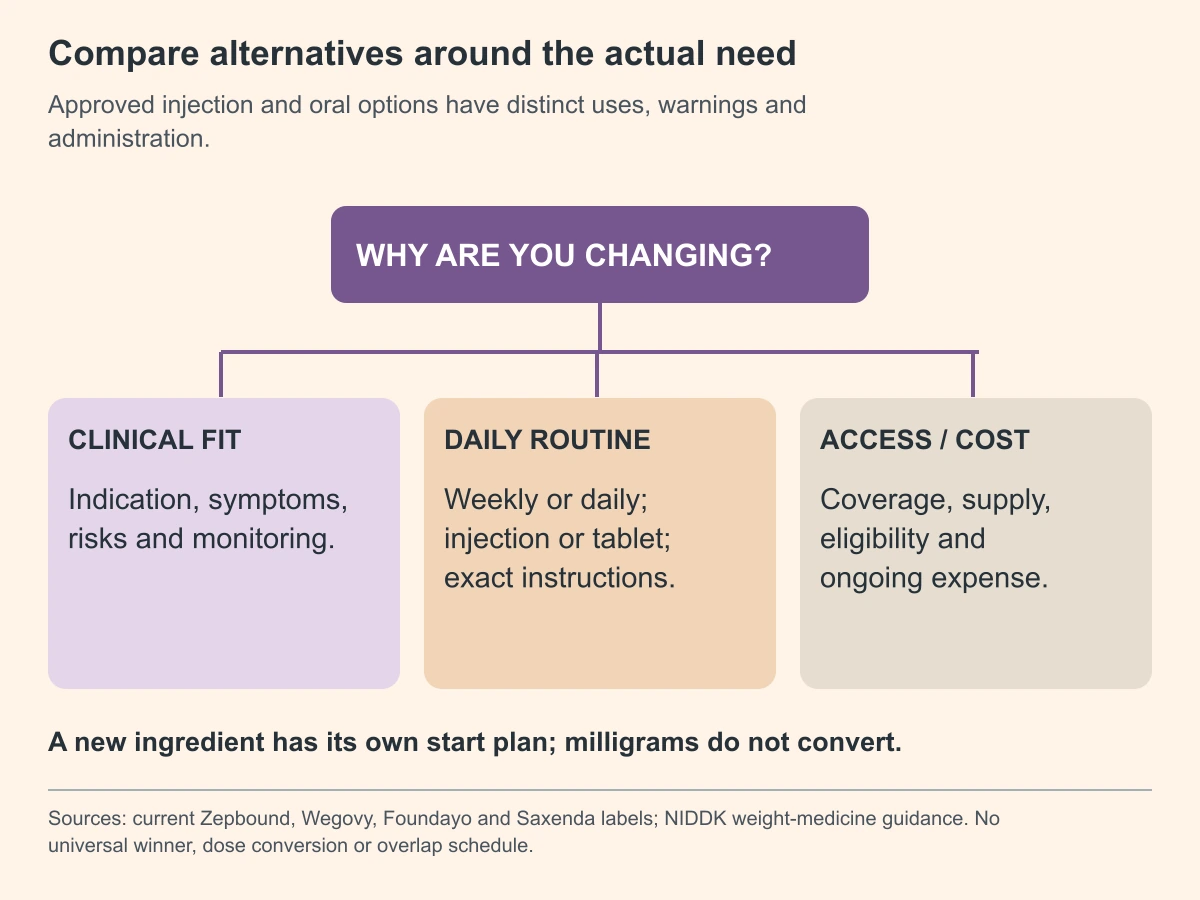
Alternatives to Zepbound include other approved weight-management medicines and different approaches to ongoing care. The best comparison starts with why you need a change: cost, side effects, an injection routine, access, response, or a medical condition. Another medicine is not automatically equivalent, and there is no simple milligram conversion from tirzepatide to semaglutide or an oral treatment.
Current options include injectable or oral Wegovy, oral Foundayo, daily injectable Saxenda, and selected medicines outside the GLP-1 category. This guide explains how their roles differ and which questions help a clinician choose a suitable plan.
Clarify what Zepbound is treating
The current Zepbound label, revised August 2026, identifies tirzepatide as a GIP and GLP-1 receptor agonist. Its indications include reducing excess body weight and maintaining weight reduction in specified adults, and treating moderate to severe obstructive sleep apnea in adults with obesity.
That second indication matters when comparing alternatives. Another medicine with weight-management approval does not automatically have the same sleep-apnea indication or replace the rest of an OSA care plan. Tell the clinician which conditions and outcomes are being addressed.
The label also states that combining Zepbound with another tirzepatide-containing product or a GLP-1 receptor agonist is not recommended. An alternative is not an invitation to layer two medicines together while deciding which one works better.
Our tirzepatide questions guide provides broader treatment context. If you are switching because of a reaction or serious symptom, obtain clinical advice before focusing on price or convenience.
A comparison of selected alternatives
The table describes roles and administration, rather than ranking expected results or prescribing a replacement dose. Each product has its own eligibility, warnings, escalation schedule, and monitoring.
| Option | Ingredient or category | Practical distinction to discuss |
|---|---|---|
| Wegovy injection | Semaglutide, GLP-1 receptor agonist | Weekly injection with its own presentations and indications |
| Wegovy tablets | Semaglutide, GLP-1 receptor agonist | Daily oral routine with fasting and administration requirements |
| Foundayo | Orforglipron, GLP-1 receptor agonist | Daily tablet taken with or without food; its own interaction review |
| Saxenda | Liraglutide, GLP-1 receptor agonist | Daily injection rather than a weekly tirzepatide routine |
| Qsymia | Phentermine/topiramate | Oral treatment outside the GLP-1 category, with distinct precautions |
| Contrave | Naltrexone/bupropion | Oral treatment with its own health-history and medication review |
| Orlistat products | Intestinal fat-absorption treatment | A different mechanism and food-related considerations |
The NIDDK weight-medicine guide describes approved weight-management options and the need to assess benefits, adverse effects, medical history, and cost. This is a selected comparison, not an exhaustive current drug list or a personal treatment recommendation.
Wegovy injection versus Zepbound
Wegovy contains semaglutide, which acts at the GLP-1 receptor. Tirzepatide acts at both GIP and GLP-1 receptors. Those ingredient and mechanism differences do not create an interchangeable dose scale.
The current Wegovy label lists product- and route-specific indications. Injection uses include weight management, cardiovascular risk reduction in specified adults, and a particular noncirrhotic MASH population. The MASH indication has accelerated-approval context that should remain part of the description.
A clinician can compare those uses with the actual conditions being treated. A preference for one product’s indication is different from a claim that it will produce better results for every person. The tirzepatide versus semaglutide results guide explains how to interpret comparisons without converting study averages into guarantees.
Review the exact device if a switch is proposed. Different Wegovy presentations have their own training requirements. Familiarity with one weekly injection does not eliminate the need to learn the new presentation correctly.
What oral GLP-1 options should be discussed?
Oral treatment can change the daily routine, but tablets are not all administered the same way. Wegovy tablets have specific morning, fasting, water, and waiting instructions in their label. The oral semaglutide comparison explains those practical differences.
Foundayo’s current prescribing information identifies orforglipron as an oral GLP-1 receptor agonist for weight management in specified adults. It is taken once daily with or without food. It is a different ingredient from semaglutide and tirzepatide.
The FDA’s Foundayo approval announcement supports its approved role; it is not a compounded oral tirzepatide product. Its label includes its own adverse reactions, contraindications, and medication interactions. In particular, a pharmacist should review the full medication list rather than assume that injection-related advice covers the tablet.
Ask whether a daily routine is practical for you and what happens after missed doses or a longer interruption. “No injection” is one consideration, while tolerability, food instructions, interactions, cost, and follow-up remain important.
Where does Saxenda fit?
The Saxenda label concerns liraglutide for weight management in its specified populations. It is a daily injection, so its routine differs from weekly Zepbound. Its indications and directions should not be replaced with those of another liraglutide brand.
Daily administration can be acceptable for some people and inconvenient for others. Ask about the device, supplies, storage, schedule, and plan for evaluating response. A treatment you can obtain and use consistently deserves practical consideration alongside efficacy evidence.
Our Saxenda versus Wegovy guide discusses that comparison. If gastrointestinal symptoms prompted the Zepbound question, make the symptom history part of the review; another GLP-1 medicine is not guaranteed to eliminate them.

What about medicines outside the GLP-1 category?
Qsymia, Contrave, and orlistat products represent different mechanisms and clinical considerations. They may be discussed when a GLP-1 option is unsuitable or inaccessible, but a lower advertised price does not establish suitability.
The Qsymia label, for example, has specific pregnancy-related precautions and a restricted pharmacy program, along with other contraindications and monitoring. This illustrates why an oral alternative needs its own assessment rather than being treated as a simpler version of tirzepatide.
Ask the clinician about your blood pressure, other medicines, relevant psychiatric or neurological history, pregnancy plans, and the expected benefit-risk balance. The questions vary by product. Do not start a leftover prescription or combine treatments on your own.
NIDDK also distinguishes medicines approved for long-term weight management from appetite medicines approved for shorter use. A drug name mentioned in a forum does not establish that its duration or indication fits your goals.
Is Mounjaro a direct replacement?
Mounjaro and Zepbound both contain tirzepatide, but Mounjaro’s current label addresses type 2 diabetes and specified cardiovascular risk reduction. The brands’ indications, authorization rules, devices, and coverage pathways can differ.
The same ingredient is therefore not a universal insurance workaround or permission to substitute without the prescriber. Describe the actual diagnosis and prescription when asking about access. An insurer’s coverage criteria should not be used to invent a diagnosis.
Our Mounjaro alternatives guide focuses on the diabetes and treatment-fit questions. Keep that purpose separate from selecting an alternative for Zepbound’s weight-management or OSA indication.
How should cost and access be compared?
Compare the same supply period and the full care cost: medication, consultations, required supplies, dispensing, shipping, and ongoing follow-up. An introductory price or a savings-card headline may have eligibility rules or change after the first fills.
Ask the plan about the exact product, indication, and presentation. A cheaper cash quote may not be the cheaper insurance route, and a covered formulary entry does not alone determine the processed claim. Our GLP-1 insurance guide helps organize those questions.
The Zepbound cost guide and tirzepatide versus semaglutide cost comparison provide further context. Confirm an actual pharmacy quote rather than relying on a national price as if it were guaranteed locally.
If access may be interrupted, contact the care team early. Do not stretch dose intervals, take partial doses, or use another person’s medicine to bridge the gap. Ask for a written transition and follow-up plan.
Are compounded products equivalent alternatives?
The FDA’s general compounding guidance states that compounded drugs are not FDA-approved and are not reviewed by the agency for safety, effectiveness, or quality before marketing. An ingredient name alone does not establish equivalence to an approved finished product.
The FDA’s GLP-1 compounding concerns also address problems involving unapproved products and dosing. Compare the actual preparation, concentration, pharmacy, directions, and legal availability rather than treating every vial advertised as semaglutide or tirzepatide as the same option.
CoreAge Rx’s semaglutide and tirzepatide treatment information provide separate assessment information. Ask which exact preparation is offered, what evidence applies, and how monitoring and total costs work. A service page does not establish a personal substitution plan.

What should a switching appointment cover?
Bring the reason for changing treatment, current product and dose, last administration date, symptoms, recent response, and other medicines. Include whether Zepbound is addressing weight, OSA, diabetes-related needs, or another concern in your care plan.
Ask how the old medicine will be stopped, how the new one will be initiated, and what to do if symptoms or access problems occur. Milligram amounts across ingredients do not provide a conversion formula. Product-specific escalation and restart instructions need to come from the clinician.
Review pregnancy planning and contraception where relevant, because some options have additional oral-contraception instructions after initiation or escalation. Ask about nutrition support, glucose monitoring when indicated, and the timing of follow-up.
Our balanced meals guide supports routine nutrition planning. A medicine change should fit an ongoing care plan rather than replace food, activity, and support with an expectation that the next brand will solve every difficulty.
Frequently asked questions
Is there a pill alternative to Zepbound?
Yes, approved oral weight-management options exist, including oral Wegovy and Foundayo, as well as selected non-GLP-1 medicines. They differ in ingredients, administration, warnings, and eligibility. They are not oral versions of tirzepatide.
Which alternative is strongest?
There is no universal winner for every person and clinical goal. Studies, tolerated treatment, conditions, risks, and access all matter. A clinician should help interpret the evidence for the actual decision.
Can I use both medicines while switching?
Do not overlap treatments independently. The Zepbound, Wegovy, and Foundayo labels have combination limitations involving GLP-1 medicines. Obtain a specific transition plan.
Does another weight-loss medicine also treat OSA?
Do not assume that an alternative has Zepbound’s OSA indication. Discuss the complete sleep-apnea plan and the actual approved uses of the proposed replacement.
Educational information for adults; individual treatment decisions require a qualified clinician. Sources reviewed October 1, 2026. Original AI-generated article images depict fictional people and objects, not patient outcomes. Other editorial images are illustrative. Graphics summarize the cited sources.