
Saxenda and Wegovy are prescription medicines with weight-management indications, but they differ in ingredient, treatment routine, and study results. Saxenda contains liraglutide and is injected daily. Wegovy contains semaglutide; its injection is taken weekly, and it also has an adult tablet formulation with separate instructions.
The best-known direct comparison studied daily liraglutide 3 mg against weekly semaglutide 2.4 mg. Its findings are useful, but they do not compare every current Wegovy formulation or predict an individual’s response. The right decision also considers medical history, tolerability, coverage, and follow-up.
The main differences
| Feature | Saxenda | Wegovy |
|---|---|---|
| Active ingredient | Liraglutide | Semaglutide |
| Drug class | GLP-1 receptor agonist | GLP-1 receptor agonist |
| Routine relevant to the direct trial | Daily injection | Weekly injection |
| Adult dose compared in STEP 8 | 3 mg daily | 2.4 mg weekly |
| Current route options | Injection | Injection and adult tablets, with distinct instructions |
| Other indication considerations | Review the Saxenda-specific weight-management label | Product- and population-specific cardiovascular and liver indications may matter |
Sources: Saxenda prescribing information, Wegovy prescribing information, and the STEP 8 trial. This adult-focused comparison does not provide a pediatric treatment plan.
What did STEP 8 study?
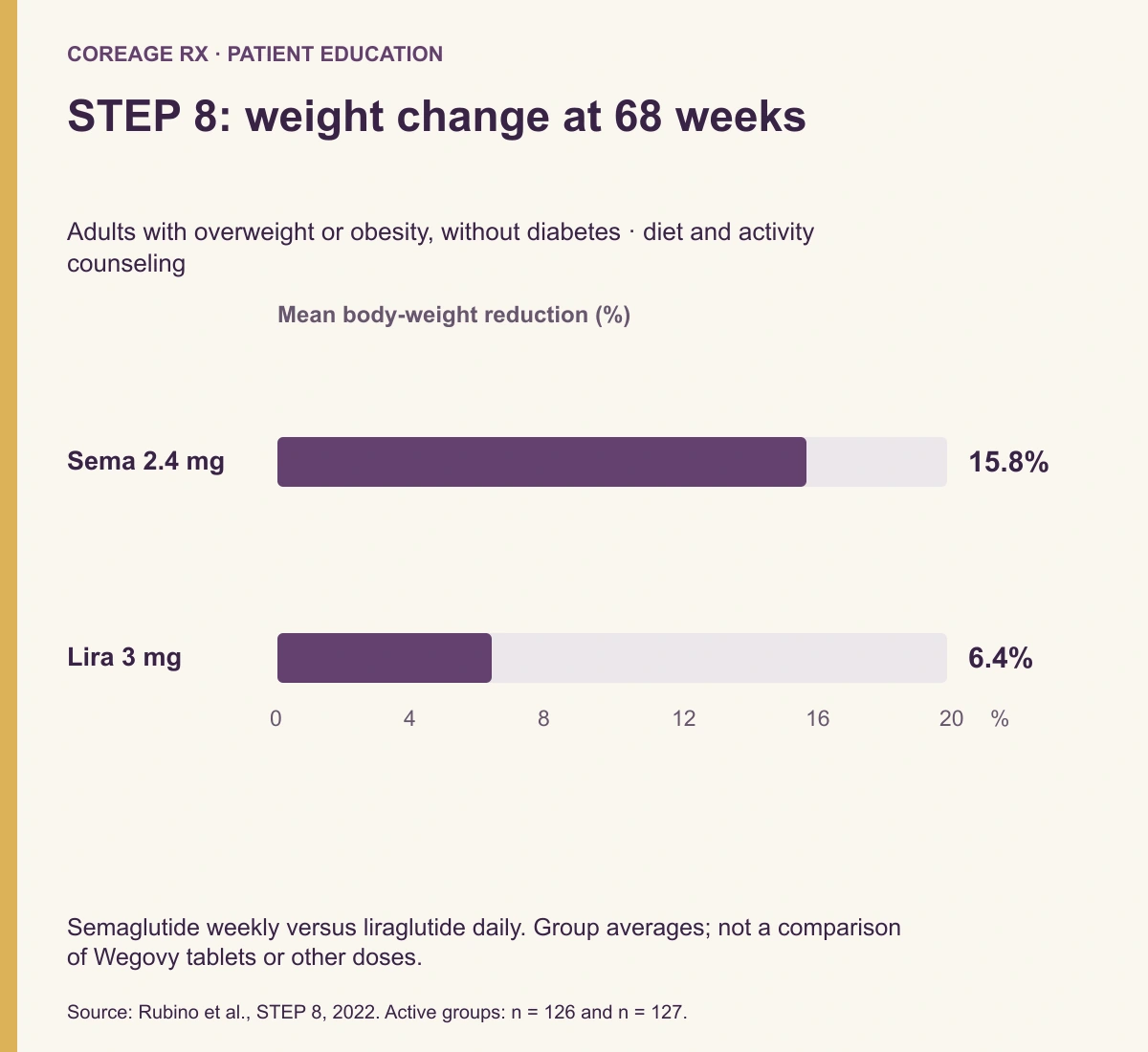
STEP 8 enrolled 338 adults with overweight or obesity who did not have diabetes. Participants received semaglutide 2.4 mg weekly, liraglutide 3 mg daily, or corresponding placebo treatment, alongside diet and physical-activity counseling. The study lasted 68 weeks and was conducted at 19 U.S. sites.
There were 126 participants assigned to semaglutide, 127 to liraglutide, and 85 in the pooled placebo group. The trial provides a direct comparison of the two active regimens, which is more informative than putting percentages from unrelated studies into a ranking. Source: STEP 8 trial report.
However, it is still one study with specified eligibility criteria, escalation rules, and follow-up. Its results should be read within that setting rather than treated as a guarantee for everyone prescribed either medicine.
How much weight did participants lose?
At 68 weeks, the reported mean body-weight change was a reduction of 15.8% with semaglutide 2.4 mg and 6.4% with liraglutide 3 mg. The estimated difference between the two active groups was 9.4 percentage points. The pooled placebo group had a mean reduction of 1.9%. Source: STEP 8 results.
These are group averages expressed as percentages of starting body weight. They are not pounds, a weekly rate, or a prediction for someone beginning treatment today. Participants had different individual responses, and a trial result does not identify the appropriate dose for a particular patient.
The comparison also does not establish results for Wegovy tablets or a different injection regimen. When a headline says “Wegovy versus Saxenda,” check whether it preserves the 2.4 mg weekly and 3 mg daily doses used in this study.
Was Wegovy easier to tolerate?
Gastrointestinal adverse events were reported by 84.1% of semaglutide participants and 82.7% of liraglutide participants in STEP 8. Treatment discontinuation for any reason occurred in 13.5% and 27.6%, respectively. “For any reason” is not the same as stopping specifically because of adverse effects. Source: STEP 8 safety and discontinuation findings.
The treatment rules also differed. Semaglutide escalation took 16 weeks, with 1.7 mg permitted when 2.4 mg was not tolerated. Liraglutide escalation took four weeks, with different stop-and-restart provisions when 3 mg was not tolerated. Those rules matter when interpreting persistence on treatment.
The findings therefore do not justify promising that weekly treatment will be gentler for a particular person. Ask how the prescribing team handles persistent symptoms, delayed escalation, and reassessment before starting either medicine.
How do daily and weekly routines compare?
Saxenda requires a daily injection routine and the appropriate pen technique. Wegovy injection requires a weekly routine, but the exact device and presentation still determine how it is prepared, administered, and stored. Fewer injection days do not remove the need for training.
Think about work schedules, travel, storage, manual dexterity, and who can help if using the device is difficult. A routine that sounds easier in the abstract may not be the one that works best in daily life.
The label and pharmacy instructions for the dispensed product should be the reference. Do not copy directions from another person’s pen, another country, or a different presentation. Our Wegovy prescription guide explains the clinical and access questions to clarify before the first dose.

How does dose escalation work?
Both treatments start below the full treatment dose to support tolerability. Saxenda’s adult label describes weekly increases from 0.6 mg daily through 1.2, 1.8, and 2.4 mg to the recommended 3 mg daily dose. Adults who cannot tolerate 3 mg should discontinue according to the label and discuss the next plan with the clinician. Source: Saxenda adult dosing.
Wegovy has formulation- and indication-specific dose instructions. An adult injection plan should not be borrowed for a tablet or a pediatric patient. Our Wegovy side-effects guide explains why escalation and persistent symptoms belong in the follow-up discussion.
This description is not an instruction to adjust your dose. If the written plan is unclear or symptoms are preventing progression, contact the prescribing team before changing the amount or timing.
Does Saxenda have a response checkpoint?
Yes. For adults, the Saxenda label directs assessment 16 weeks after treatment begins and discontinuation if at least 4% of baseline body weight has not been lost. The label explains that a clinically meaningful sustained response is unlikely in that situation. Source: Saxenda response assessment.
That is a product-specific adult rule, not a universal threshold for all GLP-1 medicines. Pediatric Saxenda instructions use a different assessment framework, and another product may have different requirements.
Ask how baseline weight, follow-up, tolerability, and the next decision will be documented. A response checkpoint should be part of a care plan rather than a surprise discovered when requesting a refill.
Are there reasons to choose a product beyond weight change?
Wegovy has a cardiovascular-risk-reduction indication for adults with established cardiovascular disease and overweight or obesity. Its injection also has an indication for noncirrhotic MASH with specified moderate to advanced fibrosis in adults; that liver indication received accelerated approval based on improvement in MASH and fibrosis, with confirmatory clinical benefit requirements.
The tablet and injection indications are not identical: the injection’s MASH and pediatric uses should not automatically be assigned to tablets. Source: current Wegovy indications.
These details can matter more than a general preference for daily or weekly treatment. A clinician should connect the selected product to the actual condition being treated, rather than assuming all medicines in the same class have the same outcome evidence.
What safety history should be discussed?
Both labels include boxed warnings about thyroid C-cell tumors and contraindications involving a personal or family history of medullary thyroid carcinoma or MEN2. Both require review of pancreatitis concerns, gallbladder disease, severe gastrointestinal symptoms, dehydration, hypersensitivity, and other product-specific issues.
Discuss pregnancy plans, breastfeeding, diabetic eye disease where relevant, and upcoming anesthesia or deep sedation. Other diabetes medicines can affect hypoglycemia risk, so the full medication list matters. Sources: Saxenda safety information and Wegovy safety information.
Severe or persistent abdominal pain, inability to maintain hydration, or signs of a serious allergic reaction need prompt medical attention. A familiar digestive side effect should not be used to explain away a new severe symptom without assessment.
What happens after missed doses or a treatment gap?
Instructions depend on the product and the length of the interruption. Do not assume that the last tolerated dose remains an appropriate restart dose after a gap. Saxenda’s instructions specifically address restarting after an interruption, and Wegovy has its own missed-dose and reinitiation guidance.
Contact the prescribing team or pharmacist with the exact product, last dose, and timing of the interruption. Avoid doubling doses or using another person’s schedule to catch up. Sources: Saxenda administration instructions and Wegovy administration instructions.
If a gap occurred because of cost, availability, or side effects, address that cause alongside the restart question. Repeated interruptions may require a broader treatment review.

Can you switch or combine them?
Saxenda and Wegovy should not be treated as interchangeable milligram for milligram. Their labels do not recommend use with another GLP-1 receptor agonist, and overlapping them is not a routine way to improve response.
A switch should include explicit timing and dose instructions, a symptom plan, and review of other medicines. Previous tolerance of one product does not establish the correct dose of the other. Our semaglutide questions guide provides related follow-up questions.
If exploring CoreAge Rx semaglutide care, verify the actual product and formulation involved. Ingredient similarity does not establish that a different preparation is branded Wegovy or that every branded trial result applies to it.
How should you compare costs?
Compare the actual prescription, presentation, quantity, pharmacy, and payment route. Coverage can differ by product and indication, and an initial advertised price may not describe the ongoing cost. Include appointments, supplies, and follow-up when evaluating the care arrangement.
Our GLP-1 insurance guide explains formulary checks, prior authorization, and common denial questions. For the broader treatment decision, see which GLP-1 medicine is best.
The direct trial favors semaglutide 2.4 mg for average weight reduction over liraglutide 3 mg in the studied population. The individual decision still needs a product-specific assessment of safety, goals, routine, access, and what will happen if the first plan is not working well.
Educational information for adults; individual treatment decisions require a qualified clinician. Sources checked September 27, 2026. Original AI-generated article illustrations depict fictional people and objects, not patient outcomes. Other editorial images are illustrative. Graphics summarize the cited sources.