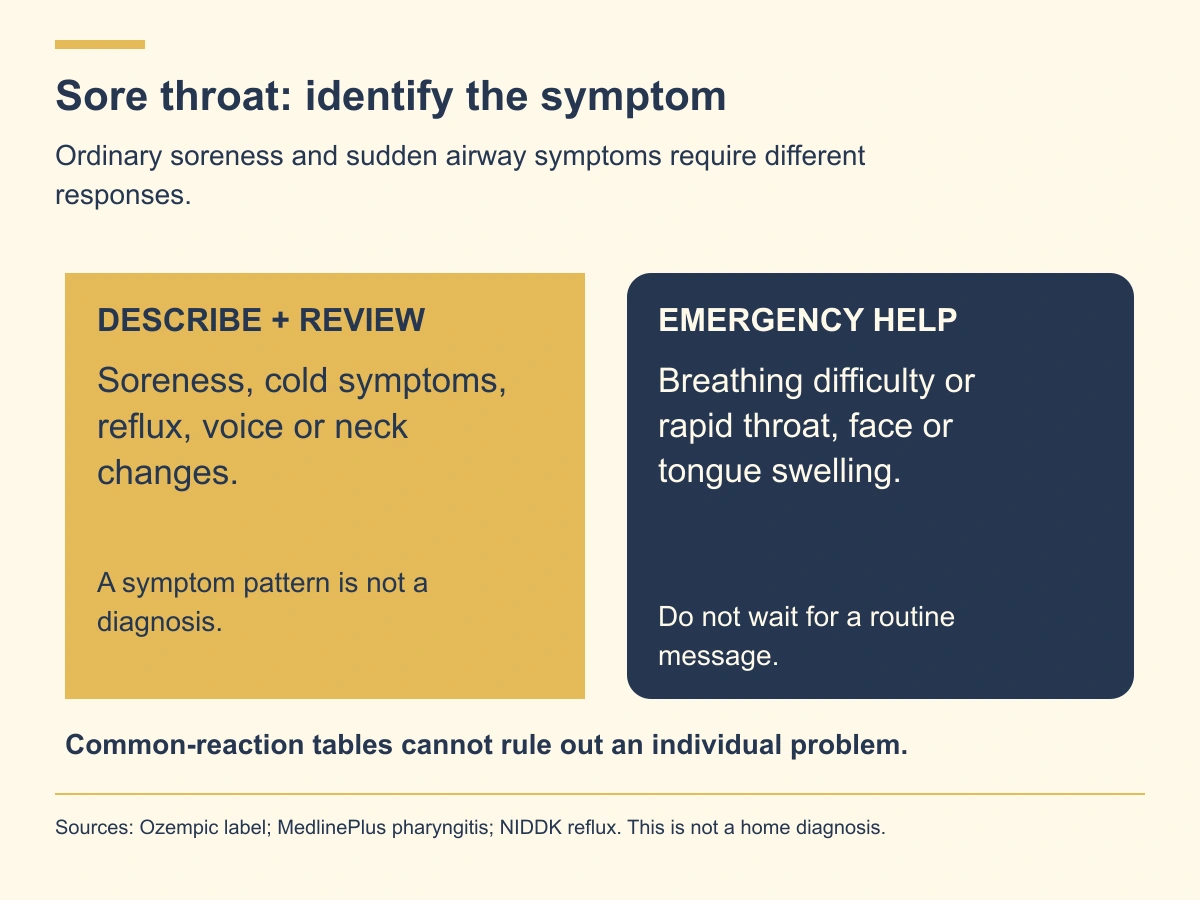
A sore throat during Ozempic treatment does not automatically mean that Ozempic caused it. Sore throat is not listed among the common reactions in the reviewed Ozempic trial table, but that table cannot diagnose your symptom or rule out a problem. The immediate question is whether you have an ordinary throat illness, reflux-related symptoms, persistent voice or neck changes, or signs of a serious allergic reaction.
Breathing difficulty, rapid throat or facial swelling, or an inability to swallow normally needs urgent medical attention. A mild scratchy throat with cold symptoms belongs to a different discussion. Describing that difference clearly is more useful than searching for one blanket answer about Ozempic and the throat.
Is sore throat a common Ozempic side effect?
The current Ozempic prescribing information lists nausea, vomiting, diarrhea, abdominal pain, and constipation in its common-reaction table. Sore throat is not among those entries. This is a statement about that table, not proof that a medicine-related problem is impossible. Ozempic prescribing information, section 6.1.
Clinical trial tables have reporting thresholds and reflect specific study populations. A person’s symptom can be real and require evaluation even when it does not appear in a short list. Similarly, a symptom that begins after an injection may have another cause.
For the broader treatment context, how Ozempic works separates blood-sugar and appetite effects from the idea that every new symptom has the same explanation. Keep the exact medicine, formulation, and dose history available for the care team.
Start by describing the throat symptom
“Sore throat” can refer to scratchiness, painful swallowing, a burning sensation, tightness, or a change in voice. Those are not interchangeable descriptions.
Write down whether you have a fever, cough, runny nose, rash, swollen glands, heartburn, regurgitation, or a new lump in the neck. Include whether the symptoms started suddenly or gradually, and whether they are improving. Mention recent exposure to someone who was ill.
If the problem is tightness or swelling rather than ordinary soreness, say so directly. If it is painful to swallow but you can still swallow fluids, describe that separately from being unable to swallow. A clinician uses the combination of findings to decide what needs assessment and how quickly.
| Symptom pattern | Why the distinction matters | Useful next step |
|---|---|---|
| Scratchiness with cold-like symptoms | A respiratory infection may be relevant | Describe duration, fever, exposure, and progression |
| Burning with regurgitation or meal-related symptoms | Reflux may be part of the review | Record meals, lying down, and other reflux symptoms |
| Persistent hoarseness or a neck lump | The Ozempic label calls for evaluation of these symptoms | Contact the prescriber for assessment |
| Rapid swelling, breathing difficulty, or severe throat tightness | A serious reaction or airway problem is possible | Obtain emergency help |
The table organizes questions. It does not diagnose infection, reflux, allergy, or a thyroid condition from a symptom pattern alone.
Could an infection be responsible?
MedlinePlus explains that viruses account for many sore throats. Some bacterial infections also cause throat symptoms, and testing may be needed to identify strep throat. Antibiotics do not treat a viral illness. MedlinePlus pharyngitis guidance.
A cough, fever, or sick contact can be helpful context, but symptoms alone do not identify the organism. Do not start leftover antibiotics or borrow another person’s prescription because a sore throat appeared during Ozempic treatment.
If you are prescribed an antibiotic, give the pharmacist your exact medicine list. Our Ozempic and antibiotics guide explains why the particular antibiotic, illness, and other prescriptions matter. The word “antibiotic” does not supply a universal interaction answer.
An illness can also change eating, drinking, and glucose management. Ask the diabetes care team about your own sick-day plan when relevant, especially if you use other glucose-lowering medicines or cannot maintain normal intake.
Could reflux contribute to throat symptoms?
Reflux can involve stomach contents coming back into the throat or mouth. GERD may also involve cough or hoarseness, although these symptoms do not by themselves establish reflux. NIDDK reflux symptoms and causes.
Ozempic delays gastric emptying, and its label discusses gastrointestinal reactions. That does not establish that every sore throat during treatment comes from reflux or that a specific throat episode was caused by slower stomach emptying.
If you notice burning, an acidic taste, regurgitation, or symptoms related to meals and lying down, tell the clinician. Our Ozempic heartburn and reflux guide covers the fuller reflux review. Record the symptoms rather than assuming the diagnosis and adding an acid reducer automatically.
Persistent vomiting, painful swallowing, gastrointestinal bleeding, or concerning chest symptoms need assessment. A medicine for acid does not address every explanation for throat discomfort, and relief after taking one does not prove what caused the symptom.
What does the thyroid warning mean for a sore throat?
Ozempic has a boxed warning based on thyroid C-cell tumors in rodents; whether it causes these tumors in humans is unknown. The label calls attention to symptoms such as a neck mass, swallowing difficulty, breathing difficulty, and persistent hoarseness. It also lists a personal or family history of medullary thyroid carcinoma, or MEN2, as contraindications. Ozempic label, section 5.1.
An ordinary sore throat is not a thyroid cancer diagnosis. At the same time, a persistent voice change, a new neck lump, or an ongoing swallowing problem should not be dismissed as “just an Ozempic side effect.” Arrange a clinical review and describe the specific change.
Other thyroid diagnoses differ from medullary thyroid carcinoma. Our Zepbound after thyroid removal guide explains why the exact diagnosis and medical history remain important after surgery. It does not transfer treatment eligibility from one medicine to another.
Do not use a normal thyroid blood test as proof that a neck or voice symptom requires no further review. Tell the clinician what you are experiencing and let the assessment determine what information or testing is useful.

How is a serious allergic reaction different?
The Ozempic label describes serious hypersensitivity reactions, including anaphylaxis and angioedema. Swelling of the face, lips, tongue, or throat, breathing problems, or other signs of a severe reaction require prompt medical help. Ozempic label, section 5.8 and Medication Guide.
A rapidly changing airway symptom is not something to monitor through an online FAQ. Obtain emergency help and tell responders about the medicine and any other recent exposures. If a serious reaction is suspected, the label directs discontinuation and prompt treatment; subsequent medication decisions belong with the treating team.
Do not take another dose to test whether the symptom happens again. A clinician needs to review what occurred, whether emergency treatment was required, and the implications for future prescriptions.
What information should you send the prescriber?
A brief, specific message can make a nonurgent review easier:
- The exact Ozempic dose, last injection date, and any recent dose change.
- When the throat symptom began and whether it is soreness, burning, tightness, or hoarseness.
- Fever, cold symptoms, reflux symptoms, sick contacts, and any neck swelling.
- Whether you can swallow fluids and maintain normal food and drink intake.
- Other medicines, supplements, allergies, and treatments already tried.
For example: “I have had a scratchy throat and runny nose for two days. I can drink normally. There is no swelling or breathing difficulty. My last injection was three days ago. Should I arrange testing or change anything in my sick-day plan?” A message like this gives context without asserting a drug reaction.
Use urgent channels for urgent symptoms. A routine portal message is not a substitute for immediate assessment of breathing difficulty or severe swelling.
Can you use an over-the-counter throat treatment?
MedlinePlus describes supportive options for uncomplicated sore throat, but your other conditions and medications still matter. Ask a pharmacist about the exact product, particularly when combination cold remedies contain several active ingredients. MedlinePlus sore-throat care.
Read the whole label. A product marketed for “cold and flu” may contain a pain reliever, decongestant, or other ingredient you are already taking. Our Tylenol and Ozempic medication checklist explains duplicate-acetaminophen questions. It does not establish that every pain medicine or combination remedy is appropriate for you.
If you have difficulty drinking because of nausea or throat pain, mention that promptly. Our Wegovy thirst and dry-mouth guide offers useful distinctions between mouth symptoms and dehydration, while keeping the product-specific prescription review separate.
Should you stop Ozempic because your throat hurts?
For a nonurgent sore throat, ask the prescriber about the illness and your next dose rather than making a change from a general article. The care team may need to consider glucose management, intake, symptom severity, and other prescriptions.
Suspected serious allergy requires urgent care and the label’s discontinuation guidance. That situation is different from a mild throat symptom without signs of a severe reaction. If you received emergency care, contact the prescribing team before further treatment decisions.
Avoid a generic “skip a week” rule. Ask what to do about the next scheduled dose, how to manage the underlying condition, and when to follow up. Keep any existing sick-day instructions available.

Questions people commonly ask
If symptoms begin the day after an injection, does that prove Ozempic caused them?
No. The timing is useful information, but infections, reflux, other exposures, and unrelated conditions can overlap with the injection schedule. Tell the clinician the timing without treating it as a diagnosis.
Does a scratchy throat mean thyroid cancer?
A scratchy throat alone does not establish that diagnosis. Persistent hoarseness, a neck lump, or swallowing difficulty deserves assessment under the label’s symptom guidance, rather than reassurance or a cancer conclusion from a search result.
Should everyone with throat symptoms take omeprazole?
No. Acid suppression is not a treatment for every sore throat. If reflux is suspected, discuss the symptoms, medicine history, and an appropriate evaluation. Our omeprazole and Ozempic guide explains the medication-review questions.
Is Ozempic the same as every semaglutide product?
No. Brand, route, approved uses, presentation, and product instructions matter. The CoreAge Rx semaglutide information page is a starting point for service questions; identify the actual dispensed product before applying brand-specific instructions.
When should an ordinary sore throat be reviewed?
MedlinePlus advises contacting a clinician when a sore throat persists for several days or occurs with findings such as high fever, swollen neck glands, or rash. Breathing trouble needs immediate care. Your health history may justify earlier assessment.
Use the symptom description to guide care
Check urgent symptoms first. Then identify the throat pattern, record relevant illness and medicine details, and contact the appropriate care team. This gives you a clearer next step than assuming a sore throat is either a routine Ozempic reaction or evidence of a serious diagnosis.
Educational information for adults; individual treatment decisions require a qualified clinician. Sources reviewed October 5, 2026. Original AI-generated article images depict fictional people and objects, not patient outcomes. Other editorial images are illustrative. Graphics summarize the cited sources.