
Taking omeprazole with Ozempic is a question about your complete treatment plan, the exact semaglutide product, and the symptoms being treated. A pharmacist or prescriber should review both medicines together. A study involving oral semaglutide offers useful information, but it does not provide individual clearance for every person taking weekly Ozempic injections.
If reflux appeared after starting or increasing treatment, mention that change. Omeprazole reduces stomach acid; it does not explain every cause of nausea, abdominal pain, or chest discomfort. This guide separates the absorption question from the symptom question so you can have a more useful conversation about care.
First, identify the exact medicines
Bring the dispensing labels or a clear list with product names, strengths, schedules, and recent changes. Ozempic injection and semaglutide tablets have different directions. The current tablet label includes both Rybelsus and Ozempic tablets, making the word “Ozempic” alone an incomplete description. Our oral semaglutide versus injections guide explains why route matters.
For omeprazole, note whether it was prescribed or bought over the counter, how long you have used it, and what the clinician intended it to treat. Prescription treatment and a package-directed nonprescription course should not be treated as interchangeable plans. Include antacids, supplements, and occasional medicines in the list, even if you do not think of them as prescriptions.
What does the oral-semaglutide study show?
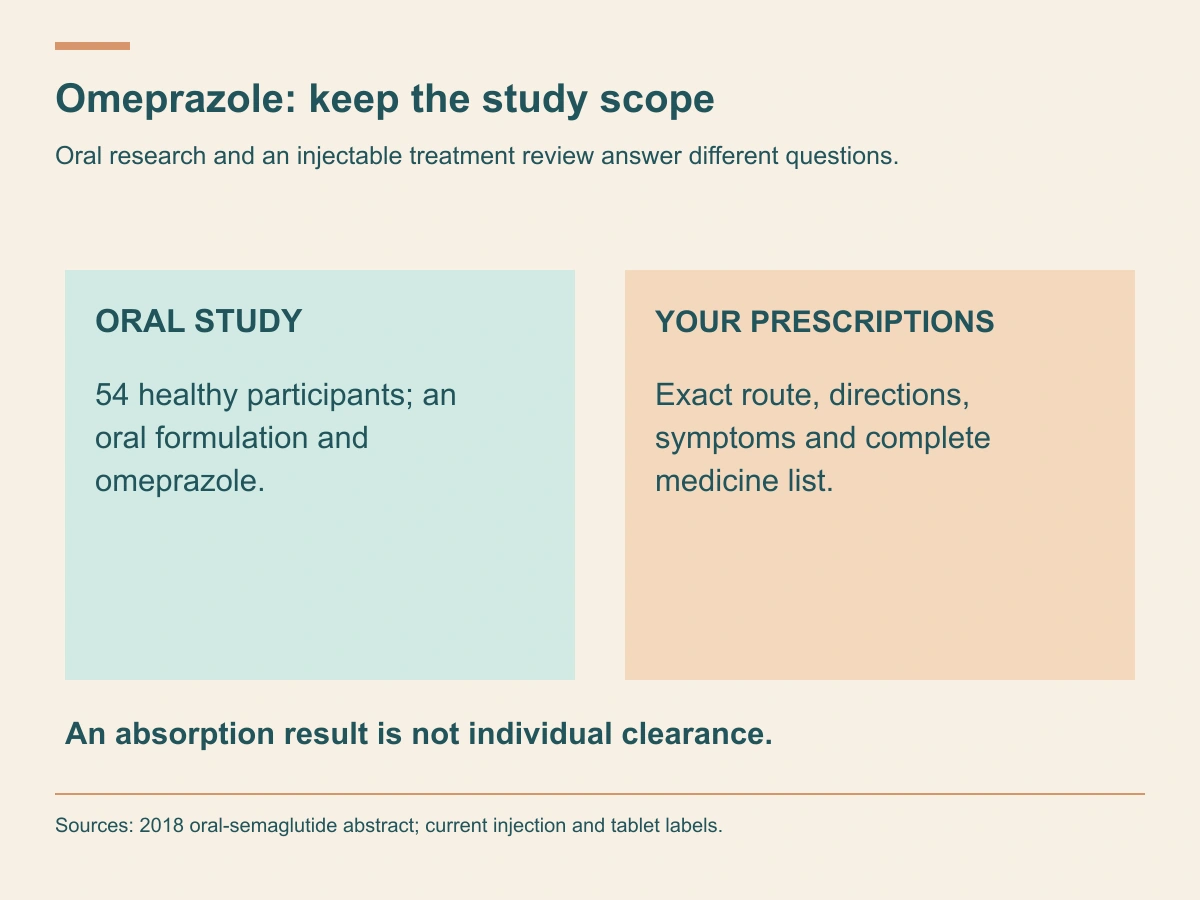
A 2018 randomized, open-label pharmacokinetic study involved 54 healthy participants. It compared oral semaglutide alone with oral semaglutide plus omeprazole 40 mg daily. Semaglutide exposure was slightly higher with omeprazole, but the differences were not statistically significant; the authors did not consider them clinically relevant. Reported adverse events were mild or moderate, most often gastrointestinal. Primary study abstract.
This was an absorption study of an oral formulation in healthy volunteers. It was not a long-term study of weekly Ozempic injections in people with diabetes, reflux, and several other prescriptions. That distinction limits what the result can answer. It also prevents a reassuring absorption result from becoming a claim that all digestive symptoms are harmless.
The current semaglutide tablet label reports no clinically significant pharmacokinetic difference with omeprazole. It still has specific administration directions. Semaglutide tablet prescribing information. Neither finding means you should create your own schedule or switch between tablets and injections.
What does the injectable Ozempic label say about oral medicines?
Ozempic injection delays gastric emptying (the movement of food from the stomach into the intestine) and can potentially affect absorption of oral medicines. Its label says the oral medicines evaluated in clinical pharmacology trials were not affected to a clinically relevant degree, while advising caution with concomitant oral medicines. That wording describes the studied evidence; it does not establish an identical result for every possible prescription. Ozempic injection label, section 7.2.
Tell the care team if another medicine seems to work differently, if you cannot keep tablets down, or if swallowing has become difficult. Include when the change started and whether the semaglutide dose, eating pattern, or another medicine changed at the same time. A useful description is more specific than “my medicines interact.” It gives the pharmacist several possibilities to investigate without assuming one cause.
Does omeprazole treat every digestive effect of Ozempic?
No. Omeprazole is a proton-pump inhibitor, a medicine that decreases acid production. It can be prescribed for acid-related conditions, but an acid-reducing medicine is not a treatment for every cause of nausea, vomiting, constipation, early fullness, or abdominal pain. Omeprazole drug information.
Describe the actual experience: burning behind the breastbone, a sour taste, food coming back up, nausea without burning, painful swallowing, or a feeling of fullness that prevents meals. Those descriptions can lead to different questions. Our semaglutide nausea and vomiting guide and Ozempic burping guide cover related symptoms without treating them as one diagnosis.
It is also possible to have reflux that predates semaglutide. The clinician needs that history. If a symptom was already present, explain whether it became more frequent, more severe, or simply more noticeable. Improvement after an acid medicine may be useful information, but it does not prove the original cause or rule out another problem.

Questions that belong in a medication review
| Question | Information to bring | Why it helps |
|---|---|---|
| Which semaglutide product do I take? | Injection or tablet, exact brand and strength | Administration directions differ. |
| Why am I using omeprazole? | Diagnosis, prescription or OTC course, duration | The intended treatment and follow-up matter. |
| What symptom changed? | Timing, severity, meals, swallowing and vomiting | Similar-sounding symptoms need different assessment. |
| What else do I take? | All prescriptions, antacids, supplements and occasional products | The complete list is more useful than reviewing one pair. |
| Can I eat, drink and take medicines? | Representative intake and any missed or vomited doses | Poor intake can complicate the broader care plan. |
Use the table as preparation, not as a test you must finish before seeking help. Concerning symptoms should be assessed promptly. For a routine appointment, a short note covering several representative days often communicates more than a long list of foods you have stopped eating.
Do the medicines need to be separated by a certain number of hours?
There is no universal spacing rule in this article for omeprazole and weekly Ozempic injection. The oral-semaglutide study does not establish one. Follow each prescription and ask the pharmacist to reconcile the directions if they are difficult to fit together.
Semaglutide tablets have a separate fasting administration rule: the reviewed label directs taking them in the morning with water, up to four ounces, then waiting at least 30 minutes before food, other drinks, or other oral medicines. Tablet label. Omeprazole directions depend on its formulation and prescription. A pharmacist can explain the sequence for your actual products. Do not transfer tablet directions to an injection or assume a longer gap fixes persistent vomiting.
If shift work, caregiving, or an irregular breakfast makes the plan confusing, say so. A workable schedule should be written clearly enough that you know what to do on ordinary days. Ask separately about forgotten doses rather than improvising an extra dose to compensate.
Meal habits to discuss when reflux is the concern
NIDDK notes that, for nighttime or lying-down reflux, finishing meals at least three hours before lying down may improve symptoms. Triggers vary; commonly linked foods include high-fat meals, alcohol, coffee, mint, chocolate, spicy foods, and acidic foods. These are possibilities to review, not a requirement to remove every item from your diet. NIDDK reflux eating guidance.
Consider whether the difficulty follows one large meal, a particular drink, or eating just before bed. Change one manageable feature at a time when appropriate, while keeping enough food and fluid in the day. Our balanced-meal guide can help you assemble meals when appetite is lower. Restricting more and more foods without a plan can leave you with a narrow diet and an unresolved symptom.
When should I get medical help?
New chest pressure, breathlessness, faintness, or pain spreading to an arm, jaw, back, or shoulder needs emergency assessment; do not wait to see whether an acid medicine helps. Our chest-pain and palpitations guide explains why symptoms take priority over attributing them to treatment.
Persistent vomiting, painful or difficult swallowing, bloody or coffee-ground-like vomit, black tarry stools, or unexplained weight loss also require medical review. NIDDK symptom guidance. Seek urgent care for severe or persistent abdominal pain, especially with vomiting or inability to keep fluids down. Ozempic has warnings for potentially serious digestive effects and is not recommended in severe gastroparesis. Ozempic label.

Frequently asked questions
Can I start OTC omeprazole because Ozempic gives me heartburn?
Ask a pharmacist or clinician whether the symptoms and your medicine list fit an OTC course. Follow the package if it is appropriate. Frequent recurrence, poor intake, or warning signs need assessment, rather than repeatedly extending self-treatment. Explain that you use semaglutide and mention any recent increase.
Does taking omeprazole mean Ozempic will stop working?
The reviewed oral study does not support that conclusion. It also cannot predict your glucose (blood sugar) or weight response to an injection. Treatment response should be reviewed with the appropriate clinical measures and the actual product, not inferred from reflux or one day of appetite.
Should I skip Ozempic when reflux is worse?
Contact the treating team for product-specific instructions. Persistent symptoms deserve a review before another planned increase. Do not replace the prescribed plan with repeated skipping, doubling, or switching products. The missed-dose and restart guide explains why timing and product details matter.
Where to go next
Our omeprazole and weight-changes article addresses appetite and scale questions separately. The semaglutide questions guide organizes broader treatment decisions. If you are exploring care, the CoreAge Rx semaglutide page describes the service; eligibility and the exact prescription require an individual consultation.
Educational information for adults; individual treatment decisions require a qualified clinician. Sources reviewed October 3, 2026. Original AI-generated article images depict fictional people and objects, not patient outcomes. Other editorial images are illustrative. Graphics summarize the cited sources.