
Burping, also called belching or eructation, is reported in Ozempic’s prescribing information. That does not mean every burp is caused by Ozempic, or that a sulfur-like odor identifies a particular disease. The useful questions are when symptoms began, whether treatment or meals changed, how much they affect eating and daily life, and whether warning symptoms are present.
Mild occasional belching and persistent vomiting with severe abdominal pain need different responses. This guide explains the label finding, practical information to record, and when to seek assessment rather than trying to diagnose the problem by smell.
What the Ozempic label actually reports
The current Ozempic prescribing information includes eructation among additional gastrointestinal adverse reactions reported at frequencies below 5% in the reviewed placebo-controlled adult type 2 diabetes trials. The listed figures were 0% with placebo, 2.7% with 0.5 mg Ozempic, and 1.1% with 1 mg Ozempic.
| Reviewed trial group | Participants reporting eructation |
|---|---|
| Placebo | 0% |
| Ozempic 0.5 mg | 2.7% |
| Ozempic 1 mg | 1.1% |
These are figures from particular trial groups, not a personal risk prediction. They do not describe every current dose, formulation, or population. The smaller figure in one higher-dose group does not establish that increasing a dose treats burping or that the effect follows a simple dose pattern.
The reaction term describes belching; it does not separately measure a sulfur odor. The table therefore cannot tell you the rate of “sulfur burps” or diagnose why a particular person’s burps smell different. Our semaglutide side-effect guide explains why exact product and study context matter.
Belching, reflux, and intestinal gas are different questions
NIDDK’s gas guidance defines belching as gas released from the stomach through the mouth. Swallowed air can contribute. Eating or drinking quickly, chewing gum, fizzy drinks, and other habits can increase swallowed air.
Lower-intestinal gas and its odor involve another part of digestion. Do not take an explanation of sulfur in flatus and present it as proof of the cause of a sulfur-smelling burp. The location of the symptom and the supporting evidence matter.
Reflux symptoms can overlap with a complaint about burping, but burping alone does not establish reflux disease. The Ozempic label also lists dyspepsia and gastroesophageal reflux disease among additional gastrointestinal reactions. A clinician may need to assess which symptom is actually happening and whether another condition is involved.
Ozempic’s effects on digestion are relevant, but a symptom does not automatically prove gastroparesis or another specific diagnosis. The Wegovy gastric-emptying guide explains the broader concept while keeping product-specific questions visible. It should not be used to diagnose an Ozempic user from one symptom.
What a sulfur-like odor can and cannot tell you
An odor description is useful to report, but it is not a diagnostic test. It cannot by itself confirm an infection, bacterial overgrowth, a medication reaction, or that a particular food is responsible. Nor does an odor prove that the medicine is working or that your body is “detoxing.”
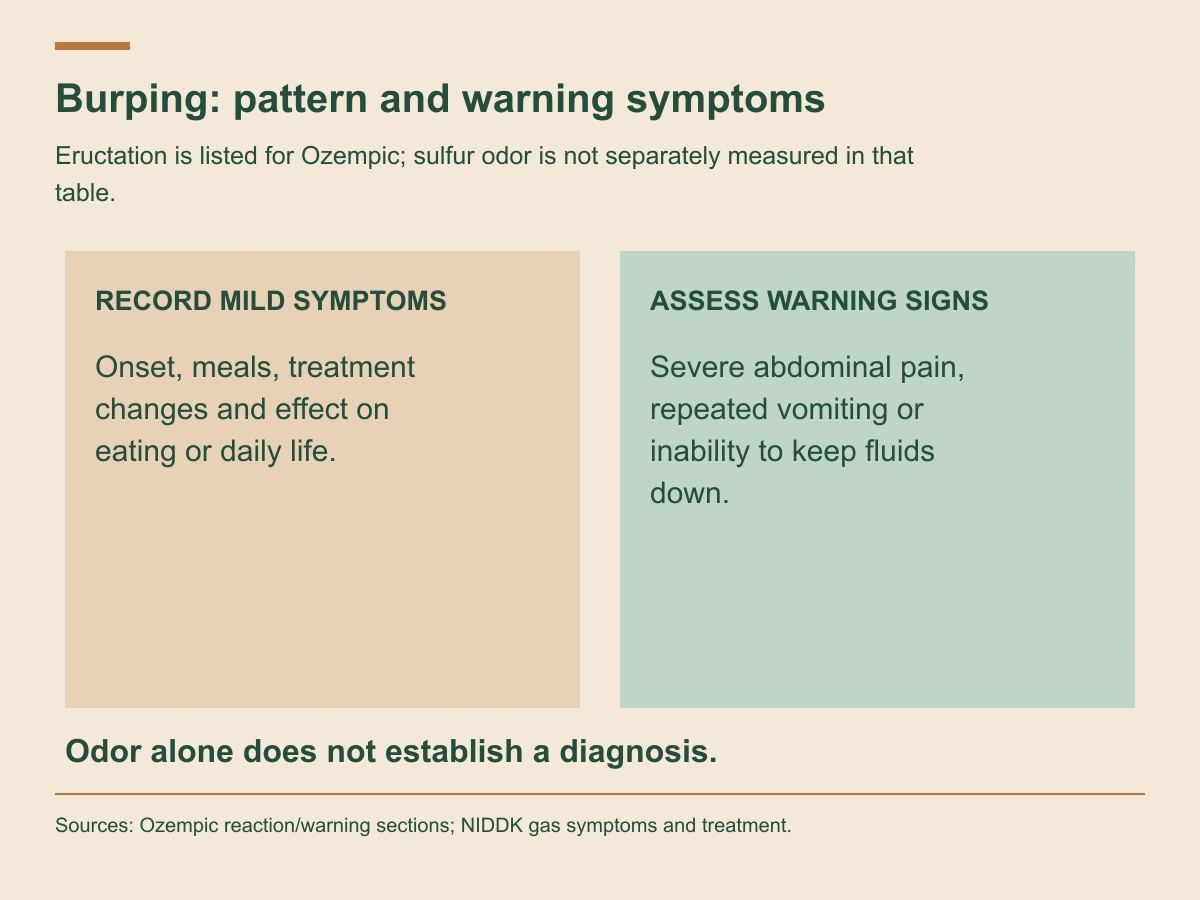
Describe the pattern instead. Is it occasional or repeated? Did it begin after starting or changing treatment? Does it occur with heartburn, regurgitation, diarrhea, constipation, vomiting, fever, or pain? Are you able to eat and keep fluids down?
Bring any recent changes in medicines, supplements, meal pattern, and illness to the review. A clinician can decide whether the history suggests a need for testing or another assessment. Do not start an antibiotic or an elaborate elimination diet based solely on smell.
The source limit is worth keeping clear: the reviewed Ozempic table establishes reported eructation in particular trials, not a verified sulfur-burp mechanism. A useful article can acknowledge that limit and still help you organize symptoms and seek appropriate care.
A short symptom record can help
You do not need a detailed log of every burp. A brief record of a few representative episodes can give the care team more useful information than a general statement that a medicine disagrees with you.
- When the symptom started and whether treatment recently changed.
- The exact product, prescribed dose, and other medicines or supplements.
- Relevant meals, drinks, portions, and how quickly you ate.
- Associated pain, reflux, nausea, vomiting, constipation, or diarrhea.
- Whether you can eat, drink, sleep, and function normally.
- Any possible dosing mistake or uncertainty about a compounded preparation.
If you use a compounded vial, tell the team explicitly when the concentration, supplied syringe, or directions changed. Our semaglutide measurement guide explains why an incorrect amount is a different concern from ordinary mild digestive symptoms.
Do not delay urgent assessment to complete a diary. If symptoms are severe, bring the information you have and get help. The record supports a clinical conversation; it does not authorize continuing, repeating, or increasing a dose.

Practical habits for mild symptoms
For mild symptoms without warning signs, it may be useful to examine air-swallowing habits. NIDDK’s treatment guidance discusses eating more slowly, sitting down to eat, reducing fizzy drinks, and avoiding gum or hard candy when these contribute to swallowed air.
The same guidance describes that a clinician may suggest smaller, more frequent meals or adjustments to foods that trigger symptoms. Keep adequate nutrition in the plan. A blanket rule to avoid many food groups can make eating difficult without establishing the cause.
Try to understand a specific pattern rather than changing every food at once. If a beverage is carbonated or you routinely eat very quickly, that is a concrete question to discuss. If a particular meal seems associated, note its ingredients and portion as well as other symptoms.
Our Wegovy food guide provides broader meal questions for semaglutide treatment, while the semaglutide protein and muscle guide keeps intake and function visible. Neither establishes that every Ozempic user should follow one menu or eliminate a particular food.
Medicines and supplements are not universal fixes
An antacid, acid-suppressing drug, gas product, probiotic, or digestive supplement is not automatically the right response to every belching complaint. The useful choice depends on the symptom pattern, underlying condition, other medicines, and individual history.
NIDDK recommends discussing supplements and complementary products with a clinician for safety. It also explains that medicines may be chosen for a diagnosed condition rather than for gas in general. Gas treatment guidance. A product advertised for sulfur burps does not independently establish a benefit or suitability.
Ask a pharmacist or clinician what the suspected problem is, why a particular treatment would help, how long it should be used, and when to reassess. Avoid adding several products at once or borrowing another person’s regimen. That can make it harder to interpret both benefit and new symptoms.
Our omeprazole and weight-change guide illustrates why reflux treatment and weight concerns are separate questions. Starting acid suppression is not a way to establish the cause of every Ozempic symptom.
When symptoms need prompt or urgent assessment
Contact a clinician if belching is persistent, newly changing, bothersome, or accompanied by other symptoms. NIDDK recommends medical discussion for gas symptoms with abdominal pain, constipation, diarrhea, or unexplained weight loss. Do not assume ongoing symptoms are harmless because burping appears in a label.
The Ozempic label warns about pancreatitis, including persistent or severe abdominal pain that may extend to the back, with or without nausea or vomiting. It also describes dehydration-related kidney injury and severe gastrointestinal reactions. Severe pain, repeated vomiting, inability to keep fluids down, fainting, or substantial weakness needs prompt medical assessment. Ozempic label.
Breathing trouble, facial or throat swelling, or signs of a severe allergic reaction require emergency help. An odor or a mild burp is not the deciding factor when serious symptoms are present. Tell the treating team which medicine you use and any possible dose error.
Our semaglutide nausea and vomiting guide explains reporting and warning signs. If pancreatitis is suspected, the label directs discontinuation and appropriate management; a clinician should assess the situation rather than treating severe symptoms with a general gas remedy.

Dose timing, escalation, and treatment decisions
The current Ozempic label permits weekly administration at any time of day, with or without meals. That does not establish a universal nighttime or morning solution for belching. Changing the clock time is different from assessing persistent symptoms, tolerability, or an uncertain dose.
Our semaglutide timing guide separates permitted routines from unproven symptom advantages. If symptoms are affecting intake or daily function, discuss the treatment plan before a scheduled increase. Do not speed up escalation because you expect side effects to disappear at a larger dose.
If a dose was missed or treatment interrupted, use product-specific guidance with the prescribing team. The missed-dose and restart guide explains why the product and length of the gap matter. Another person’s schedule cannot settle your restart decision.
For prospective care, the CoreAge Rx semaglutide page provides service information to discuss with the team. Confirm the exact preparation, assessment, pharmacy, and follow-up. A product page is not an individualized prescription or a promise that a different preparation will solve burping.
Frequently asked questions
Does Ozempic cause burping?
Eructation is reported in its prescribing information, but a person’s symptom can have other contributors. Review onset, meals, treatment changes, other medicines, associated symptoms, and function rather than assigning cause automatically.
Are sulfur burps separately measured in the label?
The reviewed reaction term is eructation, not a separately defined sulfur-odor outcome. Do not use its percentages as sulfur-burp rates or interpret odor as proof of a specific condition.
Do burps mean Ozempic is working?
No. A digestive symptom is not a validated measure of treatment benefit. Evaluate the intended health outcomes and tolerability with the care team, including adequate food, fluids, and everyday function.
Should I change my injection to bedtime?
No universal bedtime benefit for belching is established here. Weekly timing flexibility does not replace assessment of persistent symptoms or dose tolerability. Discuss any treatment change with the prescriber.
Can I take a probiotic or an antacid?
Ask a pharmacist or clinician about the actual symptom and your medicines. These products are not interchangeable fixes, and smell alone does not determine the appropriate treatment.
How long will it last?
There is no universal duration from the reviewed evidence. New, persistent, worsening, or disruptive symptoms deserve review; severe pain, repeated vomiting, or dehydration requires prompt assessment rather than waiting for a predicted end date.
Educational information for adults; individual treatment decisions require a qualified clinician. Sources reviewed October 2, 2026. Original AI-generated article images depict fictional people and objects, not patient outcomes. Other editorial images are illustrative. Graphics summarize the cited sources.