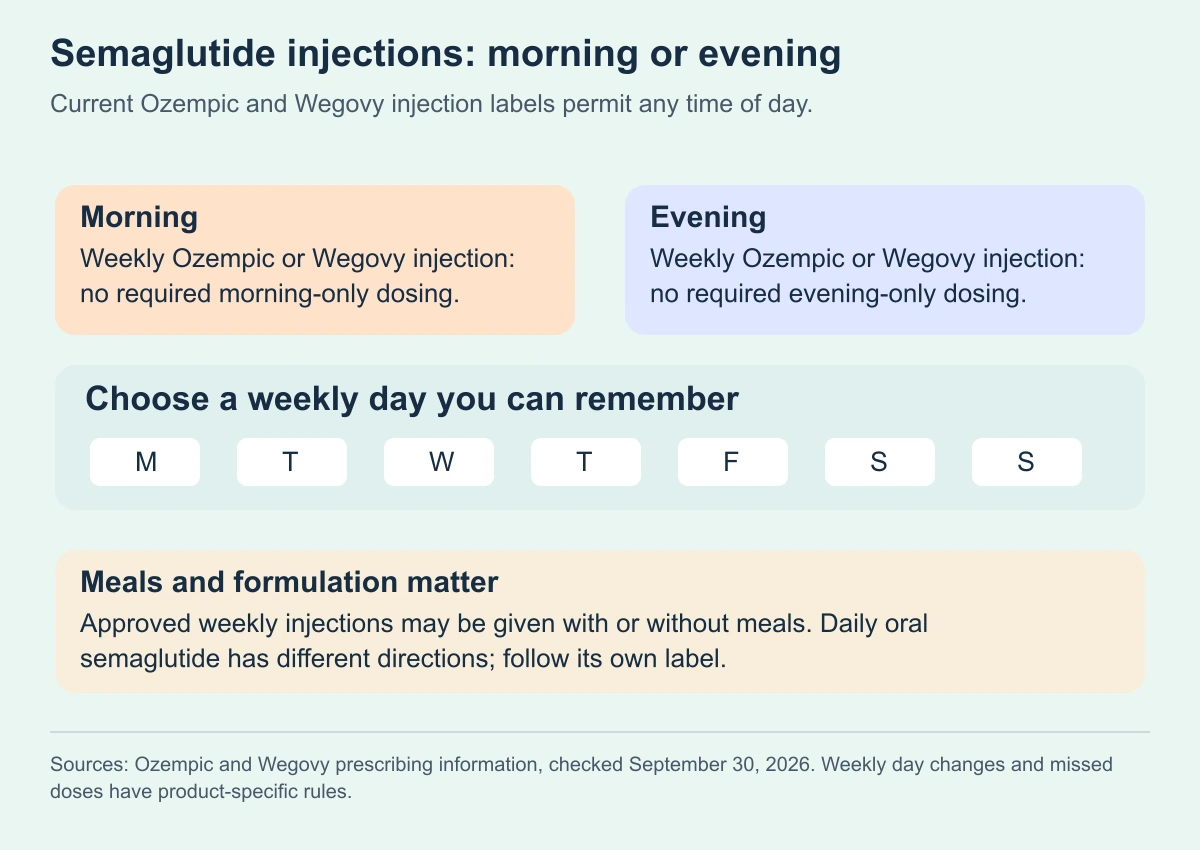
For approved weekly Ozempic and Wegovy injections, the labels allow administration at any time of day, with or without meals. Neither requires a morning-only or bedtime-only injection. A useful time is one that makes the prescribed weekly routine easier to remember and follow.
That answer applies to the injections. Daily oral semaglutide has different administration instructions, and a compounded preparation needs its own prescription and pharmacy review. Before adjusting your routine, identify the exact product and route. Sources: Ozempic prescribing information, Wegovy prescribing information.
Is morning or night better for results?
The labels reviewed here do not identify a universally more effective morning or evening injection time. Claims that a particular hour will produce faster weight loss, eliminate nausea, or make the medicine target belly fat go beyond those instructions.
Morning may suit someone who already checks a weekly planner before work. Evening may suit someone who has a quieter routine after dinner. Those are practical reasons to choose a time, rather than evidence that one hour has a stronger biological effect.
Choose a routine that you can follow without rushing through preparation or forgetting what you have already taken. If someone helps with the injection, their availability may matter too. The goal is a reliable prescribed schedule, not a supposedly perfect hour.
Does the injection need to happen at the exact same hour?
The labeled schedule is once weekly on the same day, with any time of day permitted. A reminder at a consistent hour can be helpful, but that reminder is an organizational tool rather than a required hour-specific dosing rule.
Keep the weekly day visible and record the completed injection. If you use several medicines, make sure a reminder identifies the product as well as the day. A generic “medicine time” alert can create confusion between daily and weekly treatments.
If the day itself needs to change, the interval between injections becomes important. Do not move a weekly dose forward without checking the product’s day-change rule. That is a different question from taking the scheduled injection later in the evening.
Should you inject before or after eating?
Approved weekly Ozempic and Wegovy injections may be given with or without meals. Their labels do not require fasting, a particular breakfast, or an empty stomach before injection. Ozempic label, Wegovy label.
Meal choices can still affect how comfortable you feel during treatment. If appetite is lower or nausea limits eating, discuss a manageable eating pattern rather than skipping meals to make the injection “work harder.” Our food guide for GLP-1 treatment explains how portions, nutrient intake, and tolerance fit together.
A meal does not replace the dose, and injection timing is not a reason to take more medicine. If you also use insulin or a medicine that can cause low blood glucose, the overall glucose and meal plan needs individual clinical guidance. Semaglutide labeling identifies an increased hypoglycemia risk with insulin or insulin secretagogues.
Will a bedtime injection let you sleep through side effects?
Some people prefer bedtime because it fits their routine. That does not establish that sleep prevents the medicine’s digestive effects, or that symptoms will occur only during the first few hours after injection.
Nausea, vomiting, diarrhea, abdominal pain, and constipation can occur during treatment. The Ozempic label reports that most nausea, vomiting, and diarrhea reports in the reviewed trials occurred during dose escalation. Moving the injection to bedtime does not replace assessment of persistent symptoms. Ozempic prescribing information.
If symptoms are interfering with sleep, meals, or fluid intake, record the pattern and contact the care team. Our semaglutide nausea and vomiting guide discusses the questions that help a clinician evaluate the problem. Do not assume that a more convenient injection time makes severe symptoms safe to ignore.
Should you inject before a weekend or a quiet day?
Choosing a weekly day that leaves time for preparation and access to help can be sensible. Someone who travels on Mondays might prefer another day; someone who has assistance on Saturday might organize around that availability.
There is no guarantee that changing the day will place side effects neatly into a free weekend. Treatment experiences vary, and another illness or medicine can contribute to symptoms. Plan around your actual pattern rather than promising yourself that a calendar choice will control it.
Before a dose increase, tell the prescriber if the current dose is difficult to tolerate. A work schedule may help organize follow-up, but it should not determine an independent dose reduction or increase. Our first-month semaglutide guide separates treatment expectations from day-to-day planning.

How can you change the weekly injection day?
Use the instructions for your product. Ozempic labeling says the administration day can be changed if the interval between doses is at least two days, stated in the label as more than 48 hours. Wegovy injection labeling allows a day change when the last dose was given two or more days before.
These statements should not be simplified into a general instruction to inject whenever two calendar dates look different. Check the actual elapsed time and label, and ask the pharmacist when the interval is close to the boundary or the previous injection time is uncertain. Sources: Ozempic label, Wegovy label.
After a change, update the calendar and record the new weekly day. Keep the written prescription and product directions available. Do not use a day change to add an extra injection because appetite returns or the scale has not changed.
What if you forgot the scheduled injection?
Ozempic and Wegovy have different missed-dose instructions. The Ozempic label permits taking a missed dose within five days after it was missed; after that, skip it and resume the regular schedule. Wegovy injection instructions use how close the next scheduled dose is: take the missed dose when the next dose is more than 48 hours away, and skip it when the next dose is less than 48 hours away.
If the timing is exactly at a boundary, uncertain, or involves more than one missed injection, ask the pharmacist or prescriber rather than interpreting a simplified table. Wegovy also directs people who miss two or more consecutive weeks to contact their healthcare provider about restarting. Wegovy prescribing information.
Our missed-dose and restart guide addresses those situations more fully. Taking two injections together to make up for a missed week is not a routine catch-up plan.
Is oral semaglutide taken at the same time?
No. The current Wegovy tablet instructions call for one tablet on an empty stomach in the morning with plain water, no more than four ounces. Wait at least 30 minutes before eating, drinking, or taking other oral medicines, and swallow the tablet whole. Those instructions belong to that approved oral product, not to its weekly injection. Wegovy prescribing information.
Other oral products and compounded oral preparations require their own instructions. Do not assume that a tablet, dissolving preparation, or liquid has equivalent absorption or can replace an injection milligram for milligram.
Our oral semaglutide versus injections guide explains why the route and formulation affect the decision. If you are unsure what was prescribed, ask before using an injection-timing article to organize a daily medicine.
What about a compounded semaglutide injection?
A compounded preparation is not FDA approved and may have a different concentration or additional ingredients. Confirm the intended weekly schedule, exact dose, measuring equipment, storage requirements, and any current handling guidance with the prescriber and pharmacy.
FDA has identified dosing errors involving compounded semaglutide, including errors in measuring amounts and schedules that use more medicine or increase it faster than approved labeling. A familiar injection day cannot compensate for an unclear concentration or dose. FDA’s current GLP-1 concerns.
Our semaglutide dosage guide explains why milligrams, liquid volume, and syringe markings are different. CoreAge Rx’s semaglutide product page can help you begin a discussion about available care and eligibility; the actual prescription and dispensed preparation determine administration.

Do storage, travel, or injection sites change the best time?
The time you choose should allow correct storage and use of the actual product. A routine that regularly leaves the medicine in a hot car or encourages rushed preparation is less useful than one you can follow properly.
Storage limits differ by presentation and whether a product is in use. Check them before travel rather than borrowing a number from another brand or a different device. Our semaglutide storage and travel guide covers those distinctions.
Likewise, choosing morning does not make one injection region more effective. Follow the permitted sites and rotate the specific spot according to the instructions. Our GLP-1 injection-site guide explains how device and region questions fit together.
When should you contact the care team instead of changing the clock?
Contact the prescriber for symptoms that persist, prevent adequate eating or drinking, or repeatedly disrupt daily life. Severe or persistent abdominal pain, repeated vomiting, dehydration signs, or a suspected serious allergic reaction needs prompt care. Tell procedural and anesthesia teams that you take semaglutide when planning a procedure. The product labels identify these issues as clinical questions, not timing preferences.
A useful note includes the exact medicine, current dose, last injection date and time, recent changes, other medicines, and what the symptoms are doing. The best routine supports that information. It should make treatment easier to follow while leaving medical changes with the clinician.
Educational information for adults; individual treatment decisions require a qualified clinician. Sources reviewed September 30, 2026. Original AI-generated article images depict fictional people and objects, not patient outcomes. Other editorial images are illustrative. Graphics summarize the cited sources.