
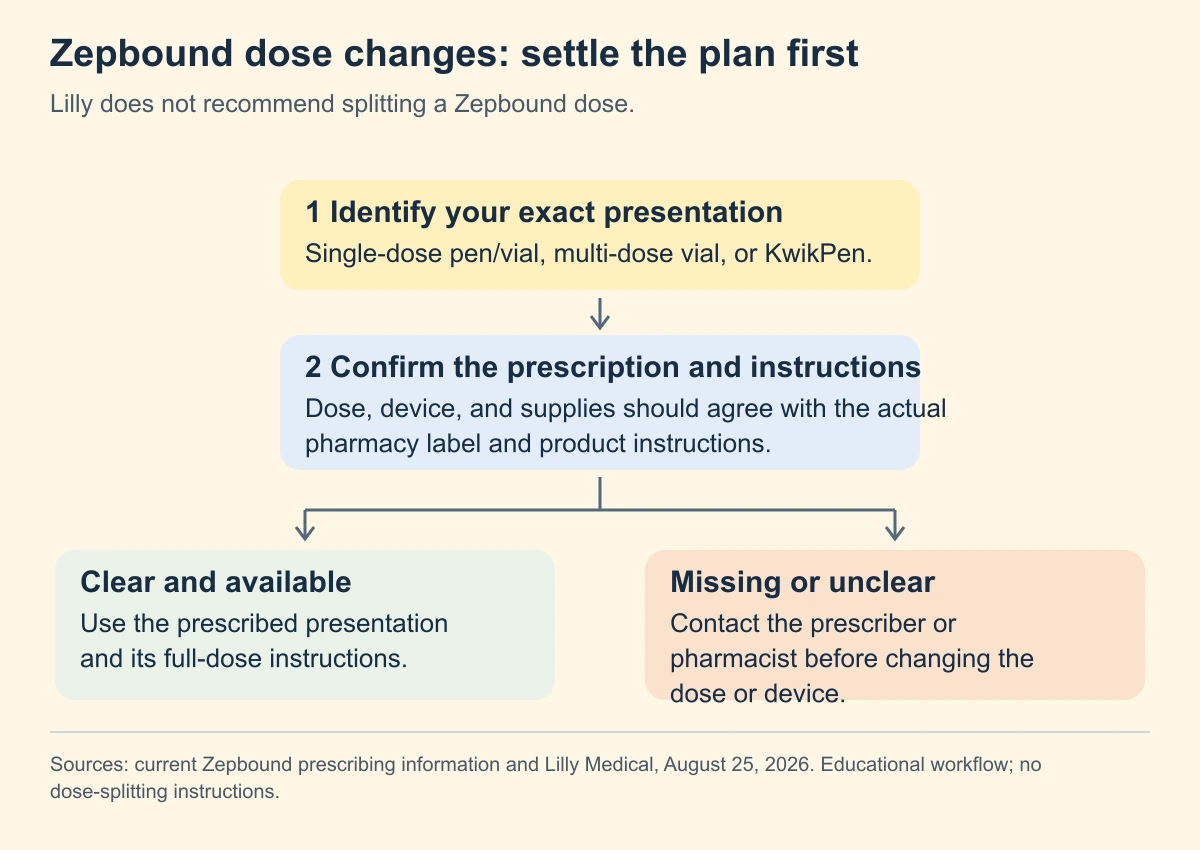
Lilly does not recommend splitting a Zepbound dose. Its current manufacturer guidance says the presentations were designed and tested to deliver their intended doses, and their instructions do not provide a method for delivering less than a full fixed dose. A dose-splitting chart found online does not establish that a modified injection will be accurate, effective, or safe.
People usually ask about splitting because the prescribed strength is expensive, unavailable, or difficult to tolerate. Those are useful reasons to contact the prescriber or pharmacist. The practical solution begins with the actual prescription and presentation, rather than a conversion table or a count of pen clicks. Lilly’s current dose-splitting answer.
What does “splitting a dose” mean?
Several different questions can hide behind that phrase. Someone might want to use part of a higher-strength injection, divide a weekly amount across separate days, save liquid for later, or combine two lower-strength injections. Each changes something different about the prescribed plan.
These questions should also be separated from ordinary dose escalation. Moving to a different prescribed strength after a clinician reviews treatment is part of a treatment plan. Manipulating the current device to produce an unlisted amount is a different decision.
Before calling the pharmacy, write down which change you are considering and why. “I cannot obtain the next prescribed strength” gives the care team a clearer problem to solve than “I need a splitting chart.” Our tirzepatide first-month guide explains why tolerability and follow-up belong in that conversation.
Why do the different Zepbound presentations matter?
Current U.S. labeling includes single-dose pens, single-dose vials, multi-dose vials, and single-patient-use KwikPens. A vial is therefore not automatically a single-dose product, and a pen is not automatically a one-injection product. Read the precise name and instructions on the package you received.
| Presentation | The distinction to understand |
|---|---|
| Single-dose pen | Intended to deliver the designated injection; it is not a reusable source of smaller doses |
| Single-dose vial | Intended for the labeled single-dose use; saving part is not the same as using a labeled multi-dose vial |
| Multi-dose vial | Contains labeled doses for one patient, with its own concentration, handling, and instructions |
| KwikPen | Contains labeled doses for one patient; it is not an invitation to create a click-count schedule |
Source: Zepbound prescribing information. These descriptions identify the presentations; they do not replace the instructions supplied with your medicine.
Concentration and injection volume can also differ between presentations. A number remembered from one package should not be transferred to another. If the pharmacy changes the presentation, confirm that the training and supplies fit the new one. Our Zepbound injection-site and device guide discusses those device distinctions in more detail.
Can a multi-dose vial or KwikPen be split into smaller doses?
The manufacturer’s August 25, 2026 answer says Lilly has not studied splitting doses from the Zepbound KwikPen or multi-dose vial and does not have information on the effectiveness or safety of doing so. A container holding several labeled doses does not establish that any smaller amount is validated.
For single-dose presentations, the manufacturer also identifies contamination concerns when a dose is split or saved. Avoid assuming that information about an older single-dose vial applies to every newer presentation; the relevant product and its current instructions matter. Lilly Medical.
There is no manufacturer-supported splitting chart to reproduce here. An online chart may make the arithmetic appear easy while leaving sterility, device performance, storage, and dosing accuracy unresolved. A clinician can review a needed prescription change, but a chart cannot perform that review.
What is the Zepbound 2.5 mg starting dose for?
The labeled initiation schedule starts with 2.5 mg once weekly for four weeks. The label identifies this as an initiation dose, not an approved maintenance dose. Subsequent increases occur in 2.5 mg steps after at least four weeks at the current dose, with treatment response and tolerability considered.
For weight reduction and long-term maintenance, the labeled maintenance doses are 5, 10, or 15 mg once weekly. For obstructive sleep apnea, the labeled maintenance doses are 10 or 15 mg once weekly. The maximum labeled dose is 15 mg once weekly. These are product-label descriptions, not a personal instruction to increase treatment. Zepbound prescribing information.
Feeling little appetite change during initiation is a reason to discuss expectations, not to take extra injections. Significant nausea, vomiting, or diarrhea is also a reason for contact before a planned increase. Progress and tolerability need to be assessed together.

Can you take two 2.5 mg Zepbound injections to make 5 mg?
Two amounts of 2.5 mg add up to 5 mg mathematically. That arithmetic does not authorize two injections or establish a substitute for the prescribed 5 mg presentation. The labeled starting schedule does not tell a person to double the 2.5 mg dose on their own.
If the 5 mg presentation is unavailable, ask the prescriber and pharmacist to resolve the actual prescription and supply problem before injecting. Explain what you have, what was prescribed, when your next dose is due, and whether you are having side effects. Do not assume a friend’s plan or a social-media workaround applies to you.
The same caution applies when someone has already taken one injection and is uncertain whether it worked. An uncertain injection should not be “topped up” using a second device without advice. Report what happened and use the appropriate product instructions for troubleshooting.
Does dividing the weekly amount prevent side effects?
There is no basis in the manufacturer guidance reviewed here for promising that an improvised split schedule will prevent nausea or improve results. Changing the amount, frequency, or presentation changes the treatment being evaluated.
Describe the symptom pattern instead: when symptoms begin, their relationship to an increase, whether you can eat and drink, and whether they recur between injections. That information can help the clinician assess tolerability, other causes, and the next step. Our Zepbound diarrhea guide explains why persistent digestive symptoms deserve more than a dose workaround.
Severe or persistent abdominal pain, repeated vomiting, inability to keep fluids down, marked dizziness, or reduced urination needs prompt medical advice. Severe abdominal pain can require urgent assessment, including for pancreatitis. A different injection schedule should not delay that care. Zepbound prescribing information.
What if you miss a dose or need a different weekly day?
The Zepbound label says a missed dose may be taken as soon as possible within four days, or 96 hours, after it was missed. If more than four days have passed, skip that missed dose and take the next on the regular day. It also requires at least three days, or 72 hours, between doses when changing the weekly administration day.
Those rules are not instructions to split a weekly dose or inject repeatedly to catch up. They apply to missed doses and day changes under the labeled schedule. If several doses were missed, the restart question needs additional guidance from the prescriber. Zepbound prescribing information.
Our tirzepatide missed-dose and restart guide separates those situations. If you are unsure whether a previous injection was completed, tell the care team that uncertainty before choosing another dose.
Are milligrams, milliliters, and syringe units interchangeable?
No. Milligrams describe the amount of medicine. Milliliters describe liquid volume. Syringe markings describe volume according to that particular syringe. The relationship depends on the concentration of the actual product and the prescribed amount.
A dose in milligrams cannot be converted into a syringe marking without the correct concentration and equipment. This is especially relevant when a preparation or presentation changes. Our tirzepatide measurement guide explains the terms without treating an internet conversion as a prescription.
Do not draw medicine from a pen, transfer it into another container, or use leftover liquid based on a chart. If the directions are unclear, have the pharmacy demonstrate how the prescribed product is meant to be used.
How are compounded tirzepatide questions different?
Compounded preparations are not Zepbound presentations and are not FDA approved. Their concentrations, ingredients, and instructions can differ. That does not make a Zepbound dose-splitting table appropriate for a compounded vial, or vice versa.
FDA has reported concerns about compounded GLP-1 dosing errors and schedules that use more medicine, more frequent doses, or faster increases than approved labeling. Questions about an actual preparation belong with its prescriber and dispensing pharmacy. FDA’s current GLP-1 concerns.
Our pharmacy-selection guide explains the formulation and instruction questions to settle. If you are exploring care through CoreAge Rx, the tirzepatide product page is a starting point for discussing available care and clinical eligibility; it is not permission to modify a branded device.
What should you ask before the next injection?
Bring the exact package or a clear record of its name, strength, presentation, and pharmacy directions. Ask whether the prescribed dose has changed, which presentation will supply it, and what to do if the next strength cannot be obtained.
Also explain the reason for the request: cost, shortage, side effects, uncertain injection completion, or difficulty understanding measurements. Ask when to contact the team again if the problem continues. A clear written plan is more useful than a chart that changes the medicine without resolving the underlying question.
Educational information for adults; individual treatment decisions require a qualified clinician. Sources reviewed September 30, 2026. Original AI-generated article images depict fictional people and objects, not patient outcomes. Other editorial images are illustrative. Graphics summarize the cited sources.