
An advertised “GLP-1 patch” should not be treated as an equivalent to an approved GLP-1 medicine. Many products marketed this way describe botanical or other “natural” ingredients rather than semaglutide or tirzepatide. An ingredient list, a testimonial, or a claim to “support GLP-1” does not establish reliable delivery through skin or a clinically demonstrated weight-loss effect.
The approved products cited in this guide use specified oral or injectable routes, not ordinary adhesive patches. Experimental microneedle research is a different category from a retail herbal sticker. If the appeal is fewer injections or lower cost, ask about legitimate approved options and a complete care plan rather than assuming the patch has the same evidence.
What does “GLP-1 patch” mean on an advertisement?
The phrase can describe different things. A seller may use it for a patch containing botanical ingredients, a product claiming to stimulate the body’s own GLP-1, or an alleged drug-delivery product. Those descriptions are not interchangeable.
GLP-1 is a hormone involved in meal-related signaling. A GLP-1 receptor agonist is a medicine that activates the relevant receptor. A product described as supporting normal GLP-1 activity is not automatically a receptor-agonist medicine, and a familiar hormone name on a package does not establish drug content.
Our GLP-1 overview explains the hormone, medicines, and supplement claims separately. Before evaluating a patch, establish exactly what it contains and what outcome the seller is claiming.
What did researchers find in marketed “natural” patches?
A 2026 pharmacy editorial identified 24 transdermal patch products and one gel marketed as “natural GLP-1” dietary supplements. Frequently listed ingredients included berberine, glutamine or glutamate, cinnamon, and pomegranate. The authors reported concerns about advertising and product documentation.
That publication was an editorial reviewing marketed products, not a randomized trial showing that the patches produce weight loss. Its inventory also should not be treated as a laboratory analysis of every current seller. It raises questions about the products reviewed and about claims that need verification.
An ingredient’s reputation in oral supplement research cannot establish that a patch delivers a suitable amount or produces the same result. The formulation, route, dose, and actual product all matter.
Does an ingredient in a patch reach the bloodstream?
Not necessarily in a predictable or clinically useful amount. Printing an ingredient on the label answers a different question from demonstrating how much is released, absorbed, and available to act in the body.
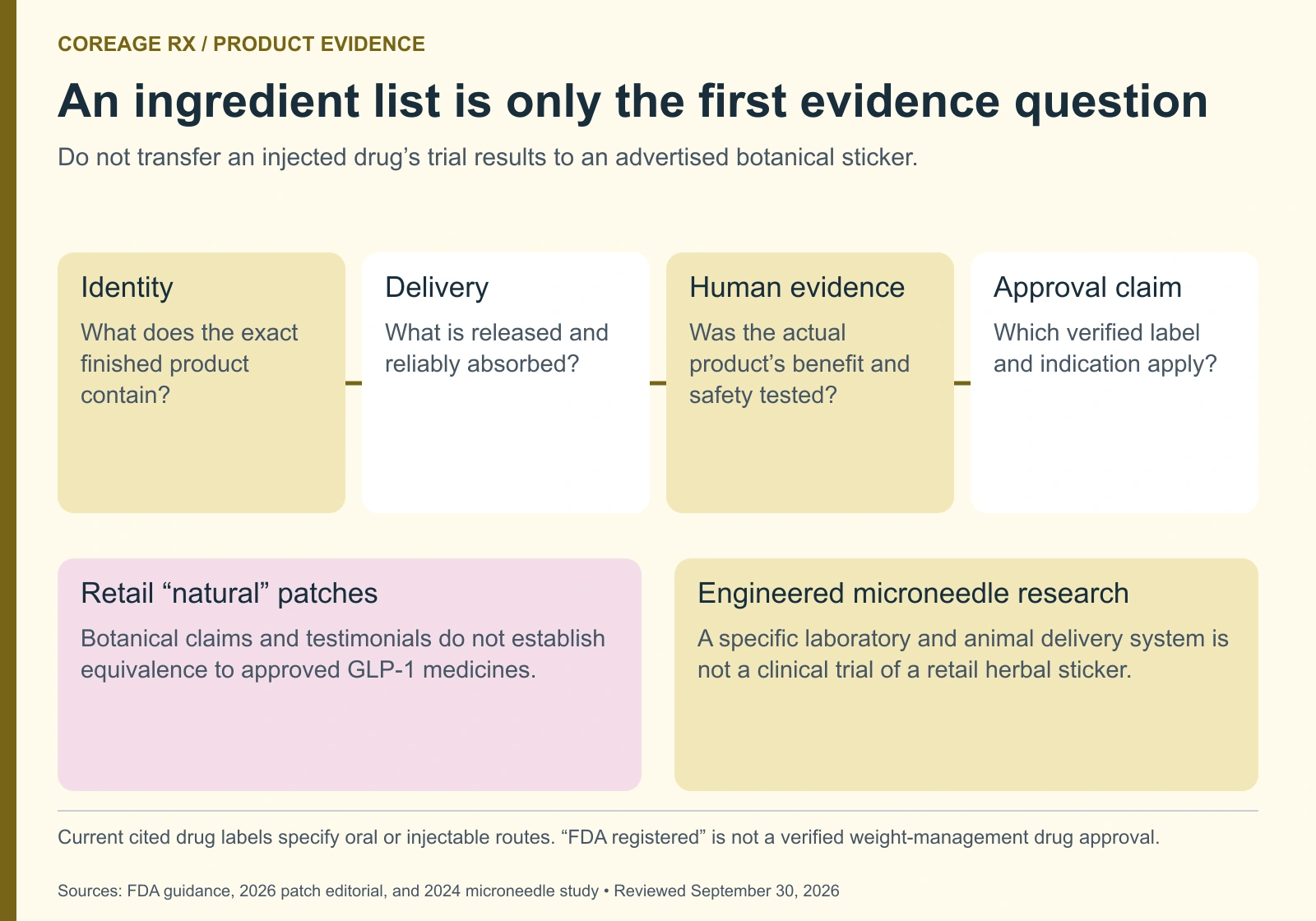
A useful evidence sequence would establish:
- What the finished product actually contains, with reliable testing.
- How the ingredient is released from that formulation.
- Whether the delivery route produces a consistent relevant exposure.
- Whether the exact product has demonstrated the claimed benefit and acceptable safety in people.
Skipping from “contains an ingredient” to “works like a prescription injection” bypasses those questions. A seller’s patch-size description, wearing time, or claim of slow release is not by itself a measured bloodstream dose.
The distinction is particularly important when an advertisement borrows the name of a prescription medicine. Research on an injected or swallowed drug cannot automatically support another route or formulation.
What about scientific research on microneedle patches?
Researchers do investigate new delivery methods. A 2024 microneedle study, for example, tested a specially engineered system containing semaglutide and designed for scheduled release. Its work included laboratory and animal experiments; a pharmacokinetic experiment used rats.
That system used microneedles designed to penetrate skin. It was not a trial of an ordinary adhesive herbal patch bought online, and it did not establish approval or clinical effectiveness for such a retail product.
This is a useful example of why the word “patch” is too broad to establish equivalence. A purpose-built experimental drug-delivery technology and a commercial botanical sticker can share a category word while differing in ingredients, construction, exposure, testing, and regulatory status.
If an advertisement cites microneedle research, ask whether the marketed product is actually the studied technology and whether its own clinical and approval claims can be verified. A future possibility in drug delivery is not evidence that every current patch works.
Are these patches FDA-approved GLP-1 medicines?
The current labels reviewed here describe Ozempic injection, Wegovy oral and injectable presentations, Mounjaro injection, and Zepbound injection. They do not authorize substituting a retail patch for those products. Sources: Ozempic, Wegovy, Mounjaro, Zepbound.
Do not infer approval from a website phrase such as “FDA registered,” a manufacturing-facility reference, or a supplement disclaimer. Ask for the actual approved drug name, product label, route, and indication. Those details should match the product being offered.
The FDA also explains that dietary supplements must be ingested; topical products are not dietary supplements under that definition. Source: FDA dietary-supplement questions and answers. A seller calling a skin patch a dietary supplement does not settle its regulatory category or establish approval for weight management.

Does “natural” mean safer?
No. “Natural” is not a demonstration of product purity, consistent exposure, safety, or effectiveness. A patch can also cause a local reaction, and uncertainty about delivery does not prove that none of its ingredients can have an effect.
The FDA’s consumer supplement guidance recommends reviewing supplement use with a healthcare professional because products can involve risks and interactions. Do not assume a botanical product is suitable with every prescription or health condition.
If a patch causes rash, burning, swelling, or other symptoms, stop using it and seek appropriate advice. Difficulty breathing, major swelling, fainting, or another severe reaction requires urgent help. Keep the packaging and ingredient information available for the clinician.
This does not mean every marketed product has been shown to cause the same harm. It means a reassuring adjective cannot replace actual product-specific evidence.
How should you assess a weight-loss claim?
Ask whether the evidence is about the exact finished product in people. A reliable explanation should identify the study population, comparison group, duration, outcomes, adverse events, and how many participants remained in follow-up.
| Claim shown online | Evidence question to ask |
|---|---|
| “Works like Ozempic” | Was this exact product directly tested against the named medicine? |
| “Clinically studied ingredients” | Was the finished patch studied, or only an ingredient by another route? |
| “Supports GLP-1” | What measurable clinical benefit was demonstrated in people? |
| “Results in days” | What controlled study supports that timeline and amount? |
| Before-and-after photos | What else changed, and where are the controlled data? |
| “FDA registered” | What actual approval and label apply to the finished product? |
Testimonials can describe a person’s experience, but they cannot isolate a product’s effect from eating changes, other medicines, measurement variation, or other factors. A large claim needs stronger evidence than an image or a review count.
Our natural GLP-1 food and supplement guide explains why a biological signal and a clinically established weight-management treatment are different questions.
Can a patch replace your current diabetes medicine?
Do not replace or reduce prescribed treatment based on an advertisement. If cost, side effects, or injection burden is a problem, contact the prescribing team and make a continuity plan. Diabetes treatment needs to address the actual condition and monitoring requirements.
The FDA’s discussion of unapproved GLP-1 products explains why approved medicines and unreviewed products should not be represented as equivalent. Compounded medicines also have a distinct regulatory status; they are not automatically approved generic versions of the branded drugs.
A patch is not a dosing conversion for a pen, tablet, or vial. A seller’s wearing schedule cannot tell you how to taper another medicine or predict glucose control. Make treatment changes with the clinician responsible for the prescription.
What if you want an option without injections?
Discuss approved oral treatments and whether they fit your diagnosis and circumstances. Current Wegovy labeling includes tablets for specified uses, with instructions and dose schedules that differ from injections. Source: current Wegovy label.
An approved oral product is not equivalent to every tablet, drop, gummy, or patch using the term GLP-1. Nor are oral and injected semaglutide milligram numbers interchangeable. Our oral semaglutide versus injections guide explains those distinctions.
The best consultation starts with the treatment goal, medical history, other medicines, tolerance, and access. Avoiding injections is a reasonable preference to discuss; it does not require accepting unsupported claims about a retail sticker.
What if patches appeal because prescription treatment costs more?
Compare complete, legitimate access options. Public price advertisements can omit the exact product, amount, eligibility, or ongoing care fees. A patch’s lower price does not establish the same clinical role.
Our GLP-1 cost comparison and insurance guide explain current payment pathways. The online prescription guide discusses assessment, pharmacy identity, and follow-up.
CoreAge Rx’s semaglutide and tirzepatide service pages describe its programs. Confirm the exact formulation, pharmacy product, all recurring charges, and care plan. A shared ingredient name does not automatically mean a service dispenses a particular approved brand.

How are patches different from nutrition support?
Ordinary food choices and individualized supplements can support nutrition without acting as replacements for prescription GLP-1 medicines. The purpose should be a real dietary need, rather than a claim that a food or supplement reproduces a branded trial outcome.
Our GLP-1 support supplement guide and supplements during treatment article explain related questions. They do not establish that a topical patch improves medication effectiveness or fills nutritional gaps.
The joint GLP-1 nutrition advisory emphasizes adequate intake, individualized assessment, and physical function during treatment. Those priorities remain relevant regardless of how a person prefers to obtain care.
What should you do before buying?
Identify the exact product, ingredients, route, evidence, and claim. Verify any approval statement and discuss relevant medicines or conditions with a clinician or pharmacist. If the seller cannot connect the claim to credible evidence for the actual patch, do not treat it as equivalent to an approved treatment.
A useful decision may be to review lower-cost care, approved oral options, or the reason injections feel difficult. Those conversations address the real concern without assigning a prescription medicine’s benefits to an unverified product.
Educational information for adults; individual treatment decisions require a qualified clinician. Sources reviewed September 30, 2026. Original AI-generated article images depict fictional people and objects, not patient outcomes. Other editorial images are illustrative. Graphics summarize the cited sources.