
Dark spots after acne can remain after the pimple itself has settled. These flat marks are often discussed as post-inflammatory hyperpigmentation, but they should be distinguished from active acne, red or purple marks, and scars that change the skin’s texture. The distinction matters because each feature may need a different approach.
A useful plan addresses two goals at once: preventing new inflammation and treating the marks that remain. Adding a brightening product while acne stays uncontrolled can leave you managing a continuing supply of new spots. An irritating routine can complicate both goals.
Identify what remains after the breakout
Look at whether the area is flat, raised, or indented. Note its color and whether tenderness or an active bump remains. A shadow from a depression can look darker in one light even when the main issue is texture rather than pigment.
The AAD’s dark-spot guidance explains that marks can follow acne and other inflammation. A clinician can help determine whether the appearance fits post-inflammatory hyperpigmentation or another change.
Do not assume every spot on an acne-prone face came from acne. A new, changing, bleeding, or unusual lesion should be assessed before it is repeatedly treated with a brightening cream.
Separate the treatment goals
| Finding | Main question |
|---|---|
| New pimples | Is the acne regimen preventing new lesions adequately? |
| Flat brown marks | Is pigment treatment appropriate after diagnosis? |
| Red or purple marks | Is the color change primarily pigment or something else? |
| Indented scars | Does the concern require a texture-focused assessment? |
| Raised scars | What treatment fits the scar type and location? |
More than one finding can be present. You may need a plan that coordinates acne and pigment treatment while acknowledging that established scars have a different discussion. A single brightening ingredient should not be expected to do all three jobs.

Treat ongoing acne as part of prevention
Preventing new lesions can reduce the repeated inflammation that leaves additional marks. The AAD’s acne guidance for darker skin tones discusses the overlap between acne and post-inflammatory pigmentation. It also highlights the importance of avoiding irritation.
If acne is painful, deep, persistent, or scarring, seek a broader treatment assessment. A cosmetic serum may not be sufficient. The clinician should consider the full acne pattern and the effect on your daily life, not only the color left behind.
The gentle acne routine guide explains how to organize treatment around a few clear steps. Consistency and tolerance matter when the aim is to prevent the next cycle of lesions and marks.
Picking can create another problem to treat
Squeezing a lesion can injure the surrounding skin and extend inflammation. Repeatedly checking whether a bump can be emptied may turn a limited breakout into a larger area of irritation. The urge is understandable, but the result can make both texture and color more troublesome.
Avoid sharp tools, aggressive extraction, and scrubbing over healing areas. If a lesion is especially painful or persistent, ask the clinician what it is and what treatment is appropriate.
Also distinguish normal sebaceous filaments from blackheads. Treating every visible dot as something to remove can create unnecessary inflammation. The filament comparison can help reset that expectation.
Sun protection supports pigment care
The AAD’s dark-spot guidance recommends appropriate sunscreen, including tinted options with iron oxide for relevant pigment concerns. Choose broad-spectrum SPF 30 or higher and follow the label, with shade and protective clothing.
A sunscreen that fits acne-prone skin and your skin tone is easier to use consistently. If it feels heavy, pills, or causes discomfort, discuss the actual product and the rest of the routine. Do not assume every sunscreen in a broad category will behave the same way.
The tinted sunscreen guide explains the label discussion. An acne cream containing zinc oxide is not automatically a sunscreen, and a brightening cream does not replace one.

Consider pigment ingredients within the whole plan
Niacinamide, kojic acid, hydroquinone, and other ingredients may be discussed depending on the diagnosis and medical context. Their roles are not identical. A prescription combination needs its own treatment area, schedule, and duration.
The niacinamide pigmentation guide and kojic-acid guide explain the supporting evidence. The hydroquinone prescription guide covers the more specific treatment-window and monitoring discussion.
Do not add all of these as separate products because each appears on a list of brightening ingredients. A clinician can decide whether a simpler formula or a different sequence would fit your acne treatment and tolerance better.
Coordinate Pore Favor and Spot On if both are considered
Pore Favor lists salicylic acid, zinc oxide, niacinamide, and urea. Spot On lists hydroquinone, kojic acid, and niacinamide. The public ingredient summaries do not disclose individual strengths.
These are different provider-guided formulations. If both are being discussed, ask which area each treats, when each is used, and whether the combination is appropriate for your skin. Niacinamide appears in both, but that shared ingredient does not make the directions interchangeable.
Do not independently layer the products to speed up the process. The Spot On ingredient guide and Pore Favor guide can help prepare a complete product review.
Avoid the irritation-and-pigment cycle
A routine with multiple acids, a retinoid, a scrub, and a brightening prescription can become difficult to tolerate. If irritation creates additional inflammation, new color changes may appear while the original marks are being treated.
Keep a timeline of products and symptoms. Note which areas burn, itch, scale, or become red, and whether the problem began after a particular change. Bring the complete list to the prescriber rather than assuming one active is always the culprit.
Stop a newly introduced product that causes a marked reaction and seek advice. The dark-spot irritation guide explains what information helps a clinician review the problem.
Track old marks and new marks separately
Choose a few existing marks to follow in comparable photographs. Keep lighting, distance, expression, and skin preparation similar. At the same time, record new acne lesions and new marks rather than combining everything into one overall judgment of uneven tone.
This distinction can reveal useful progress. Older marks may be fading while new breakouts create additional ones, suggesting that acne control needs attention. Alternatively, acne may improve while established pigment remains slow to change.
Do not use one photograph to decide that a product has failed or to justify increasing the amount. Review the pattern over time with the clinician and keep the prescribed treatment window in view.
Ask about maintenance and recurrence
Once acne and pigment improve, ask which steps should continue and which should change. A hydroquinone-containing preparation should not automatically become an indefinite maintenance product. The provider should define the next stage.
If breakouts recur, discuss the acne plan rather than only restarting an old brightening prescription. If pigment returns without obvious acne, reassess whether the diagnosis or triggers are different.
The melasma and post-acne comparison explains why similar colors can have different causes. A history of acne should not prevent a fresh look at a changing pattern.
When to seek earlier care
Painful deep acne, scarring, or substantial distress warrants professional attention. A spreading rash, marked swelling, blistering, or persistent burning after a new product needs advice. Severe facial swelling or breathing difficulty requires urgent care.
Unexpected blue-gray darkening during hydroquinone use should be assessed rather than treated with more product. Discuss pregnancy, breastfeeding, allergies, other medications, and recent procedures before starting or combining prescriptions.
Keep the two goals connected
At a consultation, bring examples of both an active lesion and a mark that remains after healing, if present. Describing when each appeared helps the clinician separate prevention from treatment of existing discoloration. You do not need to wait until the skin looks its worst before asking for that distinction to be explained.
Post-acne pigment care works best when the plan prevents new inflammation and addresses the remaining marks without unnecessary irritation. The result may be gradual, and color and acne may improve at different rates.
A clear diagnosis, a manageable acne regimen, appropriate sun protection, and a defined pigment-treatment plan are more useful than adding every brightening ingredient at once. Track each outcome and let the follow-up decision reflect the actual pattern of change.
Explore Spot On™
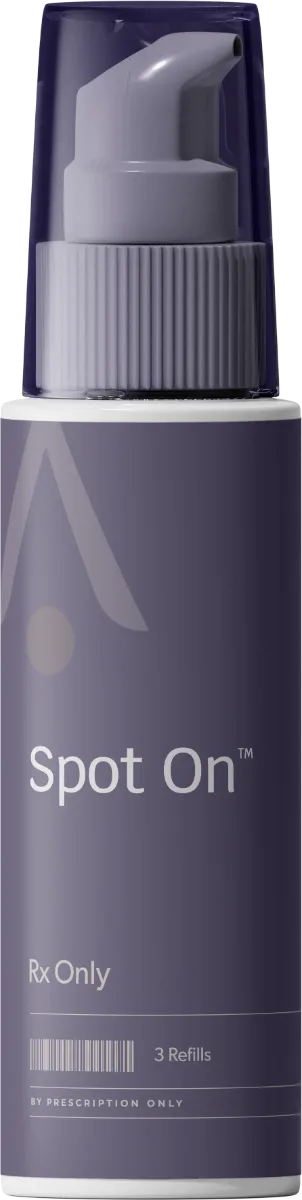
Spot On lists hydroquinone, kojic acid, and niacinamide. Confirm the dispensed strengths, treatment area, and planned treatment duration with your provider. A new or changing dark spot should be assessed before cosmetic treatment. Review the current Spot On™ page and bring your existing skin-care products to the provider discussion.
Related reading
- Hyperpigmentation Treatment: Dark Spots, Diagnosis, and Daily Care
- Melasma, Sunspots, and Post-Acne Marks: Why the Difference Matters
- Niacinamide for Hyperpigmentation: A Supporting Ingredient
- Sunscreen for Dark Spots: Broad-Spectrum Protection and Tinted Options
- A gentle routine for acne-prone skin
Educational information; your prescription and clinician’s instructions guide individual care. Product details and linked sources checked September 15, 2026. Ingredient research does not establish identical results for a finished compounded formula. Photographs are illustrative and do not show treatment outcomes.