
Stopping testosterone replacement therapy can lead to the return of symptoms that were present before treatment, but there is no universal recovery schedule. What happens depends on the original cause of low testosterone, the formulation, treatment duration, current health, and whether the body’s own hormone production can recover. Sperm production follows a related but separate process.
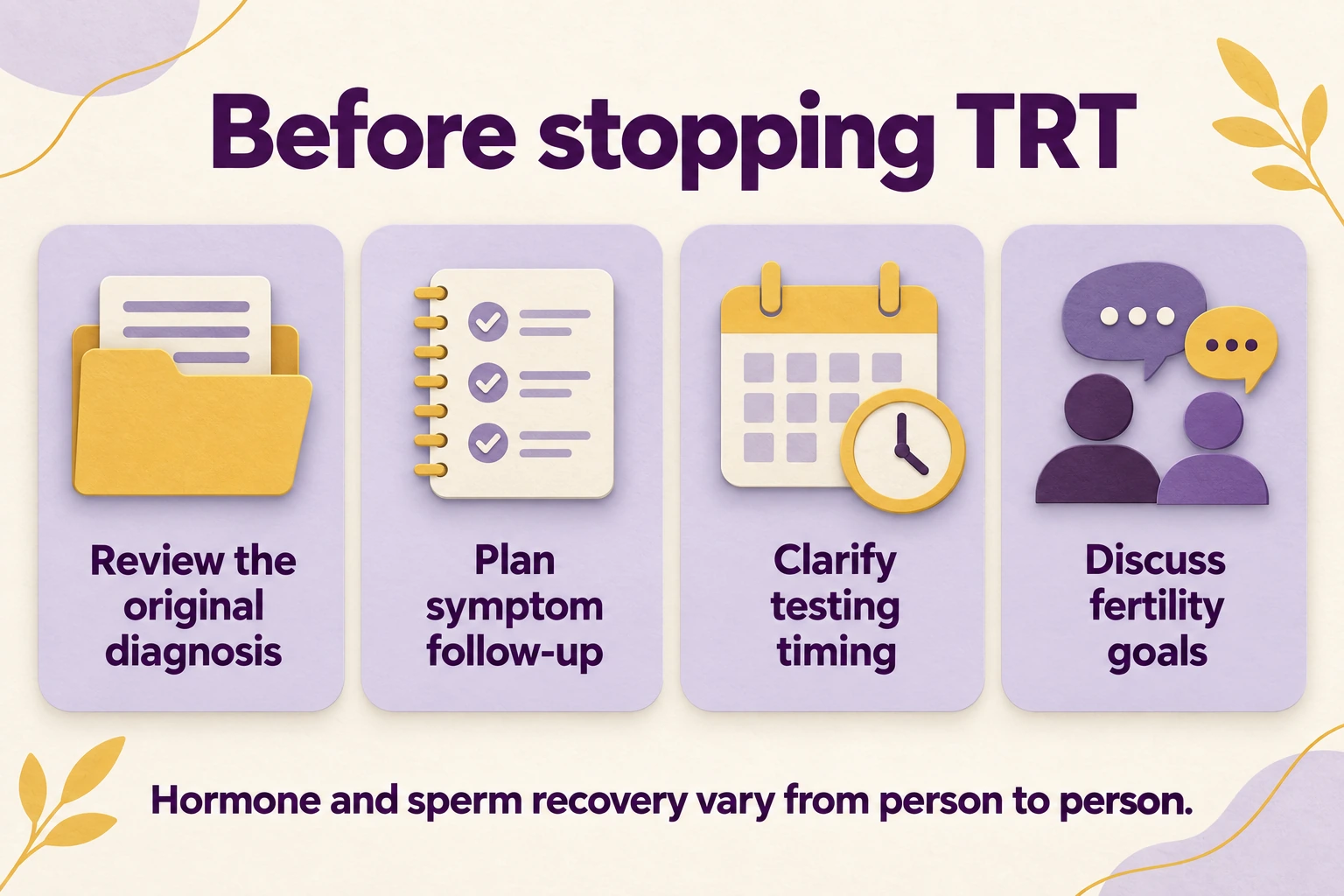
A useful stopping plan begins with the diagnosis and the reason for the change. It should explain symptom follow-up, the timing of any testing, fertility goals, and how to get help if the transition is difficult. This guide focuses on prescribed TRT in adult men with hypogonadism and does not provide a self-directed taper or “post-cycle” drug regimen.
Why people consider stopping TRT
Reasons vary. A person may have received little meaningful benefit, developed an adverse effect, changed fertility plans, or found the cost or routine difficult to maintain. A new clinician may also want to review how the original diagnosis was established. Each situation leads to different questions.
Start by stating the main concern. “I want to have a child,” “my blood count has risen,” and “my energy never improved” are not interchangeable reasons to change treatment. The clinician needs to know which problem the plan is trying to solve.
If access or affordability is the issue, say so early. An unplanned gap can be harder to manage than a discussed change, particularly with a long-acting formulation or a history of severe symptoms. Ask about follow-up options before supplies run out rather than stretching doses or substituting a different product independently.
The original diagnosis shapes expectations
TRT can be prescribed for low testosterone arising from a problem in the testes or from the hormonal signaling system involving the hypothalamus and pituitary. Other contributors, including medicines and certain health conditions, may be relevant in some patients. The likelihood of recovering adequate untreated hormone production is not the same across these situations.
The Endocrine Society guideline recommends evaluating the cause of confirmed testosterone deficiency. If the underlying condition permanently limits production, stopping replacement does not remove that condition. If a potentially reversible contributor has changed, a clinician may consider how to reassess it.
Ask for the original records: symptoms, at least two diagnostic testosterone results when available, collection details, and any testing of the cause. The total and free testosterone guide explains why complete reports are more useful than a remembered number. A careful review can identify what is known and what remains uncertain.
Why the body’s own hormone production can be suppressed
Testosterone taken from outside the body can reduce the signals that normally stimulate the testes. That feedback is part of why exogenous testosterone can suppress sperm production. A blood testosterone level during treatment reflects the treatment context and does not demonstrate that the untreated signaling system is working normally.
The full Endocrine Society guideline discusses the reproductive implications of testosterone therapy. When treatment is stopped, the presence of medicine in the body, the underlying diagnosis, and recovery of signaling all influence what happens next.
It is useful to separate two questions: when the prescribed testosterone exposure declines, and whether adequate natural production returns. Those are not identical events. A person can have low levels after the medicine’s effect has diminished if the original disorder persists or recovery has not occurred.
Formulation changes the timing of the transition
A gel, a short-acting injection, a long-acting injection, and an implanted product do not release testosterone in the same way. The timing of the last dose therefore matters when planning testing and interpreting symptoms. A schedule from someone using a different formulation may be irrelevant to your situation.
Bring the exact product name, concentration, route, prescribed interval, and date of the most recent use. If a compounded product is involved, bring the pharmacy label rather than describing the dose only in syringe “units.” The clinician needs the actual medicine information to understand exposure.
Our TRT injections versus gel guide explains practical differences between formulations. Do not create a stopping plan by skipping random doses, changing the route, or mixing remaining supplies from old prescriptions. Ask for clear instructions that match the product you are using.
Symptoms can return, but the pattern is individual
Lower sexual interest, fatigue, or other symptoms related to the original deficiency may return as treatment effects diminish. The timing and severity vary, and symptoms such as poor sleep or low mood can have additional causes. A difficult transition should prompt review rather than an assumption that every change is simply inevitable.
Choose a few meaningful measures to track: ability to complete usual activities, sleep quality, sexual interest, or the symptom that originally led to treatment. A short record can show whether the concern is stable, worsening, or associated with another change in health or medication.
Avoid comparing the experience with bodybuilding forums or a friend’s timeline. People may differ in diagnosis, exposure, dose, other drugs, and baseline health. Describing your own course clearly is more useful than trying to fit it into a promised number of weeks.
Fertility recovery is a separate question
A rising testosterone result does not prove that sperm production has recovered. Semen testing and reproductive evaluation answer different questions from a blood hormone test. If pregnancy is a current or future goal, discuss it before stopping or changing treatment whenever possible.
The AUA/ASRM male-infertility guideline advises against exogenous testosterone in men interested in current or future fertility. It explains that recovery of sperm production after stopping can take months and, in some cases, much longer. Recovery is variable and should not be promised for a particular date or assumed to be complete.
The TRT and fertility guide describes why specialist care may be useful. Tell the clinician about the desired timing of pregnancy and any previous fertility evaluation. Do not wait until a deadline is close to mention that goal, and do not assume that stopping TRT alone will address every possible fertility factor.

Why online recovery percentages can mislead
A recovery estimate from a study applies to the people and exposures studied. Data from healthy participants in male-contraception research, for example, may not predict what happens in a patient with longstanding hypogonadism or a different treatment history. A short-term study also cannot guarantee an individual outcome.
Ask what a quoted timeline refers to: testosterone in the blood, return of signaling hormones, a particular sperm concentration, pregnancy, or improvement in symptoms. These are different endpoints. A claim that “recovery takes three months” is not useful if it does not say what recovered and in whom.
A better plan acknowledges uncertainty and schedules reassessment. The clinician can explain which findings would suggest progress, which would prompt further investigation, and when reproductive-specialist input is appropriate. That approach is more useful than treating a population average as a personal deadline.
Is a taper always needed?
There is no universal patient-directed taper that applies to all TRT products and diagnoses. The reason for stopping, formulation, medical history, and clinical urgency influence the plan. A person stopping because of an adverse effect may need different instructions from someone undergoing a planned reassessment.
Ask whether the clinician recommends stopping, changing the interval, changing the formulation, or another approach, and why. If a stepwise change is prescribed, get the exact instructions in writing. Do not infer a schedule from a general article or from the amount of medicine remaining in a vial.
The practical goal is a supervised transition with appropriate follow-up. A taper is not a guarantee that symptoms will be avoided or that fertility will recover more quickly. The plan should be judged by whether it fits the clinical problem and includes a response to new concerns.
Avoid self-directed “post-cycle therapy”
Online recovery protocols may suggest prescription medicines, hormones, or combinations intended to stimulate production after testosterone use. These products have their own risks, monitoring requirements, and clinical indications. A regimen discussed in a bodybuilding context is not an individualized treatment plan for prescribed TRT.
Do not add medicines such as hCG, selective estrogen-receptor modulators, or aromatase inhibitors without specialist assessment and a prescription when appropriate. The need for an intervention depends on the cause of deficiency, fertility goals, laboratory findings, and other factors. An online protocol can also obscure the untreated hormone pattern that the clinician is trying to evaluate.
If you have already used additional products, tell the care team what they were and when you used them. Accurate information helps interpret testing and symptoms. The purpose of that conversation is to plan appropriate care, not to make you defend a previous decision.
Testing should have a purpose and a planned time
Ask when a follow-up blood test would be interpretable for your formulation and what question it will answer. Testing too early or without documenting the last dose can create a number that is difficult to use. Repeat assessment may be needed depending on the clinical course.
MedlinePlus describes testosterone testing and why results are interpreted with symptoms and other information. During a stopping plan, additional tests may be selected to evaluate the original cause, a treatment-related concern, or fertility. Not everyone needs the same panel.
Keep a written record of the last dose, any subsequent treatment changes, and the collection date. Ask who will review the results and how the plan changes if levels remain low or symptoms are troublesome. A test without an agreed next step can leave the most important question unanswered.
Support daily function while the plan is reviewed
A manageable sleep routine, adequate food intake, and activity suited to your health can support general well-being. They do not guarantee restoration of natural testosterone production. If symptoms limit activity, discuss adjustments rather than forcing a previous exercise routine or interpreting every difficult workout as permanent loss.
For strength-related goals, the beginner strength-training guide and creatine after 50 provide a separate educational starting point. The Strong Suit creatine product page offers current supplement details for readers comparing options with their clinician. Creatine is not a substitute for testosterone replacement when a hormone disorder requires treatment.
Sleep deserves particular attention if snoring, gasping, or daytime sleepiness is present. The TRT and sleep-apnea guide explains why a breathing disorder needs its own care. Treating another contributor can be valuable even if the hormone assessment remains unresolved.

When to contact the clinician sooner
Report a substantial decline in mood, severe fatigue, worsening function, or symptoms that make daily responsibilities unsafe. If you have thoughts of self-harm, seek immediate crisis or emergency support. Do not wait for a scheduled hormone test to address an urgent mental-health concern.
Chest pain, severe shortness of breath, fainting, or sudden neurological symptoms need urgent assessment. If stopping was prompted by an abnormal blood count, blood-pressure issue, prostate concern, or another adverse finding, follow that problem’s monitoring plan as well. Stopping the prescription does not automatically document that the concern has resolved.
The Endocrine Society’s 2026 TRT statement emphasizes accurate diagnosis and careful risk assessment. Those principles remain useful during a treatment change: identify the problem, follow the relevant findings, and reassess rather than assuming that stopping answers every question.
Common questions
Will my natural testosterone definitely return?
No. Recovery depends on the original diagnosis and other factors. Some people have an underlying condition that continues to limit production after treatment is stopped.
How long until I feel like I did before TRT?
There is no reliable universal timeline. The formulation, exposure, underlying condition, and other health factors matter. A symptom and follow-up plan is more useful than a fixed promise.
Can fertility recover even if I feel tired?
Symptoms do not measure sperm production. Fertility evaluation and semen testing may be needed, and a blood testosterone result alone cannot establish recovery.
Can I restart if stopping is difficult?
Contact the prescriber for reassessment. Restarting should account for why treatment was stopped, current symptoms, test results, and any new risks or fertility goals. Do not resume an old regimen automatically.
What should a written stopping plan include?
It should name the product, explain the treatment change, record the last dose or planned schedule, identify symptoms to monitor, specify testing and follow-up, and provide a contact route. The main TRT guide helps place that plan in the broader diagnosis and treatment discussion.
Related reading
- Low Testosterone, Stress, or Poor Sleep? Sorting Out Overlapping Symptoms
- Total vs. Free Testosterone: Understanding SHBG and Lab Results
- TRT and Sleep Apnea: Screening, Symptoms, and Follow-Up
- TRT and PSA: Understanding Prostate Monitoring Without Panic
- Testosterone replacement therapy: the starting guide
- TRT side effects and monitoring
- TRT and fertility planning
Educational information for adults; personal treatment decisions require a qualified clinician. Sources checked September 16, 2026. Original AI-generated illustrations depict fictional people and are not patient testimonials.