Prostate safety is a common concern when someone considers testosterone replacement therapy. The TRAVERSE trial provides unusually large randomized evidence, but its reassuring findings need to stay connected to the men who were actually enrolled and the monitoring they received.
The study found few prostate cancers and no statistically significant difference between testosterone and placebo in the measured prostate outcomes. That is useful evidence. It is not proof that the risks are identical, that screening can be skipped, or that the result applies to men with known prostate cancer.
What is PSA, and what does it tell us?
Prostate-specific antigen, or PSA, is a protein measured in a blood test. A PSA result can help guide prostate evaluation, but it is not a cancer diagnosis on its own. Its meaning depends on the value, trend, symptoms, medications, examination, and clinical context.
Benign prostatic hyperplasia, or BPH, means noncancerous prostate enlargement. Lower urinary tract symptoms, or LUTS, include problems such as changes in urine flow, urgency, or incomplete emptying. Prostate cancer, BPH, urinary symptoms, and PSA changes are related clinical topics, but they are not the same outcome.
TRAVERSE examined several of these questions separately. Our TRT and PSA monitoring guide provides a practical introduction; this article looks at the original randomized evidence behind the safety discussion.
Who was included in TRAVERSE?
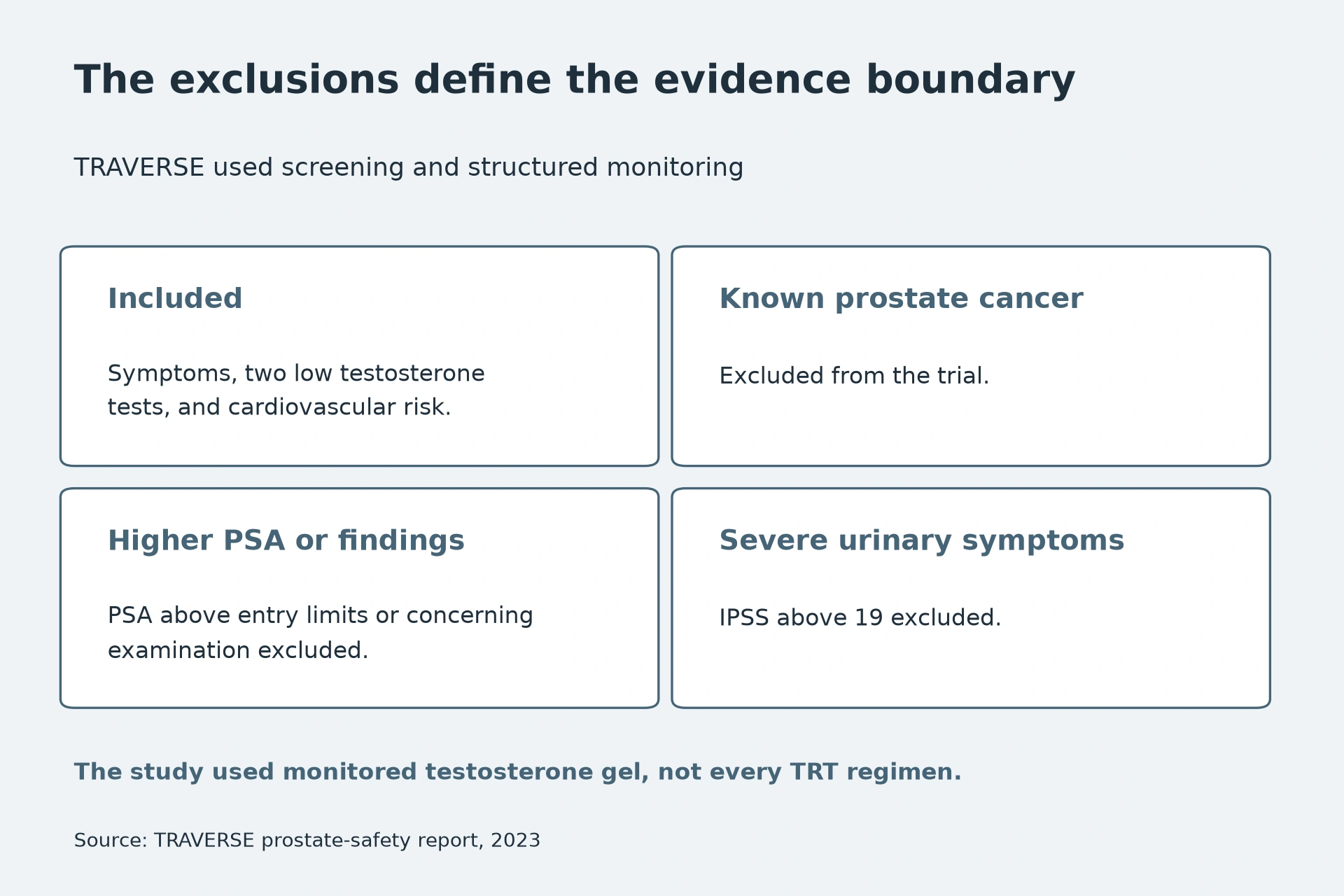
Participants were men aged 45–80 with at least one symptom of hypogonadism, two fasting morning testosterone measurements below 300 ng/dL, and established cardiovascular disease or increased cardiovascular risk. They were randomly assigned to daily 1.62% testosterone gel or matching placebo. Treatment was adjusted and monitored under the study protocol. Original prostate-safety report.
The full analysis set included 5,204 men. The prostate safety analysis included 5,198 who received at least one dose: 2,596 in the testosterone group and 2,602 in the placebo group. These numbers are close but not interchangeable; the event percentages should use the safety-analysis denominators.
Average treatment exposure was approximately 22 months in each group. The report accumulated 14,304 person-years of follow-up. A person-year combines time contributed by multiple people; it does not mean any one participant was observed for thousands of years or that the trial answers lifetime risk.
Who was excluded, and why does that matter?
Men were excluded for a history of prostate cancer, PSA above 3.0 ng/mL, severe LUTS defined by an International Prostate Symptom Score above 19, or a prostate nodule or induration. The PSA exclusion threshold was lower for men taking a 5-alpha-reductase inhibitor, a medicine class that can alter PSA interpretation. Eligibility criteria.
The trial therefore deliberately reduced enrollment of men at higher prostate-cancer risk or with severe urinary symptoms. That makes its findings more informative for similarly evaluated men, while limiting how confidently they can be extended to excluded groups.
These thresholds describe study entry criteria. They are not a universal rule that every value below 3 is harmless or every value above 3 means cancer. Individual decisions require the broader clinical context and may involve a urologist.
How many high-grade prostate cancers occurred?
The primary prostate endpoint was adjudicated high-grade prostate cancer, defined by a Gleason score of at least 4 + 3. Independent review of an outcome, called adjudication, helps apply the study definition consistently.
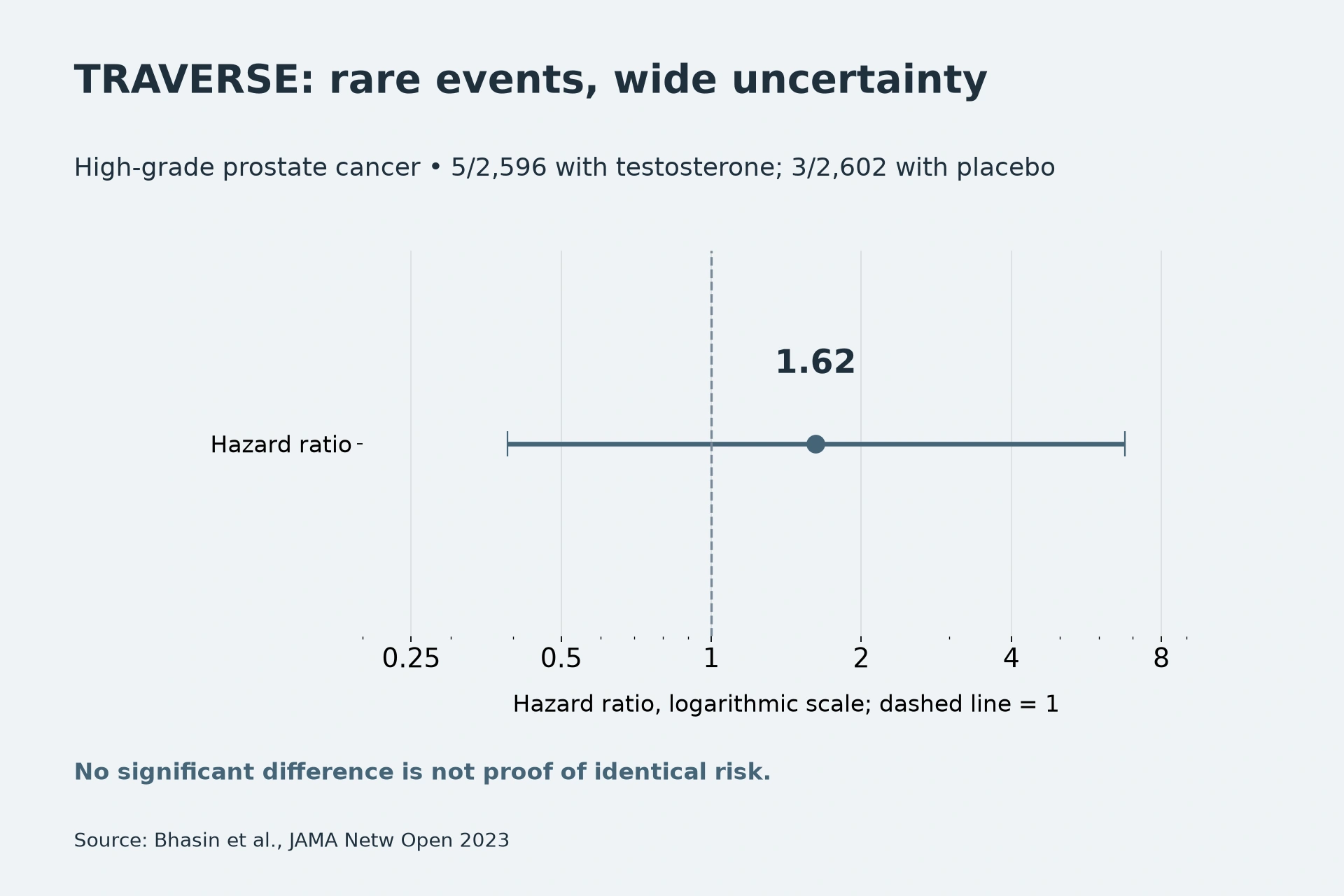
There were 5 cases among 2,596 testosterone recipients (0.19%) and 3 among 2,602 placebo recipients (0.12%). The reported hazard ratio was 1.62, with a 95% confidence interval of 0.39–6.77; the difference was not statistically significant. Primary result.
It is tempting to focus only on the two small percentages. The confidence interval is equally important. With only eight events, the estimate is imprecise and compatible with a broad range of relative effects. The investigators explicitly cautioned against interpreting the findings as proof that cancer risk was the same in both groups.
What does “not statistically significant” mean here?
It means the study did not demonstrate a difference meeting its statistical criterion. It does not mean the trial proved no difference exists or excluded every clinically important increase or decrease.
A useful analogy is measuring a small object with a ruler whose markings are far apart. The measurement still tells us something, but it cannot resolve every fine distinction. In this trial, rare events and limited follow-up constrain precision even though the overall sample was large.
The appropriate conclusion combines both observations: prostate events were uncommon in this screened population, and substantial uncertainty remains about the exact relative risk. Replacing that with “TRT cannot cause prostate cancer” would overstate the study.
What happened to other prostate outcomes?
The incidences of any prostate cancer, acute urinary retention, prostate biopsy, invasive prostate procedures, and new medication for urinary symptoms did not differ significantly between the treatment groups. Changes in symptom scores also did not differ significantly. Secondary results.
That provides useful context beyond the primary cancer endpoint. However, secondary outcomes have their own event counts and uncertainties. They should not be collapsed into a single claim that every prostate problem was ruled out.
The findings also do not establish testosterone as a treatment for BPH or urinary symptoms. A safety comparison showing no detected worsening under specified conditions is different from a trial demonstrating therapeutic benefit for those symptoms.
Why can PSA rise without proving cancer developed?
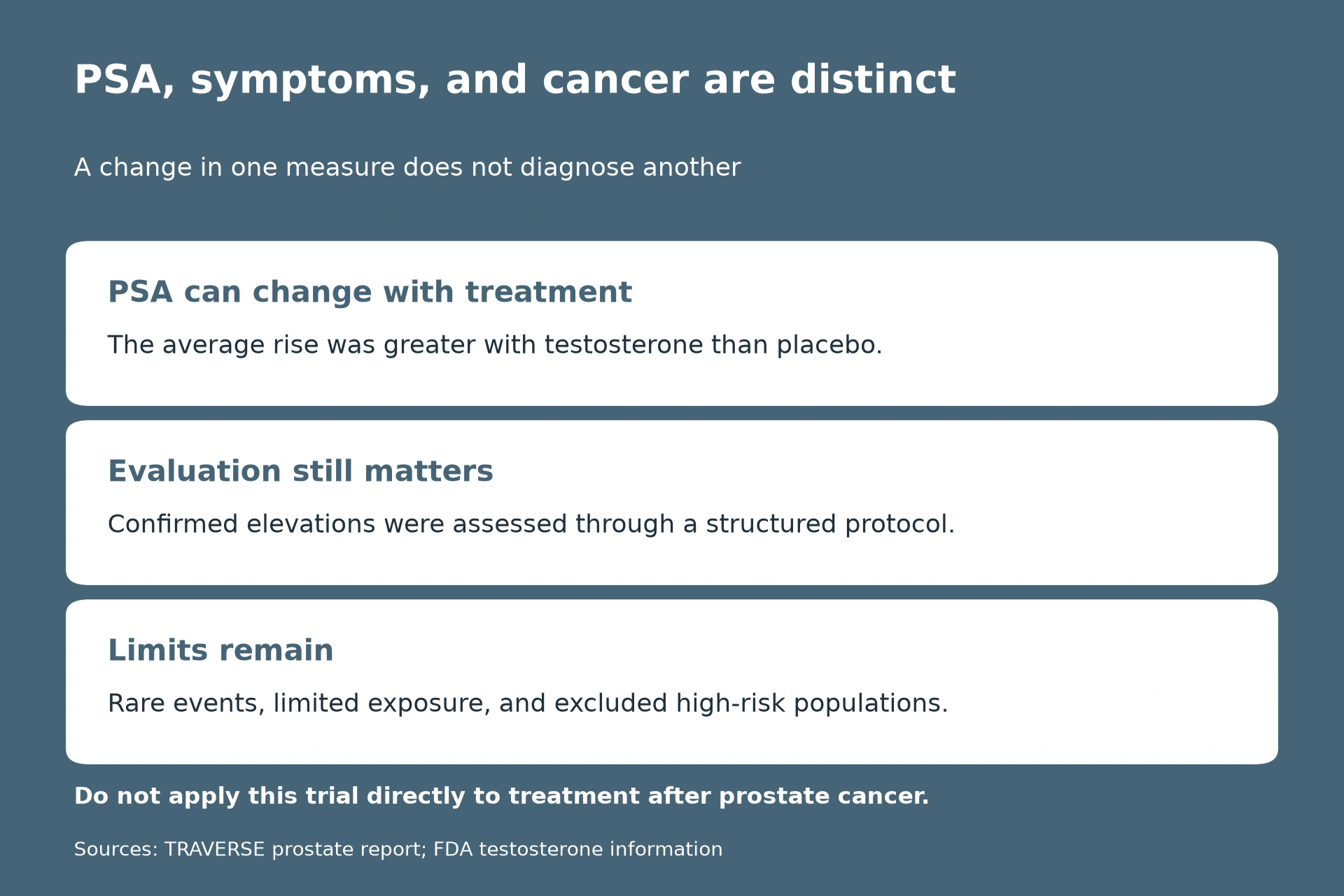
PSA concentrations increased more with testosterone than placebo. The average estimated between-group difference was small—approximately 0.15 ng/mL at 12 months—and did not continue widening thereafter. PSA analysis.
A biochemical change and a cancer event answer different questions. Testosterone-related PSA changes can prompt further evaluation, but the test alone cannot establish the cause. The trial used prespecified referral procedures and verified PSA elevations before proceeding through a structured evaluation process.
Participants with confirmed elevations received information about the meaning of PSA and the benefits and risks of biopsy to support shared decisions. The monitoring process is part of the context that produced the study’s outcomes. Removing that process while quoting the same reassuring result would ignore an important feature of the research.
What are the main limitations?
First, the results do not directly apply to men with known prostate cancer, higher PSA values, concerning examination findings, or no confirmed hypogonadism. Second, prostate cancer can develop over many years, while treatment exposure averaged roughly 22 months.
Third, there were few cancers, producing wide confidence intervals. Fourth, treatment discontinuation and loss to follow-up were substantial, and the COVID-19 pandemic affected retention. The investigators performed sensitivity analyses, but those analyses do not turn the study into complete lifelong observation. Limitations section.
Finally, this was monitored testosterone gel at physiological replacement targets. It does not prove identical outcomes for every formulation, higher-than-replacement dosing, anabolic-steroid use, or unmonitored treatment. Our TRT injections versus gel guide explains why route and regimen remain relevant.
How do the FDA’s newer labeling developments fit?
In February 2025, the FDA announced class-wide testosterone labeling changes after reviewing TRAVERSE and ambulatory blood-pressure studies. These included removing boxed-warning language about increased adverse cardiovascular outcomes and adding or strengthening blood-pressure warnings. FDA’s 2025 communication.
The FDA’s current testosterone information page also describes requested June 2026 updates, including removal of the age-related-hypogonadism limitation language and revision of prostate-cancer and BPH safety information. A request to update labeling should not be described as proof that every individual product already has identical revised wording. Current FDA information.
These developments make older blanket descriptions of testosterone labeling incomplete. They do not erase the prostate study’s exclusion criteria or make treatment appropriate for every person with fatigue. The current label for the exact prescribed product and the clinical assessment still matter.
What should happen before considering TRT?
The Endocrine Society guideline emphasizes compatible symptoms, consistently low testosterone confirmed with repeat morning testing, and evaluation of the underlying cause. It also identifies circumstances where testosterone should not be started without appropriate assessment. Clinical guideline.
A consultation should include prostate history, urinary symptoms, prior PSA results where relevant, family history, medication use, and the follow-up plan. Known or suspected prostate cancer requires specialist-informed decision-making; this trial cannot settle treatment after prostate cancer because those men were excluded.
Fertility, blood counts, blood pressure, sleep-related concerns, and other conditions belong in the same conversation. Our TRT fertility evidence review, testosterone and anemia review, and TRT monitoring guide examine these separate issues.
How can someone make follow-up more useful?
Keep a record of the exact product, dose, treatment dates, relevant laboratory results, and changes in symptoms. Report a new change in urination instead of assuming it is simply age-related or automatically caused by TRT.
Inability to pass urine, visible blood in urine, fever with urinary symptoms, or severe pain warrants prompt medical assessment. The low average event rate in a study does not determine the cause or urgency of a new symptom.
The CoreAge Rx TRT information page can support an individualized consultation. Its injectable treatment should not be presented as the exact gel regimen used in TRAVERSE, and the paper’s percentages are not personalized risk estimates.
Watch: the parent TRAVERSE research program
This NEJM video summarizes the parent trial’s cardiovascular safety findings. It provides context for TRAVERSE but does not report the separate prostate analysis. The prostate findings and their limitations are linked in the original paper above.
Common questions about TRT and prostate safety
Did TRAVERSE prove testosterone never increases prostate-cancer risk?
No. It found low event rates without a statistically significant difference in carefully screened men. Few events, limited treatment duration, and a wide confidence interval prevent a universal no-risk conclusion.
Does a PSA increase automatically mean cancer?
No. It is a finding that needs interpretation. The study used repeat confirmation and a structured evaluation process rather than treating every rise as a diagnosis.
Can the study tell me whether TRT is safe after prostate cancer?
Not directly. Men with a history of prostate cancer were excluded. That question needs specialist evaluation and evidence relevant to the particular cancer and treatment history.
Does this mean prostate monitoring is unnecessary?
No. The trial’s reassuring observations occurred alongside screening and monitoring. They do not show that removing those steps preserves the same outcomes.
What is the most balanced conclusion?
TRAVERSE offers useful evidence that serious prostate events were uncommon in appropriately selected and monitored men receiving testosterone gel. It supports informed decisions while preserving uncertainty about excluded populations, rare events, and longer-term exposure.
Original papers and supporting sources
The references distinguish full research papers, published abstracts, and official guidance. This educational narrative review is not a systematic review or an individual treatment recommendation. Sources were checked in October 2026.
- Bhasin S et al. Prostate Safety Events During Testosterone Replacement Therapy in Men With Hypogonadism: A Randomized Clinical Trial. (2023). Full text reviewed. DOI: 10.1001/jamanetworkopen.2023.48692. Open full text.
- FDA. Testosterone labeling changes, February 28, 2025. FDA labeling communication.
- FDA. Testosterone Information, including requested June 2026 revisions. Current FDA information.
- Endocrine Society. Testosterone Therapy in Men With Hypogonadism, 2018. Professional guideline.