Testosterone can improve symptoms in appropriately diagnosed men while reducing sperm production. That apparent contradiction makes more sense when blood testosterone and the hormonal signals needed inside the testes are considered separately.
The research also shows why fertility recovery should be discussed before treatment. Many men recover sperm production after hormonal suppression, but a recovery estimate from a carefully selected contraceptive trial is not a guarantee for someone after years of TRT or anabolic-steroid exposure.
How can testosterone reduce sperm production?
The reproductive system relies on signaling between the brain, pituitary gland, and testes. Testosterone supplied from outside the body can suppress pituitary signals, including luteinizing hormone and follicle-stimulating hormone. A normal or high testosterone concentration in a blood test therefore does not establish that the local conditions needed for sperm production are intact.
This is why feeling better, having improved libido, or achieving a target blood testosterone level does not prove fertility is preserved. A semen analysis answers a different question from a hormone test.
The AUA/ASRM male-infertility guideline advises against prescribing exogenous testosterone to men interested in current or future fertility. Our TRT and fertility introduction explains the practical implications, and the professional guideline provides the clinical framework.
What did the early testosterone-contraception trial demonstrate?
A World Health Organization multicenter study enrolled 271 healthy fertile men. It used a specific testosterone injection regimen to suppress sperm production and then assessed contraception in men who met a defined suppression criterion. Original 1990 report.
A total of 157 men became azoospermic in three consecutive semen samples; the estimated cumulative rate of achieving this state by six months was 65%. Azoospermia means no sperm were detected in the examined ejaculate. Those qualifying men entered the contraceptive-efficacy phase, where one pregnancy occurred during 1,486 months of observation.
The distinction between enrolled men and those who qualified for that phase is critical. The favorable contraceptive result did not apply to everyone who received testosterone, and not all men became azoospermic. This research does not make ordinary TRT a reliable contraceptive method.
Do not stop another contraceptive method because testosterone may reduce sperm counts. Suppression can be incomplete and variable, and this trial used repeated laboratory testing and a defined research protocol.
What did the pooled recovery analysis measure?
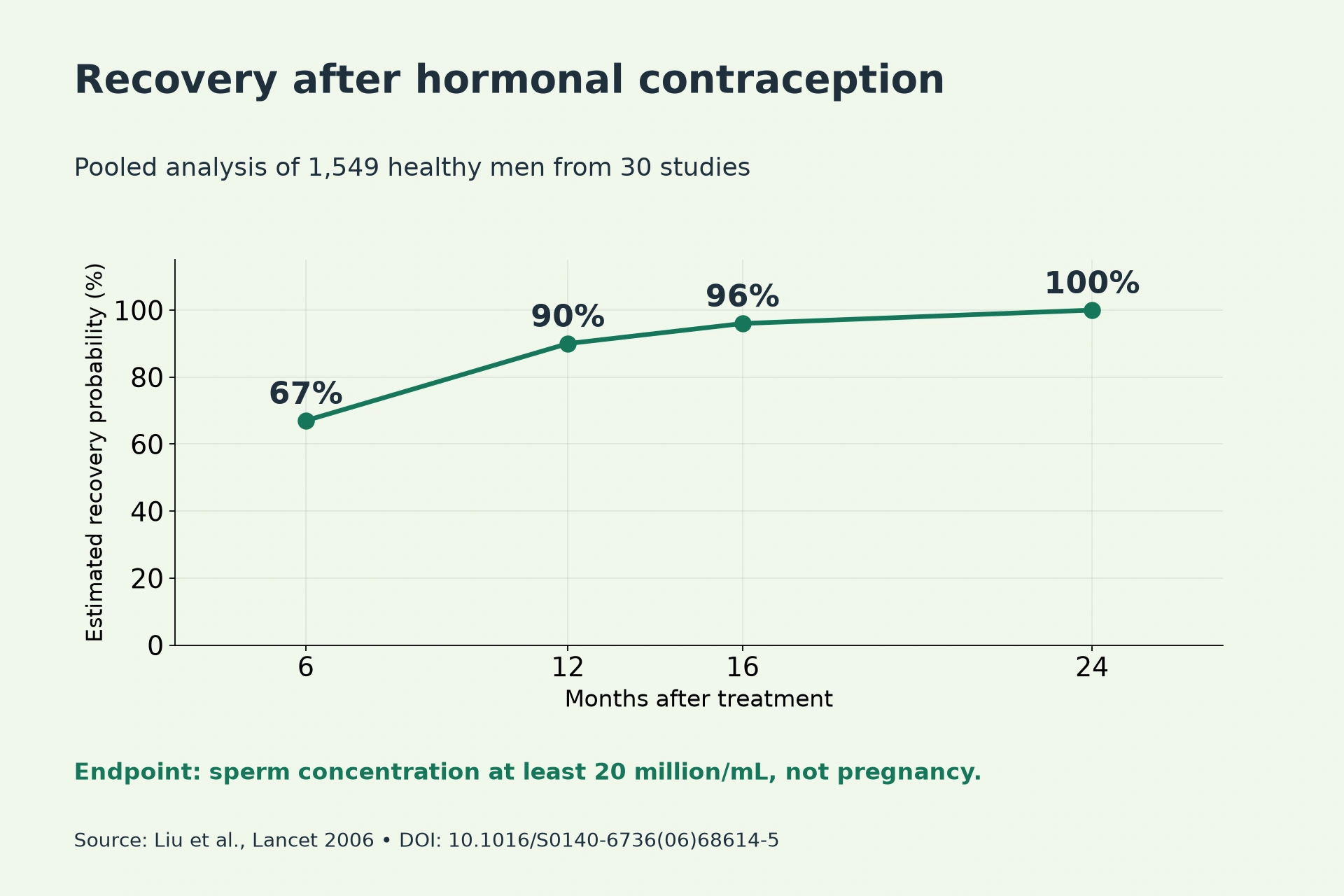
A 2006 individual-participant analysis combined data from 30 hormonal male-contraception studies, involving 1,549 healthy men aged 18–51. The studies had used androgen or androgen-plus-progestogen regimens, and sperm output was monitored during recovery. Liu and colleagues, 2006.
The main endpoint was recovery to a sperm concentration of 20 million per milliliter. The estimated median time to that threshold was 3.4 months. The reported probabilities of reaching it were 67% within six months, 90% within 12 months, 96% within 16 months, and 100% within 24 months.
These estimates describe the pooled contraceptive-study population and its model. The 24-month estimate should not be rewritten as “everyone on TRT will fully recover within two years.” That would extend the finding to people, exposures, and baseline conditions the analysis did not establish.
Why is the recovery threshold not a pregnancy guarantee?
Sperm concentration measures the number of sperm per milliliter of semen. It does not, by itself, capture ejaculate volume, motility, sperm function, partner factors, timing, or the full circumstances required for conception.
The pooled analysis used 20 million/mL as a research recovery threshold. It was not a guarantee of pregnancy and should not be treated as a universal pass/fail fertility boundary. Likewise, recovering to that threshold is different from returning to a person’s own pretreatment sperm count.
The earlier WHO trial illustrates this distinction. It reported a median of about 3.7 months from azoospermia to at least 20 million/mL, while the median time to the participant’s mean baseline concentration was 6.7 months. Different definitions of “recovered” produced different timelines. WHO recovery findings.
Who was represented in the pooled analysis?
The participants were healthy men with normal baseline hormone function, often called eugonadal men. They were selected for contraceptive research and monitored under study protocols. Most were White or Asian, and the age range ended at 51.
That is different from a man with an underlying testicular or pituitary disorder, prior infertility, prolonged unsupervised androgen use, or many years of TRT. A person can also have reduced fertility before testosterone treatment begins, making later interpretation more complicated.
The analysis found that several characteristics were associated with the rate of recovery, including duration of treatment and formulation. Those associations do not create a simple individualized calculator. In particular, a model derived from selected healthy volunteers should not be used to promise a deadline to an older infertility-clinic patient. Integrated analysis.
What did a study of men with testosterone-associated infertility find?
A separate retrospective study examined 66 men presenting to an academic male-infertility clinic after testosterone use. They stopped testosterone and received clinician-directed human chorionic gonadotropin, or hCG, together with a selective estrogen receptor modulator, or SERM. Kohn and colleagues, 2017.
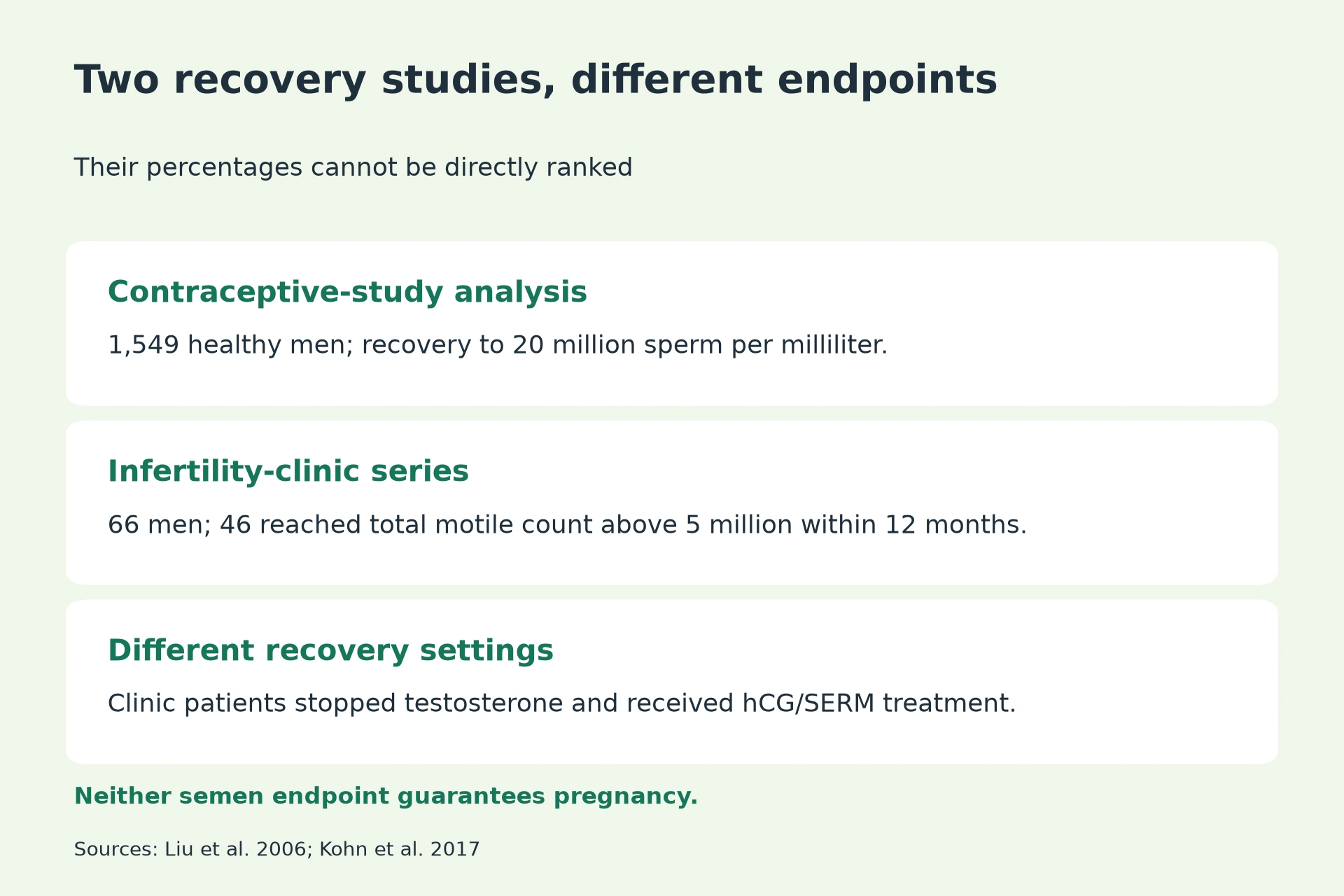
The endpoint was total motile sperm count above 5 million within 12 months, which was reached by 46 men, or 70%. Total motile count combines semen volume, sperm concentration, and the proportion moving; it is not the same as 20 million sperm per milliliter.
Increasing age and longer testosterone exposure were associated with slower or less likely recovery under the study’s definition. This clinical finding reinforces the importance of discussing fertility before prolonged treatment, but it has substantial limits.
It was a retrospective clinic series without a randomized untreated comparison. Participants received active fertility-directed treatment. It therefore cannot tell us how many would have recovered spontaneously, prove that the regimen caused every recovery, or establish a universal treatment protocol.
Why should the two recovery percentages not be compared as competitors?
The pooled contraceptive analysis reported 90% recovery by 12 months to a concentration threshold. The clinic series reported 70% reaching a total motile-count threshold during specialist treatment. Those percentages have different populations, denominators, endpoints, and treatment contexts.
| Feature | Contraceptive-study analysis | Infertility-clinic series |
|---|---|---|
| Participants | 1,549 healthy men | 66 men presenting after testosterone use |
| Design | Integrated analysis of 30 studies | Retrospective clinical study |
| Recovery endpoint | Sperm concentration of 20 million/mL | Total motile count above 5 million |
| Recovery setting | Follow-up after study regimens | Testosterone cessation plus hCG/SERM care |
| Pregnancy established by the endpoint? | No | No |
It would be misleading to conclude that one treatment approach is “20% worse” from these figures. The studies answer different questions. Their value lies in showing why recovery can be common yet still variable and clinically important to plan for.
What should be discussed before starting TRT?
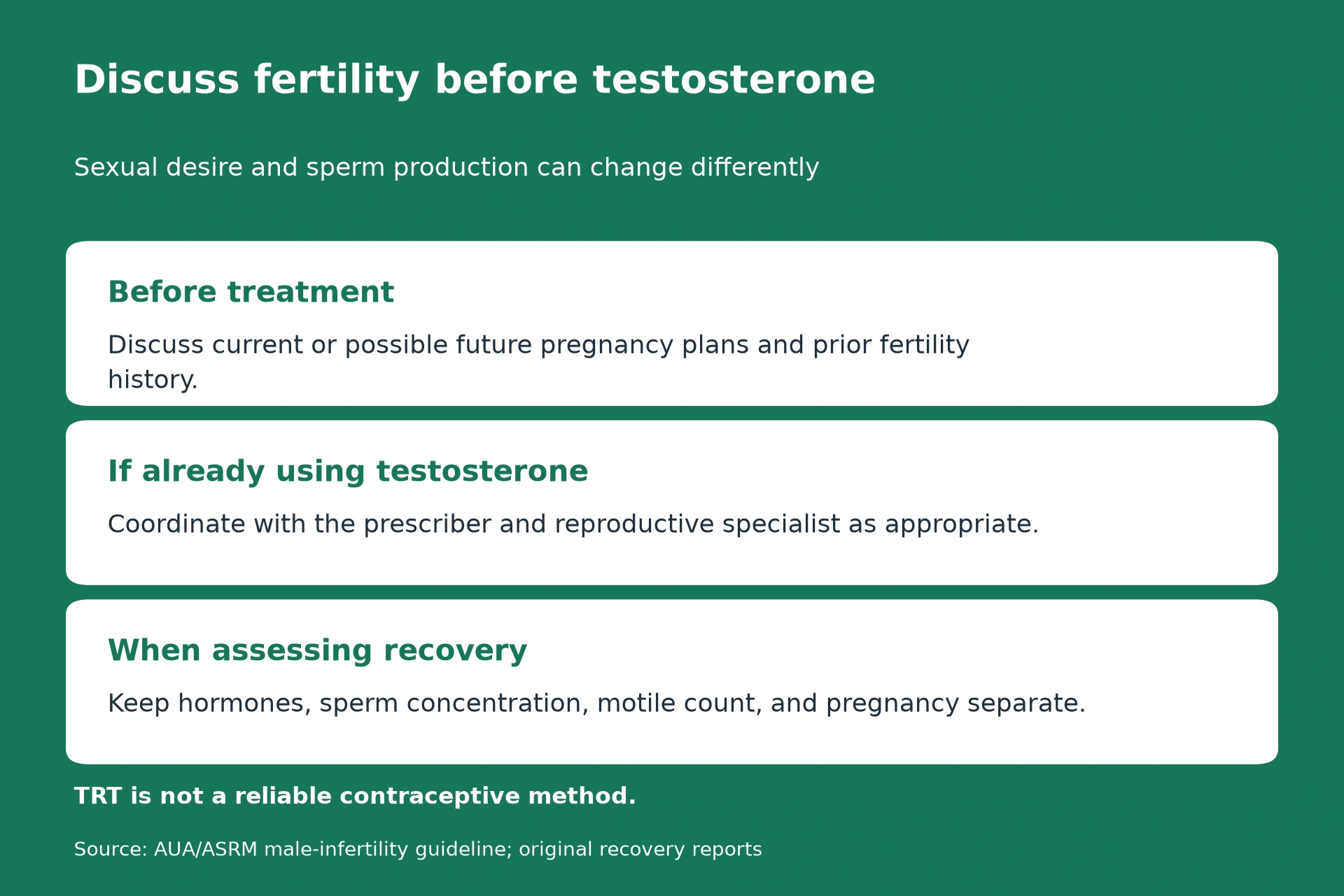
Tell the clinician whether having children is a current goal, a possible future goal, or uncertain. “Not trying this month” is not the same as having no future fertility plans. Include previous pregnancies, prior semen testing, testicular problems, cancer treatment, and any use of testosterone or anabolic agents.
A clinician may consider semen testing and reproductive-specialist input according to the situation. A baseline measurement can sometimes help later interpretation, but no single test establishes permanent future fertility. Discussion of sperm preservation or alternative management is individualized.
The starting-TRT questions guide can help organize the appointment. A symptom benefit is only one part of the decision; our TRT sexual-function review explains why sexual desire, erections, and fertility should be evaluated separately.
What if someone is already on testosterone and wants a pregnancy?
Arrange a conversation with the prescriber and, where appropriate, a reproductive urologist. Bring the complete treatment history, including formulations, doses, duration, prior use outside medical care, and any semen or hormone results.
Do not create a recovery regimen from internet protocols. hCG and SERMs are prescription therapies with specific clinical considerations, and the clinic study does not provide evidence for self-treatment. The right approach depends on the cause of low testosterone, fertility findings, symptoms, partner factors, and timing.
The AUA/ASRM guideline supports evaluation of both partners when infertility is being assessed. A predicted male recovery timeline should not delay attention to another factor affecting the couple’s opportunity to conceive. Male-infertility guideline.
Does a normal testosterone result mean recovery is complete?
No. Hormone concentrations and semen outcomes can move on different timelines. A normal blood result cannot substitute for a semen assessment when the question is sperm production, just as a semen concentration alone cannot guarantee pregnancy.
It is helpful to agree in advance on what will be monitored and what counts as progress. A clinician may interpret repeated measurements, because biological and sampling variation can make a single result incomplete. The goal is to answer the reproductive question rather than simply normalize one laboratory number.
The CoreAge Rx TRT information page can support a discussion about whether testosterone is appropriate. It should not be interpreted as a fertility treatment offer or as proof that adding another medication preserves fertility for every patient.
Watch: a broader male-fertility discussion
Mayo Clinic urologist Dr. Sevann Helo discusses male-fertility considerations in this video. It provides general context and does not establish a personal post-TRT recovery schedule. The original recovery studies remain the basis for the numerical results above.
Questions about TRT and fertility recovery
Is sperm suppression always permanent?
No. The contraceptive studies documented substantial recovery after treatment stopped. But those results do not guarantee full or timely recovery for every person with a different baseline condition or exposure history.
Does everyone become infertile on testosterone?
No. Suppression varies, and not everyone becomes azoospermic. That is one reason TRT should not be relied on as contraception.
Can improved libido mean fertility improved too?
No. Desire, sexual activity, and sperm production are different outcomes. Feeling better can coexist with a lower sperm count.
Does the 3.4-month median mean I should wait that long before getting help?
No. It is a research summary from selected volunteers, not an instruction to delay evaluation. A median also means many participants took longer. Reproductive planning should account for the couple’s full situation.
What is the most useful conclusion?
Discuss fertility before TRT whenever possible. Recovery evidence is encouraging in defined settings, but the endpoint, population, duration of exposure, and need for specialist care all matter when applying it to a real person.
Original papers and supporting sources
The references distinguish full research papers, published abstracts, and official guidance. This educational narrative review is not a systematic review or an individual treatment recommendation. Sources were checked in October 2026.
- AUA/ASRM. Diagnosis and Treatment of Infertility in Men, amended 2024. Professional guideline.
- et al. Contraceptive efficacy of testosterone-induced azoospermia in normal men. World Health Organization Task Force on methods for the regulation of male fertility. (1990). Published abstract reviewed.
- Liu PY et al. Rate, extent, and modifiers of spermatogenic recovery after hormonal male contraception: an integrated analysis. (2006). Published abstract reviewed. DOI: 10.1016/s0140-6736(06)68614-5.
- Kohn TP et al. Age and duration of testosterone therapy predict time to return of sperm count after human chorionic gonadotropin therapy. (2017). Published abstract reviewed. DOI: 10.1016/j.fertnstert.2016.10.004.