
An NAD+ injection prescription should make the connection between the medication, its concentration, the prescribed amount, and the supplied measuring device clear. “Units,” milliliters, and milligrams describe different things. A number copied from a website or another person’s syringe does not identify the right amount for your preparation.
This guide is about reading and checking a prescription, not selecting a dose. CoreAge Rx’s public product description cannot replace the directions on the medicine dispensed to you. If the label and your instructions disagree, the pharmacy or prescribing clinician should resolve that discrepancy before use.
Read the label as a connected set of information
Start with the patient’s name, drug name, and dispensing pharmacy. Then locate the concentration, container volume, route, amount to administer, frequency, storage instructions, and beyond-use date. Confirm that the supplies provided correspond to the instructions.
Each detail answers a different question. The concentration describes how much drug is in a volume of liquid. The container volume describes how much liquid was supplied. The directions specify what the individual should use. A large number printed on a vial may describe its total contents rather than one administration.
The FDA compounding overview helps explain why compounded preparations may require product-specific clarification. A familiar drug name does not establish a single standardized concentration across every prescription.
Milligrams describe the amount of drug
A milligram is a unit of mass. When a prescription gives the amount in milligrams, it is identifying an amount of NAD+, not necessarily a visible syringe marking. The volume corresponding to that amount depends on the concentration of the liquid.
For example, a more concentrated solution contains more drug in the same volume. That basic relationship is why using the same syringe mark with a changed concentration can deliver a different amount. The individual calculation should be confirmed by the pharmacy using your actual prescription and device.
Do not treat a total milligram amount on the front of the vial as a direction to inject all of it. Check the dispensing instructions that specify each administration.

Milliliters describe liquid volume
A milliliter measures volume. A syringe may display milliliter markings, another measurement scale, or markings designed for a particular medicine. The device needs to be understood before it is used.
A volume instruction and a mass instruction should agree for the supplied concentration. If one document gives an amount in milligrams and another gives a syringe mark, ask the pharmacist to explain the connection in writing. A complete instruction should be reproducible without mental shortcuts.
Avoid using a different measuring device simply because it appears similar. The scale, capacity, and intended use may differ even when two syringes look alike.
“Units” need an explicit device context
In online discussions, “units” often refers to markings on an insulin-style syringe. Those markings do not by themselves define a mass of NAD+. A statement such as “use the same number of units” is incomplete without the actual device and concentration.
For a prescribed non-insulin medication, the pharmacist should explain the required marking on the supplied device and the corresponding volume and drug amount. This is especially important if the prescription is refilled with a different concentration or if supplies are replaced.
Do not assume that a unit is a universal measure shared by different medications. The safest reading is the one that ties the number to the actual label and equipment rather than to a remembered online example.
Separate concentration from the vial’s total contents
The label may provide both a total amount and a concentration. These numbers are related, but they serve different purposes. Total contents help describe the container; concentration supports interpreting how much drug is in the prescribed volume.
A vial described as stronger may contain a higher concentration, more total liquid, or a different total amount. Those are not interchangeable descriptions. Ask which one changed if the packaging looks different on a refill.
Likewise, a smaller bottle does not necessarily contain fewer prescribed administrations. The directions, concentration, container amount, and beyond-use date all affect how the supply is used.

The route is part of the prescription
Subcutaneous, intramuscular, and intravenous administration are distinct routes. An instruction for one should not be translated into another based on convenience or a comparison chart. The formulation, equipment, technique, and monitoring need to match the prescribed route.
The injections versus IV article explains the evidence differences. Here the practical point is simple: the route written for your medicine should be unambiguous and should agree with the training you received.
If a product page lists more than one possible route, that describes options considered in care; it does not authorize the patient to choose between them independently.
Training should include a demonstration and a check-back
A useful teaching session lets the patient explain the directions back using the actual supplies. The clinician or pharmacist can ask the person to identify the medicine, describe the prescribed amount and timing, and point to the relevant marking on an unused demonstration device.
This process can reveal a misunderstanding before the medicine is administered. It is particularly helpful when written material uses several measurement terms or when more than one injectable medicine is used in the household.
Request accessible instructions if small print, vision, dexterity, language, or memory makes the routine difficult. The solution may involve clearer written directions, additional teaching, or a different clinical plan; it should not depend on guessing.
Use a short verification checklist
| Item | What should be clear |
|---|---|
| Identity | Correct person, medicine, pharmacy, and prescription |
| Formulation | Concentration and whether any preparation is required |
| Administration | Prescribed route, amount, device, and timing |
| Handling | Storage, beyond-use date, and instructions after first use |
| Support | Whom to contact for discrepancies, missed doses, or symptoms |
The checklist is a way to organize questions. It does not establish a dose or replace training. Keep the pharmacy’s final instructions with the medication so they remain available at the point of use.
A refill deserves a fresh comparison
People often become comfortable with a routine and stop reading the label closely. A refill is a useful time to check whether concentration, amount, frequency, device, or storage changed. The appearance of the vial is not a reliable guide to whether the instructions are identical.
If the pharmacy confirms that the plan changed, replace outdated reminders and keep the current version easy to identify. A photograph of the latest label can help during a consultation, but the physical container should remain correctly labeled.
Avoid combining leftover supplies from different prescriptions. Using a previous syringe or written note with a new preparation can create a mismatch that is easy to overlook.
Missed or uncertain administrations need specific advice
Ask in advance what to do if an administration is missed, interrupted, or uncertain. A general article cannot determine whether to skip, reschedule, or change the plan for an individual prescription. Do not automatically combine amounts to catch up.
If you are unsure whether an amount was already used, explain that uncertainty to the treating team. A brief administration record can reduce this problem. Record what actually happened rather than filling in a planned schedule as though every entry occurred.
The same principle applies when a device fails or some liquid is lost. The next step depends on the preparation and circumstances, not an improvised replacement estimate.
Handling and disposal belong in the instructions
The CDC’s injection-safety guidance emphasizes preventing contamination and using new sterile injection equipment. The supplied instructions should explain handling for the prescribed preparation and route. Do not reuse equipment or share a vial or syringe with another person.
The FDA’s sharps information describes safe containment of used needles. Arrange the disposal method before starting, including when traveling. A complete prescription routine includes what happens to supplies after use.
For storage questions, use the NAD+ storage guide to organize the conversation with the pharmacy. General advice cannot establish the stability of a particular compounded formulation.
Research protocols are not personal directions
Studies may report a dose, frequency, or route for selected participants under specific monitoring. Those details describe an experiment. They should not be adopted as a personal regimen or used to override the dispensed prescription.
The NAD+ evidence guide explains the limitations of the available human studies. Understanding those limits also helps prevent the assumption that a higher amount must produce a better result.
Before using the medicine, you should be able to describe the plan clearly with the actual label in hand. If that explanation still depends on a guess about concentration, units, or route, the prescription needs clarification first.
Explore NAD+ Injectable
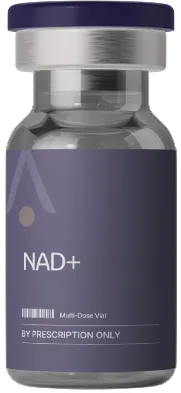
CoreAge Rx lists NAD+ Injectable as a provider-guided compounded treatment. The dispensed label must identify the concentration, route, and individual directions; clinical findings from another NAD+ preparation do not establish the same result for this product. Review the current NAD+ Injectable page and bring a complete medication and supplement list to the provider discussion.
Related reading
- NAD+ Injections: Evidence, Uses, and Questions to Ask
- NAD+ Injection Side Effects and Product-Quality Questions
- Storing and Traveling With Prescribed NAD+ Injections
- NAD+ nasal spray versus injections
Educational information; your prescription and clinician’s instructions guide individual care. Product details and linked sources checked September 15, 2026. Studies of another preparation or delivery route do not establish identical results for a finished compounded product. Photographs are illustrative and do not show treatment outcomes.