Memory lapses can be unsettling, especially when they appear alongside fatigue or a low testosterone result. It is reasonable to ask whether correcting the hormone level will improve thinking. Two randomized research programs tested that idea and did not establish a cognitive benefit in the older men they studied.
The Testosterone Trials included a dedicated memory analysis, while TEAAM examined several cognitive domains during a longer treatment period. Their findings are useful for setting expectations: a prescription that raises testosterone should not automatically be described as a treatment for memory loss or a way to prevent dementia.
Why might testosterone and memory appear connected?
Hormone levels, sleep, mood, illness, medicines, and cognitive performance can change with age. If two changes occur together, one does not necessarily cause the other. An observational association between lower testosterone and poorer cognition therefore cannot establish that replacement will reverse the cognitive problem.
A randomized trial addresses a more direct question: do people assigned testosterone perform better than comparable people assigned placebo? That comparison accounts for some influences that can otherwise make a treatment appear helpful, including expectation, repeated testing, and changes that happen over time in both groups.
Our low-testosterone symptoms and testing guide explains why symptoms and appropriately repeated laboratory measurements belong together. A memory complaint alone does not diagnose hypogonadism, and a single hormone result does not explain every symptom.
Who entered the Testosterone Trials memory analysis?
The Cognitive Function Trial assessed men in the broader Testosterone Trials program. The primary memory analysis involved 493 men aged at least 65 with low testosterone and age-associated memory impairment. Of these, 247 were assigned testosterone gel and 246 placebo gel. Original cognitive trial report.
Age-associated memory impairment was defined using both subjective memory complaints and objective test performance. It was not simply a person’s report of feeling distracted. It also should not be treated as interchangeable with a diagnosis of Alzheimer’s disease.
Participants used testosterone gel adjusted toward the normal range for younger men, or matched placebo, for one year. Cognitive testing occurred at baseline, six months, and twelve months. The trial tested a specific route, duration, and clinical population.
What was the main memory test?
The primary outcome was delayed paragraph recall: participants heard material and later recalled it, producing a score on a 0–50 scale. The analysis compared changes across the follow-up assessments. Secondary tests examined visual memory, executive function, and spatial ability. Study methods.
Naming the test matters. A statement that a treatment “improves the brain” could refer to alertness, mood, reaction time, a laboratory biomarker, or an actual memory task. Those are not equivalent outcomes, and an improvement in one would not prove improvement in all the others.
For patients, the practical question is often broader than a test score: can I manage appointments, work, medicines, finances, and daily responsibilities? Trials help evaluate a treatment claim, while a clinical assessment connects symptoms with everyday function.
What did the trial find?
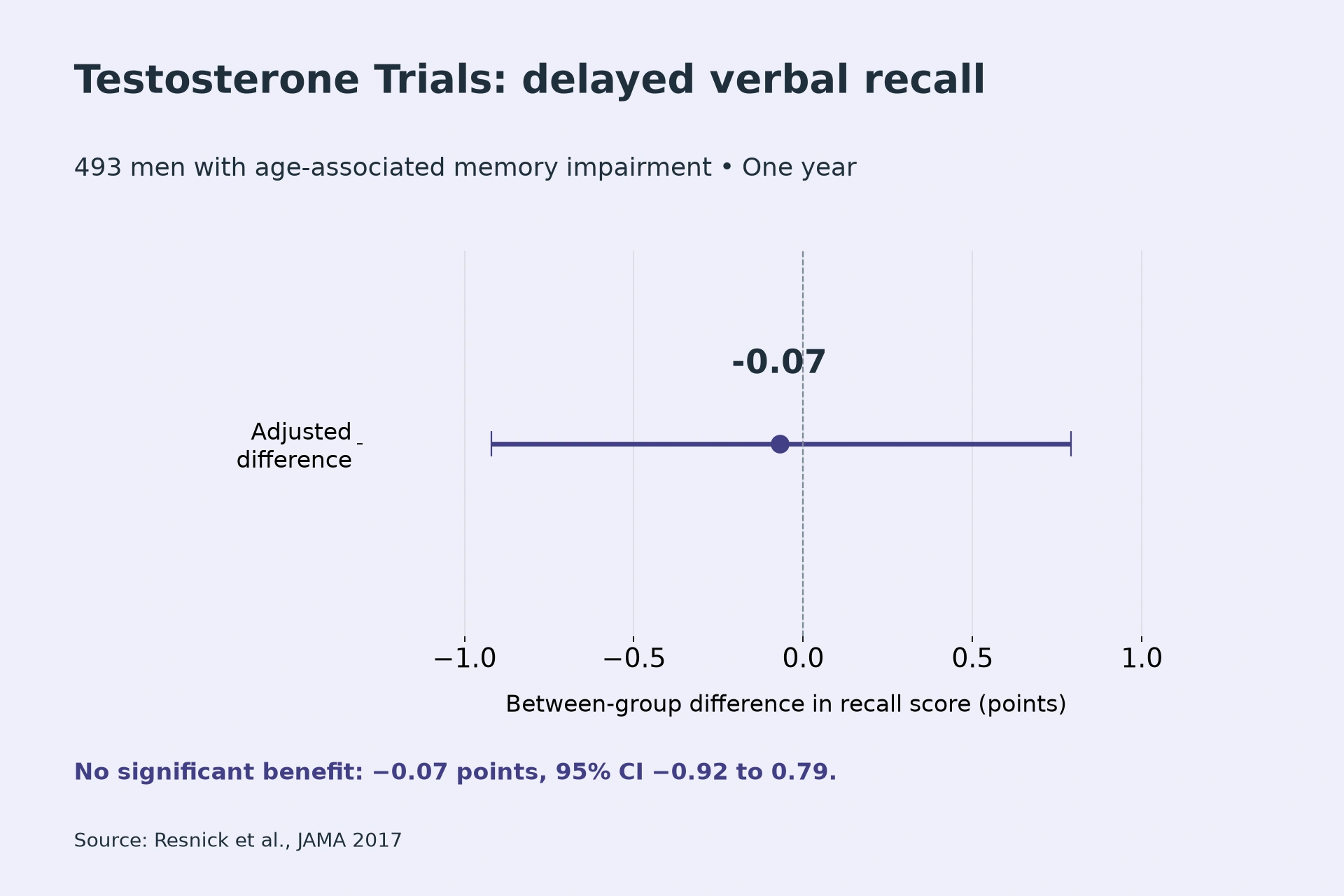
The adjusted between-group difference in delayed paragraph recall was −0.07 points, with a 95% confidence interval of −0.92 to 0.79 and P = 0.88. Testosterone did not show a significant advantage for the main memory endpoint. Nor did the reported secondary comparisons establish benefits for visual memory, executive function, or spatial ability. Trial results.
Both groups’ average recall scores increased over time. The testosterone group’s mean rose from 14.0 at baseline to 16.2 at twelve months; the placebo group’s rose from 14.4 to 16.5. Looking only at improvement within the treated group would therefore create a misleading impression of treatment success.
The between-group comparison is the relevant test. The trial does not tell us exactly why both groups improved, but it demonstrates why a before-and-after story is weaker evidence than a randomized comparison.
Does a null result prove testosterone can never affect cognition?
No single trial proves that a treatment has zero effect in every population under every circumstance. The confidence interval describes the uncertainty around this study’s estimated difference. The conclusion should remain specific: this regimen did not establish better memory in these older men over one year.
That qualification should not be used to reverse the result into a positive claim. Saying “it might work in someone else” does not provide evidence that it improves memory for a prospective patient. A recommendation needs support relevant to the actual diagnosis and goal.
The findings also do not determine whether treating a different, clearly established endocrine disorder could improve symptoms indirectly. That is a separate clinical question rather than a reason to market TRT as a general cognitive enhancer.
What did TEAAM add?
TEAAM randomized 308 men aged 60 or older with low or low-to-normal testosterone to daily testosterone gel or placebo for three years. A prespecified secondary analysis examined cognition in the 280 men who had baseline cognitive assessments. Original TEAAM cognitive report.
The study assessed verbal memory, verbal fluency, visuospatial ability, manual dexterity, and attention or executive function. Testosterone levels increased with treatment, demonstrating biological exposure, but the cognitive comparisons did not show a significant advantage.
For paragraph recall, the reported adjusted difference was 0.29, with a 95% confidence interval of −1.2 to 1.8. The study also reported no significant relationship between changes in cognitive scores and changes in measured hormone concentrations. Raising the laboratory value was not the same as improving the measured cognitive outcomes.
How do the two studies fit together?
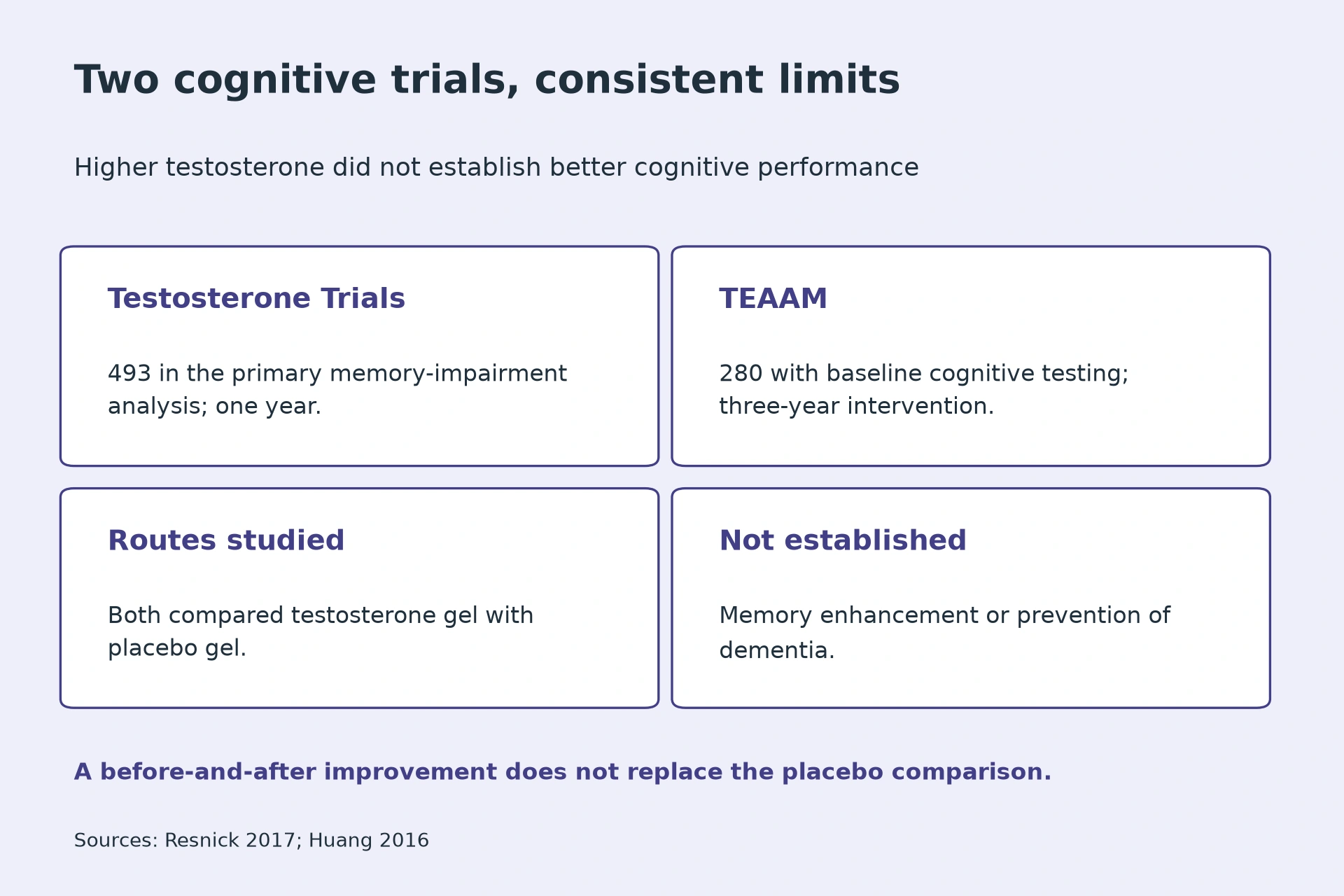
The studies differed in enrollment criteria, size, duration, and analysis. The Testosterone Trials focused its primary memory question on men with age-associated impairment. TEAAM provided a longer treatment window in a population with low or low-normal levels.
Their consistency makes a broad promise of improved memory difficult to justify. At the same time, neither was a definitive dementia-prevention trial following a large population for decades, and neither establishes treatment effectiveness for diagnosed Alzheimer’s disease.
| Feature | Testosterone Trials cognition study | TEAAM cognition analysis |
|---|---|---|
| Featured population | 493 men with age-associated memory impairment | 280 men with baseline cognitive testing |
| Age eligibility | At least 65 | At least 60 |
| Treatment duration | One year | Three years |
| Intervention | Testosterone gel versus placebo gel | Testosterone gel versus placebo gel |
| Cognitive conclusion | No established memory benefit | No established benefit across tested domains |
| Important boundary | Not a dementia-treatment trial | Cognition was a prespecified secondary analysis |
What if someone feels clearer after starting TRT?
An individual’s experience deserves attention. Feeling more alert or less distressed may matter even when it is not the same as improved delayed recall. The next step is to describe what changed, how consistently, and what else changed at the same time.
For example, sleep, mood, alcohol use, medication timing, or a new daily routine may influence concentration. A personal improvement does not identify the cause with the certainty of random assignment, and it cannot establish dementia prevention.
Our low testosterone versus stress and poor sleep guide and TRT sleep-apnea guide offer related questions to bring to a clinician. Avoid escalating a dose simply because a vague sense of “brain fog” persists.
How should memory symptoms be evaluated?
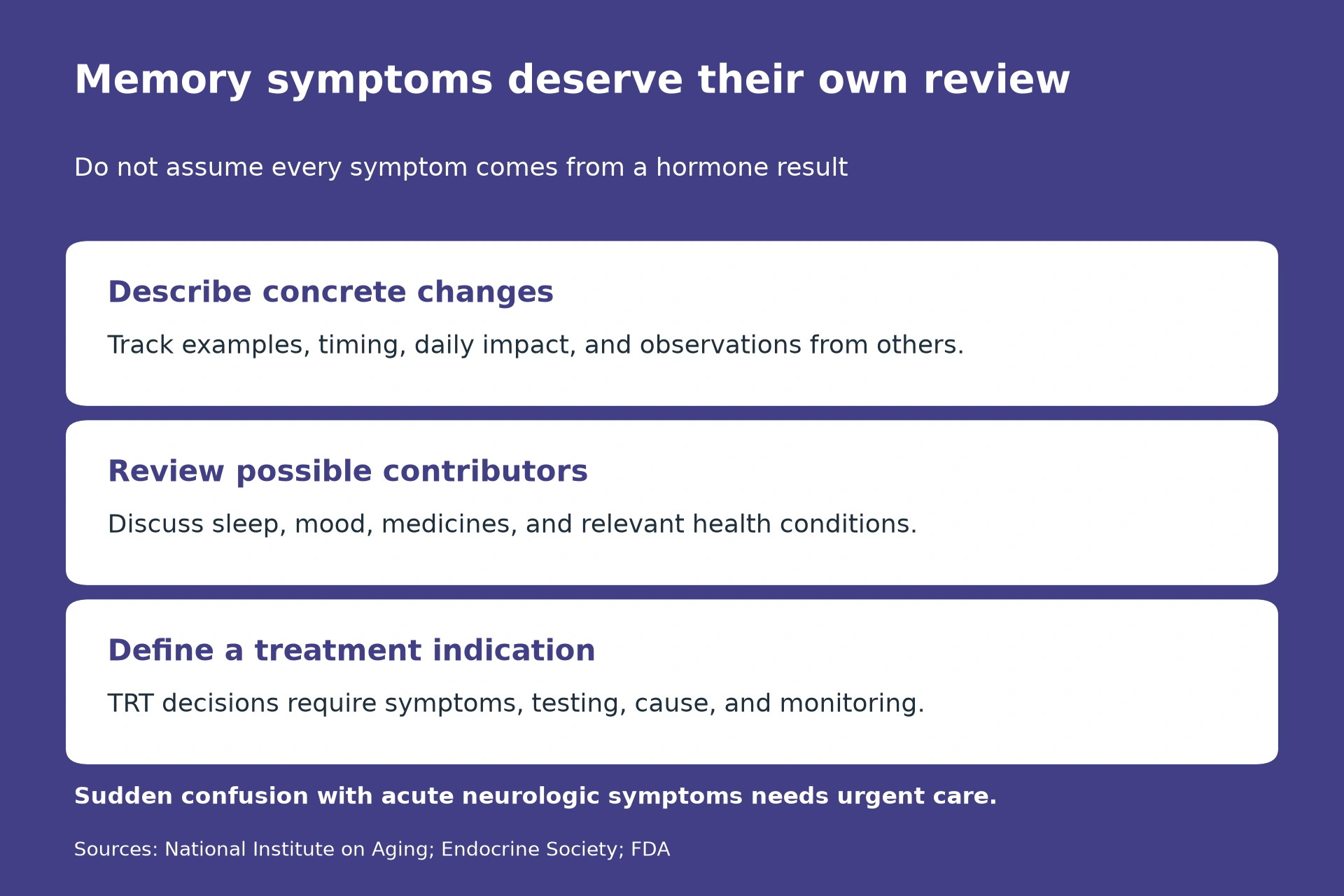
The National Institute on Aging distinguishes ordinary forgetfulness from changes that interfere with daily life. Medicines, mood problems, and other health conditions can contribute to memory difficulties, and some causes are treatable. Persistent or worsening symptoms deserve assessment rather than an assumption that they are hormonal. NIA memory guidance.
Bring concrete examples: missed appointments, repeated questions, difficulty following familiar tasks, or changes noticed by someone close to you. Include the timing, any sudden onset, and a current medication and supplement list. A clinician can decide which examination, tests, or referrals are appropriate.
Sudden confusion or memory change with new weakness, speech difficulty, or other acute neurologic symptoms requires urgent medical attention. That is a different situation from a gradual concern discussed at a routine hormone visit.
Where does TRT still fit?
The Endocrine Society guideline recommends diagnosing hypogonadism using compatible symptoms and consistently low testosterone concentrations, with evaluation of the cause. Treatment decisions also require discussion of benefits, risks, fertility, and monitoring. Clinical guideline.
A lack of cognitive benefit does not negate evidence for other carefully defined outcomes. Our reviews of testosterone and anemia, sexual-function trials, and bone outcomes examine those questions separately.
The TRT product page provides service information. It should not be interpreted as offering a proven memory treatment. These cognitive studies used gels; they do not establish that an injection, pellet, or higher dose would overcome the negative results.
What safety discussion belongs beside the evidence?
Monitoring remains important when testosterone is prescribed for an appropriate indication. Blood counts, prostate-related assessment when relevant, blood pressure, symptoms, and fertility plans can affect the decision and follow-up. Our TRT monitoring guide explains the practical questions.
The FDA’s 2025 labeling action removed cardiovascular-risk language from the boxed warning after review of TRAVERSE, while requiring or strengthening blood-pressure warnings. That update did not create an indication for memory enhancement or make monitoring unnecessary. FDA labeling update.
The cognitive papers disclose their funding and relationships. TEAAM’s support included AbbVie and academic or foundation sources. Funding context belongs alongside the trial design and results, including results that did not favor the intervention.
Video: understanding testosterone deficiency
This Mayo Clinic overview introduces testosterone deficiency. It provides background on the condition; it does not establish that testosterone improves memory or summarize the cognitive trials above.
Frequently asked questions
Is brain fog proof that I need testosterone?
No. “Brain fog” is a broad description, not a diagnosis. Testing and assessment should address the symptom pattern and possible causes rather than assuming a hormone explanation.
Would a higher dose work better for memory?
These studies do not establish that strategy. Increasing testosterone beyond the prescribed target can add risk without evidence of cognitive benefit.
Did the trials show that testosterone causes dementia?
No. They did not establish a cognitive benefit, which is a different statement from demonstrating dementia causation. Their designs and follow-up do not settle every long-term neurologic question.
What is a reasonable goal before starting treatment?
Agree on the diagnosed condition, the symptom or outcome being targeted, the monitoring plan, and when to reassess. A vague promise of better thinking is not an adequate substitute for that plan.
Original papers and supporting sources
The references distinguish full research papers, published abstracts, and official guidance. This educational narrative review is not a systematic review or an individual treatment recommendation. Sources were checked in October 2026.
- Resnick SM et al. Testosterone Treatment and Cognitive Function in Older Men With Low Testosterone and Age-Associated Memory Impairment. (2017). Published abstract reviewed. DOI: 10.1001/jama.2016.21044.
- Huang G et al. Effects of long-term testosterone administration on cognition in older men with low or low-to-normal testosterone concentrations: a prespecified secondary analysis of data from the randomised, double-blind, placebo-controlled TEAAM trial. (2016). Published abstract reviewed. DOI: 10.1016/s2213-8587(16)30102-4.
- Bhasin S et al. Testosterone Therapy in Men With Hypogonadism: An Endocrine Society Clinical Practice Guideline. (2018). Published abstract reviewed. DOI: 10.1210/jc.2018-00229.
- National Institute on Aging: memory, forgetfulness, and aging. Official guidance.
- FDA: 2025 testosterone labeling changes. Official guidance.