Weight loss and lower glucose do not automatically establish fewer heart attacks or strokes. SURPASS-CVOT tested cardiovascular outcomes directly, comparing tirzepatide with dulaglutide in adults who already had type 2 diabetes and atherosclerotic cardiovascular disease.
The result was important and specific: tirzepatide met the trial’s criterion for noninferiority to dulaglutide. It did not meet the prespecified criterion for superiority on the main cardiovascular endpoint. Understanding those two words prevents a favorable trial from becoming a stronger claim than its data support.
What question did SURPASS-CVOT ask?
The double-blind trial compared weekly tirzepatide, escalated up to 15 mg, with weekly dulaglutide 1.5 mg. Both groups received an active glucose-lowering medicine. The principal question was whether tirzepatide’s cardiovascular result would be no worse than dulaglutide’s by more than the prespecified statistical margin. Original SURPASS-CVOT report.
The primary endpoint combined death from cardiovascular causes, myocardial infarction, and stroke. A composite counts a participant’s qualifying event according to the study’s rules; it does not mean every participant experienced all three outcomes.
This is different from a weight-loss trial, a blood-pressure substudy, or a heart-failure symptom trial. Those can all inform care, but they measure different things. Our tirzepatide blood-pressure review addresses one of those related questions.
Who participated?
The trial randomized 13,299 people. It subsequently excluded 134 who did not meet inclusion criteria, leaving a modified intention-to-treat population of 6,586 assigned tirzepatide and 6,579 assigned dulaglutide. These analysis denominators are the relevant ones for the main event counts. Trial population.
Participants had a mean age of 64.1 years; 29% were women. Average diabetes duration was 14.7 years, average HbA1c was 8.4%, and average BMI was 32.6. The population therefore had established diabetes and vascular disease, rather than uncomplicated obesity or newly identified risk factors alone.
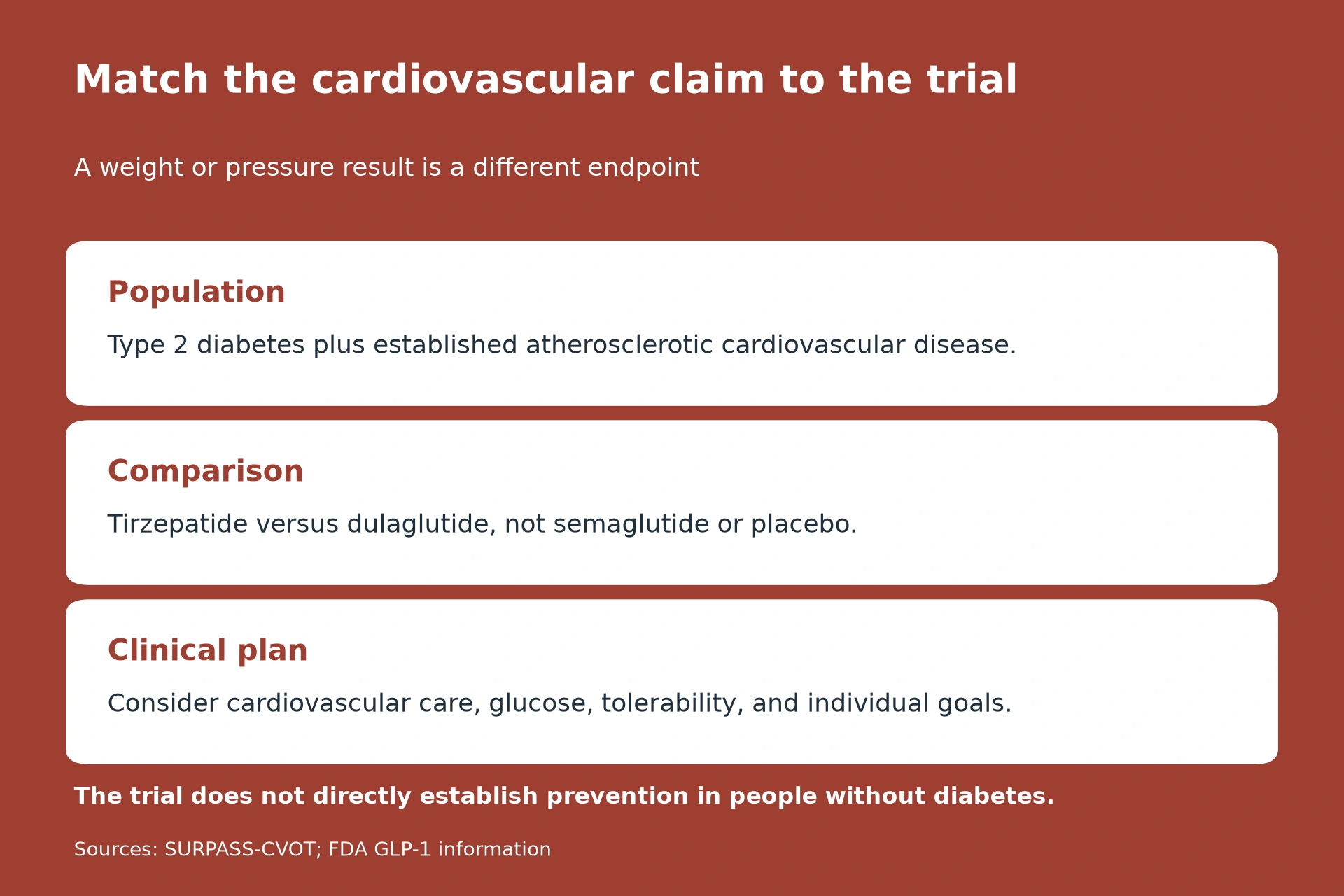
Atherosclerotic cardiovascular disease refers to disease involving plaque in arteries. Its presence changes baseline risk. Results from this population cannot simply be described as proven cardiovascular prevention for every younger person considering weight treatment.
What were the actual event results?
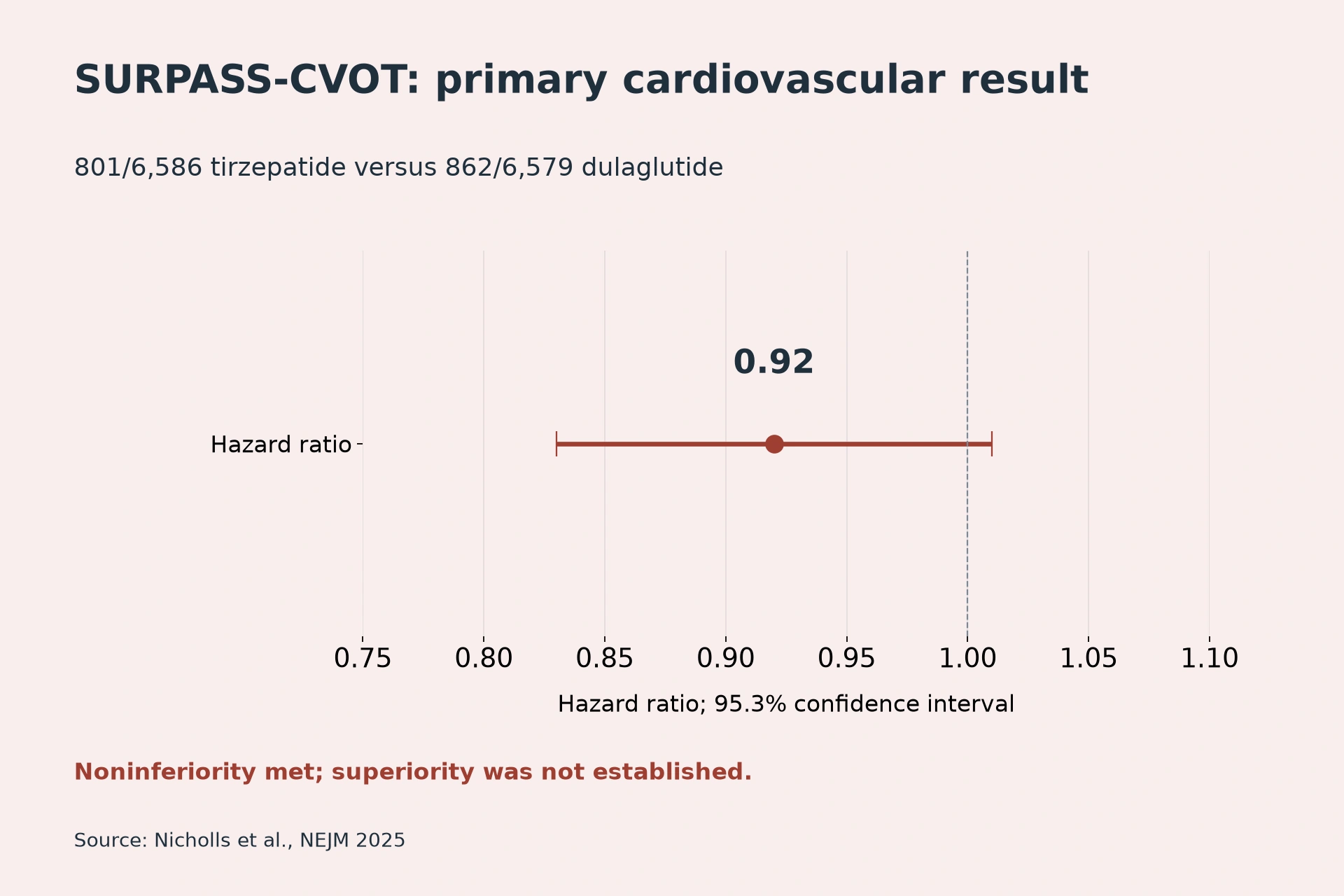
The primary composite occurred in 801 of 6,586 tirzepatide participants and 862 of 6,579 dulaglutide participants. The published percentages were 12.2% and 13.1%. The hazard ratio was 0.92, with a 95.3% confidence interval of 0.83 to 1.01. Primary results.
A hazard ratio summarizes the relative event rate over follow-up in a time-to-event analysis. A value below 1 favors tirzepatide numerically here. However, the interval extends slightly above 1, so the result does not establish a statistically significant superiority advantage under the trial’s specified test.
The difference between the rounded event proportions is about 0.9 percentage points. It should not be described as a proven 0.9-point benefit for every patient. It is also not the same quantity as the hazard ratio, and it is not an annual risk difference.
What does noninferiority mean in plain language?
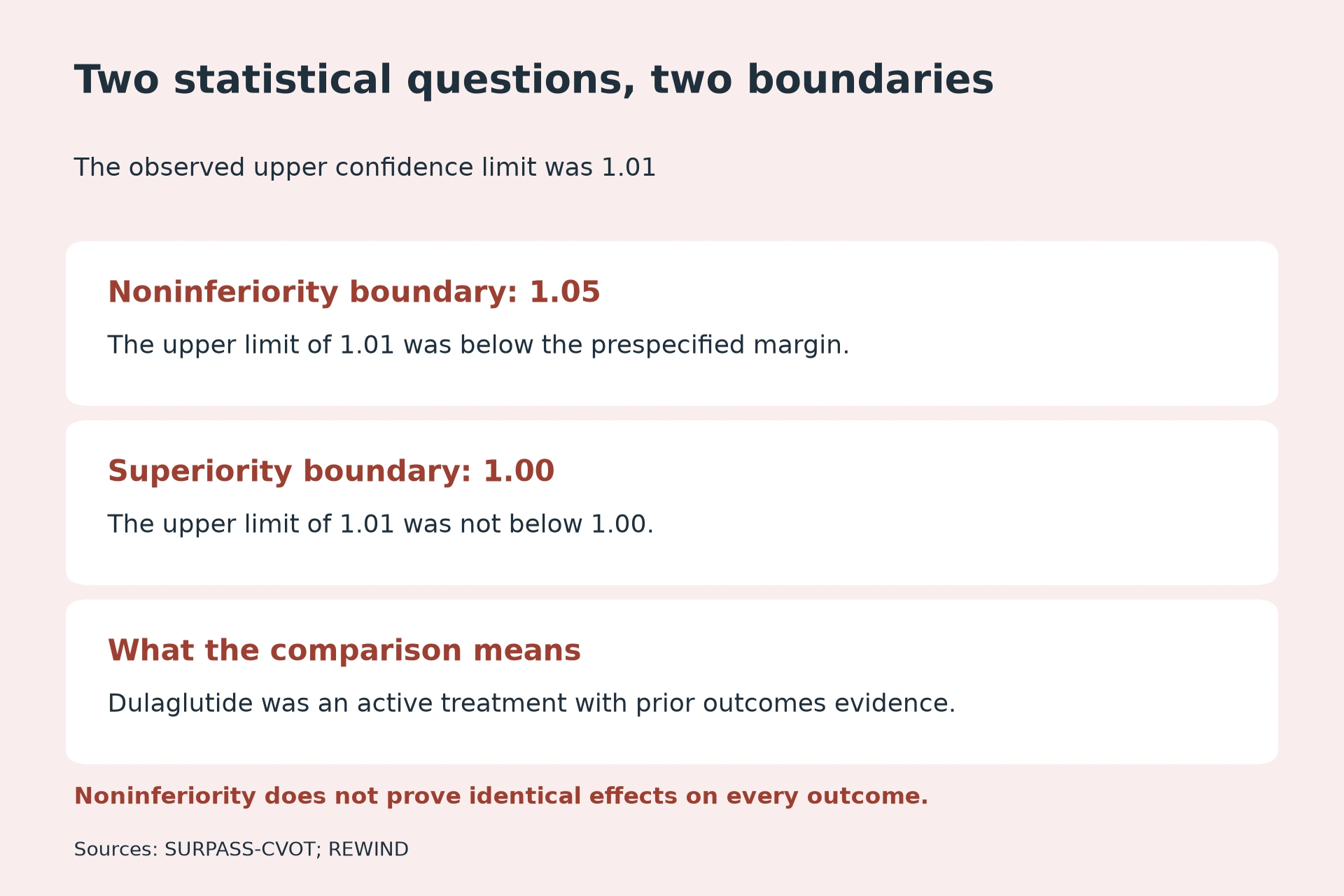
A noninferiority trial sets a margin before examining the results. It asks whether the data exclude a disadvantage larger than that margin. In SURPASS-CVOT, the upper limit of the 95.3% confidence interval had to stay below 1.05 for the hazard ratio. The observed upper limit was 1.01, so the criterion was met. Statistical design.
Noninferiority is not a claim that two drugs are identical. It does not mean their weight effects, side effects, costs, or individual responses are the same. It applies to the specified endpoint, population, comparison, and margin.
An analogy is a quality test with a prespecified acceptable boundary. Passing that boundary answers the test that was set. It does not automatically prove that the new option is better on every measure.
Why was superiority not established?
For superiority on the primary endpoint, the upper confidence limit needed to be below 1.00. It was 1.01. The reported P value was 0.003 for noninferiority and 0.09 for superiority. Those are different hypotheses; quoting the smaller P value as proof that tirzepatide prevented more events would misstate the analysis. Original report.
The point estimate is compatible with a possible advantage, but the uncertainty also includes no difference. A careful account can acknowledge the favorable numerical direction while preserving the actual conclusion.
“No established superiority” does not prove that the treatments have exactly equal effects. It means the trial did not provide sufficient evidence to make that stronger claim under its planned test.
| Interpretation question | Accurate answer |
|---|---|
| Was tirzepatide compared with an inactive injection? | No, the comparator was dulaglutide. |
| Was the main event count numerically lower with tirzepatide? | Yes. |
| Was the noninferiority criterion met? | Yes. |
| Was primary-endpoint superiority established? | No. |
| Does the result prove equal effects on every individual component? | No. |
| Does it establish the same result in people without diabetes? | No. |
Does the composite tell us about each type of event?
The main analysis combines cardiovascular death, myocardial infarction, and stroke to answer a prespecified overall question. It does not establish that the treatment effect is identical for all three components. A component can have fewer events and therefore greater statistical uncertainty than the composite.
Nor should the total be described as three separate proven benefits. To assess a claim about stroke alone, for example, readers need the stroke-specific estimate, its confidence interval, and its place in the analysis plan. Similarly, a result about the first qualifying event does not by itself describe the full burden of repeated events over time. These distinctions keep the headline aligned with the primary report. SURPASS-CVOT endpoint definition.
Why is dulaglutide a meaningful comparator?
Dulaglutide had already been tested against placebo in REWIND. That trial randomized 9,901 people with type 2 diabetes and either previous cardiovascular events or cardiovascular risk factors. Over a median 5.4 years, its primary cardiovascular composite occurred in 12.0% with dulaglutide and 13.4% with placebo; the hazard ratio was 0.88, with a 95% confidence interval of 0.79–0.99. Original REWIND report.
This background helps explain why matching an active comparator within a strict margin is meaningful. SURPASS-CVOT was not merely a demonstration against doing nothing.
It would still be incorrect to multiply the REWIND and SURPASS-CVOT hazard ratios to manufacture a precise tirzepatide-versus-placebo result. The studies enrolled different populations at different times. An indirect calculation is not a substitute for a randomized comparison and its assumptions would need explicit justification.
Can this trial rank tirzepatide against semaglutide for heart protection?
No. Semaglutide was not the comparator. Our SELECT and SOUL review discusses semaglutide cardiovascular trials, including their different populations and formulations. Comparing headline hazard ratios across those studies would not tell an individual which medicine is best.
The SURMOUNT-5 review covers a direct weight-loss comparison between tirzepatide and semaglutide. A head-to-head result for weight does not become a head-to-head result for cardiovascular events.
Likewise, our GLP-1 and HFpEF article addresses a different heart-failure setting. Cardiovascular medicine includes several conditions and endpoints; treating them as one generic “heart benefit” loses clinically useful detail.
What about secondary analyses and newer headlines?
A large trial can generate reports on other outcomes or subgroups. Those may add useful evidence, but the endpoint, analysis plan, and statistical treatment should remain visible. A positive secondary composite cannot retrospectively change the main trial’s primary conclusion.
When reading a newer report, ask whether the analysis was prespecified, whether it includes repeated events or first events, whether it adds kidney outcomes to cardiovascular outcomes, and whether testing was adjusted for multiple comparisons. These are different research questions, not merely alternate labels for the same number.
This article anchors its conclusion to the primary SURPASS-CVOT report. It does not treat a later exploratory signal or a press summary as proof of superiority on the original three-component endpoint.
What did the report say about adverse events?
Overall adverse-event incidence appeared similar between the groups, while gastrointestinal adverse events were more frequent with tirzepatide. A trial that meets its cardiovascular criterion still requires attention to tolerability and individual contraindications. Safety summary.
The study was funded by Eli Lilly. Funding disclosure helps readers evaluate the research context alongside the randomized design, specified endpoints, peer review, and transparent numerical results. It is neither a reason to dismiss the trial automatically nor a reason to omit its limitations.
The trial doses and products should not be copied into an unsupervised switching plan. Our tirzepatide first-month guide and tirzepatide questions guide cover practical discussions about initiation and follow-up.
How can this evidence inform an appointment?
Start by clarifying whether your situation resembles the trial: established type 2 diabetes and atherosclerotic cardiovascular disease. Then discuss the whole treatment plan, including glucose control, weight, blood pressure, lipids, kidney health, tolerability, and existing cardiovascular medicines.
A useful question is, “What outcome are we choosing this treatment to improve, and which study supports that outcome for someone like me?” Another is, “What would make us reconsider the choice?” These questions connect research to care without turning one paper into an automatic prescription.
CoreAge Rx provides tirzepatide information and semaglutide information for service-related questions. The evidence described here belongs to the studied products and regimens; it does not demonstrate equivalent outcomes for every formulation or compounded preparation. FDA information on unapproved GLP-1 products.
Video: the journal’s trial summary
This NEJM Group summary presents the original SURPASS-CVOT comparison. Read it alongside the endpoint counts and confidence interval above, especially the distinction between noninferiority and superiority.
Frequently asked questions
Does “noninferior” mean tirzepatide is ineffective?
No. It means the prespecified comparison excluded an unacceptable disadvantage relative to dulaglutide for the main endpoint. It does not establish superiority, but it is a meaningful result against an active comparator.
Can I say tirzepatide reduced heart events by 8%?
The hazard-ratio point estimate was 0.92, but its confidence interval included 1. Presenting “8% fewer events” without the uncertainty and failed superiority test would imply a demonstrated benefit that the main analysis did not establish.
Do the percentages tell me my personal risk?
No. They describe selected trial participants over follow-up. Personal risk depends on health history and other factors, and an individual estimate should come from a clinical assessment.
Should someone without diabetes use this as the main reason to start treatment?
This trial did not test that population. Other indications and studies may be relevant, but the evidence should be matched to the person and the actual treatment goal.
Original papers and supporting sources
The references distinguish full research papers, published abstracts, and official guidance. This educational narrative review is not a systematic review or an individual treatment recommendation. Sources were checked in October 2026.
- Nicholls SJ et al. Cardiovascular Outcomes with Tirzepatide versus Dulaglutide in Type 2 Diabetes. (2025). Published abstract reviewed. DOI: 10.1056/nejmoa2505928.
- Gerstein HC et al. Dulaglutide and cardiovascular outcomes in type 2 diabetes (REWIND): a double-blind, randomised placebo-controlled trial. (2019). Published abstract reviewed. DOI: 10.1016/s0140-6736(19)31149-3.
- FDA: concerns with unapproved GLP-1 drugs. Official guidance.