People who have already changed their eating and activity often ask whether medication can add anything further. SURMOUNT-3 directly examined a version of that question: what happens when tirzepatide is introduced after a successful, structured lifestyle program?
The trial found substantial additional weight reduction. Its design also created an important limit: only participants who had already lost at least 5% during the initial program could enter the randomized phase. Understanding that selection is essential before treating the headline result as an expectation for everyone.
What was the study’s sequence?
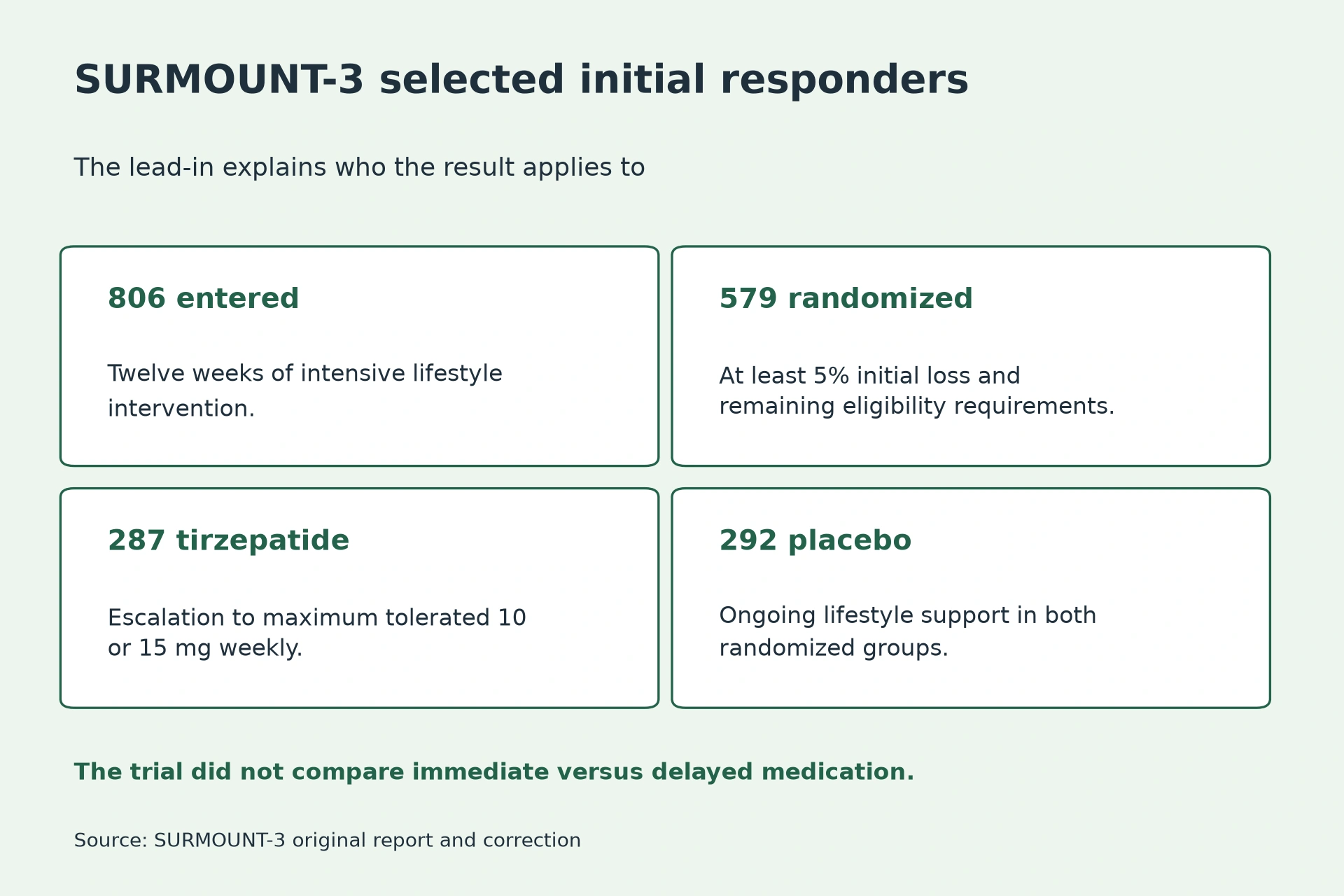
SURMOUNT-3 enrolled adults with obesity, or overweight plus an obesity-related complication, without diabetes. Everyone first received an intensive lifestyle intervention. Participants who lost at least 5% of their original weight and remained eligible were then randomized to weekly tirzepatide or placebo for 72 weeks. Original trial.
The randomized population included 287 participants assigned tirzepatide and 292 assigned placebo. The study used a maximum tolerated maintenance dose of 10 or 15 mg after escalation. These are details of the trial protocol, not instructions to start at a high dose or adjust a prescription without supervision.
Both groups continued lifestyle support during the randomized period. Consequently, the trial compared medication plus ongoing support with placebo plus ongoing support in people who had already responded to the lead-in program.
What did “intensive lifestyle intervention” involve?
The initial 12 weeks included eight counseling sessions delivered by a dietitian or another qualified professional. The protocol included structured dietary targets, optional meal replacements, activity goals, and behavioral strategies such as reviewing food and activity records. It was more involved than a brief instruction to “eat less and exercise.” Trial methods.
The study’s calorie targets were standardized research instructions. They should not become a personal meal prescription copied from a blog. Nutritional needs vary with body size, health, activity, medicines, and other factors, particularly when appetite is already reduced.
Our guides to balanced meals, sustainable habits, and walking for weight management offer practical context. A clinician or dietitian can help adapt that context to an individual’s needs and limitations.
Why does the lead-in selection matter?
Of 806 people entering the lifestyle phase, 579 proceeded to randomization. The remaining participants did not all fail for one identical reason; eligibility and completion requirements also mattered. The randomized result applies most directly to the selected group that qualified. Participant flow.
This design is sometimes called an enriched trial: it concentrates on people with a characteristic relevant to the research question. Here, that characteristic included demonstrated initial weight loss. It makes the study informative about adding medication after successful lifestyle intervention, while narrowing its generalizability.
The trial does not imply that patients must prove sufficient willpower before medication becomes appropriate. It also does not show that people who lose less during an initial program cannot benefit from medication. Those questions require other evidence and individual clinical assessment.
What were the additional weight-loss results?
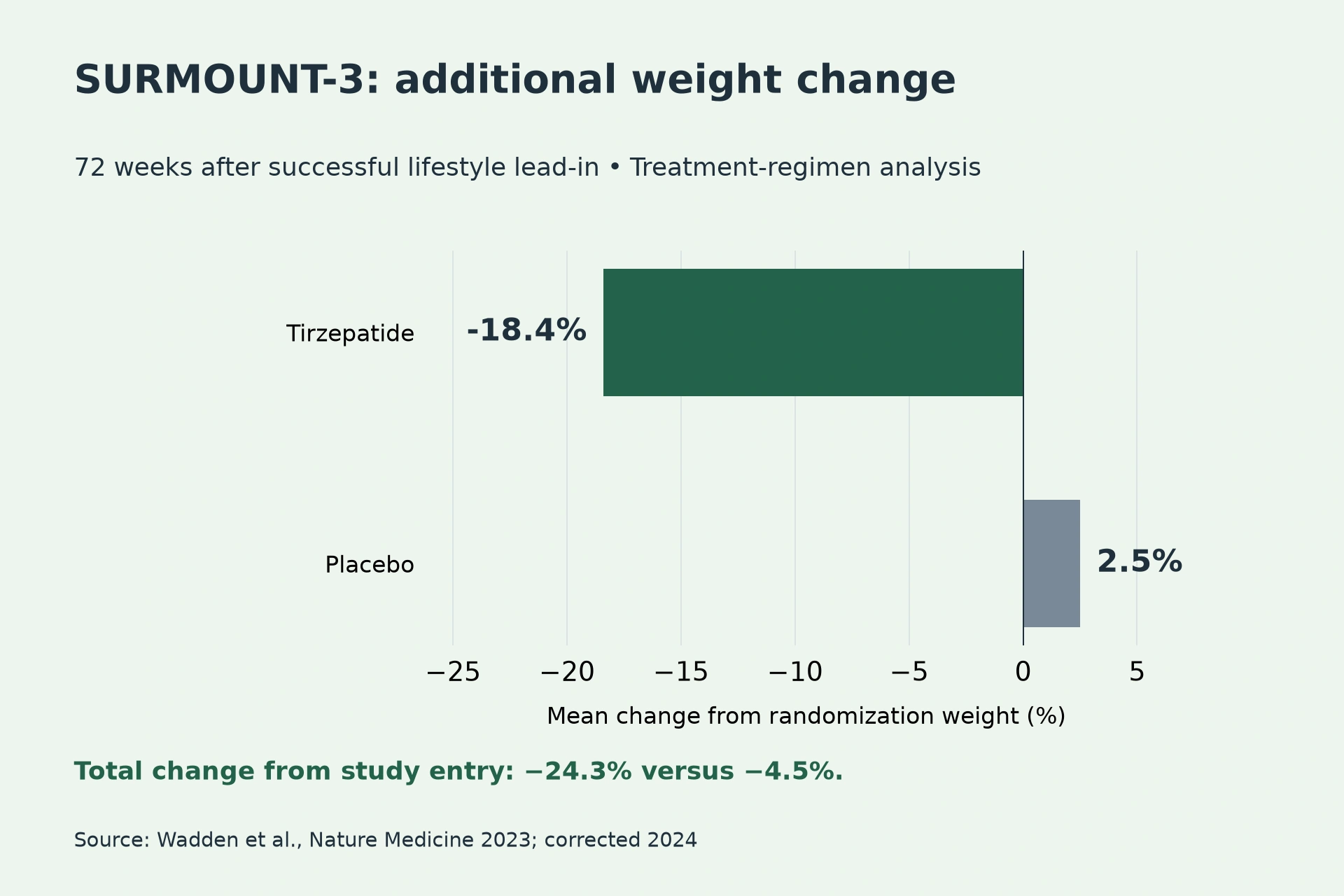
From randomization to week 72, the treatment-regimen analysis reported mean weight changes of −18.4% with tirzepatide and +2.5% with placebo. The estimated between-group difference was −20.8 percentage points, with a 95% confidence interval of −23.2 to −18.5. Primary results.
The proportion achieving at least another 5% reduction from their randomization weight was 87.5% with tirzepatide and 16.5% with placebo. These results show a substantial average advantage in the selected study population, while still allowing individual variation.
The reported −20.8-point model estimate does not exactly equal subtracting the rounded displayed means. That small discrepancy is a reason to retain the paper’s estimate rather than “correct” it using rounded numbers from a chart.
How much weight was lost from the very beginning?
The report also measured change from study entry, before the lifestyle phase. On the treatment-regimen analysis, the total change across the 84-week sequence was −24.3% with subsequent tirzepatide and −4.5% with subsequent placebo. Total study-entry change.
It is incorrect to add 6.9% and 18.4% as if both percentages used the same starting weight. The first reduction changes the denominator for the second. For illustration, losing 6.9% of 100 units leaves 93.1; reducing that by another 18.4% leaves approximately 76.0. This explains the arithmetic principle, not the exact modeled trial estimate.
The reported trial total should be quoted directly. It is the result of the study’s analysis, not a number reconstructed from rounded group averages.
Why do some reports say 21.1% or 26.6% instead?
The paper included more than one estimand, meaning a precisely defined treatment question and analysis strategy. Its treatment-regimen estimand assessed assignment regardless of treatment adherence. Its efficacy estimand asked about the effect under a different approach to treatment discontinuation and related events.
The efficacy analysis reported 21.1% additional loss after randomization and 26.6% total loss from study entry with tirzepatide. Those figures should not be swapped into a paragraph describing the treatment-regimen results without explanation. Both sets belong to the paper, but they answer different versions of the question. Analysis methods and results.
For a reader considering treatment, it is useful to know both the effect under sustained treatment conditions and the result of a strategy that includes interruptions. Neither is a guarantee of what will happen outside a trial.
Did the study prove that lifestyle treatment and medication are synergistic?
It showed that adding tirzepatide after the lead-in produced more weight loss than adding placebo. It did not include a group that started tirzepatide at study entry without that intensive lead-in. Therefore, it cannot determine whether the sequence was better than starting medication and lifestyle care together.
The investigators discussed several possible explanations for the large total loss, including the selected population and differences from other trials. A larger number than in a separate study is not proof of a special additive biological interaction.
Similarly, the study did not randomize participants to medication versus bariatric surgery. Cross-study comparisons with surgical averages can offer context but cannot establish equal effectiveness, durability, risk, or suitability.
| Common question | What SURMOUNT-3 can answer |
|---|---|
| Can tirzepatide add weight loss after a successful intensive program? | Yes, the randomized comparison supports that conclusion in eligible participants. |
| Must everyone lose 5% before starting medicine? | No; that was a research entry criterion. |
| Is delayed medication better than immediate medication? | Not tested directly. |
| Is tirzepatide equivalent to surgery? | Not tested directly. |
| Can I expect the largest reported percentage? | Individual results are not guaranteed. |
What about quality of life?
A later report examined health-related quality-of-life measures from SURMOUNT-3. Tirzepatide participants generally had larger improvements than placebo participants on the reported measures. Within the tirzepatide group, larger weight reductions were generally associated with larger improvements. Quality-of-life analysis.
Questionnaire results help connect a scale change to daily life. They do not establish that every participant experienced the same improvement, and within-group associations do not prove that weight loss was the sole cause.
This distinction is especially useful for setting goals. Walking comfortably, participating in activities, and reducing a specific health burden may matter more to an individual than achieving a particular headline percentage.
How should the quality-of-life associations be read?
Randomization supports the comparison between assigned treatment groups. It does not automatically make every later comparison causal. For example, grouping tirzepatide participants by how much weight they eventually lost creates groups defined by an outcome that happened after treatment began. Those groups may differ in health, adherence, tolerability, or other factors.
The association between greater loss and larger questionnaire improvement is useful context, but it cannot establish that pursuing a larger loss will necessarily improve an individual’s quality of life. The person’s nutrition, function, symptoms, and preferences still matter. Both the main trial and later quality-of-life report disclose industry funding and author relationships, which readers can inspect in the original publications. Quality-of-life methods and disclosures.
What safety and tolerability issues matter?
Gastrointestinal adverse events were the most common with tirzepatide, and most were mild or moderate. The trial used escalation, eligibility screening, follow-up, and procedures for handling symptoms. Those supports are part of the context in which the results were obtained. Safety findings.
Our tirzepatide nausea and reflux guide and protein and muscle guide discuss common follow-up questions. Persistent vomiting, severe abdominal pain, dehydration symptoms, or difficulty maintaining adequate intake require clinical review rather than a push to keep losing weight.
These trials used specified research products and schedules. Their findings do not establish equivalent effectiveness or quality for every compounded product or mixture. FDA information on unapproved GLP-1 products.
What should a practical treatment conversation cover?
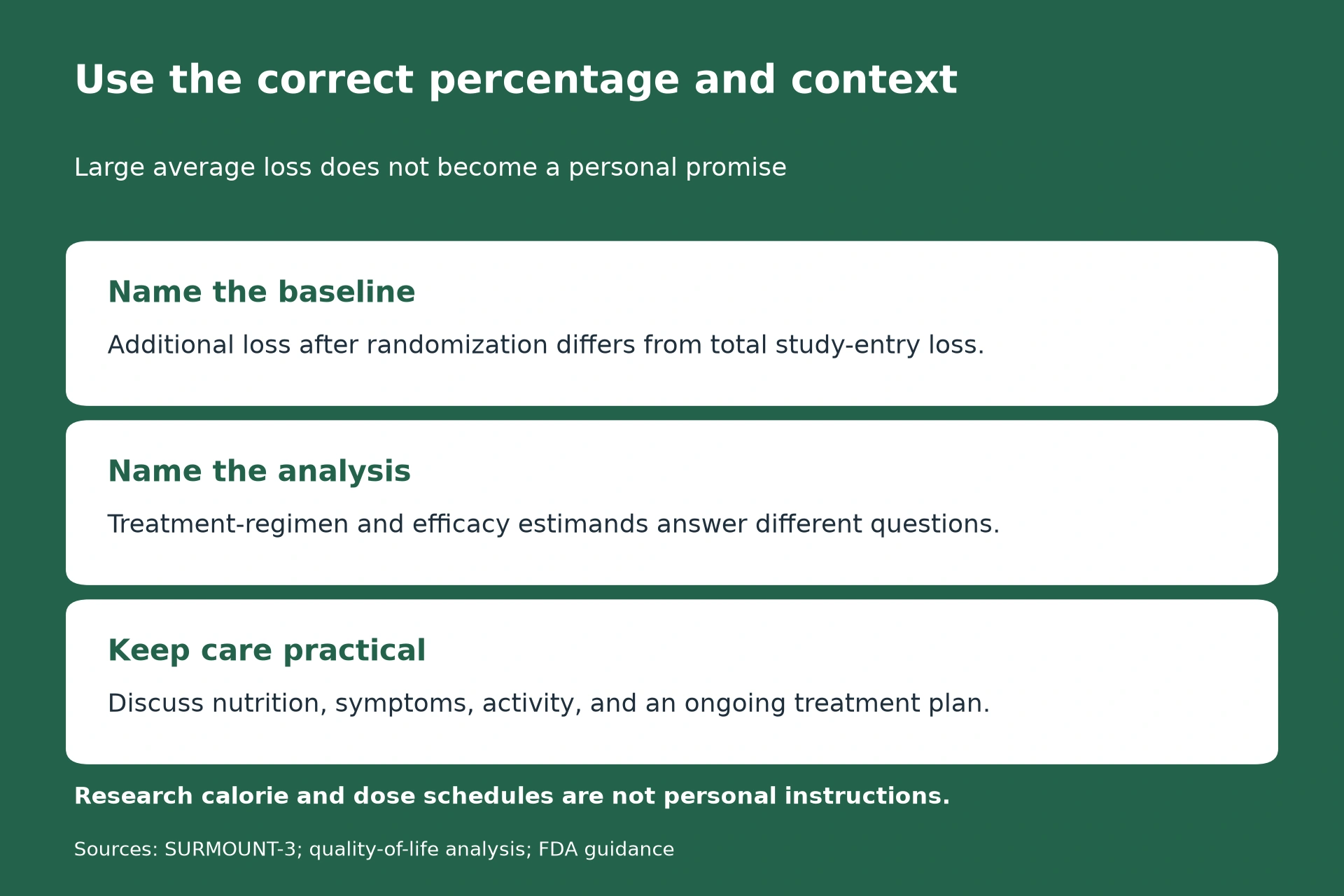
Bring a description of the habits and support already tried, what helped, what was difficult, and what outcome matters next. That information is more useful than labeling the previous effort a success or failure based only on a threshold.
Ask how medication would fit with adequate meals, strength-preserving activity, symptom monitoring, and long-term access. Also discuss what happens if a dose is missed, treatment is interrupted, or a plateau develops. Our tirzepatide questions guide provides a starting checklist.
The tirzepatide product page explains the available service. For comparisons, read the SURMOUNT-5 head-to-head trial review. The two research questions complement each other, but neither replaces an individualized assessment.
Video: combining approaches in obesity care
This short Mayo Clinic video provides general context for combined treatment. It does not explain every SURMOUNT-3 endpoint, establish the best sequence for everyone, or substitute for the original paper.
Frequently asked questions
Is the placebo group’s regain evidence that lifestyle changes are pointless?
No. Participants had already lost weight during the initial program, and the placebo group’s average remained below study-entry weight. The randomized comparison shows the additional effect of the medication strategy, not the absence of value in nutrition, activity, or support.
Should I reproduce the study’s calorie targets?
No. A trial protocol is not a personalized nutrition plan. Discuss intake and activity with a qualified professional, especially if you have medical conditions, limited mobility, or reduced appetite.
Does this study tell us what happens after stopping tirzepatide?
Its primary question concerned treatment after lifestyle intervention. Read our GLP-1 withdrawal studies review for the separate question of discontinuation and maintenance.
Was the published correction checked?
Yes. The authors corrected swapped legend labels in two panels of the original figure. The explanation and original graphics here use the numerical results in the paper and acknowledge the correction rather than reproducing the earlier mislabeled figure. Correction notice.
Original papers and supporting sources
The references distinguish full research papers, published abstracts, and official guidance. This educational narrative review is not a systematic review or an individual treatment recommendation. Sources were checked in October 2026.
- Wadden TA et al. Tirzepatide after intensive lifestyle intervention in adults with overweight or obesity: the SURMOUNT-3 phase 3 trial. (2023). Full text reviewed. DOI: 10.1038/s41591-023-02597-w. Open full text.
- Wadden TA et al. Author Correction: Tirzepatide after intensive lifestyle intervention in adults with overweight or obesity: the SURMOUNT-3 phase 3 trial. (2024). Full text reviewed. DOI: 10.1038/s41591-024-02883-1. Open full text.
- Gibble TH et al. Tirzepatide and health-related quality of life in adults with obesity or overweight: Results from the SURMOUNT-3 phase 3 randomized trial. (2025). Full text reviewed. DOI: 10.1111/dom.16463. Open full text.
- FDA: concerns with unapproved GLP-1 drugs. Official guidance.