The first months of weight treatment attract attention, but the longer-term question is often more useful: what happens after the early losses slow down? Two semaglutide studies help answer that question across two and four years, while also showing why trial averages should not become personal targets.
STEP 5 studied weight management directly. SELECT was a cardiovascular outcomes trial with a prespecified analysis of weight and waist measurements. Both found sustained average weight reduction with continued treatment, but they enrolled different people and used different approaches to follow-up and analysis.
What did STEP 5 test?
STEP 5 assigned adults with obesity, or overweight plus a weight-related condition, to weekly semaglutide 2.4 mg or placebo. Participants did not have diabetes. Both groups received a behavioral intervention, so the comparison tested adding the study medicine to that support. Original STEP 5 paper.
The 304 participants had an average age of about 47 and average BMI of 38.5. Approximately 78% were women and 93% were White. Those characteristics matter when applying the average result to someone who differs substantially from the study population.
The two main endpoints were percentage weight change and the proportion losing at least 5% by week 104. The main analysis assessed treatment assignment regardless of discontinuation or rescue intervention. This approach is different from counting only people who tolerated every dose and stayed on treatment.
What were the two-year results?
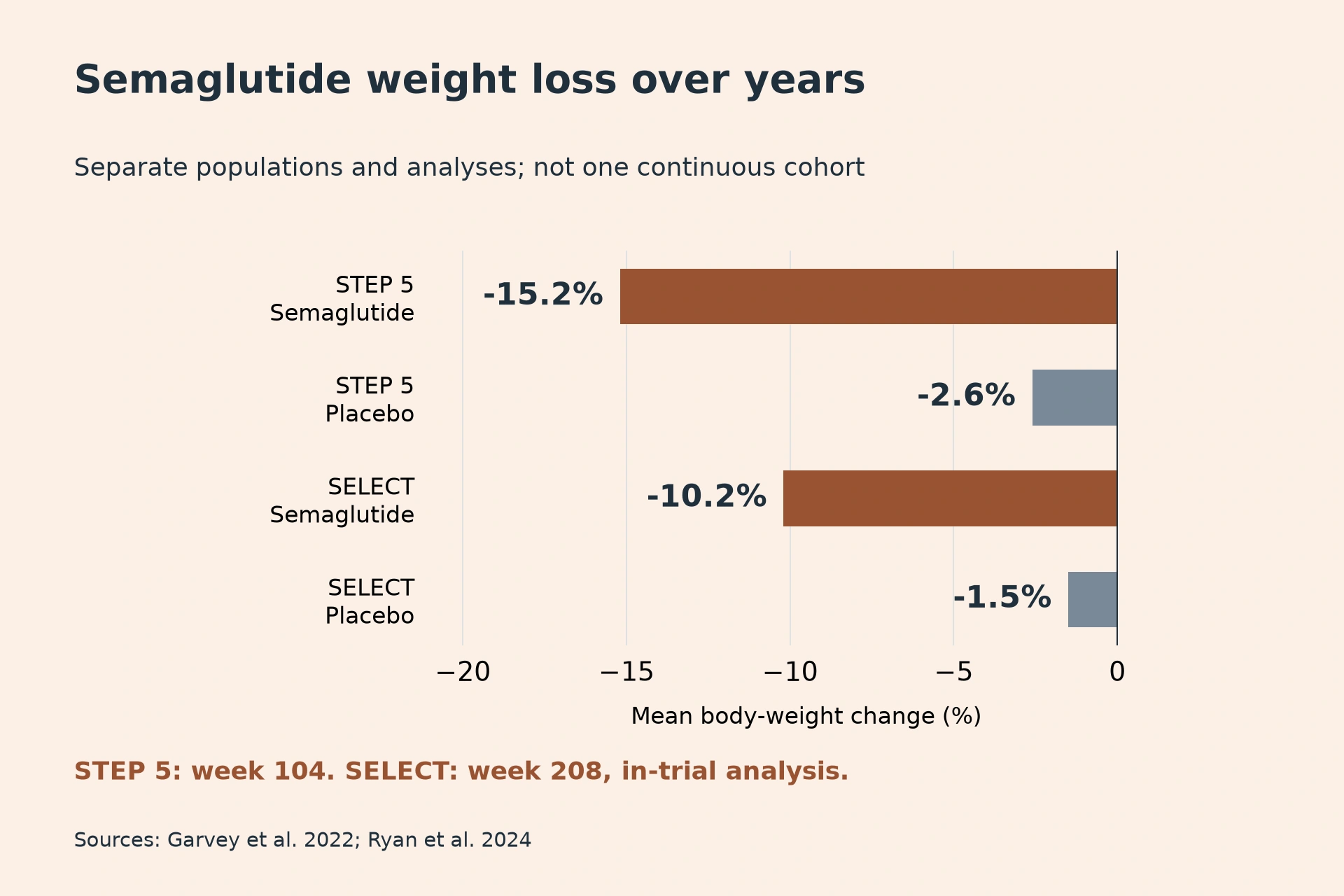
Average weight change was −15.2% with semaglutide and −2.6% with placebo, an estimated difference of −12.6 percentage points. The 95% confidence interval for that difference was −15.3 to −9.8 percentage points. The proportion reaching at least 5% weight loss was 77.1% versus 34.4%. STEP 5 results.
A percentage is relative to starting weight. As a purely illustrative calculation, 15.2% of 200 pounds is 30.4 pounds. That is not a prediction that a 200-pound patient will lose that amount. An average describes a group, and the range of individual responses can be substantial.
The paper’s weight trajectory showed an initial decline followed by a plateau that persisted through two years. Sustaining a lower weight can be an outcome of treatment even when the scale is no longer falling each month.
What does a plateau actually mean?
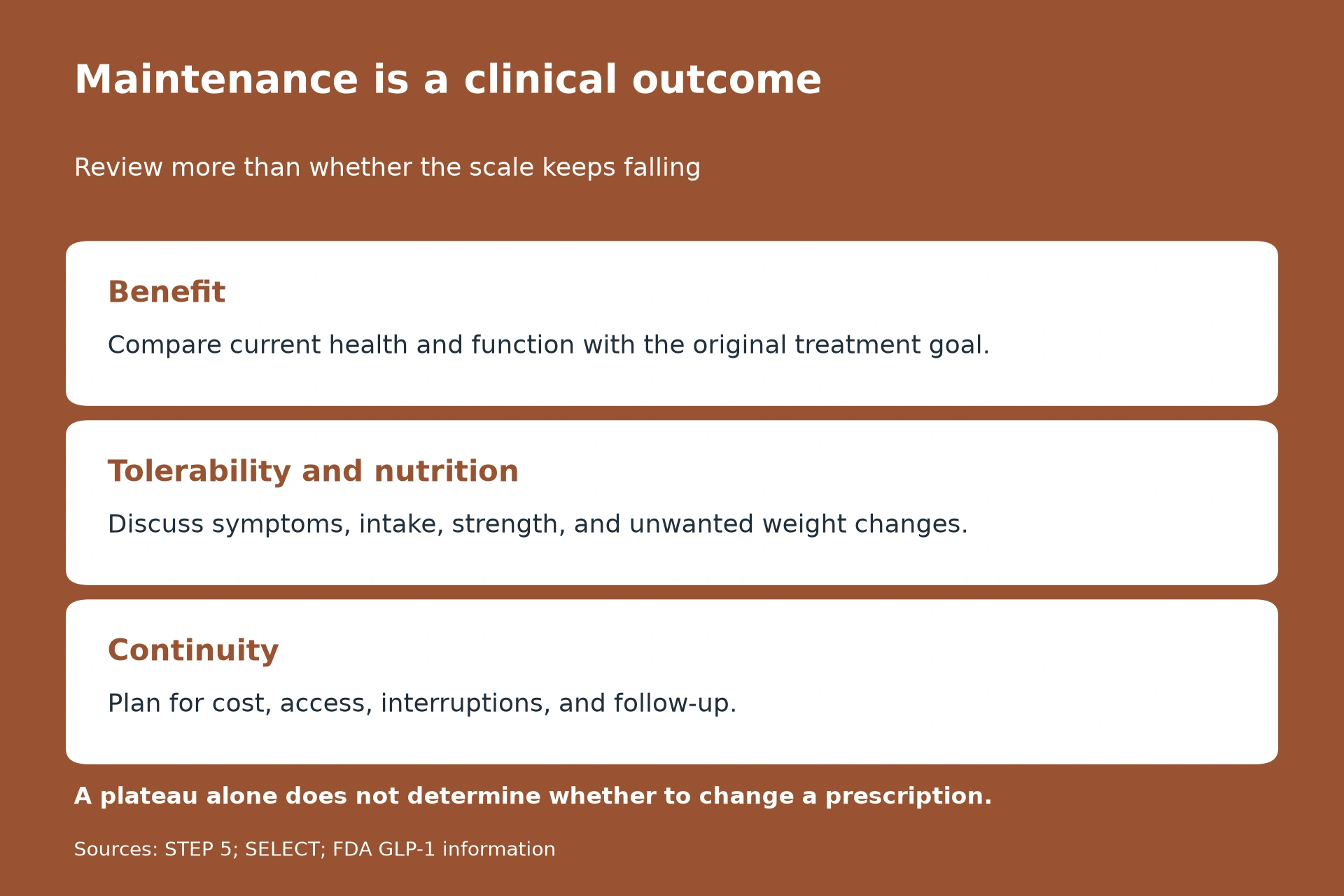
A plateau means that weight is relatively stable over an interval. It does not, by itself, reveal whether a medicine is still helping, whether a dose should change, or whether the person has reached a medically useful outcome.
Consider two people with a stable scale. One has maintained an earlier loss, improved mobility, adequate nutrition, and manageable side effects. The other has poor intake, weakness, persistent nausea, and no improvement in the health problem treatment was meant to address. The same scale pattern would lead to different clinical conversations.
Our semaglutide plateau guide explains what to review. Treatment decisions should use the trend, health measures, adherence, tolerability, and goals together. A plateau is not a reason to independently take extra doses or add another GLP-1 medicine.
How was SELECT different?
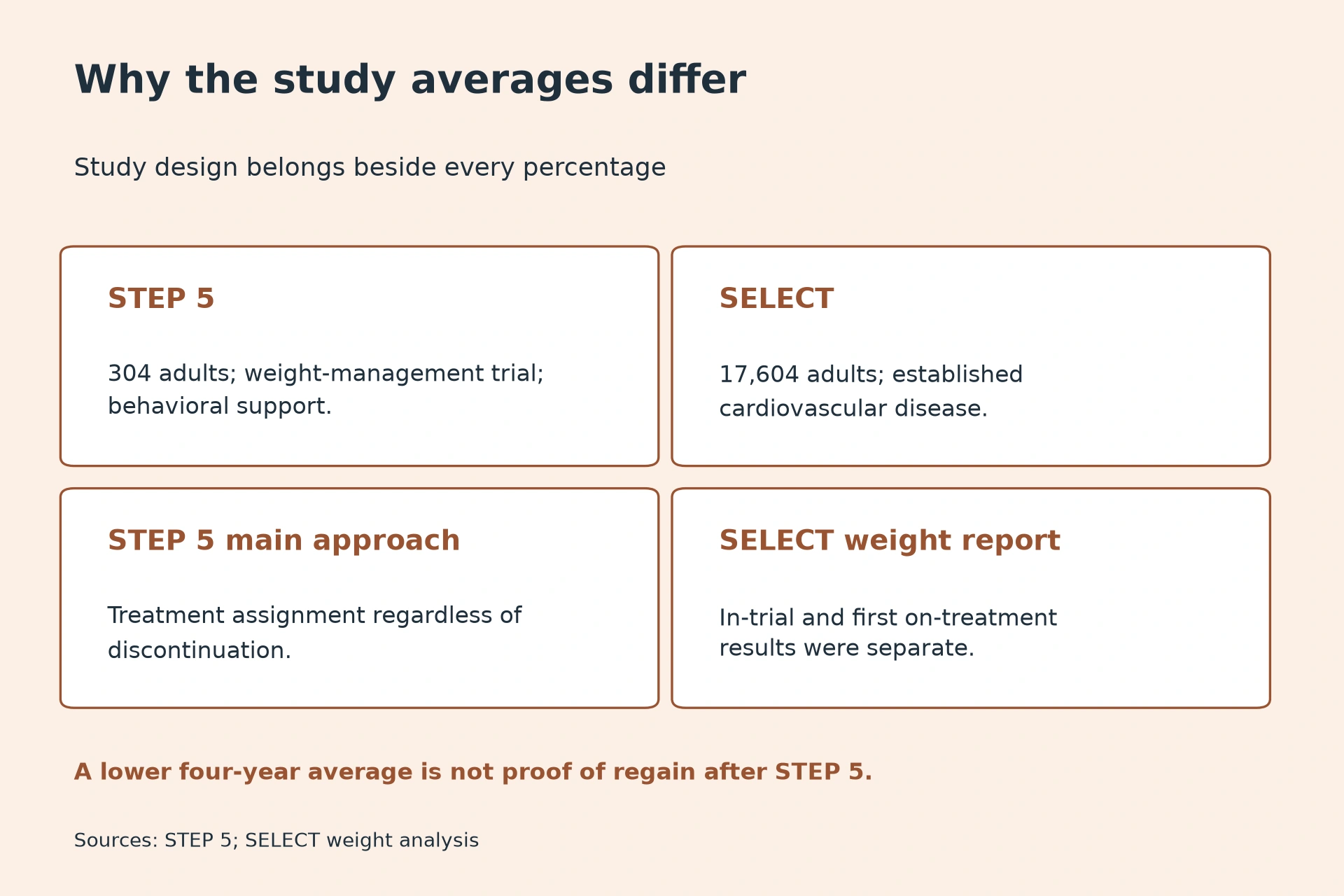
SELECT enrolled 17,604 adults aged 45 or older who had established cardiovascular disease, a BMI of at least 27, and no diabetes. Its principal purpose was to examine cardiovascular events. Weight outcomes were analyzed separately within that larger trial. SELECT weight analysis.
Participants were older on average than those in STEP 5, and most were men. They received cardiovascular standard care and counseling, without the same structured weight-loss intervention used in the STEP program. People also entered for a cardiovascular trial rather than necessarily because weight loss was their main goal.
Our SELECT and SOUL heart-health article examines cardiovascular outcomes. The present article focuses on weight durability. A weight change and a heart-event result are related clinical topics, but they are not the same endpoint.
What did four years of SELECT show?
The published in-trial analysis reported average weight changes of −10.2% with semaglutide and −1.5% with placebo at 208 weeks. Average waist changes were −7.7 cm and −1.3 cm, respectively. Weight loss continued to about week 65 and was then sustained through the reported four-year period. SELECT results.
The figures show observed measurements from participants contributing data at each time. Not every one of the 17,604 randomized participants supplied a four-year weight measurement. That distinction matters when a headline puts the entire enrollment count next to a late follow-up result.
The authors also reported a “first on-treatment” analysis, which followed observations until the first prolonged interruption. In that analysis, four-year mean weight change was −11.7% versus −1.5%. The different numbers reflect different analysis windows, not a contradiction or two separate prescriptions.
Why not compare 15.2% and 10.2% as a decline?
STEP 5 and SELECT did not follow the same group consecutively. Comparing their averages as though people lost 15.2% at two years and then regained to 10.2% at four years would invent a trajectory that neither study measured.
The studies differed in age, sex distribution, baseline health, motivation, support, dose exposure, follow-up, and statistical methods. These factors can influence results. Cross-trial comparisons are useful for asking why outcomes vary; they cannot replace a randomized comparison within one population.
| Question | STEP 5 | SELECT weight analysis |
|---|---|---|
| Main study setting | Weight-management trial | Cardiovascular outcomes trial |
| Randomized population | 304 adults without diabetes | 17,604 adults with cardiovascular disease, without diabetes |
| Featured follow-up | 104 weeks | 208 weeks |
| Semaglutide weight change | −15.2% | −10.2% in-trial |
| Placebo weight change | −2.6% | −1.5% in-trial |
| Interpretation | Two-year efficacy with behavioral support | Longer-term durability in a different cardiovascular-risk population |
What did the studies show about tolerability?
In STEP 5, gastrointestinal adverse events were reported in 82.2% of semaglutide participants and 53.9% of placebo participants; most were mild or moderate. These are cumulative reports over the trial, not the proportion of people feeling nauseated every day for two years. STEP 5 safety results.
SELECT reported adverse events leading to permanent treatment discontinuation in 16.6% of the semaglutide group and 8.2% of the placebo group. Its weight analysis also examined tolerability across baseline BMI categories. Fewer serious adverse events overall do not mean that every participant tolerated the medicine well. SELECT safety discussion.
Persistent vomiting, inability to keep fluids down, severe abdominal pain, or substantial weakness deserve prompt assessment. Our semaglutide nausea guide discusses symptom review; simply waiting for the next weight measurement is not a sufficient response to significant illness.
What makes long-term evidence more difficult to interpret?
Over several years, participants can interrupt treatment, miss visits, develop new conditions, or use other therapies. A trial’s statistical approach determines how those events contribute to its answer. That is why an observed late-visit average and an analysis intended to reflect treatment assignment are not interchangeable.
STEP 5 reported high trial completion, but completing a final safety visit does not necessarily mean taking every assigned dose. SELECT also reported treatment discontinuation and showed separate in-trial and on-treatment results. Read the participant flow and analysis definitions before assuming the most favorable percentage applies to every person who starts treatment. Both research programs were sponsored by Novo Nordisk, a disclosure to consider alongside their randomized designs and reported limitations. STEP 5. SELECT.
Does long-term treatment mean the highest dose forever?
These papers describe particular research regimens and trial procedures. They do not establish a single lifetime dose for every patient, an automatic escalation rule, or a tapering schedule. The appropriate prescription depends on the exact product, approved labeling, treatment indication, response, and tolerability.
The results also do not directly validate compounded mixtures, nasal preparations, or a “microdose” marketed using the same molecule name. The FDA explains that unapproved GLP-1 products have not undergone its review for safety, effectiveness, and quality. FDA information.
Readers considering care can use our semaglutide product information to identify the service and questions to ask. Trial evidence should be matched to the actual product and route being offered, with no assumption that every formulation produces the same outcomes.
What should a maintenance visit include?
A useful visit can start with the reason treatment was begun. Was the aim to improve glucose control, reduce a weight-related health burden, improve function, or address another indication? That goal helps determine which measurements matter now.
Discuss appetite, meal quality, ability to meet nutritional needs, strength, activity, sleep, side effects, other medicines, and practical access. A lower number on the scale does not confirm adequate nutrition or preserved function. Our protein and muscle guide and GLP-1 lean-mass evidence review explore those separate questions.
Tracking waist measurements or a consistent functional activity may add context, but measurements should not become a daily test of personal success. The purpose is to support a sustainable clinical plan, not to make every normal fluctuation feel like treatment failure.
What happens if treatment stops?
STEP 5 and the SELECT weight analysis primarily address outcomes during long-term assigned treatment. They do not show that stopping leaves the same protection against regain. Withdrawal studies ask a different question and should be read directly.
Our GLP-1 withdrawal and weight-regain review and semaglutide maintenance guide explain that evidence. If cost, side effects, pregnancy plans, or another circumstance may interrupt care, discuss a transition plan before changing the prescription whenever possible.
Long-term treatment is a shared decision that can be revisited. A clinical benefit does not remove the importance of burden, affordability, preferences, and alternatives.
Video: GLP-1 treatment in older adults
This Mayo Clinic discussion adds context on appetite, function, and treatment considerations after age 60. It is broader than STEP 5 or SELECT and should not be interpreted as a personal recommendation or a guarantee of the trial averages.
Frequently asked questions
Can semaglutide keep working when my weight stops falling?
Sustained lower average weight during continued treatment is consistent with the trial findings. Whether treatment remains worthwhile for an individual requires a broader review of benefits, burdens, and health goals.
Does SELECT prove everyone can lose 10% for four years?
No. It reports a group result from a defined cardiovascular-risk population, with varying treatment exposure and follow-up measurements. Individual response and tolerability differ.
Does a smaller loss mean I should switch to tirzepatide?
These two papers cannot make that decision. Our SURMOUNT-5 head-to-head review addresses a direct comparison in another population. Switching still requires review of the person’s indication, current medicine, safety, and goals.
How should I use these numbers in practice?
Use them to set realistic questions: what outcome matters, how will it be measured, when will we reassess, and what would prompt a change? They are evidence for a conversation, not a weight-loss contract.
Original papers and supporting sources
The references distinguish full research papers, published abstracts, and official guidance. This educational narrative review is not a systematic review or an individual treatment recommendation. Sources were checked in October 2026.
- Garvey WT et al. Two-year effects of semaglutide in adults with overweight or obesity: the STEP 5 trial. (2022). Full text reviewed. DOI: 10.1038/s41591-022-02026-4. Open full text.
- Ryan DH et al. Long-term weight loss effects of semaglutide in obesity without diabetes in the SELECT trial. (2024). Full text reviewed. DOI: 10.1038/s41591-024-02996-7. Open full text.
- FDA: concerns with unapproved GLP-1 drugs. Official guidance.