Blood pressure often changes during weight management, but a lower reading in a clinic is only part of the picture. Researchers studying tirzepatide examined both office readings and measurements collected across an entire day and night.
The SURMOUNT-1 findings support a blood-pressure-lowering effect in the populations studied. They also raise practical questions about monitoring, dizziness, other blood-pressure medicines, and how much of the observed change was related to weight loss.
What do the two blood-pressure numbers mean?
Systolic pressure, the top number, reflects pressure when the heart contracts. Diastolic pressure, the bottom number, reflects pressure between beats. Both are reported in millimeters of mercury, written mm Hg.
An office measurement is a snapshot. Ambulatory blood-pressure monitoring, or ABPM, uses a wearable device that takes repeated readings during ordinary daytime activity and sleep. It helps researchers distinguish a sustained change from an isolated clinic result.
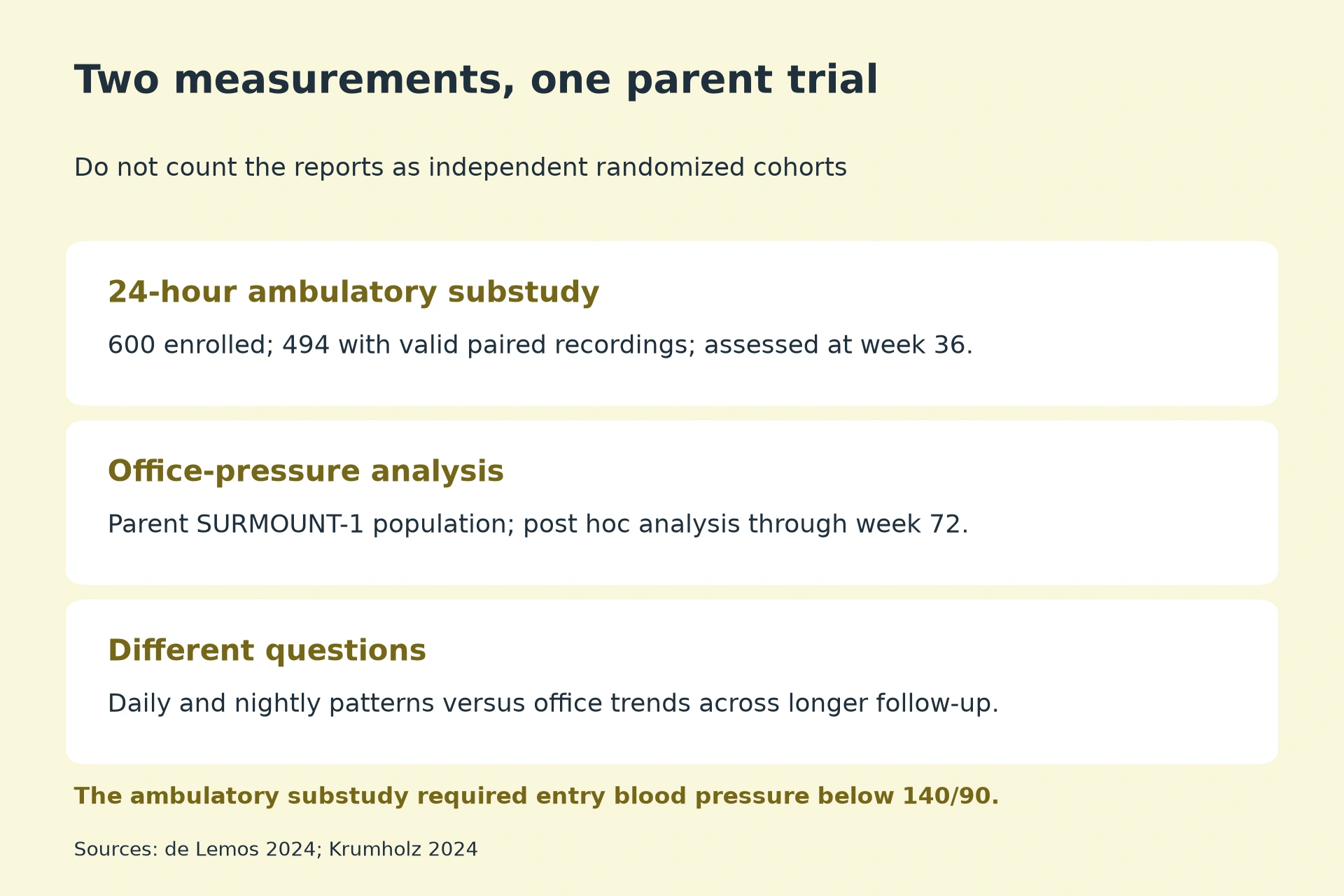
The two SURMOUNT-1 reports used these different measurement settings. Keeping the setting, duration, and sample size attached to each number helps explain why their estimates are not identical. Our Ozempic and blood-pressure guide covers similar practical questions for semaglutide, while this review focuses on tirzepatide’s original research.
Who entered the ambulatory substudy?
The parent SURMOUNT-1 trial randomized 2,539 adults with obesity or overweight and a weight-related complication, without type 2 diabetes. A prospectively planned subgroup underwent 24-hour monitoring at baseline and week 36. The substudy enrolled 600 participants. Original ambulatory report.
Entry to the substudy required blood pressure below 140/90 mm Hg and stable antihypertensive treatment for at least three months if such medicines were used. About 30% reported hypertension at baseline and 29% reported taking at least one antihypertensive medicine. Average baseline 24-hour pressure was approximately 124.6/72.1 mm Hg.
Those details matter: this was not a trial enrolling everyone with uncontrolled or resistant hypertension. Many participants started with pressures that were already controlled. The results cannot define management of a hypertensive emergency or replace trials specifically designed for difficult-to-control hypertension.
Of the 600 enrolled, 494 had valid ABPM data at both time points. The investigators required a sufficient proportion of valid readings, including a minimum number during daytime and nighttime. Reporting the analysis sample prevents the mistaken impression that every enrolled participant contributed a complete pair of recordings.
How much did 24-hour systolic pressure change?
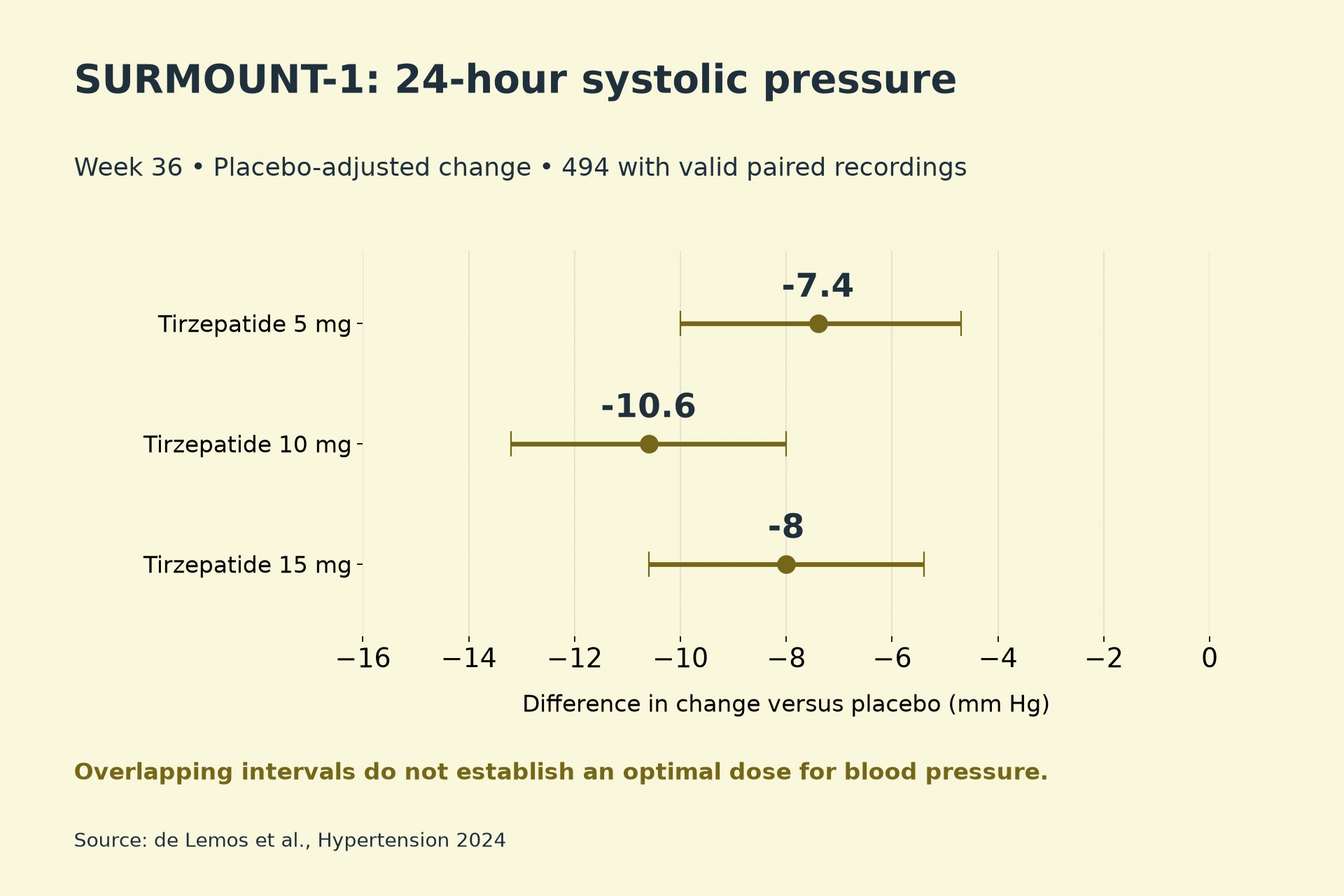
At week 36, the estimated systolic-pressure changes relative to placebo were:
| Tirzepatide trial group | Placebo-adjusted systolic change | 95% confidence interval |
|---|---|---|
| 5 mg weekly | −7.4 mm Hg | −10.0 to −4.7 |
| 10 mg weekly | −10.6 mm Hg | −13.2 to −8.0 |
| 15 mg weekly | −8.0 mm Hg | −10.6 to −5.4 |
The weekly doses describe the study groups. They are not a recommendation to choose or increase a dose based on a blood-pressure target. The reductions occurred during both daytime and nighttime monitoring. Ambulatory results.
“Placebo-adjusted” is essential. These numbers represent the difference in change between a tirzepatide group and placebo; they are not simply the number subtracted from each person’s starting reading. The confidence intervals describe uncertainty in those group comparisons.
Why was the largest reduction not at the highest dose?
The 10-mg group’s estimated systolic reduction was numerically larger than the 15-mg group’s. That does not prove 10 mg is the best dose for blood pressure. A numerical ranking within a substudy can reflect variation, overlapping confidence intervals, sample composition, and other factors.
The useful supported conclusion is that each tirzepatide group had a lower mean 24-hour systolic pressure than placebo. Determining an optimal antihypertensive dose would require an appropriately designed question and analysis. Dose selection in clinical care also involves the approved indication, tolerability, response, and exact prescribed product.
This is a good example of why a chart needs an explanatory caption. Showing three bars without uncertainty or context can make an exploratory dose pattern look like a precise prescribing rule.
What about diastolic pressure and heart rate?
Diastolic findings were less uniform. Placebo-adjusted changes were −2.0 mm Hg with 5 mg and −2.9 mm Hg with 10 mg. The 15-mg estimate was −0.5 mm Hg, with a confidence interval crossing zero, so that comparison did not show a statistically significant diastolic reduction. Original report.
The investigators also observed higher 24-hour heart rate relative to placebo: approximately 2.1, 2.3, and 5.4 beats per minute in the 5-, 10-, and 15-mg groups, respectively. Lower pressure and higher pulse can therefore appear in the same dataset. It would be inaccurate to say that every cardiovascular measurement moved in the same direction.
An average pulse change is not a diagnosis of an arrhythmia or a prediction of symptoms. New palpitations, fainting, or other concerning symptoms need individual evaluation rather than being dismissed because a trial reported an average increase.
What did the 72-week office-pressure analysis find?
A later post hoc analysis examined office blood-pressure changes in the parent SURMOUNT-1 trial. Pressure declined most rapidly during the first 24 weeks and then generally stabilized. By week 72, the net reduction versus placebo was 6.8 mm Hg systolic and 4.2 mm Hg diastolic. Office-pressure analysis.
At week 72, 58.0% of participants assigned to tirzepatide were classified as having normal blood pressure, compared with 35.2% assigned to placebo. That classification is a study outcome; it does not prove that participants could safely stop prescribed medicines.
The office analysis and ambulatory substudy should not be counted as independent replications. Both draw from SURMOUNT-1. Their consistency is informative because they use different measurements and time points, but the underlying research population overlaps.
Was weight loss responsible for the pressure reduction?
The office analysis used mediation analysis, a statistical method that estimates how much of a treatment effect may operate through another measured change. It estimated that weight loss explained 68% of the systolic and 71% of the diastolic reduction. The ambulatory report also found an association between weight change and pressure change. Office analysis; ambulatory substudy.
These estimates support weight loss as an important contributor. They do not divide an individual’s blood-pressure improvement into a known “weight part” and “drug part.” Mediation analyses depend on assumptions and cannot by themselves prove every biological pathway.
The ambulatory study did not measure changes in food intake or 24-hour urinary sodium excretion. Consequently, it could not quantify how dietary or sodium changes contributed. This is a specific limitation worth keeping alongside any claim that tirzepatide acts directly on blood vessels or independently of weight.
Did the studies prove fewer heart attacks or strokes?
No. These reports evaluated blood pressure, with related physiological and safety measurements. Lower pressure can be clinically meaningful, but a favorable risk-factor change is not the same endpoint as a reduction in heart attacks, strokes, or cardiovascular death.
For outcome-specific evidence, see our GLP-1 heart-failure review and semaglutide cardiovascular-studies review. The participants and endpoints in those trials differ. Results should not be transferred from one medicine or condition to another without examining the relevant study.
Likewise, the tirzepatide sleep-apnea review discusses breathing outcomes. Improvements across several health domains can matter, but they remain separate research questions rather than interchangeable proof of overall cardiovascular protection.
Why does dizziness deserve attention during treatment?
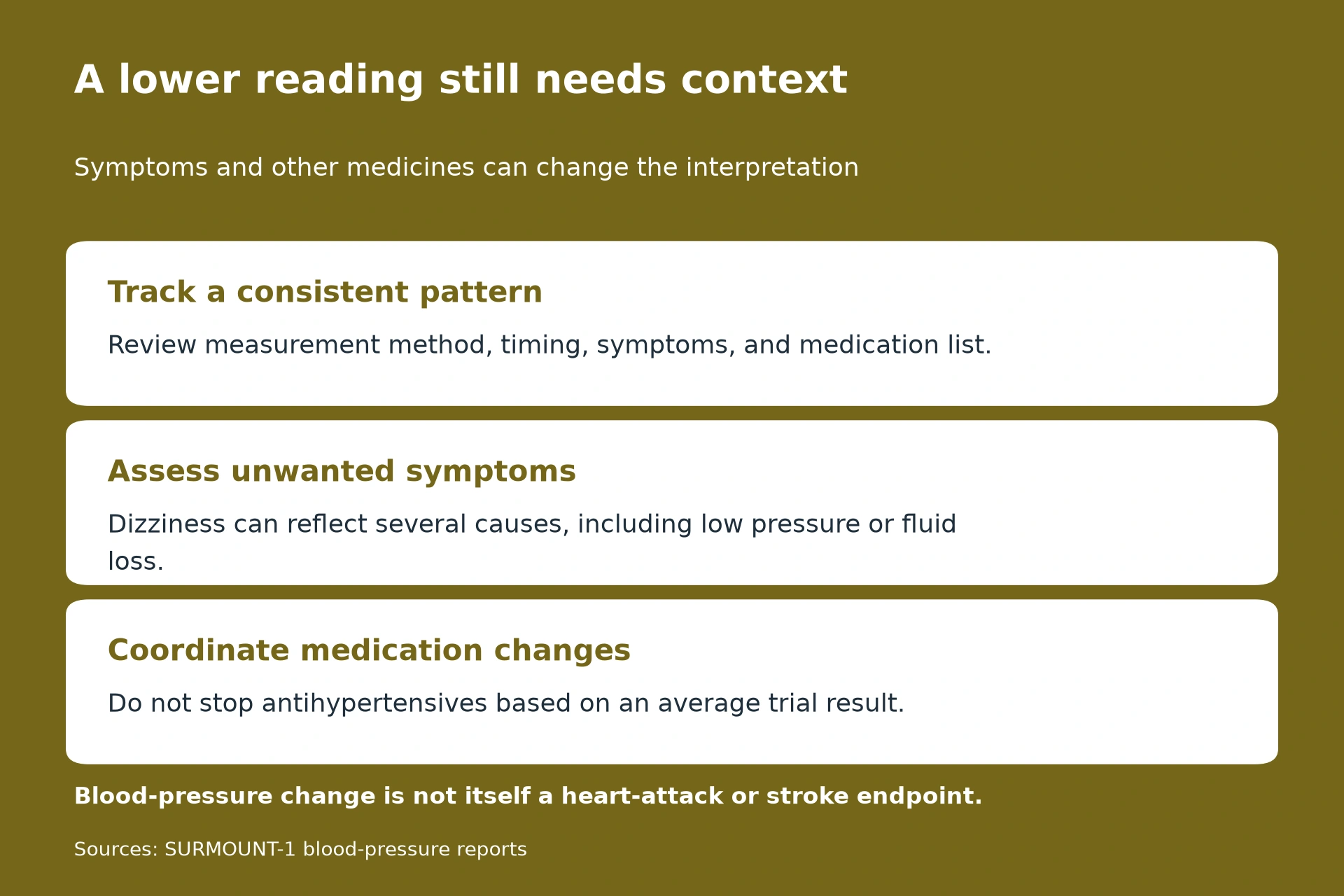
The office-pressure report found that adverse events associated with low blood pressure were uncommon but occurred more often with tirzepatide. A person also may experience dizziness for reasons other than medication-related pressure reduction, including reduced intake, dehydration, another medicine, or an unrelated illness. Safety analysis.
That is why symptoms should be interpreted with readings, timing, fluid intake, and the medication list. A single low reading is different from recurrent symptoms, and normal pressure at one visit does not explain every episode of lightheadedness.
Discuss persistent or recurrent dizziness with the treating clinician. Fainting, chest pain, severe shortness of breath, or new neurological symptoms require urgent medical attention. The trial’s average results should never be used to explain away an acute problem.
Should blood-pressure medicines be reduced as weight falls?
Sometimes a clinician may reassess a regimen as weight, blood pressure, kidney function, symptoms, and other factors change. The SURMOUNT-1 reports do not provide a universal schedule for doing so. Do not stop or reduce an antihypertensive because a research chart suggests an average decline.
Bring a record of readings taken with a consistent method, symptoms and their timing, and an accurate medication list. Include nonprescription products as well as prescribed medicines. The aim is to identify a pattern that can support a decision, rather than to react to whichever isolated number is highest or lowest.
The CoreAge Rx tirzepatide information page can support a consultation about treatment suitability. The product and its formulation should be identified explicitly. These trials do not automatically establish identical effects for compounded preparations or nonstandard dosing schedules; the FDA’s GLP-1 information explains why product status matters.
Watch: improving the quality of a blood-pressure reading
This Mayo Clinic video provides practical measurement context. It does not present the SURMOUNT-1 analysis or instruct viewers to change medication. Follow the instructions for your device and the monitoring plan agreed with your clinician.
Questions readers often ask
Can tirzepatide lower blood pressure even if it was normal before treatment?
The substudy’s average baseline pressure was not markedly elevated, and systolic pressure still fell relative to placebo. That supports monitoring across a range of starting readings rather than assuming only people with very high pressure can experience a change.
Is the 72-week result a promise of a 6.8-point drop for me?
No. It is a group comparison against placebo. Individual changes can be smaller, larger, absent, or affected by other medicines and conditions.
Do I need a 24-hour monitor to take tirzepatide?
The study used ABPM to answer a research question. Whether an individual needs ambulatory monitoring, home readings, or another assessment depends on the clinical situation. This article does not establish a universal testing requirement.
Does lower blood pressure mean dehydration is harmless?
No. A long-term average pressure benefit and an acute problem from poor intake or fluid loss are different issues. Symptoms and clinical context remain important even when weight and blood-pressure trends appear favorable.
What should I take away from these studies?
Tirzepatide lowered average systolic pressure in the studied SURMOUNT-1 populations. Use the finding to plan coordinated monitoring, while keeping office versus ambulatory measurements, weight-related mechanisms, and actual cardiovascular outcomes distinct.
Original papers and supporting sources
The references distinguish full research papers, published abstracts, and official guidance. This educational narrative review is not a systematic review or an individual treatment recommendation. Sources were checked in October 2026.
- de Lemos JA et al. Tirzepatide Reduces 24-Hour Ambulatory Blood Pressure in Adults With Body Mass Index ≥27 kg/m2: SURMOUNT-1 Ambulatory Blood Pressure Monitoring Substudy. (2024). Full text reviewed. DOI: 10.1161/hypertensionaha.123.22022. Open full text.
- Krumholz HM et al. Tirzepatide and blood pressure reduction: stratified analyses of the SURMOUNT-1 randomised controlled trial. (2024). Full text reviewed. DOI: 10.1136/heartjnl-2024-324170. Open full text.
- FDA. Concerns with unapproved GLP-1 drugs used for weight loss. FDA safety information.
Additional evidence and study details
- Tirzepatide and Heart Outcomes: What SURPASS-CVOT Shows Against Dulaglutide. Understand the SURPASS-CVOT cardiovascular result against dulaglutide, its confidence interval, and why noninferiority differs from superiority.