
A 900-calorie diet is a very restrictive intake that should not be treated as a universal do-it-yourself weight-loss target. A specialized, nutritionally complete program with clinical supervision is different from simply eating 900 calories of ordinary food. The calorie number alone cannot tell you whether your nutritional needs are being met or whether a plan is appropriate for you.
If you are reaching roughly 900 calories because of low appetite, nausea, a demanding schedule, or a desire for faster weight loss, the next step is to review the reason and the full eating pattern. It is not enough to decide that the number must be working because it is low. This guide explains the distinction between clinical programs and self-directed restriction, the limits of calorie calculators, and questions to bring to your care team.
Why does the number need more context?
Calories describe energy. They do not, by themselves, show whether you are getting adequate protein, fluids, fiber, vitamins, minerals, or food variety. Two patterns with the same calorie total can contain very different foods and can create very different practical challenges.
For example, a low total reached by missing meals is different from an intentionally designed clinical program. Likewise, a total estimated from an app may omit drinks, dressings, cooking ingredients, or inaccurate portion entries. Neither situation is resolved by declaring a single number suitable for everyone.
Our calorie-intake guide explains why estimates need individual interpretation. The balanced-meal guide looks at the foods making up the meal, rather than treating a daily total as the only decision.
Is 900 calories a low-energy or very-low-energy diet?
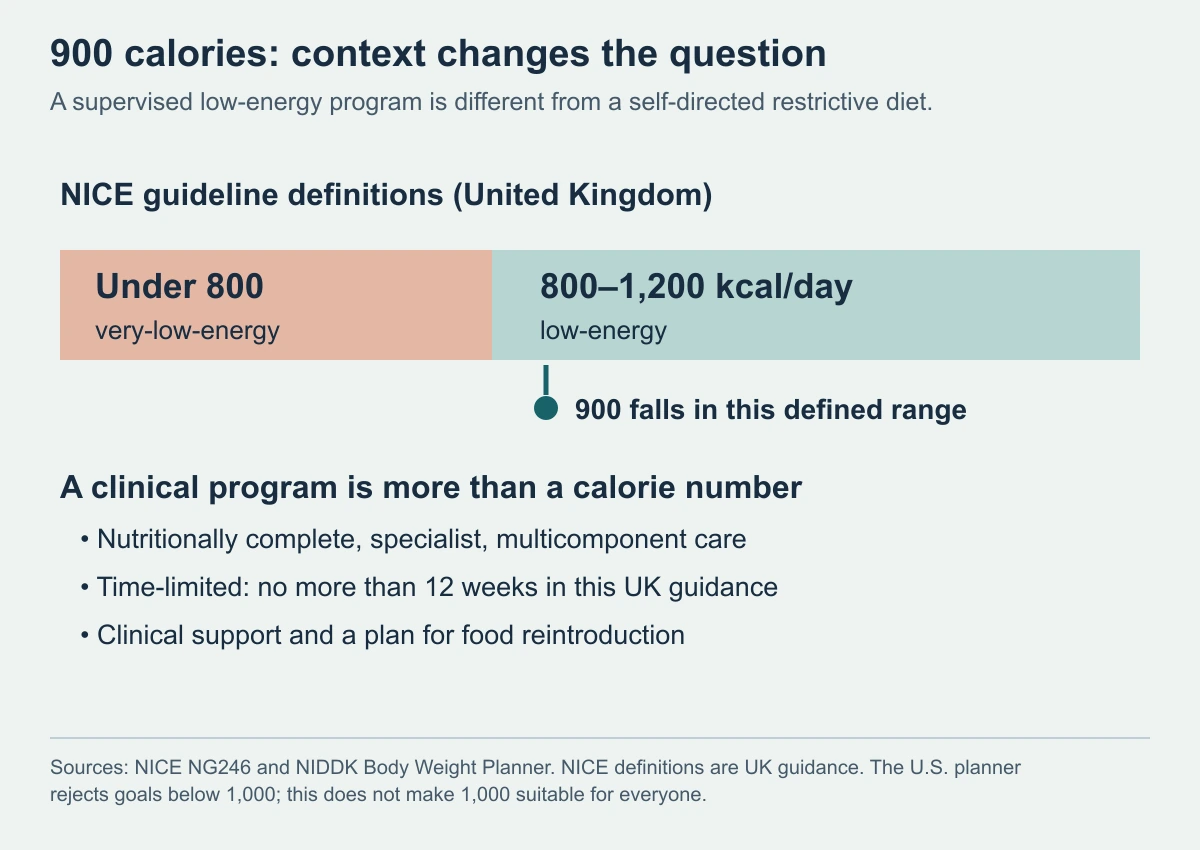
Definitions depend on the guidance being used. In its current United Kingdom guideline, NICE defines low-energy diets as 800–1,200 calories a day and very-low-energy diets as fewer than 800. Under those definitions, 900 is in the low-energy range. The terminology does not establish that it is appropriate for self-directed use. NICE dietary guidance
NICE places these approaches in a specialist, multicomponent weight-management setting. Its recommendations include nutritionally complete diets, clinical support, limited duration of no more than 12 weeks, and a plan for food reintroduction. Low-energy approaches are considered for specific groups, including adults with obesity or adults with overweight and type 2 diabetes. This is UK guidance, not a U.S. insurance rule or a personal prescription.
The main lesson is the structure surrounding the intake: suitability assessment, nutritional completeness, supervision, and what happens afterward. Borrowing a calorie range from a clinical guideline without those features does not create the same program.
What does a U.S. calorie planner say?
The NIDDK Body Weight Planner rejects goals or intakes below 1,000 calories a day and warns that food-group targets and nutrient recommendations cannot be met below that level within the tool. This is a safeguard in a public planning tool, rather than a recommendation to eat exactly 1,000 calories. NIDDK planner
It also does not mean that every intake just above the threshold is adequate. Personal needs and clinical circumstances still matter. The planner’s information is intended for adults and excludes use for younger people or people who are pregnant or breastfeeding. It is not a substitute for evaluation by a health professional. About the planner
If a calculator, app, or online menu gives you a very low target, take the result to a qualified clinician or registered dietitian. Ask how it accounts for your health, current treatment, activity, eating history, and nutritional needs. Do not assume a precise-looking output makes a restrictive target reliable.
Will eating 900 calories guarantee weight loss?
This article cannot predict a personal result or a rate of weight change. A stated intake is not the same as a verified intake, and a change on the scale does not identify which body tissues or fluids changed. The outcome also does not tell us that the approach is nutritionally adequate.
NIDDK describes overweight and obesity as health conditions influenced by multiple factors. The purpose of treatment is broader than finding the lowest number you can tolerate. NIDDK overview
If you have followed a restrictive pattern and have not seen the result you expected, avoid automatically cutting further. Review how the intake was estimated, whether the plan is realistic, and whether medical or medication-related factors need attention. An accurate review is more useful than turning frustration into a lower target.

Does adding supplements make the diet complete?
A supplement does not establish that a self-directed 900-calorie pattern provides adequate nutrition. It does not account for all the foods, energy, protein, fiber, fluids, and individual requirements involved in a meal plan. Nutritional completeness in a clinical program is a specific feature of that program, not something to assume from a multivitamin label.
Bring the exact supplements and doses to a care review. Your clinician can consider the ingredients alongside medicines, laboratory findings, and any diagnosed deficiency. Buying more products before clarifying the eating pattern can make the routine more complicated without answering the underlying question.
Our supplements during GLP-1 treatment guide discusses when a supplement question needs an ingredient-specific review. The protein and muscle guide explains why protecting function during weight loss deserves attention beyond a calorie total.
What if low appetite during treatment leads to very little food?
Lower appetite does not prove that your current intake meets your needs. If you are repeatedly unable to eat enough, have persistent nausea, or are skipping most meals, describe that pattern to the prescribing team. Include when it started, whether it followed a treatment change, and what food and fluids you are actually managing.
The current Zepbound label includes gastrointestinal adverse reactions and a warning about kidney injury related to volume depletion. Difficulty eating accompanied by vomiting or diarrhea therefore needs to be assessed in context, rather than celebrated as an especially successful medication response. Zepbound prescribing information
This is not a reason to change the dose yourself. Your clinician can review tolerability, symptoms, nutrition, and the actual treatment plan. The semaglutide questions guide and tirzepatide questions guide provide related questions to raise. Our nausea and vomiting guide also explains why persistent symptoms deserve attention.
NIDDK describes prescription weight-management medicines as part of care that includes healthy eating and physical activity. They are not a substitute for an adequate eating plan. Medication overview
What should you ask about a supervised program?
If a clinician recommends a low-energy program, ask for the full plan rather than just the calorie amount. Written instructions help clarify responsibilities and make it easier to know whom to contact when something changes.
| Question | What you need to understand |
|---|---|
| Why is this approach appropriate for me? | The clinical reason and alternatives considered. |
| What makes the program nutritionally complete? | The exact foods or products and how they meet the plan’s requirements. |
| How long is this phase intended to last? | The duration and review points, rather than an indefinite restriction. |
| Which medicines or health conditions need review? | Treatment-specific monitoring and any changes directed by the clinician. |
| Who supports me between appointments? | A contact route for symptoms, intake difficulties, or questions. |
| What happens when ordinary foods return? | A practical transition and longer-term support plan. |
NICE emphasizes the need to discuss possible adverse effects, weight regain, eating-disorder assessment where appropriate, and medication review before these programs begin. A plan should explain both the restrictive phase and the path afterward. NICE program recommendations

What if you are already eating around 900 calories?
Start with an honest account rather than a new restriction rule. A brief record of meals, drinks, symptoms, and medication timing can help the clinician understand what is happening. It should be a tool for care, not a requirement to track every bite indefinitely.
Consider whether the low intake is intentional or whether appetite, symptoms, cost, limited cooking access, or work demands are making food difficult. Those situations may need different kinds of support. Tell the clinician if the pattern is accompanied by strong anxiety about eating more, rigid food rules, or an urge to compensate after meals.
If you have a prescribed fluid limit or another medical dietary restriction, include it in the review. Generic advice to add more water or protein may not fit your circumstances. Our hydration guide explains why fluid needs vary.
Severe or persistent symptoms should not wait for a routine nutrition appointment. For example, the Zepbound label directs patients with severe abdominal pain that may indicate pancreatitis to seek medical evaluation. Follow the warning instructions for your actual medicine and contact your care team about inability to keep fluids down or other concerning symptoms. Product warnings
Is 1,100 calories enough, or good for weight loss, if 900 is too low?
There is no universal adequacy or suitability threshold at 1,100 calories. NICE places 800–1,200 calorie low-energy diets in a specialist-supported, nutritionally complete program for specified adults, with clinical supervision and a maximum 12-week restrictive phase; that is UK guidance, not a personal U.S. prescription. The NIDDK planner rejects targets below 1,000 calories, but crossing its software threshold does not prove that 1,100 meets your individual needs. Review nutritional adequacy, symptoms, medical conditions and the complete plan with a qualified clinician or dietitian. NICE NG246 low-energy and very-low-energy diets. NIDDK Body Weight Planner intake safeguards.
Questions people commonly ask
Can you provide a 900-calorie meal plan?
The number alone cannot establish a suitable plan. A clinician or dietitian needs to decide whether a restrictive approach is appropriate and, if so, how nutritional completeness, duration, medicines, and follow-up will be handled. A generic menu would not answer those questions.
Is 900 calories acceptable because I am not hungry?
Hunger is useful information, but it does not measure whether all your needs are met. Persistent very low intake deserves review, especially during treatment or when symptoms make eating difficult. Describe both appetite and the actual foods you can manage.
Is one unusually low day the same as a planned diet?
No. The frequency, reason, symptoms, and overall pattern matter. A clinician can interpret an isolated day differently from repeated restriction or ongoing inability to eat. Avoid using one day’s number to set the next month’s target.
What should you focus on next?
Clarify why intake is low and whether the current pattern supports your health. If weight-management treatment is being considered, our medication-choice guide can help organize the clinical questions, and the CoreAge Rx semaglutide information page describes that service. A treatment decision should include an adequate nutrition and follow-up plan; it should not start with an assumption that 900 calories is the goal.
Educational information for adults; individual treatment decisions require a qualified clinician. Sources reviewed September 30, 2026. Original AI-generated article images depict fictional people and objects, not patient outcomes. Other editorial images are illustrative. Graphics summarize the cited sources.