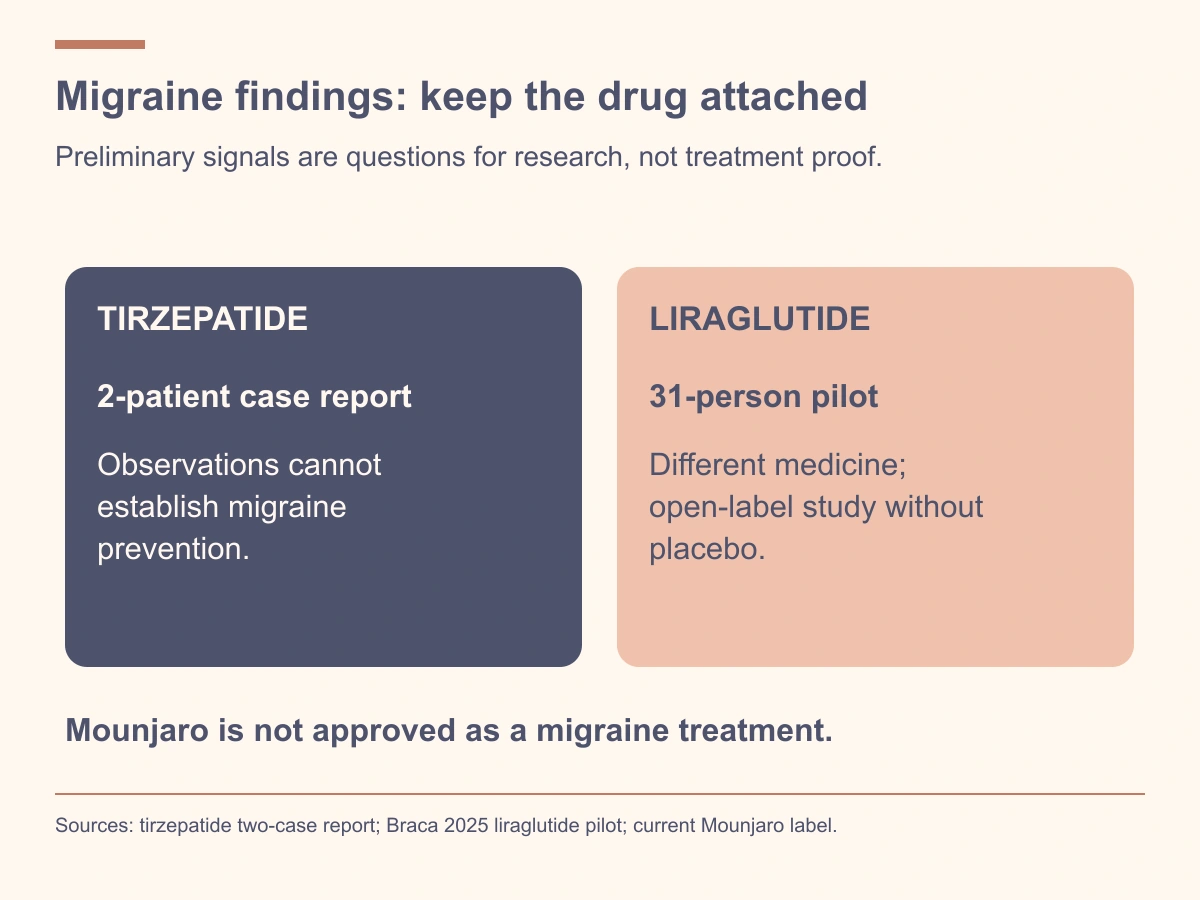
Mounjaro is not an approved migraine treatment. There is emerging research on GLP-1 medicines and headache disorders, including a two-patient tirzepatide case report and a small liraglutide pilot study. These findings are preliminary and do not establish that Mounjaro prevents migraine or should replace a migraine treatment plan.
A different question arises if headaches start or change while you take Mounjaro. The timing deserves attention, but it does not identify the cause. New symptoms may require review of glucose, food and fluid intake, other medicines, or a separate headache condition. Sudden severe headache or new neurological symptoms needs urgent assessment.
What is Mounjaro actually approved to treat?
Mounjaro contains tirzepatide, which acts at GIP and GLP-1 receptors. Its current U.S. label includes improving glucose control in adults and children aged 10 and older with type 2 diabetes, and reducing specified major cardiovascular events in adults with type 2 diabetes at high risk. Migraine prevention is not a labeled indication. Mounjaro prescribing information.
That distinction matters when a headline describes a possible new use. A research signal can justify further investigation without establishing the benefit, appropriate patients, dose, or long-term safety for that use.
Our guide to how Mounjaro works explains its established pharmacology. The Mounjaro and Zepbound comparison also shows why the same ingredient does not make every brand’s indications interchangeable.
What did the tirzepatide case report describe?
A recent case series described two people with migraine who reported fewer migraine headaches during tirzepatide use. Both also lost weight. One used a compounded preparation. The observations were retrospective, and headache estimates relied on recall rather than prospectively recorded research diaries. Tirzepatide case series.
Those details substantially limit the conclusion. Two cases cannot establish how frequently an effect occurs, which patients might benefit, or whether tirzepatide caused the change. Weight loss, natural fluctuation, other treatments, and recall can complicate interpretation. A compounded product also introduces preparation and dosing questions that cannot be assumed equivalent to an approved product.
The report describes clinical observations, not a regimen to copy. Its dosing histories should not be converted into advice to space, reduce, or restart Mounjaro for headache control. The authors themselves identify the findings as preliminary and call for further study.
Why the liraglutide study is a separate piece of evidence
A prospective pilot study enrolled 31 adults with obesity and high-frequency or chronic migraine that had not responded to at least two preventive treatments. It studied liraglutide as an add-on treatment over 12 weeks. Liraglutide is a different medicine from tirzepatide. Liraglutide pilot abstract.
The study reported that average monthly headache days decreased from 19.8 to 10.7, while the measured BMI change was small and not statistically significant. However, it was an open-label pilot without a randomized placebo comparison. The result cannot establish the same benefit for Mounjaro, people without obesity, or every person with migraine.
A measured improvement in a small group is worth investigating, but the study design cannot fully separate a treatment effect from expectations, time, or other influences. The finding supports a research question; it does not establish a dependable individual outcome.
Migraine and intracranial hypertension are different conditions
Some discussions combine migraine findings with research on idiopathic intracranial hypertension, a condition involving raised pressure around the brain. These are different diagnoses. A person should not infer raised pressure from a headache or assume that a treatment studied for one disorder is appropriate for the other.
The tirzepatide case-series discussion refers to intracranial-pressure research as part of the scientific background, not proof that Mounjaro treats all headaches. Diagnosis requires the relevant clinical assessment.
If headaches come with vision changes or other new neurological symptoms, seek medical attention rather than using a GLP-1 research article to diagnose yourself. NINDS describes migraine as a neurological disorder with several possible symptom patterns and a range of established treatment approaches. NINDS migraine information.
How strong are the different claims?
| Evidence | What it can help describe | What it cannot establish |
|---|---|---|
| Two tirzepatide cases | A possible clinical signal | A reliable preventive effect or recommended migraine regimen |
| A 31-person liraglutide pilot | A change observed during a short add-on study | A randomized treatment effect or a Mounjaro result |
| Research on another headache disorder | A separate scientific question | That every headache has the same cause or treatment |
| Your own headache diary | Timing and patterns to discuss | A diagnosis or proof that one medicine caused the change |
These distinctions protect against both overpromising benefit and dismissing symptoms. A medicine might be temporally associated with improvement or worsening without that observation, by itself, proving the mechanism.

What if headaches started after Mounjaro?
Record when they began, whether they followed a new prescription or dose change, and how they differ from your usual headaches. Include severity, duration, associated symptoms, sleep, meals, fluids, and medicines taken for relief.
Headache is not among the common adverse reactions listed in the Mounjaro label’s main table of reactions occurring in at least 5% of treated patients. That does not mean headache cannot happen, cannot be reported, or can be ignored. A common-adverse-reaction table is not a complete explanation of an individual symptom.
Tell the prescriber about repeated or changing headaches, especially if they interfere with ordinary activity. Our Mounjaro side-effects guide helps place the question alongside digestive symptoms and other warnings.
Could low blood glucose be involved?
The Mounjaro label warns that using it with insulin or an insulin secretagogue such as a sulfonylurea increases hypoglycemia risk. The medication guide includes headache among possible symptoms of low blood sugar. Symptoms can overlap with other problems, so a familiar headache should not automatically be attributed to migraine.
Follow the glucose-monitoring and low-glucose plan your diabetes team has provided. If you do not have a plan, ask for one. Do not independently change insulin or another diabetes medicine based on a headache article.
Severe confusion, loss of consciousness, or seizure is an emergency. Our Mounjaro low-blood-sugar guide explains the issue in more detail, and NIDDK’s hypoglycemia resource describes why symptoms, glucose measurements, and an individual treatment plan belong together.
Food, fluid intake, and digestive symptoms also matter
A change in eating or drinking can accompany treatment. Persistent nausea, vomiting, or diarrhea can make maintaining fluids difficult, and the Mounjaro label warns about kidney injury associated with volume depletion. The appropriate response is to assess the symptoms and intake rather than assume every headache is a benign medication effect.
Tell the care team if you are regularly missing meals, unable to drink normally, or urinating much less than usual. Do not force a generic fluid target if you have a condition requiring individualized fluid advice.
The Mounjaro kidney-disease article explains dehydration-related questions. The calorie-intake guide discusses why reduced appetite does not remove the need for adequate nutrition. A headache review should include those practical details alongside the medicine list.
Review migraine medicines as part of the whole regimen
Bring both preventive and acute headache treatments to the pharmacist or prescriber. Include nonprescription pain relievers, caffeine-containing products, and supplements. Frequent use of headache medication can itself be part of a medication-overuse headache pattern, which requires an appropriate review. MedlinePlus headache guidance.
Mounjaro delays gastric emptying and may affect absorption of oral medicines. That label warning does not establish that every oral migraine drug will fail or that a particular spacing interval will solve the problem. Review the actual drug, formulation, response, and symptoms.
Our Mounjaro medication-interaction guide explains this distinction. Ask for a written plan for attacks, including what to do if vomiting prevents an oral medicine from staying down. Do not automatically repeat a dose that may have been partly absorbed.
When a headache should not wait
Seek emergency help for a sudden explosive or “worst-ever” headache, or a headache with new weakness, difficulty speaking, confusion, loss of balance, or other neurological changes. A severe headache after injury or with fever and a stiff neck also requires urgent assessment. MedlinePlus warning signs.
A headache that is new, progressively worsening, or substantially different from your usual pattern deserves evaluation. The fact that it occurred after a Mounjaro injection does not rule out another serious cause.
Do not wait for a routine medication follow-up to assess emergency symptoms. A symptom diary is useful for stable ongoing questions; it should not delay urgent care.

What should you discuss at follow-up?
Bring the exact product, dose history, headache days, attack medicines, glucose observations when relevant, and changes in food, fluids, sleep, or health. Distinguish “fewer headaches” from “less severe attacks” and from “needing less rescue medicine.” Those are related but different outcomes.
If you already have migraine, ask whether the current preventive and acute plan still fits. If headaches improved while taking tirzepatide, share that observation without assuming it is safe to stop established migraine treatment. If they worsened, describe the pattern so the team can assess it.
For CoreAge Rx tirzepatide information, the relevant discussion is an appropriate assessment for the service’s treatment scope. It should not be presented as a migraine-prevention service based on preliminary research. Compounded drugs are not FDA-approved, and a case report involving one does not validate other compounded preparations. FDA information.
Frequently asked questions
Can Mounjaro prevent migraine?
That benefit is not established. The tirzepatide case report is preliminary, and the small pilot studied liraglutide rather than Mounjaro. Migraine prevention is not a Mounjaro labeled indication.
Should I stop my migraine medicine if headaches improve?
Discuss the change with the clinician managing migraine. Improvement during another treatment does not by itself establish that your preventive plan is no longer needed.
Does a headache mean I need a different Mounjaro dose?
Not automatically. The cause, glucose context, other medicines, intake, and warning signs need review. Do not use a headache alone to change the dose or weekly schedule.
What if I take Zepbound instead?
Identify the actual product when you speak with the care team. The Zepbound headache guide addresses that medicine separately, while the same need to assess new or severe symptoms remains.
Educational information for adults; individual treatment decisions require a qualified clinician. Sources reviewed October 5, 2026. Original AI-generated article images depict fictional people and objects, not patient outcomes. Other editorial images are illustrative. Graphics summarize the cited sources.