You can drink green tea cold if that is how you enjoy it. The evidence does not establish that serving it iced produces greater weight loss than serving it hot. What matters more for a practical beverage choice is the finished drink: added sugar, serving size, caffeine, other ingredients, and what it replaces in your day.
A plain iced tea can be an enjoyable alternative to a sweetened drink. It is not a treatment for obesity, a way to cancel out food, or a reason to buy concentrated “fat-burning” extracts. This guide explains how to compare options without getting distracted by temperature claims.
Does cold green tea help you lose weight?
The National Center for Complementary and Integrative Health says the catechins and caffeine in green tea and its extracts may have a modest effect on body weight. Effects vary with the product and circumstances. That finding does not establish a dependable number of pounds lost, a particular cup count, or an advantage for drinking the beverage cold. NCCIH green tea overview
There are two different ideas here. One is whether tea compounds have a measurable effect under study conditions. The other is whether changing a daily beverage habit helps someone follow an eating plan. If you replace a frequently purchased sweet drink with unsweetened green tea, the relevant change includes the sugar and energy in those drinks. The temperature is not what makes that comparison useful.
For example, someone may enjoy iced tea with lunch because it is refreshing and convenient. Someone else may prefer a warm cup after breakfast. Neither needs to force the less enjoyable version to pursue an unproven temperature benefit. A habit that fits daily life is easier to assess than a rigid ritual built around a marketing claim.
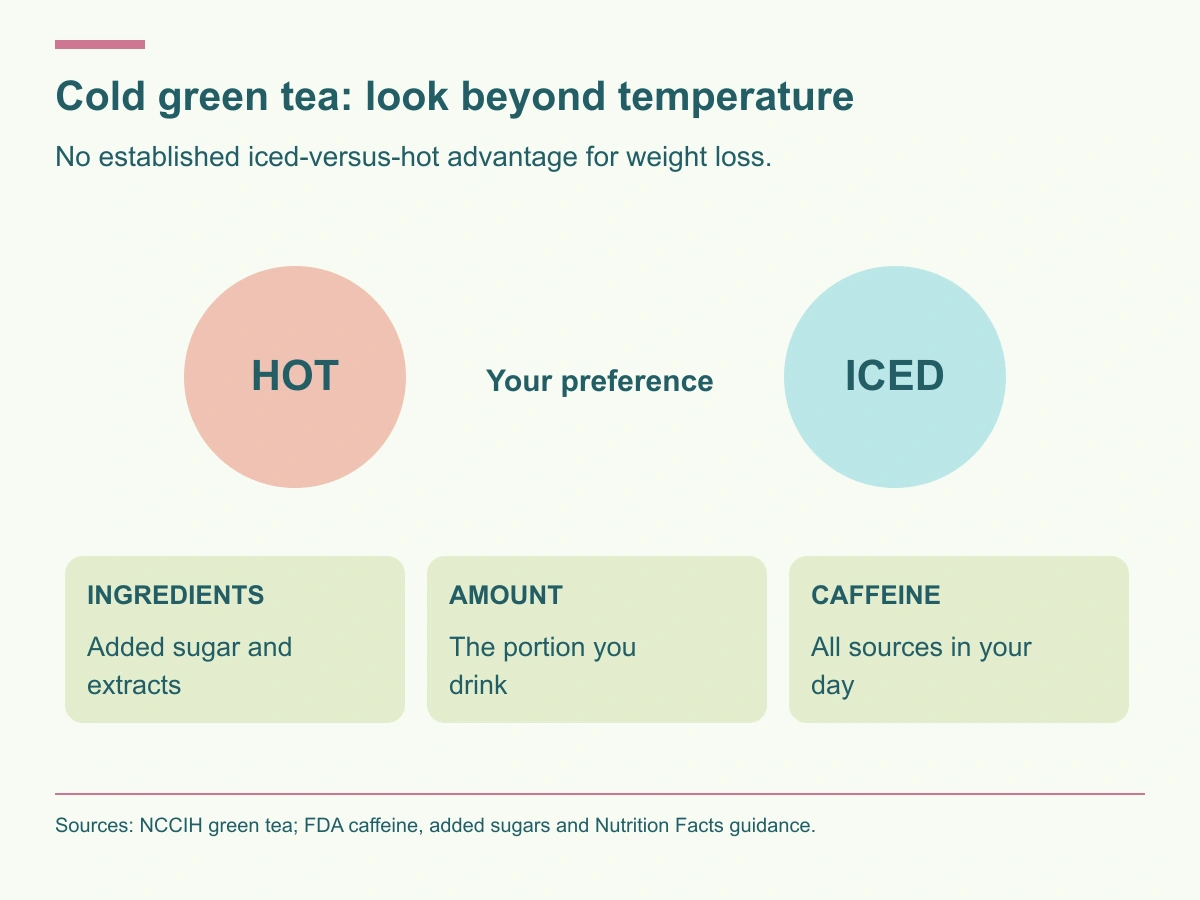
Hot tea, chilled tea, and cold-brew tea are different questions
“Cold green tea” can mean tea brewed hot and then chilled, tea prepared using a cold-brew method, or a commercially bottled drink. These are not necessarily identical products. Brewing instructions, concentration, flavorings, and serving size can differ. A comparison that ignores those details may attribute a difference to temperature when the drinks themselves are different.
Follow the preparation directions on the tea or ready-to-drink product. There is no weight-management reason to make a much stronger brew than directed, keep adding bags, or drink a concentrate undiluted. A bitter drink is not evidence of greater effectiveness.
If you like an iced drink, choose the method that gives you a taste you enjoy without requiring large amounts of added sweetener. Use clean equipment, follow storage instructions, and refrigerate prepared drinks as directed. This article does not establish a special brewing temperature, steeping time, or storage period that increases fat loss.
The related guide to the best time to drink tea addresses morning, afternoon, and evening routines. Timing and serving temperature are separate decisions, and neither supplies a proven shortcut to weight management.
Compare the actual drink, not the front of the bottle
A bottle labeled “green tea,” “natural,” or “antioxidant” still needs a nutrition-label review. Start with servings per container and the amount you normally drink. Then look at calories, added sugars, and the ingredient list. The FDA emphasizes that the serving on a Nutrition Facts label describes an amount commonly consumed; it is not a personalized recommendation. FDA label-reading guide
A bottle may list information for one serving or for the whole container. If the label uses a smaller serving than your usual drink, account for the difference. Compare two products using the same amount rather than assuming the smaller number means a better choice.
Honey, syrups, and sugar added while making tea count as added sugars. A homemade drink can therefore be sweetened even when the plain tea bag has no sugar. The FDA’s explanation of added sugars is useful for understanding the difference between a product’s total sugars and the sugars added during processing or preparation. FDA added-sugars guide
This is not a rule that every sweetened tea is forbidden. It is a way to make the choice deliberately. If an unsweetened version tastes too abrupt, gradually changing the usual preparation may be more workable than buying an expensive “diet” tea you dislike.
A practical comparison of iced green tea options
| Option | What to check | Useful interpretation |
|---|---|---|
| Plain home-brewed green tea, chilled | Preparation instructions, amount, caffeine tolerance | A beverage choice; chilling does not create a weight-loss treatment |
| Unsweetened bottled green tea | Serving size and full ingredients | Convenient, but caffeine and concentration can vary |
| Sweetened bottled green tea | Added sugar per amount actually consumed | Compare it with your usual beverage using equal portions |
| Green tea with honey or syrup | What you add to the entire drink | Homemade sweetener still changes the finished drink |
| Decaffeinated green tea | Remaining caffeine and personal sensitivity | Usually less caffeine, not necessarily none |
| Green tea extract or “detox” blend | Supplement ingredients and safety concerns | A different product from ordinary brewed tea |
A short ingredient list can make comparison easier, but it does not prove a product is appropriate for every person. The important details are the ingredients themselves, your medicines, and how the drink fits your routine.

What is the best cold green tea for weight loss?
There is no single brand established as the best cold green tea for weight loss. A practical choice is one you enjoy, can afford, can prepare consistently, and can compare clearly with your usual drinks. Look for transparent labeling rather than a promise about metabolism or belly fat.
If reducing added sugar is your goal, compare unsweetened options first. If caffeine disturbs your sleep or causes palpitations, review lower-caffeine choices instead of assuming a premium tea will be easier to tolerate. If you have a medicine interaction concern, the pharmacist needs the ingredients, not just the marketing name.
You can make a simple shopping note with four items: the product, the bottle or cup size, whether it is sweetened, and the caffeine information available. This keeps repeat purchases comparable. Price per bottle can also be misleading when bottle sizes differ, so compare the amount you would actually use.
Our sweet tea versus soda article explains why a tea label alone does not settle the beverage comparison. The more useful question is what changes when you replace one with the other.
Caffeine still counts when tea is cold
Ice does not make a caffeinated drink caffeine-free. Consider all sources across the day, including coffee, other teas, energy drinks, supplements, and some medicines. Product size and caffeine content vary, and the absence of a prominent caffeine number does not necessarily mean there is none. FDA caffeine guidance
The FDA cites 400 milligrams per day as an amount not generally associated with negative effects for most adults. It is not a target or a guarantee for everyone. Pregnancy, breastfeeding, health conditions, medicines, and individual sensitivity can change the discussion. Ask for personal advice when these apply.
Pay attention to sleep disruption, jitters, anxiety, palpitations, or digestive discomfort. If a large afternoon iced tea causes problems, moving it earlier or choosing a suitable lower-caffeine option is a practical adjustment. Increasing intake to chase weight loss is not.
Decaffeinated tea can still contain some caffeine. The decaf tea guide can help distinguish “less” from “none.” If you regularly consume a lot of caffeine and want to reduce it, a gradual change may be more comfortable than an abrupt stop.
Bottled tea is not the same as a green tea extract
Concentrated extracts are often promoted with language that makes them sound like a stronger version of a familiar beverage. Their safety profile is different. NCCIH describes digestive side effects, medication interactions, and uncommon liver injury associated especially with green tea extracts in tablets or capsules. NCCIH safety information
A supplement labeled “natural” can still contain several active ingredients. Show the full label to your pharmacist or clinician before adding it, especially when you already take prescription medicines. Do not assume that tolerating a cup of tea predicts how you will respond to a concentrated product.
Likewise, a blend advertised as a detox or cleanse should not be treated as a necessary part of weight management. A change in bowel habits or temporary fluid balance does not establish fat loss. A familiar beverage does not need additional stimulant ingredients to become worth drinking.
For another everyday comparison, see peppermint tea versus green tea. Different tea types have different ingredients and practical considerations; no one tea needs to carry the entire weight-management plan.

Cold tea when you have diabetes or take a GLP-1 medicine
Unsweetened tea can fit a diabetes eating plan, but it does not replace a meal or treat low blood glucose. NIDDK recommends individualizing meal timing and carbohydrate intake around medicines and activity. Insulin and certain diabetes tablets make skipped or delayed meals particularly important to discuss. NIDDK healthy living with diabetes
If semaglutide or tirzepatide reduces your appetite, check whether you are still eating adequately. Do not use a large tea drink to suppress hunger further when you are struggling to meet nutrition needs. Persistent nausea, vomiting, or inability to drink enough deserves clinical review.
Our balanced-meal guide offers a more useful framework than relying on beverages alone. For questions about assessment-based treatment, CoreAge Rx semaglutide information explains its service; confirm the actual preparation and instructions with the care team. A tea choice and a prescription decision serve different purposes.
Frequently asked questions
Does cold green tea burn belly fat?
There is no established cold-tea method that selectively removes belly fat. Evaluate the drink as part of the overall eating pattern, not as a treatment for one body area.
Does adding ice cancel the benefits of green tea?
Ice changes the serving temperature and can dilute the drink as it melts. It does not establish a separate weight-loss category. Choose a preparation you enjoy and follow the product instructions.
Should I drink it before every meal?
There is no proven premeal schedule or cup count that guarantees weight loss. Consider caffeine, comfort, medication instructions, and whether the routine helps you eat regularly.
Is cold green tea with lemon better?
Lemon can add flavor, but it does not establish greater fat loss. If it makes an unsweetened drink more enjoyable and suits your digestion, it can be a preference rather than a treatment strategy.
Can I drink only tea instead of eating breakfast?
Tea is not a nutritionally complete meal. If breakfast helps you meet your needs or matches your diabetes medication plan, a beverage alone is not an equivalent replacement. Review persistent poor appetite with your care team.
What is the most useful first step?
Compare one usual drink with one alternative using the amount you actually consume. Keep the change simple enough to repeat, and assess taste, sleep, symptoms, cost, and the broader meal routine. There is no need to find a special cold-tea formula.
Educational information for adults; individual treatment decisions require a qualified clinician. Sources reviewed October 6, 2026. Original AI-generated article images depict fictional people and objects, not patient outcomes. Other editorial images are illustrative. Graphics summarize the cited sources.