Tesofensine dose numbers found online usually come from research studies or commercial claims, not an established FDA-approved U.S. prescribing schedule. A research dose does not tell an individual how to start, increase, cycle, or combine a medicine. The evidence also needs careful reading: the often-cited 2008 trial has a linked journal expression of concern, and later Tesomet research studied a different combination in a specific clinical population.
If you are considering a product marketed as tesofensine, first ask about its regulatory status, the exact preparation, and the evidence supporting the proposed use. Do not use this article or a study table as a personal dosing plan.
Is there an FDA-approved tesofensine dose for weight management?
The current FDA records reviewed for this article do not establish an approved U.S. tesofensine prescribing label or dosing schedule. A recent FDA warning letter explicitly includes tesofensine among substances ineligible for the section 503A compounding pathway discussed in that letter. The current approved-application ingredient search also returned no matching tesofensine record. FDA Darmerica warning letter, FDA approved-drug database.
That is a different situation from a medicine with an approved label specifying its indication, starting dose, escalation, warnings, and administration. An online seller’s schedule does not create that approval.
The clinical discussion should start with the actual treatment options available to you. Our guide to seeking weight-management help describes what a first evaluation can cover, including health history, goals, and appropriate follow-up.
What doses were used in the older phase II trial?
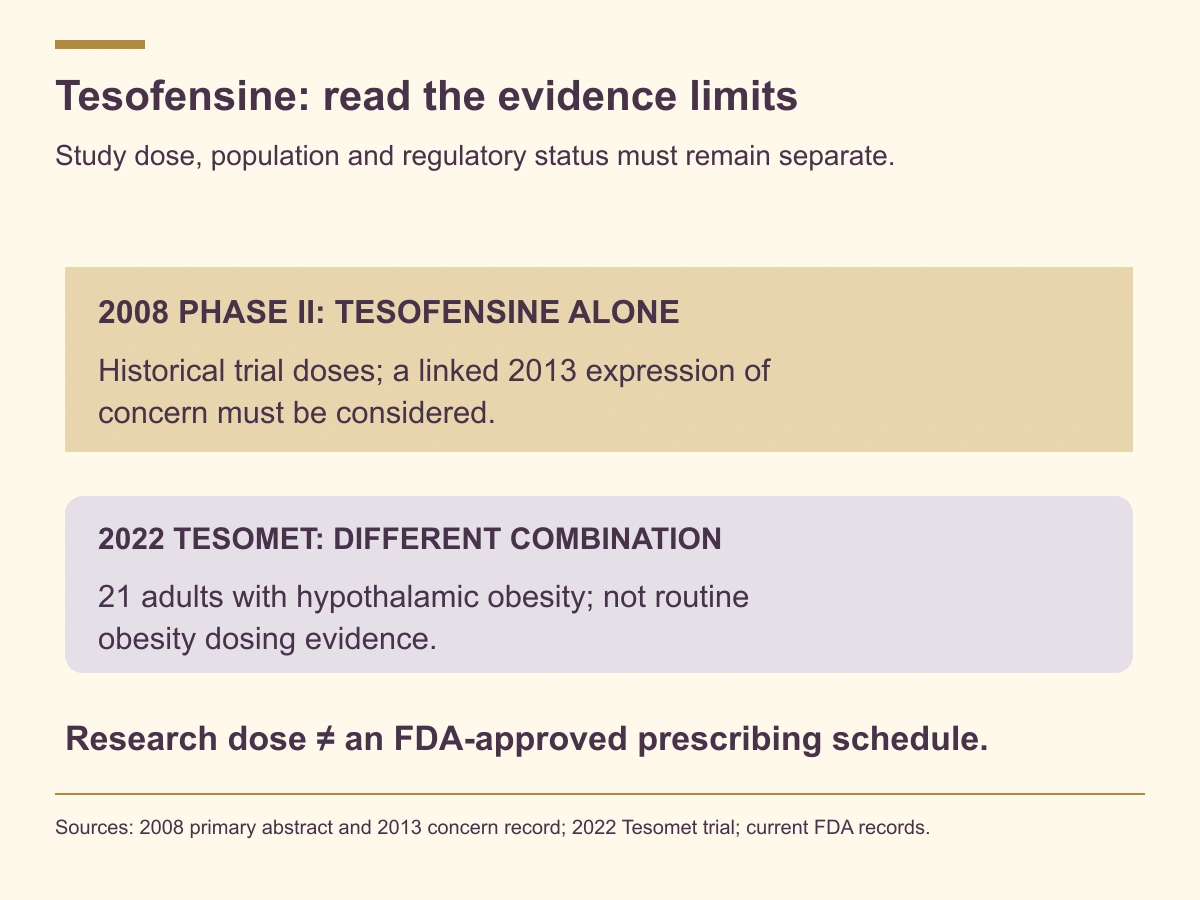
The 2008 primary abstract describes 203 participants with obesity assigned to tesofensine 0.25 mg, 0.5 mg, or 1 mg once daily, or placebo, for 24 weeks alongside an energy-restricted diet. These are historical study arms, not recommended starting or maintenance doses for a reader. 2008 primary trial abstract.
The abstract reports adverse events including gastrointestinal symptoms and insomnia, and a heart-rate increase in the 0.5 mg group. It calls for confirmation in later trials. The full interpretation must also account for the journal’s linked 2013 expression of concern. Journal expression-of-concern record.
This article therefore does not present the trial’s weight-loss figures as a promised result or use the dose arms to choose a “best” dose. A dose-response comparison in one trial cannot establish an individualized treatment schedule.
| Research setting | What was studied | Why it is not a self-dosing guide |
|---|---|---|
| 2008 phase II trial | Several tesofensine dose arms over 24 weeks | Historical study design; linked expression of concern; no patient-specific prescribing plan |
| 2022 Tesomet trial | Tesofensine plus metoprolol in adults with hypothalamic obesity | Different combination and a small, specific population |
| FDA orphan-designation record | A named combination for a rare condition | Designation is not approval or routine obesity dosing authorization |
Why the expression of concern matters
A journal expression of concern is an editorial signal that readers should consider when assessing a publication. The bibliographic record links the 2013 notice directly to the 2008 tesofensine trial. It should not disappear when the older study is summarized in a marketing article. Primary concern record.
The record alone does not justify inventing a reason, declaring every result false, or treating the article as retracted. It does mean that an unqualified claim based on the older trial leaves out relevant publication context.
Ask anyone recommending a schedule whether they have reviewed the primary study and its linked notices, and what independent evidence supports the proposed clinical use. A precise dose number is not strong evidence if the underlying study’s context is omitted.
This is also why older comparisons with “currently approved drugs” need historical interpretation. A statement made in a 2008 abstract does not compare tesofensine with every treatment available today.
Tesomet is a different research question
The 2022 Tesomet trial studied a fixed combination of tesofensine 0.5 mg and metoprolol 50 mg in 21 adults with hypothalamic obesity over 24 weeks. Hypothalamic obesity is a specific condition related to hypothalamic injury; it is not interchangeable with every form of excess weight. Primary Tesomet trial.
The study reported a treatment-related serious event involving worsening pre-existing anxiety in one participant, along with other adverse events. Its small size and specific population limit what can be generalized. The presence of metoprolol also means it cannot be read as tesofensine-alone evidence.
Do not copy the combination or add a beta blocker to address an online claim about heart rate. That would create a separate prescribing decision with its own indications, risks, and monitoring needs.
When reviewing a research headline, ask which medicine or combination was actually used, who participated, how long they were followed, and which outcomes were assessed. Those details often change the meaning of the headline.
Orphan designation does not equal FDA approval
The current FDA orphan database record reviewed here lists tesofensine plus metoprolol as designated for Prader-Willi syndrome and explicitly records that it is not FDA approved for that orphan indication. FDA orphan-designation record.
A designation concerns a particular development pathway and named condition. It does not establish approval for routine weight management, identify a general patient dose, or make a retail product equivalent to a research preparation.
Look carefully at claims such as “FDA registered,” “orphan drug,” or “research backed.” Ask what exact status is meant and whether an approved application and patient label exist for the proposed treatment. Different regulatory terms answer different questions.
A database entry can be real while a seller’s inference from it is misleading. The useful response is to verify the particular claim, not to assume that any FDA-related reference implies approval.

Why a dose chart cannot establish product quality
Before discussing milligrams, a clinician needs to know what product is being proposed. Ask about the source, formulation, ingredient identity, dispensing process, and who will handle adverse events or product questions.
A commercial chart cannot verify that a container matches a research product. A claimed purity result also does not create an approved finished medicine or a complete clinical treatment process.
The compounded GLP-1 guide explains related product-review principles for semaglutide and tirzepatide. Tesofensine is a different substance; do not assume a compounding explanation for one drug establishes an available pathway for another.
Likewise, our semaglutide mixing-chart guide describes why product identity and preparation instructions cannot be supplied by arithmetic. The same underlying question—what exactly is the patient-use product?—comes before any dose comparison.
How should potential benefits and risks be discussed?
A useful discussion names the evidence, the uncertainty, and the alternatives. It should not promise a particular percentage of weight loss from a trial average or select a dose from a testimonial.
Ask whether the proposed benefit was measured in a population similar to yours and whether the product and regimen match the study. Ask which risks were actively assessed, how common events were defined, and what follow-up existed.
The older abstract and small combination trial raise specific questions about gastrointestinal symptoms, sleep, heart rate, and anxiety. They do not create a complete safety profile for every dose, preparation, duration, or combination. 2008 abstract, Tesomet trial.
If you have a history of anxiety, cardiovascular disease, or several medicines, name that history explicitly during the review. A clinician should assess it alongside the exact proposed treatment, rather than treating a low internet dose as proof of low risk.
What if you are already taking a tesofensine product?
Tell a qualified clinician what you are using, where it came from, the amount and schedule actually taken, and when you began. Bring the label and seller or pharmacy information. Include all other medicines and supplements.
Do not increase, cycle, combine, or change the preparation based on an online chart. Ask for an event- and product-specific plan, including what to do about the next dose and which symptoms require prompt care.
New chest pain, severe breathing difficulty, fainting, or another serious symptom needs urgent medical attention. Do not assume that a racing heart or anxiety-like episode is an expected sign that the medicine is working.
If you are uncertain about the product or amount used, say that directly. The care team needs the actual uncertainty to assess the situation safely.
How do established weight-management treatments fit into the conversation?
A comprehensive evaluation can consider eating patterns, activity, sleep, medical conditions, and appropriate medications. It should also distinguish intentional weight management from unexplained weight change or persistent fatigue.
Our balanced-meal guide and sleep and weight guide provide practical starting points. Neither promises that daily habits alone will address every person’s obesity or replace clinical treatment.
For medicine questions, Ozempic alternatives explains why indication and treatment fit matter. The CoreAge Rx tirzepatide information page can help begin a discussion of a separate treatment option, its actual product, and prescribing process; it is not an endorsement of tesofensine or an eligibility promise.
Ask the clinician to explain which options have an established approval and label for the relevant condition, which are appropriate for your history, and how ongoing care will work.

Questions people commonly ask
Is 0.5 mg the “standard” tesofensine dose?
It is a dose that appears in research. That does not establish an FDA-approved U.S. standard dose or show that it is appropriate for an individual.
Can I start lower and increase gradually?
This article does not establish a starting, escalation, or cycling schedule. Ask a clinician about the regulatory and evidence questions before adopting a seller’s protocol.
Does Tesomet prove tesofensine alone is safe?
No. Tesomet is a combination, and the reviewed trial involved a small group with a specific condition. Its findings cannot be transferred wholesale to tesofensine alone or ordinary obesity care.
Is orphan designation approval for weight loss?
No. The reviewed record names a combination and a rare-condition indication and lists it as not approved for that indication. It does not provide a general weight-loss prescription.
Can I compare tesofensine’s trial percentage with Zepbound’s results?
Different trials, populations, durations, and methods do not support a simple personal ranking. The older trial’s publication notice also matters. Our compounded tirzepatide versus Zepbound guide explains another distinction that should remain clear when evaluating products.
Treat dose numbers as part of a study, not a prescription
Identify the study, population, publication context, product, and regulatory status before interpreting a dose. For a treatment decision, ask a qualified clinician about established options and an appropriate follow-up plan. A chart cannot provide those judgments.
Educational information for adults; individual treatment decisions require a qualified clinician. Sources reviewed October 5, 2026. Original AI-generated article images depict fictional people and objects, not patient outcomes. Other editorial images are illustrative. Graphics summarize the cited sources.