A semaglutide mixing chart cannot verify what is in a vial, establish that a powder is suitable for injection, or replace instructions from the pharmacy that dispensed your medicine. Approved ready-to-use products and a preparation that requires reconstitution are different situations. Before using any chart, identify the actual product and ask whether any preparation step is required at all.
If the instructions are missing or unclear, contact the dispensing pharmacy and prescriber before preparing or injecting it. Do not choose a dilution amount from a chart based only on the total milligrams printed on a container.
Why people search for a mixing chart
People often receive a vial, see an unfamiliar concentration, or find a powder marketed online and assume that a chart will tell them what to add. The word “mixing” can also be used loosely for several different tasks: preparing a product, measuring a dose, or converting syringe markings.
Those tasks require different information. A dosing chart for an approved medicine does not provide reconstitution instructions for an unknown powder. A volume calculation also cannot establish ingredient identity, sterility, or an appropriate treatment plan.
Our semaglutide dosage guide explains prescription and product distinctions. This article focuses on preparation questions and why a generic chart cannot fill the gaps in a particular pharmacy label.
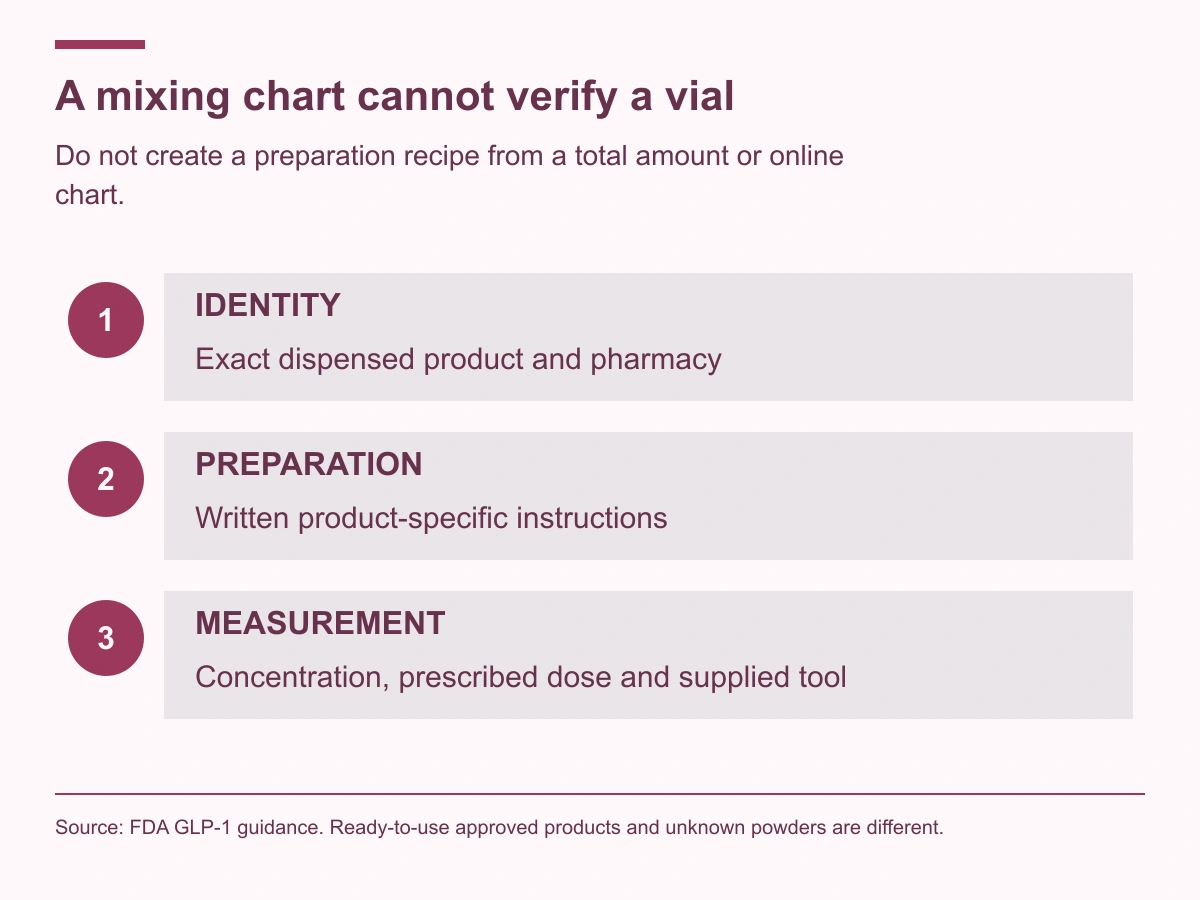
First ask whether the medicine is already ready to use
The reviewed Ozempic and Wegovy injection labels describe supplied solution presentations with their own administration instructions. They do not tell patients to create the medicine by adding a chosen amount of water to an online powder. Ozempic prescribing information, Wegovy prescribing information.
A vial from a compounding pharmacy may also contain a prepared liquid. Do not assume every vial contains a powder or needs added liquid. Adding something to a finished preparation can change its concentration and introduce a handling problem.
Read the label and ask the pharmacy to identify the product’s state and intended use. If a container’s appearance differs from what the instructions describe, resolve that mismatch before proceeding.
The semaglutide vial guide covers the broader label and dose-measurement questions. Packaging shape alone does not establish whether a product is compounded, ready to use, or properly dispensed.
Mixing, dosing, and measurement are separate questions
| Term | What it describes | What it does not establish |
|---|---|---|
| Total amount | Active ingredient stated for the whole container | The correct liquid volume or patient dose |
| Concentration | Amount of ingredient per liquid volume | That the product is authentic or sterile |
| Prescribed dose | The amount intended for one administration | How to prepare an unknown powder |
| Measured volume | The liquid amount drawn or delivered | A dose without the matching concentration |
| Reconstitution | Preparing a specified product with its specified instructions | A universal recipe for all semaglutide vials |
A total amount and a concentration are not the same label field. The same total ingredient amount could be distributed in different liquid volumes, yielding different concentrations. That is why a chart based on only one number cannot supply the full answer.
A syringe marking is also a measurement scale, not the name of a semaglutide dose. It must be interpreted through the actual concentration and prescribed instructions. Do not carry a remembered marking over to a differently labeled refill.
What written preparation instructions should resolve
If your legitimately prescribed product requires a preparation step, ask the dispensing pharmacy for instructions specific to that product. They should resolve the questions that a generic chart leaves open.
These include the identity of the preparation, whether a preparation step is intended, which supplied materials belong to it, the final labeled concentration, the measurement tool, storage, and applicable use limits. The pharmacy should also be able to explain what to do if any step or product detail is uncertain.
Do not substitute a diluent based on a social-media recommendation. This article does not specify a mixing liquid, amount, sequence, or handling technique because those choices cannot be determined from the ingredient name alone.
If the pharmacy cannot clarify its own product and instructions, ask the prescriber how to obtain a properly identified and instructed supply. A missing label detail is a reason for clarification, not a reason to invent it.
Questions to ask before using the supply
Use a focused checklist:
- What exact medicine and formulation was dispensed?
- Is it already a prepared solution, or is any preparation actually required?
- Which pharmacy prepared and dispensed it, and how can I contact them?
- What is the concentration on the final dispensed product?
- How does my prescribed dose correspond to the supplied measurement tool?
- What storage and first-use limits apply?
- What should I do if the package or instructions are inconsistent?
Ask for a demonstration or written clarification using the actual product and tool. Repeating back the instructions in your own words can reveal uncertainty before it becomes a measurement error.
Keep both the prescription and pharmacy label. A screenshot of an online chart is not a substitute for those records.

Why a refill can change the measurement question
A refill may have a different concentration, container, or instructions. Even if the prescribed milligram dose is unchanged, the measured volume may differ when concentration differs.
For example, “the same number of syringe marks as last time” is only meaningful if the relevant product details also match. A familiar-looking vial or identical total amount does not establish that match.
When receiving a refill, compare the concentration and instructions with the prior supply. If anything changed, ask the pharmacy to explain the new measurement before use. Do not resolve a discrepancy by averaging two charts or choosing whichever amount looks familiar.
FDA has received reports of serious dosing errors involving compounded GLP-1 medicines, including incorrect measurement and calculation. FDA dosing-error concerns. That makes a product-specific check worthwhile even when someone has used a vial successfully before.
Product identity and ingredient form matter
FDA explains that compounded GLP-1 drugs are not FDA approved and do not undergo the same premarket review for safety, effectiveness, and quality. It also identifies concerns about semaglutide sodium and semaglutide acetate, which differ from the active ingredient used in approved products. FDA unapproved GLP-1 guidance.
A chart labeled “semaglutide” does not determine which substance is in a container. Neither does a seller’s use of a familiar brand name. Ask the dispensing pharmacy to explain the exact preparation and ingredients.
Our compounded GLP-1 guide covers approval and formulation questions. The CoreAge Rx semaglutide information page can help begin a service discussion, but the actual dispensed product still needs identification before applying instructions.
Research-use powder is not a patient prescription
FDA warns against unapproved GLP-1 products sold directly to consumers under research-use or not-for-human-consumption claims. Such labeling does not establish that a product is suitable for self-injection. FDA research-use product warning.
A certificate, a seller’s dosing guide, or a precise-looking calculator cannot establish a complete patient-use product review. The questions include identity, quality, sterility, preparation, appropriate prescribing, and follow-up.
Do not treat a powder purchased without a proper prescribing and pharmacy process as a cheaper version of a ready-to-use approved medicine. Ask a licensed clinician about legitimate treatment options instead of trying to repair the missing safeguards with a chart.
This distinction also applies to related searches. Our tirzepatide reconstitution guide explains why a named amount in a vial does not define a universal recipe for another medication.
Storage and first-use dates are part of the instructions
Preparation and storage cannot be separated. Once a product is opened or first used, other handling limits may apply even when an unopened date is still in the future.
Current FDA guidance recommends discarding multidose compounded GLP-1 vials within 28 days after first use, even when medicine remains and the compounder’s instructions permit longer. The agency also advises new sterile needles and syringes for each dose. FDA current multidose-vial guidance.
Ask the pharmacy how to reconcile unclear instructions and which limits apply to your actual supply. Do not extend them because a solution looks clear or because an online mixing chart includes a longer storage estimate.
The semaglutide storage guide discusses temperature and travel questions. A storage allowance for branded Ozempic or Wegovy cannot be transferred to a different compounded preparation.
What if you already prepared or measured it incorrectly?
Stop guessing and contact the dispensing pharmacy and prescribing team. Explain the exact product, what happened, when it occurred, and whether any medicine was administered. Keep the container, instructions, and remaining materials available for identification.
Do not try to correct an uncertain concentration by adding more liquid or adjusting the next dose yourself. A calculation cannot restore confidence in an unknown preparation or establish that it is appropriate to use.
If a suspected dosing error has occurred, ask for prompt event-specific advice. Severe or persistent vomiting, significant abdominal pain, faintness, or other serious symptoms require urgent medical assessment. FDA’s reports include errors that led to medical care. FDA compounded-product dosing concerns.
Do not discard the information needed to investigate the event. The lot, label, pharmacy, and dose timeline can help clinicians and the pharmacy understand what occurred.

Questions people commonly ask
Can the total milligrams tell me how much water to add?
No. The total amount does not establish whether preparation is required, the intended concentration, the correct materials, or suitable handling. Ask the dispensing pharmacy for exact instructions.
Is a mixing chart the same as a dosage chart?
No. A treatment schedule describes prescribed doses for a particular product or clinical situation. It does not establish a preparation recipe for an unknown vial or powder.
Can I use the chart that worked for my previous vial?
Do not assume it applies. Verify the new product, concentration, measurement tool, and instructions. A refill can look similar while important details differ.
Does a clear liquid prove the preparation is safe?
No. Appearance does not verify concentration, authenticity, or sterility. Resolve product and handling questions through the pharmacy rather than visual inspection alone.
What if an online seller supplies detailed instructions?
Detail does not establish legitimate patient-use quality or approval. Identify the prescriber and state-licensed dispensing pharmacy, and avoid research-use products marketed for self-treatment.
Replace a generic chart with an exact-product answer
Identify the medicine, determine whether preparation is required, and obtain clear written instructions from the pharmacy. Confirm the prescribed measurement and handling limits before use. Those steps answer the real question a mixing chart cannot: whether you understand and can appropriately use the actual dispensed product.
Educational information for adults; individual treatment decisions require a qualified clinician. Sources reviewed October 5, 2026. Original AI-generated article images depict fictional people and objects, not patient outcomes. Other editorial images are illustrative. Graphics summarize the cited sources.