
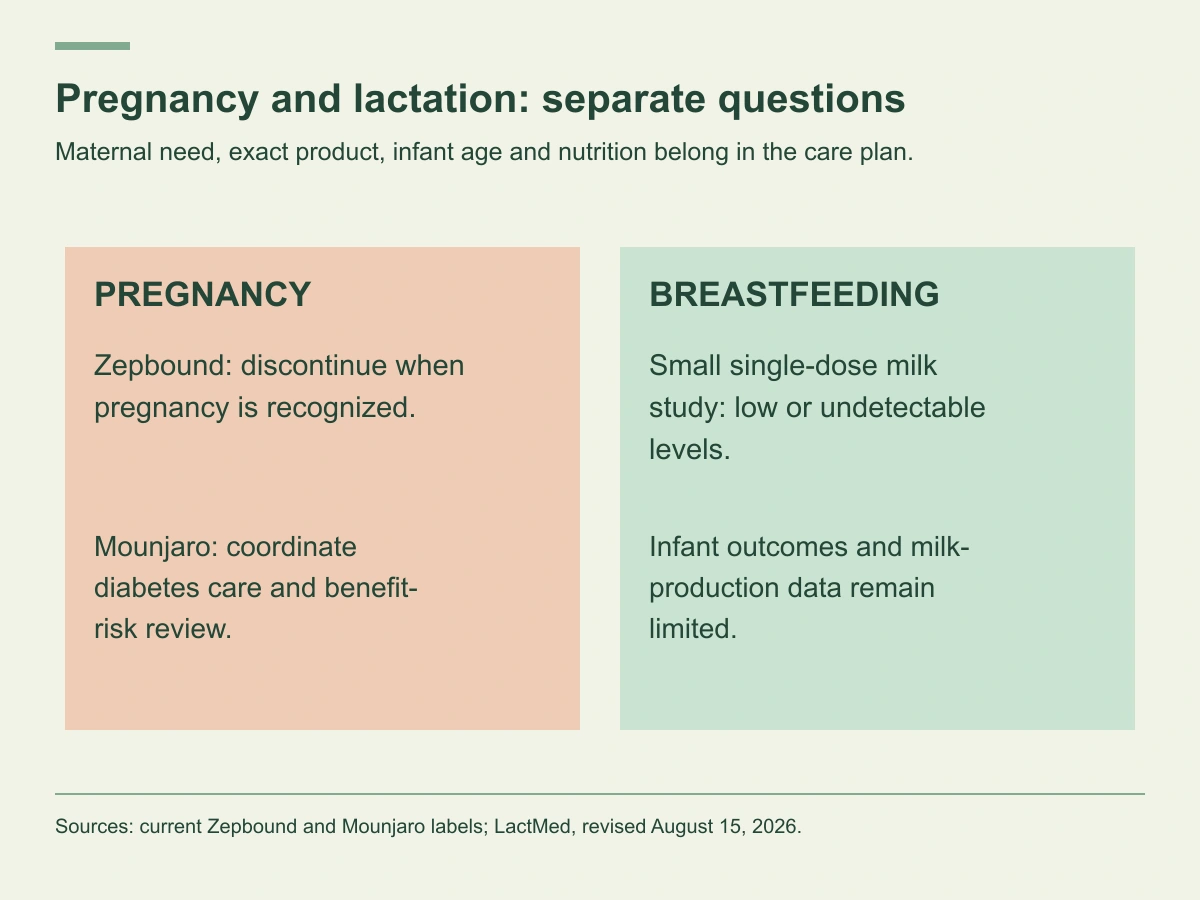
Pregnancy and breastfeeding require different tirzepatide discussions. The current Zepbound label says to discontinue treatment when pregnancy is recognized. The Mounjaro label describes limited pregnancy data and use only when the potential benefit justifies the potential fetal risk, while also recognizing the risks of poorly controlled diabetes.
Breastfeeding information has changed as new data have become available. Current labels report very low or undetectable tirzepatide levels in a small single-dose milk study, but they do not establish safety for breastfed infants or effects on milk production. A decision should address the actual medicine, maternal need, infant age and nutrition, rather than assuming pregnancy and lactation have identical rules.
Start with the exact brand and treatment goal
Zepbound and Mounjaro contain tirzepatide, but their labeled indications differ. Zepbound includes weight management and an obstructive sleep apnea indication in defined adults with obesity. Mounjaro is a diabetes medicine. The reason for treatment matters when considering a pause or alternative plan. Zepbound prescribing information, Mounjaro prescribing information.
A compounded tirzepatide preparation is not the same as either branded product. Give the clinician the package, pharmacy name, strength or concentration and prescribed schedule. Do not use a social-media brand name as a substitute for the prescription details.
Our Mounjaro medication-interaction guide explains related oral-medicine and contraception questions. The compounded GLP-1 guide covers formulation and pharmacy distinctions. Neither replaces a pregnancy-specific consultation.
What to do if pregnancy is recognized
The Zepbound label says weight loss offers no benefit during pregnancy and may cause fetal harm, and directs discontinuation when pregnancy is recognized. Contact the prescribing and pregnancy care teams promptly so they can document exposure, address symptoms and make a plan. Zepbound pregnancy information.
For Mounjaro, the label says human pregnancy data are insufficient to evaluate drug-related risks and that potential benefit must justify potential fetal risk. It also identifies risks associated with poorly controlled diabetes in pregnancy. A person taking tirzepatide for diabetes needs prompt coordination of glucose care; do not assume simply removing the prescription leaves no treatment issue. Mounjaro pregnancy information.
These label statements should not be used to predict the outcome of a particular exposed pregnancy. Animal findings provide a reason for caution, but they do not establish an individual human risk percentage. The care team can discuss exposure dates, other medicines, glucose control and appropriate pregnancy follow-up.
Information to have ready
Note the product, prescribed dose, last injection date, dates of recent dose changes and when pregnancy was recognized. Include why tirzepatide was prescribed and who manages diabetes or other relevant conditions. Bring other prescriptions and supplements as well.
If you have already had a dose before learning you were pregnant, contact the team rather than trying to calculate the outcome from a half-life chart. An exposure history helps care planning; it is not proof that harm has occurred.
The Zepbound label also describes a pregnancy exposure registry. Ask the clinician whether registry participation is appropriate and use the current official information. A registry collects evidence; it is not a diagnostic test or a guarantee about an individual pregnancy.
Planning pregnancy needs a written treatment plan
Discuss pregnancy intentions before a future prescription or dose change. Ask when the actual medicine should be stopped, what treatment will replace it if needed, how glucose will be monitored, and how contraception will be handled during the transition.
Do not automatically copy semaglutide planning instructions onto tirzepatide. Different active ingredients and labels can have different recommendations. Our semaglutide and pregnancy article addresses a separate medicine; a rule from that discussion is not a universal tirzepatide washout interval.
A useful plan includes more than a final injection date. It should cover the condition being treated, nutrition, other prescriptions and how to contact the team if pregnancy occurs sooner than expected. Ask for instructions that apply to the actual formulation rather than a generic “GLP-1” timeline.
Tirzepatide and oral contraceptives
Both current tirzepatide brand labels warn that delayed gastric emptying may reduce the effectiveness of oral hormonal contraceptives. They advise switching to a nonoral contraceptive method or adding a barrier method for four weeks after starting treatment and for four weeks after each dose escalation. Mounjaro contraception warning, Zepbound contraception warning.
That is a specific label precaution, not evidence that everyone taking a pill will become pregnant. Ask the prescribing or reproductive-health clinician which method fits your circumstances and how to handle overlapping dose changes. Do not assume that spacing the pill a few hours away from the injection solves the warning.
Also discuss vomiting, missed contraceptive pills and other medicines with the relevant clinician. Those details may require their own instructions. A medication-review visit should distinguish the tirzepatide label precaution from the directions for the actual contraceptive product.

What the breastfeeding study found
Current Zepbound and Mounjaro labels describe a study in 11 healthy lactating adults who received a single 5 mg tirzepatide dose. Tirzepatide was undetectable in 164 of 171 milk samples at the study’s detection limit. The cumulative amount detected in the other seven samples over 28 days was less than 0.02% of the maternal administered dose. Current label lactation data.
The percentage describes measured drug in collected milk compared with the administered maternal dose. It is not a percentage risk to an infant, not a statement that the infant received that exact amount, and not a guarantee of no harm.
The label explicitly says data are unavailable on effects in the breastfed infant or on milk production. A single-dose study also differs from ongoing weekly treatment. It cannot settle every question about repeated exposure, different maternal doses or a newborn’s response.
| Evidence or question | What it supports | What remains unresolved |
|---|---|---|
| Small single-dose milk study | Low or undetectable levels in the sampled milk | Infant clinical outcomes and repeated-dose exposure |
| Current brand labels | A benefit-and-risk discussion incorporating maternal need | A universal breastfeeding clearance |
| Infant age and health | Important context for the care team | A decision based only on maternal dose |
| Maternal food intake and lactation goals | Nutrition and feeding follow-up | A guaranteed effect on milk supply |
The table separates observations from decisions. It should not be read as a breastfeeding dosing guide.
How LactMed interprets the current evidence
LactMed’s tirzepatide entry, revised August 15, 2026, describes usually undetectable milk levels with the evidence available up to 5 mg and notes that substantial oral absorption by the infant is unlikely on biological grounds. It says maternal need for tirzepatide is not by itself a reason to discontinue breastfeeding, while recommending caution, especially with a newborn or preterm infant. LactMed tirzepatide review.
That is a nuanced reference assessment, not a declaration that every mother-infant pair should continue treatment. LactMed also notes that the manufacturer’s single-dose study does not account for accumulation with ongoing dosing. Additional small reported observations do not substitute for controlled infant safety studies.
The practical conversation should include infant age, prematurity, feeding, growth and other health concerns, as well as the mother’s treatment indication and alternatives. Ask who will monitor each person and what findings would change the plan.
Avoid two outdated absolutes: that there is no human milk information at all, and that low milk detection proves treatment is safe for every infant. The current evidence supports a more specific discussion with the prescribing clinician and infant’s care team.
Maternal nutrition and feeding deserve attention
Tirzepatide can affect appetite and cause digestive symptoms. During lactation, actual food and fluid intake and the ability to maintain feeding are important clinical observations. A lower appetite should not be treated as a reason to aggressively restrict food while nursing.
Tell the team about repeated vomiting, difficulty eating, rapid unintended changes, concern about milk supply or infant feeding. The available label data do not establish a predictable milk-production effect. A feeding concern deserves assessment rather than being assigned to the medicine without review.
Our GLP-1 meal guide and tirzepatide, protein and muscle guide discuss general nutrition questions. Pregnancy and breastfeeding require adaptation by the care team; a standard adult weight-loss calorie target may be inappropriate.

Questions for a coordinated appointment
Ask whether the current product remains appropriate, which alternatives address the treatment goal, and what the next-dose plan is. For diabetes, clarify monitoring and replacement treatment if needed. For breastfeeding, discuss infant follow-up, maternal intake and whether a lactation professional should be involved.
If different clinicians manage the prescription, pregnancy and infant care, make sure they receive the same medication history. A brief written plan can state who answers medicine questions, who monitors glucose or feeding, and what symptoms require earlier contact.
For future treatment exploration, CoreAge Rx describes its tirzepatide service and semaglutide service. These pages do not establish eligibility during pregnancy or breastfeeding and should not be used as a recommendation to start or restart. Compounded medicines are not FDA-approved and should be considered only when an individual medical need cannot be met by an approved drug. FDA compounding guidance.
Frequently asked questions
Can you use Zepbound during pregnancy?
The current label directs discontinuation when pregnancy is recognized. Contact the prescribing and pregnancy care teams promptly for an exposure and treatment plan rather than continuing a weight-loss schedule.
What if I take Mounjaro for diabetes?
Promptly coordinate with the diabetes and pregnancy teams. The label describes limited data and benefit-risk considerations, and poorly controlled diabetes carries its own pregnancy risks. A replacement glucose-care plan may be needed.
Can you breastfeed while taking tirzepatide?
The answer needs an individualized discussion. Current milk data are limited but more informative than older claims of no information. Labels identify missing infant and milk-production data, while LactMed recommends particular caution for newborn or preterm infants.
Does the less-than-0.02% finding prove infant safety?
No. It describes measured drug in milk after one maternal dose. It is not an infant risk percentage or evidence about every repeated-dose situation.
How long should I stop before trying to conceive?
Obtain a written plan for the actual product, treatment indication and personal history. Do not transfer another GLP-1 medicine’s planning interval onto tirzepatide or create a universal washout from this article.
Does tirzepatide affect birth control pills?
The brand labels warn about reduced oral contraceptive effectiveness and advise a nonoral method or added barrier method for four weeks after initiation and each dose escalation. Ask how that applies to your contraceptive and treatment plan.
Educational information for adults; individual treatment decisions require a qualified clinician. Sources reviewed October 2, 2026. Original AI-generated article images depict fictional people and objects, not patient outcomes. Other editorial images are illustrative. Graphics summarize the cited sources.