
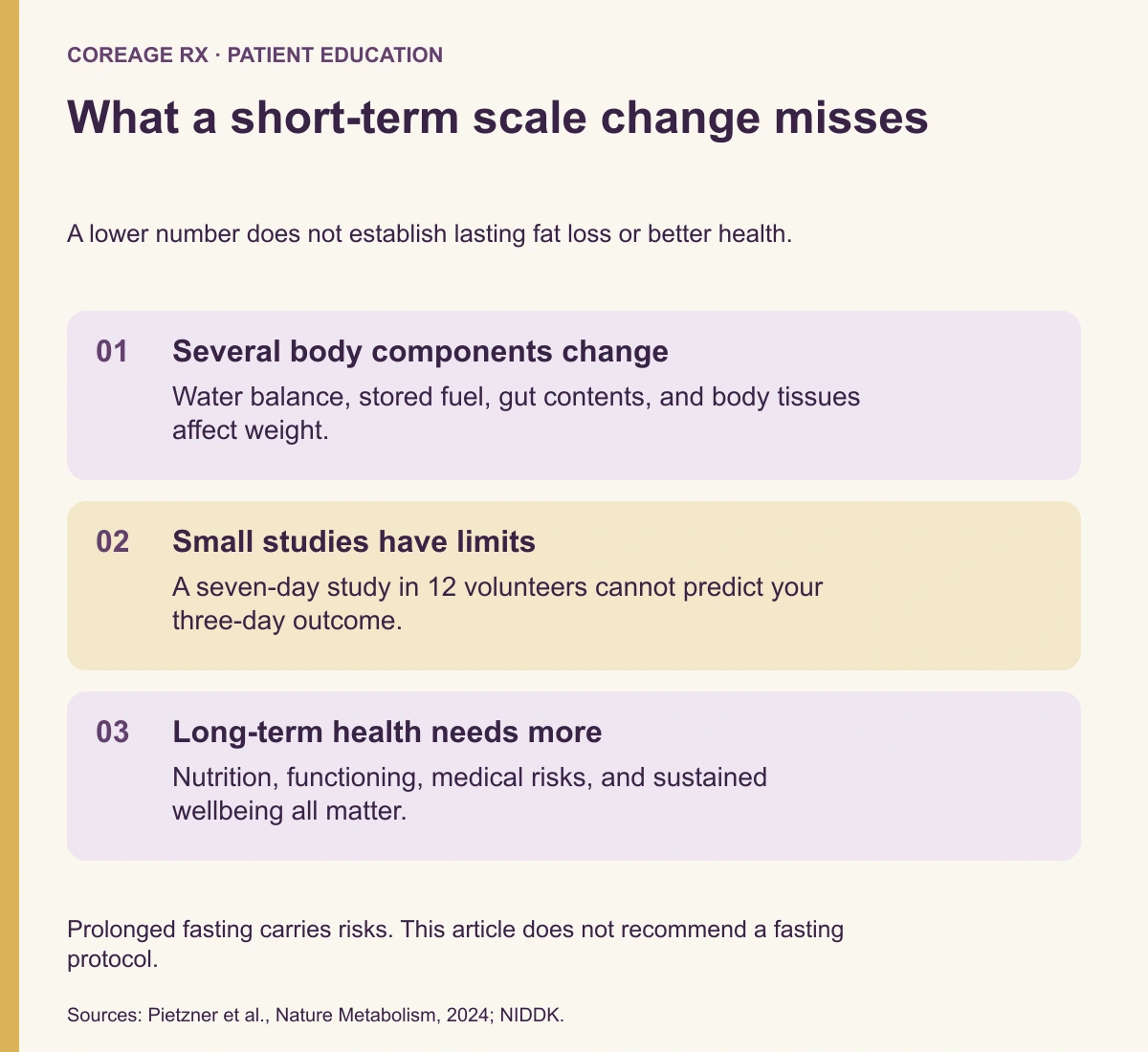
There is no reliable number of pounds that everyone will lose during a three-day water fast. A short-term change on the scale can include changes in water balance, stored fuel, digestive contents, and body tissues. It does not measure lasting fat loss or show that a plan is safe.
If you found this page while looking for a fast way to change your weight, the useful question is what the evidence can actually tell you—and what it cannot. This article reviews the limitations of fasting research, medical concerns, and ways to seek a sustainable plan. It does not recommend a water-fast protocol or a target amount of weight to lose.
Why a three-day weight-loss prediction is unreliable
People begin with different body sizes, eating patterns, health conditions, medication use, and hydration. Those differences make a single short-term prediction misleading. A before-and-after scale reading cannot identify which body components changed or whether any change will persist.
Even a precise measurement is not the same as a clinically useful outcome. A study can detect a change in weight or a blood marker without showing improved wellbeing, fewer medical complications, or better long-term weight management.
Be cautious with calculators and videos that promise a specific number of pounds from a fixed fasting duration. Ask whether that number comes from a relevant controlled study, who participated, what was measured, and how long researchers followed people after they resumed eating.
Scale weight and body fat are different measurements
The scale measures total body weight. Water, organs, muscle, bone, stored fuel, digestive contents, and fat all contribute. It cannot separate these components simply because a reading changes quickly.
During food restriction, the body changes how it uses stored energy. Changes in glycogen, the body’s stored carbohydrate, and associated water can contribute to short-term weight shifts. Food and fluid intake also affect what is present in the digestive system. Those processes make it inaccurate to label every lost pound as body fat.
When regular eating resumes, some short-term changes can reverse. That is not evidence of personal failure or a reason to repeat increasingly restrictive cycles. It is a reason to evaluate health and longer-term patterns rather than treating a single low reading as the goal.
What one widely discussed fasting study actually examined
A 2024 study in Nature Metabolism followed 12 volunteers during a seven-day water-only fast. Researchers measured thousands of blood proteins and examined changes before, during, and shortly after the intervention. The paper explored physiological responses to prolonged restriction. Source: Pietzner and colleagues.
The study is relevant to understanding what researchers are investigating, but it is not a trial proving that a three-day fast is an effective long-term weight-management strategy. The participants were apparently healthy, the group was small, and the study was not randomized. Researchers maintained daily contact.
The full paper also shows why body composition needs careful interpretation. Measurements included both lean and fat mass, and much of the measured lean-mass change reversed after eating resumed. Lean mass is not a direct synonym for skeletal muscle; changes in that measurement should not be described automatically as permanent muscle loss.
Why the study’s “three-day” finding is often overstated
The researchers reported that many measured protein changes became evident after about three days of complete calorie restriction. That is a laboratory observation within a seven-day experiment. It does not establish a three-day threshold at which fasting becomes beneficial for an individual.
Changes in proteins may suggest questions about biological pathways. They do not by themselves prove disease prevention, a longer life, a “reset,” or a clinically meaningful improvement. The paper examined potentially favorable and unfavorable implications, and those implications require further investigation.
When a headline turns “a marker changed after three days” into “everyone should fast for three days,” it skips several steps. The study would need relevant clinical outcomes, appropriate comparison groups, broader populations, and enough follow-up to support that stronger recommendation.
Questions that help put fasting claims in context
| Research question | Why it matters |
|---|---|
| Was the intervention actually three days? | Results from a different duration do not directly answer a three-day claim. |
| Who participated? | Findings in a small, selected healthy group may not apply to people with medical conditions. |
| Was there a suitable comparison group? | Without one, it is harder to separate the intervention from other influences. |
| What was measured? | A scale reading, protein change, and health outcome answer different questions. |
| Was there clinical supervision? | A monitored research setting is different from an unsupervised attempt at home. |
| How long did follow-up last? | A few days cannot establish durable weight management or long-term safety. |
This framework is useful beyond fasting. It also applies to claims about supplements, “metabolism boosters,” or a single food that supposedly produces medication-like results. Our natural GLP-1 article examines similar gaps between a mechanism and a demonstrated outcome.

Medical concerns deserve more attention than a predicted number
Going without food can complicate medication use and existing health conditions. People using insulin or other medicines that can lower blood glucose need individualized medical advice around changes to food intake. A fasting challenge is not a reason to alter or omit prescribed medicines independently.
Poor intake, dizziness, weakness, vomiting, or difficulty maintaining fluids may require assessment. Water alone does not turn a restrictive regimen into a nutritionally complete plan. Neither adding an electrolyte product nor following a social-media checklist establishes that prolonged fasting is appropriate for a particular person.
Pregnancy, breastfeeding, adolescence, frailty, and significant medical conditions call for particular care with nutrition. A history of restrictive eating or distress around food also matters. Discuss these circumstances with a qualified clinician rather than relying on a generic online challenge.
Fasting, rapid weight loss, and gallstones
NIDDK explains that prolonged periods without eating and rapid weight loss can affect bile composition and gallbladder emptying. Rapid weight loss can increase the likelihood of gallstone problems, and repeated weight loss and regain can also be relevant.
This does not mean every person who misses meals develops gallstones or that a blog can estimate an individual’s risk from fasting duration alone. It does mean that dramatic short-term weight changes should not be presented as an uncomplicated benefit.
If you have a history of gallstones, abdominal pain, or another digestive condition, bring that history into any weight-management discussion. Persistent or severe abdominal pain requires medical assessment rather than a conclusion that it is a normal stage of a “detox.”
What about water fasting while taking semaglutide or tirzepatide?
GLP-1 treatment can reduce appetite, but reduced appetite does not eliminate nutritional needs. Combining a medicine that affects eating and digestion with prolonged food restriction can create additional concerns that require the prescribing team’s review.
The joint nutrition advisory on GLP-1 therapy emphasizes nutritional adequacy, assessment, and support for muscle and function during treatment. If medication makes regular meals difficult, that is a reason to discuss symptoms and the care plan, not to reinterpret very low intake as an opportunity for a fasting challenge.
See our guides to semaglutide and muscle support, tirzepatide and nutrition, and semaglutide side effects. Repeated vomiting or inability to maintain food and fluids needs prompt clinical attention.
A sustainable alternative begins with assessment
If weight management is appropriate for your health, a clinician or registered dietitian can help identify an approach that provides adequate nourishment and fits your circumstances. That review can include medical history, medicines, eating patterns, sleep, activity, and the practical barriers that make a routine difficult.
NIDDK’s guidance on selecting a weight-management program emphasizes a tailored eating plan, appropriate physical activity, ongoing support, and a plan for maintenance. It warns against programs promising dramatic losses in a short time.
A useful first goal may be establishing regular meals, improving food variety, finding a form of movement that is manageable, or addressing symptoms that interfere with eating. Those steps can support health without making a rapid scale change the measure of success.
You do not need to compensate for eating
A larger meal, holiday, or day that differs from your usual pattern does not create a requirement to fast afterward. Returning to ordinary nourishment is a reasonable starting point. Food does not need to be earned through restriction or exercise.
If you feel caught in a cycle of strict rules, guilt, and loss of control around food, tell a trusted health professional. Support can focus on that cycle and your wellbeing rather than giving you another restrictive target to meet.
Our calorie-intake guide explains why estimates should support an individualized plan. It also discusses alternatives to numerical tracking when tracking itself becomes unhelpful or distressing.

Frequently asked questions
How much fat will I lose during a three-day water fast?
A reliable personal figure cannot be calculated from duration alone. Total scale change is not a direct fat-loss measurement, and small studies of different fasting durations do not establish an individual forecast. The health risks and ability to maintain adequate nutrition matter more than a promised number.
Does weight returning after a fast mean I failed?
No. Resuming food and fluids changes several components of body weight. A short-term rebound should not be interpreted automatically as fat gain or a reason to intensify restriction. Discuss longer-term health goals with a qualified professional.
Does ketosis prove that fasting is improving my health?
A change in fuel use is not proof of a long-term clinical benefit. A laboratory or metabolic finding must be interpreted alongside symptoms, nutrition, medical risks, and meaningful outcomes. It does not make a fasting protocol suitable for everyone.
Is a monitored research study the same as fasting at home?
No. Studies can use selected participants, defined exclusion criteria, daily contact, and clinical measurements. Those conditions limit how confidently a result can be applied to an unsupervised attempt by someone with different health circumstances.
Are medication services an alternative to doing this on my own?
A legitimate clinical evaluation can help identify appropriate options, which may or may not include medication. If reviewing CoreAge Rx’s semaglutide service or tirzepatide service, ask how nutritional needs, side effects, medical history, and follow-up are assessed. A prescription is not guaranteed or a replacement for adequate nourishment.
Focus on health that can be sustained
A three-day scale result cannot tell you whether a weight-management approach is effective, safe, or suitable for your life. Regular nourishment, medical assessment when needed, and ongoing support provide a more useful foundation than a promised short-term number.
Educational information for adults; individual treatment decisions require a qualified clinician. Sources checked September 26, 2026. Original AI-generated article illustrations depict fictional people and objects, not patient outcomes. Other editorial images are illustrative. Graphics summarize the cited sources.