Losing a word in the middle of a sentence, rereading the same paragraph, or feeling unusually scattered can be unsettling during perimenopause. People often call this “brain fog.” The experience is real, but the phrase describes a group of symptoms rather than a single diagnosis. Menopause hormone therapy may help some symptoms that make thinking harder, especially disruptive hot flashes and night sweats. It is not an established treatment for preventing dementia or reliably improving memory.
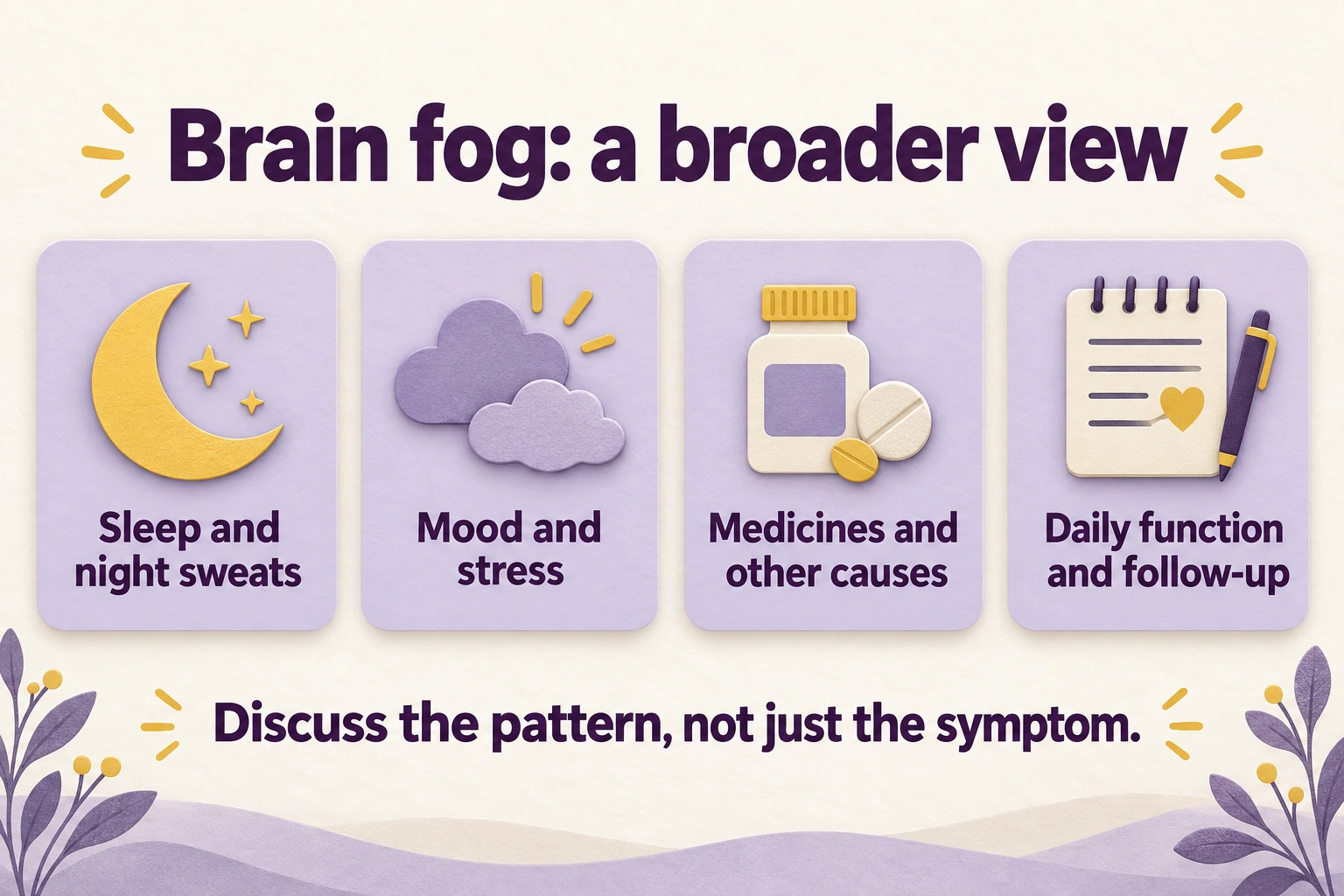
A useful appointment starts with the pattern: what changed, when it changed, and how much it affects everyday life. This guide explains where HRT fits, what else deserves attention, and how to turn a vague sense of fogginess into questions a clinician can investigate.
What people mean by menopause brain fog
Brain fog can describe trouble finding words, concentrating, remembering an intention, or keeping several tasks organized. Someone may remember information once prompted but struggle to retrieve it quickly in a busy meeting. Another person may feel mentally slower after a week of interrupted sleep. These experiences can overlap, although they are not identical problems.
It helps to replace “my memory is terrible” with a concrete example. Did you forget an appointment despite reminders, lose your place while multitasking, or repeatedly struggle with a familiar route? How often does it happen? Does it occur mainly after poor sleep, during a headache, or throughout the day?
The answers help separate an annoying change in attention from a problem that is affecting safety or independence. They also give a starting point for follow-up. A clinician cannot measure improvement very well if the only original goal was to “feel normal again.”
Why this can appear during the menopause transition
Perimenopause often brings several changes at once. Hormone patterns fluctuate, periods may become irregular, and hot flashes or night sweats may disrupt rest. Work responsibilities, caregiving, stress, mood symptoms, and existing health conditions can add to the load. The timing can make menopause a reasonable part of the discussion without proving that every cognitive symptom has a hormonal cause.
The ACOG overview of the menopause years describes the broader transition and common accompanying symptoms. Our guide to HRT during perimenopause explains why treatment decisions usually focus on the symptoms and medical history rather than a single hormone result.
A useful distinction is the difference between an association and an explanation. If fogginess begins when night sweats begin, that pattern matters. It still leaves several possibilities: disrupted sleep, mood changes, another medical problem, or more than one contributor. Keeping the assessment open makes it less likely that a treatable issue gets missed.
What HRT can realistically contribute
Systemic menopause hormone therapy is an effective treatment for bothersome hot flashes and night sweats in appropriately selected patients. Someone whose concentration suffers after repeated nighttime awakenings may feel better when those symptoms improve. That is a meaningful benefit, even when it does not establish a direct memory-enhancing effect of estrogen.
The Menopause Society’s hormone therapy information explains established uses and the need to consider age, time since menopause, health history, and treatment type. Those considerations still apply when brain fog is the concern that brought someone to the appointment.
An appropriate treatment goal might be fewer sweat-related awakenings and better ability to complete a work task. It should not be a promise of sharper thinking, protection against Alzheimer disease, or reversal of normal aging. If HRT is chosen for menopause symptoms, cognitive complaints can be tracked as part of the overall response. They should not automatically trigger a higher dose when they persist.
What the research does not establish
Clinical research does not support treating all cognitive complaints with HRT. In the ELITE-Cog randomized trial, oral estradiol did not produce a meaningful advantage over placebo on the measured cognitive outcomes, and starting closer to menopause did not establish a cognitive benefit compared with starting later. The trial studied particular treatment regimens and participants; it did not answer every question about subjective brain fog.
That distinction matters. A trial using formal memory tests is not exactly the same as a person reporting that they can think more clearly after sleeping better. Both observations can be true without showing that estrogen is a general memory medicine.
NICE menopause guidance advises against offering HRT for dementia prevention. A family history of dementia can be a reason to discuss overall health, symptoms, and concerns, but it does not turn HRT into a proven prevention strategy. Headlines about hormone timing or observational associations should not replace an individualized conversation.
Sleep deserves its own assessment
Ask whether the problem is insufficient time asleep, repeated awakening, difficulty falling asleep, or feeling unrefreshed despite enough time in bed. These patterns can lead to different next steps. A cool bedroom may make night sweats more manageable, while persistent insomnia or suspected sleep apnea calls for a more specific assessment.
Snoring, gasping, or breathing pauses should be mentioned even if nobody has previously connected them with menopause. Sleep apnea is a separate medical condition; a hormone prescription is not a substitute for evaluating it. Likewise, a person who spends enough hours in bed but feels exhausted may need more than generic advice to get additional rest.
For a focused explanation of the overlap, see HRT, sleep, and hot flashes. The practical goal is to identify what is interrupting rest and choose a response that matches it. Keeping a brief record of bedtime, awakenings, night sweats, and next-day concentration can make that conversation more specific.

Other explanations to discuss
Medication effects, mood symptoms, thyroid problems, anemia, nutritional deficiencies when relevant, alcohol use, and other health conditions can contribute to feeling mentally slow or tired. A clinician decides which possibilities fit the history and whether an examination or targeted testing is useful. There is no universal “brain fog panel” that every person needs.
MedlinePlus explains that persistent fatigue has many possible causes. Fatigue and brain fog are not interchangeable, but the overlap is a reason to describe both. Bring a list of prescription medicines, over-the-counter sleep aids, antihistamines, supplements, and recent changes. Do not stop an important medicine on your own to see whether concentration improves.
The same care applies to restrictive eating. If symptoms began during a major diet change, mention meal patterns, appetite, and any weight-management treatment. The article on balanced meals for weight management offers a practical starting point for discussing food routines without assuming that one supplement will correct every cause of tiredness.
A two-week record that stays manageable
A symptom record should make life easier, not become another source of pressure. Choose one or two situations that matter to you and write a short note when they occur. Examples include losing your place in conversations, struggling to finish paperwork, or forgetting a planned task.
For each note, include the approximate time, the task, the previous night’s sleep, and any hot flashes, headache, unusual stress, or medicine change. You do not need to rate every hour or administer repeated online memory tests. A few concrete observations can be more useful than pages of scores with no context.
At the end, look for questions rather than a self-diagnosis. Is the problem concentrated after night sweats? Has it steadily worsened? Is it present even on restful days? Bring those observations to the appointment. If symptoms are affecting safety, do not wait for the record to be complete before seeking help.
Everyday adjustments that reduce the load
Use one calendar for appointments and one reliable place for essential items. Put a reminder where the action happens: a medication list near the organizer, a written agenda before a meeting, or a checklist beside the door. These are practical supports, not evidence that you are losing independence.
Reduce avoidable multitasking when a task has consequences. Paying a bill, reviewing a medical instruction, or making a work decision may go better with notifications paused and one task in view. Give yourself permission to write down a question during an appointment instead of trying to remember it until the end.
Movement, regular meals, and a workable sleep routine can support general health. They do not guarantee that cognitive symptoms will resolve. If “try harder to be healthy” has become the entire treatment plan while symptoms continue, ask for a clearer reassessment and a specific follow-up date.
Where NAD+ and other wellness claims fit
Brain-fog searches often lead to products marketed for cellular energy or mental clarity. A biological role in energy metabolism does not by itself demonstrate that a product improves menopause-related cognition. The important question is whether human studies of the same product and route show a meaningful benefit for a comparable problem.
Our NAD+ nasal spray and brain-fog evidence review explains that distinction. Readers comparing services can also review the NAD+ Injectable product information alongside the NAD+ injection evidence guide. These pages address a different intervention; they do not establish NAD+ as a treatment for menopause brain fog.
Bring any product you are considering to the clinician’s attention, including its ingredients and route. Adding several products at once makes it harder to know what helped, what caused a symptom, or whether a more important cause of fogginess is still untreated.
When to seek prompt or urgent care
Sudden confusion, new trouble speaking, facial drooping, one-sided weakness, or an abrupt severe headache needs emergency assessment. Do not assume a new neurological symptom is menopause, migraine, or a side effect that can wait until a routine hormone review.
Arrange a clinical assessment for a gradual change that is worsening, interfering with work or household tasks, causing medication errors, or being noticed by others. Getting lost in familiar places or difficulty handling familiar responsibilities deserves attention. A previous reassuring visit does not mean a new pattern should be ignored.
The aim is proportionate care. Occasional word-finding difficulty does not automatically mean dementia, and an age-related explanation should not be used to dismiss substantial changes. Describe what is happening clearly and let the evaluation be guided by that pattern.

Questions to take to an appointment
- Which of my symptoms could reasonably be related to menopause?
- Are night sweats, insomnia, mood symptoms, or medicines contributing?
- What would make testing or a specialist assessment useful?
- If HRT is appropriate, what symptom is it intended to treat?
- What would count as improvement, and when will we review it?
- If concentration remains difficult after other symptoms improve, what comes next?
Ask for the plan in plain language. It should identify the next step, who will review the results, and which changes should prompt earlier contact. The menopause hormone therapy guide can help prepare for a broader discussion of treatment options and risks.
Common questions
Will HRT definitely clear brain fog?
No. Some people report improvement, particularly when related symptoms become more manageable, but improvement is not guaranteed. Persistent cognitive concerns deserve reassessment instead of an assumption that the dose is too low.
Does brain fog mean I am developing dementia?
Not necessarily. The term covers many experiences and cannot establish that diagnosis. The degree of change, progression, and effect on daily function matter more than the label alone.
Should I start HRT just to protect my brain?
Current guidance does not recommend HRT for dementia prevention. The decision should be based on an appropriate indication, your health history, and a discussion of expected benefits and risks.
Can I monitor this without buying a test or app?
Yes. A notebook or basic phone note can document examples, timing, sleep, and associated symptoms. The record supports a medical conversation; it does not replace evaluation when symptoms are persistent, progressive, or concerning.
Related reading
- Menopause and Joint Pain: Causes, Care, and the Role of HRT
- HRT After Hysterectomy: Why Ovary Status and Medical History Matter
- How Long Can You Take HRT? Reviews, Stopping, and Symptom Recurrence
- HRT and Migraine: Aura, Hormone Fluctuations, and Treatment Questions
- Menopause hormone therapy: the complete starting guide
- HRT benefits and risks
- Menopausal skin care and changing skin needs
Educational information for adults; personal treatment decisions require a qualified clinician. Sources checked September 16, 2026. Original AI-generated illustrations depict fictional people and are not patient testimonials.