Zepbound insurance coverage in Florida depends on your exact prescription benefit, the reason for treatment, and the plan’s current rules. A Florida address, a clinician’s prescription, or a general drug-list search does not establish that your claim will be paid. The most useful next step is to identify the actual plan and ask separate questions about coverage, authorization, the pharmacy network, and your payment.
This guide explains how to investigate a Florida commercial or Medicaid benefit, prepare a prior-authorization discussion, and respond to a denial without relying on statewide approval percentages or promises that every plan follows the same policy.
Start with the exact benefit, not the insurer’s name
An insurer can administer several kinds of contracts with different prescription benefits. An employer plan, an individual policy, and a government program may use different rules even when a familiar company name appears on the card. Ask which current drug guide and benefit document apply to your specific enrollment.
Florida Blue’s member resources illustrate this distinction: they direct members to the applicable medication guide and describe contract-dependent benefits and updates. Its pharmacy information discusses prior authorization, step therapy, quantity limits, networks, and patient cost sharing. Those resources explain how to investigate a benefit; they are not a coverage promise for every Florida Blue member or every Zepbound prescription. Florida Blue medication guides, Florida Blue pharmacy coverage rules
Have your member card, group information, and prescribed product available when you call. Ask for a reference number and the dated document supporting the answer. Our GLP-1 insurance coverage guide explains the terminology used across plans.
Why the reason for Zepbound treatment matters
Zepbound’s label includes weight reduction and long-term maintenance in specified adults with obesity or overweight, alongside diet and activity, and treatment of moderate to severe obstructive sleep apnea in adults with obesity. These are distinct clinical uses. A labeled indication does not guarantee an insurer includes the corresponding benefit or approves an individual request. Zepbound indications
If obstructive sleep apnea is part of your history, ask your clinician which diagnosis and documentation are relevant to the actual treatment decision. Do not assume an obesity-treatment exclusion also answers every question about the approved sleep-apnea use, and do not assume the sleep-apnea indication automatically overrides a plan exclusion. Obtain the plan’s policy for the actual request.
Use accurate medical records. Do not ask an office to enter a diagnosis you do not have to obtain coverage. A prior-authorization request should explain the real clinical situation and respond to the actual criteria.
Our Zepbound side-effects guide and long-term Zepbound safety article can help you prepare the treatment conversation separately from the payment decision.
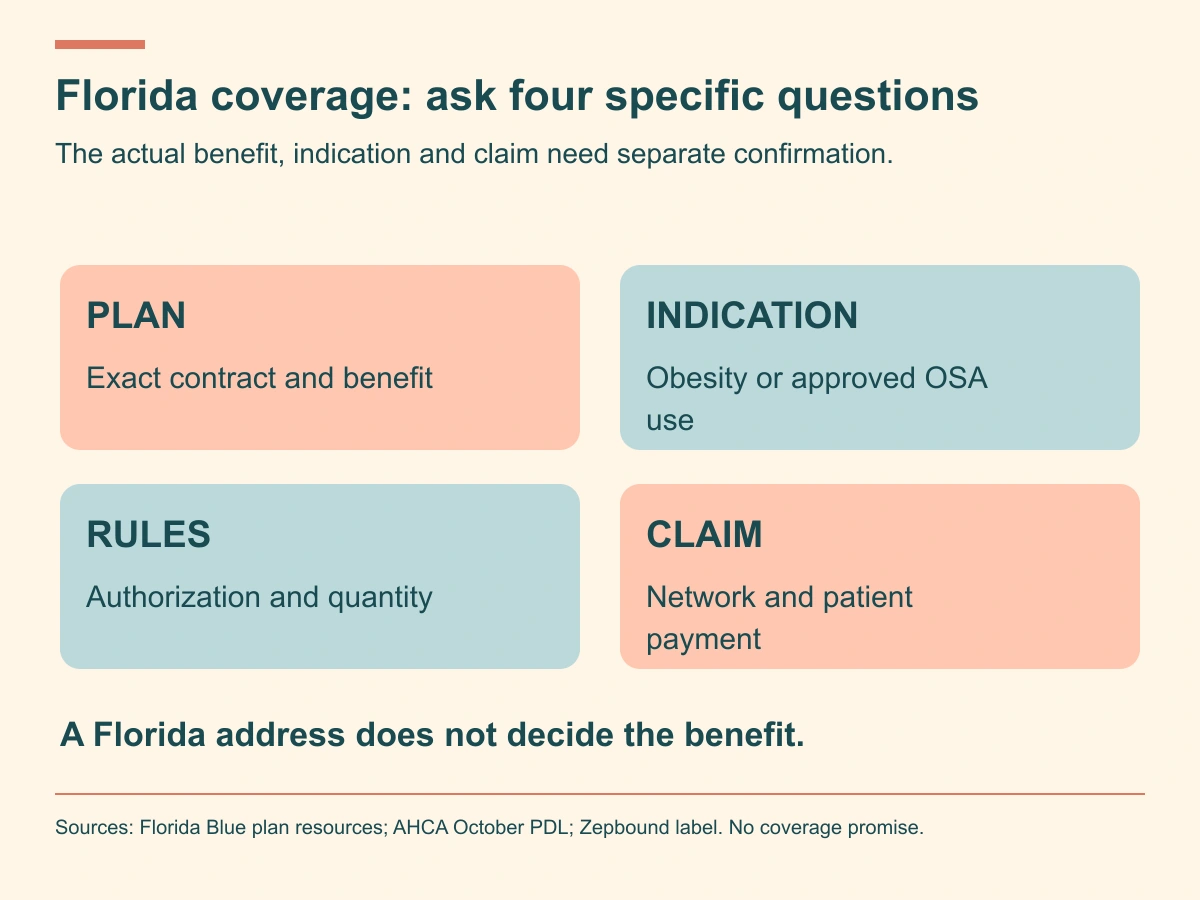
Four questions before assuming a prescription is covered
| Question | What to request | Why it matters |
|---|---|---|
| Is this treatment included in my benefit? | Applicable contract language and current drug policy | A benefit exclusion differs from a missing authorization |
| Which indication is being evaluated? | Criteria for the actual documented use | Obesity and approved sleep-apnea treatment need the right policy |
| What rules apply? | Prior authorization, step therapy, quantity limits, and renewal requirements | An initial approval may have conditions |
| What would my claim cost? | Network pharmacy quote and patient responsibility | Coverage does not mean zero payment |
Ask whether the answer is a general benefits explanation or the result of an actual submitted claim. If a pharmacy rejection occurs, request its reason and the next action. “Not covered” can be used casually for several different problems, so obtain the specific wording before deciding what to do.
Our Zepbound cost guide explains price comparisons. A manufacturer offer and an approved insurance claim have different terms; compare them separately rather than assuming they can be combined.
What the Florida Medicaid drug list can tell you
The Florida Agency for Health Care Administration publishes a preferred drug list. We checked the dated October 1, 2026 extraction and did not find a Zepbound entry in that document. That is a limited document finding, not a complete individual benefit determination or proof of a statewide exclusion for every indication and enrollment. Florida Medicaid preferred drug list
Ask the program responsible for your prescription benefit which current policy governs Zepbound for the prescribed use. Confirm whether another clinical policy or authorization resource needs to be reviewed. Identify your actual Medicaid enrollment and contact route rather than applying a commercial insurer’s guide to a Medicaid claim.
If coverage is denied, use the notice for that benefit to identify the reason, review process, and deadline. Our Medicaid and GLP-1 coverage guide explains why enrollment, indication, and program rules need separate confirmation. The New Mexico Ozempic coverage article provides another example of why the scope of a statewide list matters; its rules should not be imported into Florida.

Preparing a prior-authorization conversation
Prior authorization means the plan requires review before it approves coverage under the applicable policy. It is distinct from the clinician deciding that treatment is appropriate. A prescription can be clinically justified while the benefit still requires administrative review or excludes the requested use.
Ask the insurer for the current criteria, the submission destination, and the person or office responsible for the request. Your clinician can determine which records are appropriate. Depending on the policy and indication, the request may involve relevant history, prior treatment information, and supporting clinical documentation; do not assume every plan uses the same checklist. Florida Blue authorization and utilization information
Before a planned start, coordinate the following:
- The exact brand, strength, formulation, and prescribed quantity.
- The current policy for your actual benefit.
- The clinician’s office contact handling authorization questions.
- Any missing information identified by the plan.
- Your in-network pharmacy and its claim status.
- The approval period and renewal instructions, if approved.
Avoid duplicate submissions that leave everyone uncertain which request is active. Ask for dates and reference numbers, and confirm that the receiving office has what it needs.
Understanding a denial before appealing
Read the denial notice and classify the problem. A missing record, a step-therapy requirement, a formulary restriction, and a contract exclusion may require different responses. Ask the plan to identify the policy section or criterion involved and whether a correction, exception request, internal appeal, or another process is appropriate.
The Florida Department of Financial Services explains prescription denials and internal or external review, while also distinguishing jurisdiction by coverage type. State consumer assistance is not the correct review channel for every plan. Self-funded employer benefits, Medicare, and Medicaid have different responsible agencies and processes. Florida consumer health-insurance guidance
Follow the instructions and deadlines in your own notice. Ask your clinician to respond to the actual denial reason with accurate records. If a situation is clinically urgent, discuss whether the applicable process offers expedited review; do not presume a universal decision time or outcome.
Keep the notice, submitted records, pharmacy rejection, call notes, and any authorization reference together. A short timeline can make a follow-up call much clearer than a long account with missing dates.
If an approval still leaves a high pharmacy payment
Ask what portion of the payment comes from a deductible, copay, coinsurance, network rule, or quantity issue. Confirm the package and days’ supply used in the quote. An approved authorization may not answer each of those questions.
If comparing cash payment, obtain a dated quote for the same prescription. Ask the insurer how an outside cash transaction would affect your benefit before assuming it counts toward deductible or out-of-pocket limits. Also include care visits and follow-up in the budget when comparing service arrangements.
Do not switch to Mounjaro merely because both medicines contain tirzepatide or because a friend obtained coverage for a diabetes prescription. Brand indications, prescriptions, and benefits need separate review. Our Mounjaro cost guide addresses that product’s access questions.
If exploring CoreAge Rx services, review our tirzepatide treatment page and ask about the actual formulation, eligibility, costs, and clinician follow-up. A provider offering and an insurer-covered Zepbound prescription are not automatically the same transaction. Our compounded GLP-1 guide covers product-status questions when compounding is discussed.

A call script that gets more useful answers
Try: “I am enrolled in this plan and have a prescription for Zepbound for this documented indication. Which current benefit and clinical policy apply? Is the issue a benefit exclusion, a formulary rule, or an authorization requirement? What records and pharmacy network are required, and where can I obtain the written policy?”
If the person cannot answer, ask which team can. Record the date, representative, reference number, and next action. After a clinician submission, confirm receipt before assuming the review clock has started.
At renewal, recheck your benefit. An old approval or last year’s copay is useful history, but it does not establish that a new plan year, employer contract, or pharmacy claim will behave the same way.
Frequently asked questions
Does Florida require every insurer to cover Zepbound?
The reviewed resources do not establish such a universal coverage rule. Your actual benefit, clinical policy, and claim need confirmation.
Does Florida Blue cover it?
Ask about your specific contract and current policy. Florida Blue’s general medication resources do not settle every member’s Zepbound eligibility or cost.
Does an absent Medicaid PDL entry prove it is excluded?
No. The reviewed October document did not show an entry, but that finding alone is not a complete benefit decision. Contact the program governing your prescription benefit for the applicable policy.
Can obstructive sleep apnea change the coverage discussion?
It may change which clinical policy should be considered because Zepbound has an approved sleep-apnea indication in a specified population. It does not guarantee approval. Use your actual diagnosis and plan rules.
What should I do first after a denial?
Obtain the written reason and applicable policy, then coordinate the correct review process with your clinician. Follow the notice’s instructions and deadlines rather than sending a generic appeal to every agency.
Educational information for adults; individual treatment decisions require a qualified clinician. Sources reviewed October 3, 2026. Original AI-generated article images depict fictional people and objects, not patient outcomes. Other editorial images are illustrative. Graphics summarize the cited sources.