Ozempic insurance coverage in New Mexico depends on your particular health plan, prescription, and treatment indication. Living in Albuquerque, Santa Fe, Las Cruces, or another New Mexico community does not create one statewide Ozempic benefit or one guaranteed copay.
For Medicaid, commercial insurance, Medicare, and employer coverage, start with the organization responsible for your pharmacy benefit. Ask about the exact product and the clinical reason it was prescribed. A general statement that a plan “covers GLP-1s” is too broad to settle an Ozempic claim.
What is Ozempic approved to treat?
The current injection label includes improving glucose control in adults with type 2 diabetes, reducing major cardiovascular-event risk in adults with type 2 diabetes and established cardiovascular disease, and reducing specified kidney and cardiovascular risks in adults with type 2 diabetes and chronic kidney disease. Ozempic injection is not labeled simply as a weight-loss medicine. Ozempic prescribing information, section 1.
This matters because the clinical diagnosis and the insurance benefit are related but separate questions. Having a labeled indication does not guarantee approval; a weight goal alone does not establish a diabetes diagnosis. Documentation should accurately describe your medical history and the proposed treatment.
Our semaglutide treatment questions guide explains ingredient and product differences. The Ozempic dosage guide provides injection-specific context; an insurer may distinguish presentations rather than approve every product containing semaglutide.
Identify your benefit before searching a formulary
Find the plan name, member information, pharmacy-benefit contact, and the applicable plan year. If coverage comes through work, ask the benefit administrator which prescription benefit applies and whether the arrangement is self-funded.
Then request the current medication list for that exact benefit. A insurer’s public list may describe several plan types. The right question is not only “Is Ozempic on this company’s website?” but “Which document and rules govern my prescription claim?”
Keep the product, strength, quantity, and intended pharmacy alongside the benefit information. Those details help the plan distinguish a covered item from a different presentation, quantity, or network arrangement.
New Mexico Medicaid: understand the statewide list’s scope
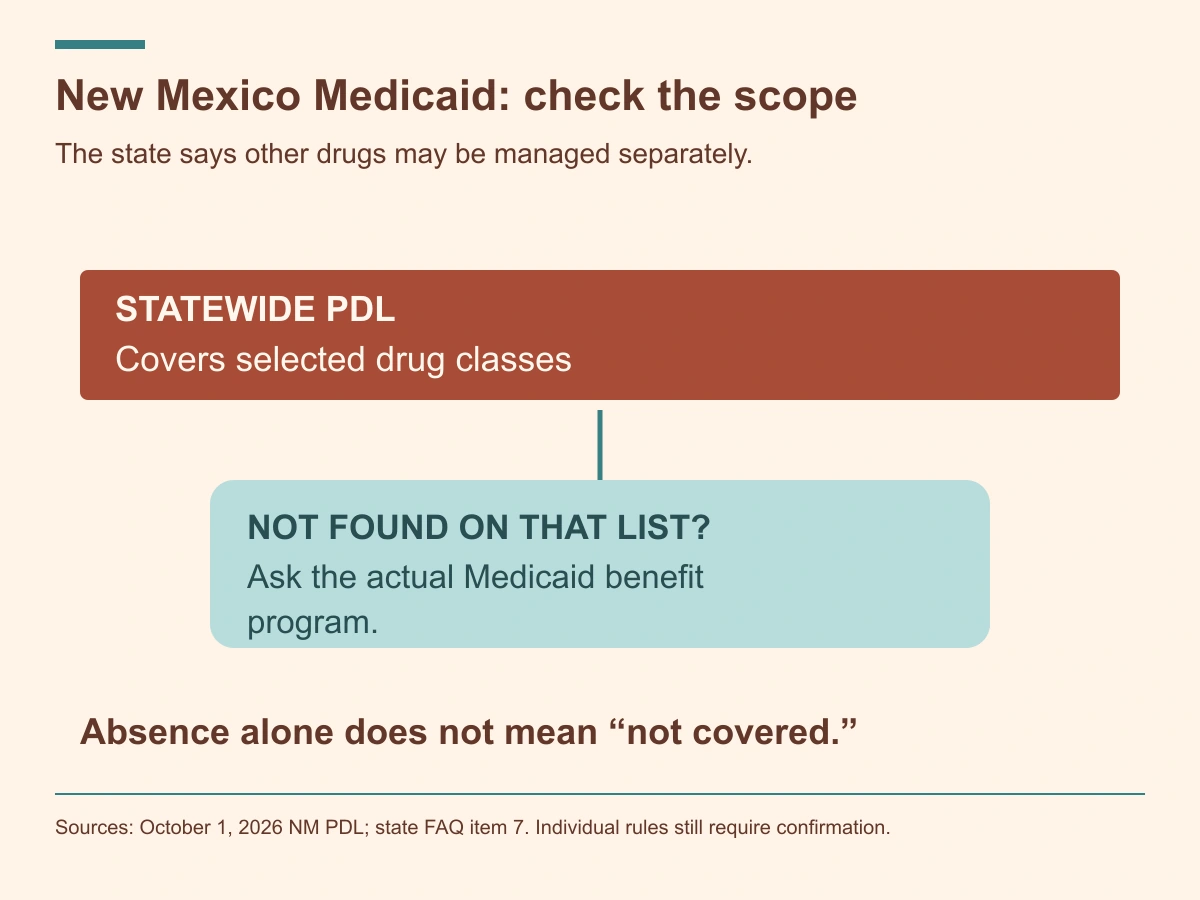
New Mexico introduced its statewide Preferred Drug List in 2026. The October 1, 2026 document states that it includes selected drug classes. Preferred status generally removes the list’s prior-authorization requirement unless additional criteria are marked, while nonpreferred products require authorization under the listed exception framework. October New Mexico Medicaid PDL.
Do not treat this selected-class list as a complete inventory of everything Medicaid can cover. The state’s FAQ specifically explains that drugs outside the statewide PDL may still be covered and are managed independently by fee-for-service and individual managed-care organizations. New Mexico PDL FAQ, item 7.
Therefore, failing to find Ozempic in that statewide document does not establish that your Medicaid benefit excludes it. Contact your own managed-care plan or the fee-for-service pharmacy program, as applicable, for the current semaglutide product rules and clinical criteria. Ask for the policy rather than relying on another member’s experience.
Ask Medicaid about the actual requested use
Tell the plan which Ozempic presentation the prescriber requested and the documented indication. Ask whether authorization is needed, what information the prescriber must provide, and whether a particular formulation or pharmacy is required.
If the answer references diabetes criteria, clarify which records must support the request. If it concerns weight-management benefits, ask which product and indication that policy addresses. Different semaglutide brands should not be treated as equivalent coverage requests.
Our Medicaid and GLP-1 coverage guide provides national context. Use it to prepare questions, while keeping the New Mexico program and your own plan’s current instructions as the relevant benefit sources.
Commercial coverage: use your own member information
Blue Cross and Blue Shield of New Mexico directs members to their own account’s pharmacy section for drug details. Its public resources explain formularies, prior authorization, step therapy, dispensing limits, and drug-list exceptions. Those resources describe how to investigate a benefit; they do not guarantee that every BCBSNM contract covers Ozempic. BCBSNM prescription drug lists.
The same approach is useful with another insurer. Ask for the actual formulary, the indication-specific policy, and the plan document governing exclusions. An employer can have a different benefit from another employer using a similar insurer name.
Before comparing costs, confirm whether the intended pharmacy is in network and whether any authorization has been approved. A price estimate that assumes an approved claim may be misleading while the request is still under review.

A coverage checklist for the call
| Question | Why it helps |
|---|---|
| Which product and presentation are covered? | Ingredient-level coverage may not identify the requested item |
| What indication and records are required? | The plan needs accurate clinical documentation |
| Is prior authorization or step therapy required? | The prescriber may need to complete an additional process |
| What quantity and pharmacy rules apply? | A claim can depend on supply and network details |
| What would the approved claim cost me? | Copay, coinsurance, and deductible are separate from approval |
| How long does authorization remain valid? | Refills and renewals may need a later review |
Write down the date, representative, policy name, and reference number. If the response is unclear, ask for an explanation in writing or a link to the applicable policy. That helps the prescriber respond to the actual requirement.
What prior authorization can and cannot do
Prior authorization is a plan’s review before it pays under specified rules. The prescriber may need to submit the diagnosis, treatment history, relevant results, and the reason for the requested product.
An incomplete request, a denied request, and an excluded benefit are different situations. Ask which one applies. Sending the same incomplete information again may not resolve a missing record; submitting more medical information may not change an explicit contract exclusion.
Avoid advice to change a diagnosis merely to obtain coverage. The useful task is to correct factual errors and submit an accurate, complete clinical record. Our GLP-1 insurance guide explains the broader authorization and benefit questions.
If a New Mexico claim is denied
Obtain the denial notice and identify the exact reason, policy reference, appeal instructions, and deadline. Ask the prescriber which medical facts address the decision and whether a formulary exception or another review process is appropriate.
New Mexico’s Office of Superintendent of Insurance describes commercial managed-care grievances, including insurer appeals and further review through its Managed Health Care Bureau. It recommends documenting conversations and reviewing the benefit booklet and appeal timeframes. OSI managed health care review.
Its grievance summary also distinguishes adverse determinations from administrative disputes. Follow the instructions for the decision you actually received; this article does not establish a single deadline for every plan or notice. New Mexico grievance procedures.
Choose the right help channel
State insurance assistance does not govern every coverage arrangement. OSI identifies separate resources for Medicaid, Medicare, military coverage, federal employee plans, and self-funded employer benefits. Ask who has responsibility for your particular benefit before submitting a complaint.
A complaint and an appeal also serve different purposes. Keep the original insurer notice and respond through the required appeal route. Seeking consumer help should not lead you to miss a deadline while waiting for an unrelated office to answer.
If ongoing treatment is involved, ask the plan and clinician about continuity rules and the practical next steps. Do not interpret a dispute about payment as individualized medical advice to stop, restart, or replace a prescription.

Separate assistance offers from insurance coverage
A manufacturer savings offer is not a coverage policy. Commercial copay assistance has eligibility restrictions and caps. Current Ozempic commercial-offer terms exclude specified government-program beneficiaries, including Medicaid and Medicare prescription coverage. Ozempic savings terms.
Our Ozempic cost guide explains current offer categories and the full bill. If you obtain a separate self-pay quote, label it clearly and ask how purchases outside insurance affect benefit accounting. Do not assume that paying cash will later produce reimbursement.
The CoreAge Rx semaglutide program page describes a separate care offering. Confirm the formulation, dispensing pharmacy, clinical eligibility, and ongoing charges. A program page or ingredient name does not establish that New Mexico insurance covers that offering.
Frequently asked questions
Does New Mexico Medicaid automatically cover Ozempic?
This article cannot confirm an individual claim. The statewide list covers selected classes, and the state says other drugs may be managed by fee-for-service or individual plans. Ask your actual pharmacy-benefit program for current criteria.
Does a doctor’s prescription guarantee coverage?
No. A clinical prescription and an insurance payment decision are separate. A plan may still require authorization or have benefit restrictions.
Can I use another person’s approval as proof?
It can suggest questions to ask, but their plan, diagnosis, product, and authorization period may differ. Use your own policy and written decision.
What should I gather first?
Collect the member information, exact prescription, current formulary and policy, pharmacy details, and any denial notice. Those documents turn a broad coverage search into a specific reviewable request.
Educational information for adults; individual treatment decisions require a qualified clinician. Sources reviewed October 3, 2026. Original AI-generated article images depict fictional people and objects, not patient outcomes. Other editorial images are illustrative. Graphics summarize the cited sources.