Zepbound has clinical safety evidence extending beyond the first months of treatment, including a multi-year tirzepatide analysis in people with obesity and prediabetes. That evidence is useful, but it does not establish lifetime safety or mean that every side effect lasts throughout a study. The clearest answer separates common symptoms, serious label warnings, the population studied, and the remaining uncertainty.
If you are considering years of treatment, ask two questions: what has been observed over the available follow-up, and what makes ongoing treatment appropriate for your own health? This guide explains the difference and helps you prepare a practical review with your clinician.
What does “long-term side effects” actually mean?
People use that phrase for several different concerns: a symptom that persists, a complication that develops later, or the possibility of harm after many years. A trial reporting that nausea occurred does not necessarily show that nausea continued for the entire trial. Likewise, a reassuring finding at a study’s end cannot rule out every rare event or answer questions about decades of exposure.
Keep the concern specific. “I still have nausea several months into treatment” requires a symptom assessment. “What do we know after three years?” requires a look at the evidence window. “Should I continue?” requires an individualized benefit-risk review.
Our Zepbound side-effects guide addresses general reactions. The tirzepatide first-month guide focuses on starting treatment. This article concentrates on how to interpret longer follow-up and how to review care over time.
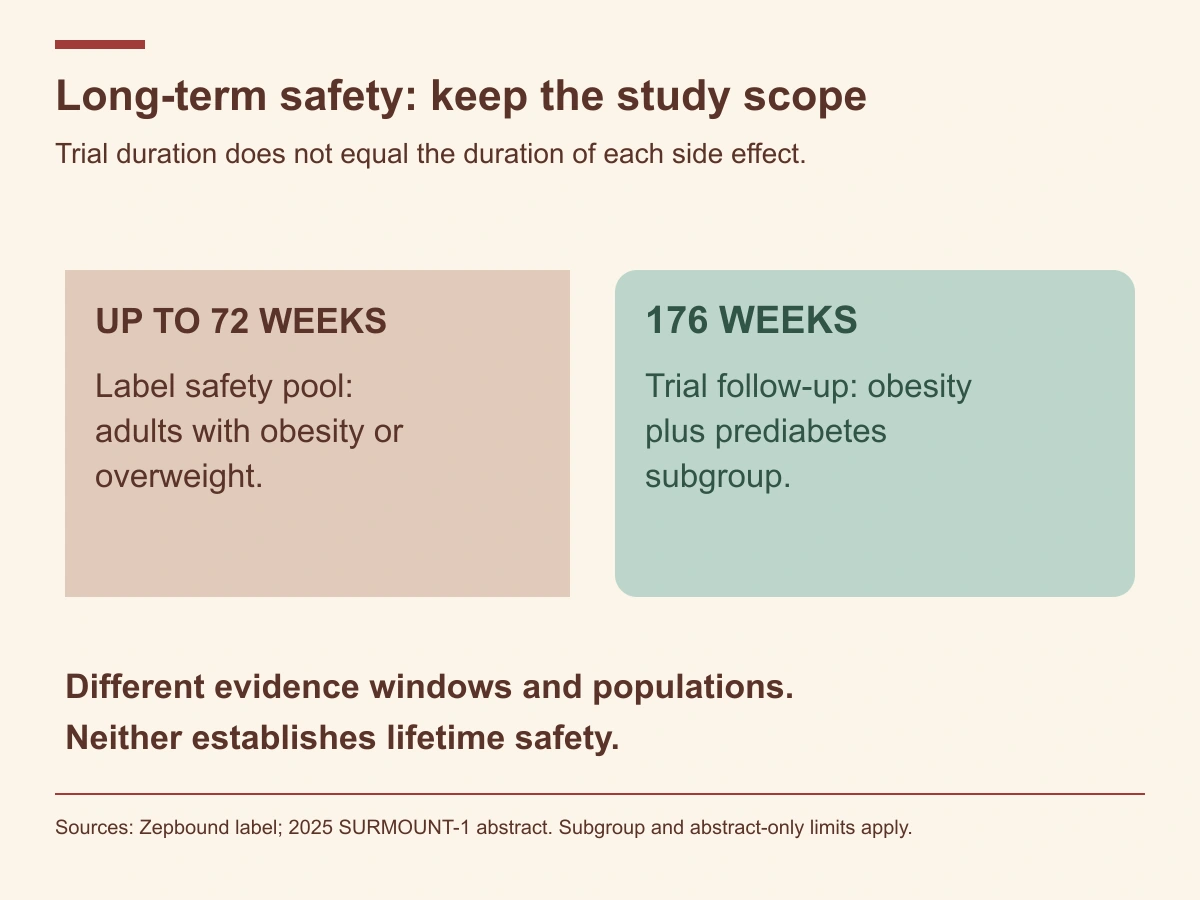
The main evidence windows are different
| Evidence | Population and time window | What it can help answer | Important limit |
|---|---|---|---|
| Label’s pooled weight-reduction safety trials | Adults with obesity or overweight, with or without type 2 diabetes; up to 72 weeks | Common reported reactions within that trial setting | Rates do not measure symptom duration or three-year incidence |
| Multi-year SURMOUNT-1 analysis | 1,032 participants with obesity and prediabetes; 176 weeks of treatment and 17 weeks off treatment | Longer observation in this specific subgroup | Does not represent every patient or lifetime exposure |
| Current prescription warnings | Product-specific risks and precautions | Which history and symptoms need clinical attention | A warning is not an individual probability calculation |
The Zepbound label describes the pooled studies and their reported reactions. The multi-year information discussed here comes from the complete published abstract available through NLM; this is an abstract-level review, not a review of every full-text table or supplement. Zepbound prescribing information, multi-year tirzepatide trial abstract
These sources should not be blended into one invented “long-term side-effect rate.” The populations, observation periods, and outcomes differ.
What the multi-year trial reported
The 2025 publication’s abstract describes an obesity-plus-prediabetes subgroup followed during 176 weeks of tirzepatide or placebo treatment, followed by 17 weeks off treatment. Gastrointestinal events were among the most common adverse events other than COVID-19, were generally mild to moderate, and occurred mainly during the early dose-escalation period. The authors reported no newly identified safety signal in that analysis. The study was funded by Eli Lilly. NLM trial abstract
That finding is reassuring within its scope. It does not mean there were no side effects, that no participant stopped treatment, or that every potential rare harm was excluded. It also does not establish the same experience in populations outside the analyzed subgroup.
When discussing the study with your clinician, ask how closely your situation resembles the participants and which risks remain relevant to your history. The study’s diabetes-prevention outcome does not by itself create a separate prescribing indication for everyone with prediabetes. Zepbound’s actual labeled indications still control the product discussion.
Do common stomach symptoms persist for years?
Nausea, vomiting, diarrhea, constipation, and abdominal symptoms appear in the label’s common-reaction information. In the pooled weight-reduction trials, most nausea, vomiting, and diarrhea events occurred during escalation and declined over time. This describes an overall trial pattern, not a guarantee that your symptoms will resolve on a particular date. Label gastrointestinal time-course information
If symptoms continue, describe their frequency, severity, relationship to doses, and effect on meals, fluids, work, or sleep. A symptom that is common in a trial can still require attention when it interferes with daily life. Do not normalize repeated vomiting or inadequate intake simply because treatment has been effective for weight reduction.
Our Zepbound fatigue guide helps organize questions when tiredness and intake changes occur together. The tirzepatide protein and muscle guide supports a discussion about nutrition and function. Neither replaces an assessment of persistent gastrointestinal symptoms.

Serious warnings remain relevant during continued treatment
The label includes warnings about severe gastrointestinal reactions, kidney injury related to volume depletion, gallbladder disease, pancreatitis, serious hypersensitivity, and hypoglycemia. Some risks depend on the broader situation, including other medicines. For example, insulin and sulfonylureas change the low-glucose discussion. Zepbound warnings and precautions
Ask your prescriber to connect those warnings to a concrete response plan. Which symptoms need immediate help? Which require a same-day call? What should you do if you cannot keep fluids down? A list of warning names is less useful than knowing how your care team wants you to respond.
Severe or persistent abdominal pain, major difficulty maintaining fluids, or symptoms suggesting a serious allergic reaction need prompt assessment according to the product instructions and clinical situation. Do not wait for a routine refill visit to mention an escalating problem.
Avoid using another person’s symptom history to decide your own diagnosis. A gallbladder warning does not mean every stomach ache is gallbladder disease, and a trial average cannot determine what is causing a new symptom.
What about thyroid tumors and cancer?
Zepbound carries a boxed warning based on thyroid C-cell tumors observed in rodents. The label states that whether it causes these tumors, including medullary thyroid carcinoma, in humans is unknown. It is contraindicated with a personal or family history of medullary thyroid carcinoma or multiple endocrine neoplasia syndrome type 2. The label also says routine calcitonin measurement or thyroid ultrasound has uncertain value for early detection in this setting. Zepbound boxed warning and contraindication context
Tell your clinician about your personal and family history rather than assuming every thyroid diagnosis is equivalent. Ask which symptoms and history need evaluation. Do not create a screening schedule from an online cancer concern or interpret an isolated test without the clinician who ordered it.
The multi-year trial’s lack of a newly identified signal does not erase the boxed warning or resolve lifetime cancer uncertainty. These are different pieces of the evidence discussion.
What should be reviewed at follow-up?
A useful continued-care review covers more than a number on a scale. Bring your current dose, treatment timeline, symptom record, other medicines, and questions about daily function.
- Benefits: Which treatment goals are improving, and how are they measured?
- Tolerability: Are symptoms persistent, worsening, or affecting food and fluid intake?
- Other medicines: Have glucose-lowering or blood-pressure medicines changed?
- Nutrition and activity: Can you eat adequately and maintain everyday function?
- Health changes: Is there a new condition, procedure, or pregnancy-related question to discuss?
- Access: Is the planned supply reliable enough to support clinician-directed treatment?
Ask which examinations or tests are appropriate for your history. There is no universal laboratory checklist established by the phrase “long-term side effects.” Tests should answer a clinical question rather than serve as a blanket guarantee of safety.
Our tirzepatide storage and travel guide helps with handling questions, and the Zepbound cost guide helps separate access concerns from treatment decisions.
Should you stop after reaching a weight goal?
Reaching a goal is a good reason to review the plan with your prescriber, but it does not supply a universal stop date. Ask how the expected benefits, side effects, your health history, and your preferences fit together. A plan may need reconsideration even when weight has improved; it may also remain useful when treatment is tolerated and the clinical goals still apply.
Our stopping tirzepatide and maintenance guide discusses that conversation separately. Do not stretch doses, alternate medicines, or combine products to create your own maintenance regimen. The Zepbound label advises against coadministration with other tirzepatide products or GLP-1 receptor agonists. Zepbound limitations of use
If exploring CoreAge Rx services, review tirzepatide treatment information and ask about the actual product, eligibility, follow-up, and costs. Research involving branded Zepbound or trial tirzepatide does not automatically establish the same approval status or outcomes for another formulation.

Questions worth taking to your clinician
Instead of asking only “Is this safe forever?”, try:
- Which evidence best matches my indication and health history?
- Which current symptoms suggest we should reassess treatment?
- Do other medicines change my risk or monitoring needs?
- What is our plan if eating or drinking becomes difficult?
- How will we review benefit and tolerability over time?
- Which findings would change the plan even if weight improves?
- Who should I contact between appointments?
These questions turn uncertainty into an ongoing care plan without pretending that all uncertainty can be eliminated.
Frequently asked questions
Has tirzepatide been studied for more than a year?
Yes. The cited multi-year analysis followed a specific obesity-plus-prediabetes subgroup during 176 weeks of treatment. Its scope should accompany any claim about that evidence.
Does “no new safety signal” mean no long-term side effects?
No. It means the analysis did not identify a new signal within its observation and population. Adverse events still occurred, and lifetime questions remain.
Does a nausea rate mean nausea lasted the whole trial?
No. A reported reaction rate and a symptom’s duration are different measurements. Persistent symptoms need their own clinical review.
Should everyone taking Zepbound get thyroid ultrasound scans?
The label describes uncertain value for routine screening in this context. Discuss your history and any clinical concern with your prescriber rather than arranging a universal screening schedule yourself.
Can I use a lower dose to avoid long-term risks?
Dose decisions need a clinician who knows your treatment and symptoms. A lower dose does not provide a general guarantee against serious risks, and an article cannot choose your regimen.
Educational information for adults; individual treatment decisions require a qualified clinician. Sources reviewed October 3, 2026. Original AI-generated article images depict fictional people and objects, not patient outcomes. Other editorial images are illustrative. Graphics summarize the cited sources.