
Dizziness while using Ozempic deserves a review of the symptom, its timing and your full treatment plan. Lightheadedness, spinning and feeling unsteady are not identical, and medication timing alone does not prove the cause. Glucose changes, fluid loss, blood pressure and unrelated conditions may all need consideration.
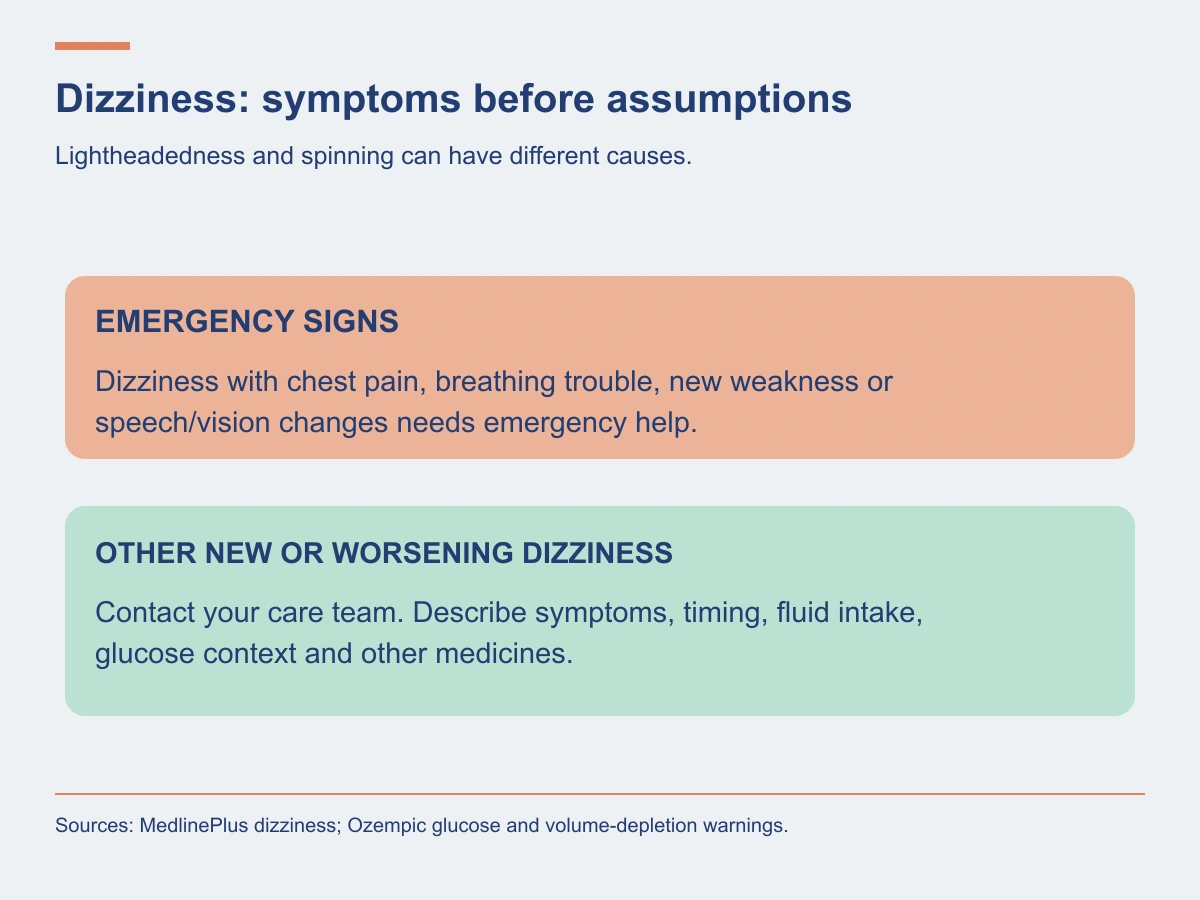
Seek emergency help for dizziness with chest pain, breathing difficulty, new weakness, trouble speaking, a new vision change or other severe symptoms. Do not wait to see whether a snack, water or the next injection schedule resolves a possible emergency.
Describe what “dizzy” feels like
MedlinePlus distinguishes lightheadedness, which can feel like you might faint, from vertigo, which can feel like you or the surroundings are spinning. It discusses several possible causes and recommends medical contact for new, worsening or medicine-associated dizziness. MedlinePlus dizziness information.
Try to describe the feeling in your own words. Does it begin when you stand up? Does turning your head bring on spinning? Are you unsteady when walking? Do you also feel sweaty, shaky, nauseated or unusually weak?
These observations help the care team decide what to assess. They are not a home diagnostic test. A person can have more than one symptom, and a familiar symptom can require a different response if it becomes more severe or is accompanied by a warning sign.
When should I get emergency help?
MedlinePlus lists dizziness with chest pain, an irregular heartbeat, shortness of breath, weakness, inability to move an arm or leg, changes in speech or vision, seizures or prolonged loss of alertness among reasons for emergency assessment. Emergency symptom guidance.
Call 911 or your local emergency number for a possible emergency. Do not drive yourself while dizzy. If symptoms include a new neurological change or severe chest symptoms, avoid delaying care while trying to decide whether Ozempic caused them.
Our chest-pain and palpitations guide explains related warning signs. A medication side-effect discussion cannot rule out a heart, neurological or other urgent problem. Trouble keeping fluids down with dizziness also needs urgent assessment, particularly when symptoms are substantial or worsening.
How could low blood sugar be relevant?
Ozempic’s label identifies an increased risk of hypoglycemia, or low blood sugar, when used with insulin or an insulin secretagogue such as a sulfonylurea. The treating team should explain the risk and the appropriate monitoring plan for those combinations. Ozempic hypoglycemia warning.
If you already have a glucose-monitoring and low-blood-sugar response plan, follow that plan and seek the level of help it specifies. Tell the team about symptoms, readings if available, medicines and changes in meals. Do not use a general article to change an insulin dose or invent a new treatment threshold.
Feeling dizzy does not establish low blood sugar. Conversely, a single reassuring reading cannot explain every symptom or cancel other warning signs. The relevant question is how the symptom fits the whole situation, including any emergency features.
If you have no diabetes diagnosis or no existing monitoring plan, explain that when you seek advice. Do not start treating all dizziness with repeated sugary drinks or assume that a borrowed meter can replace assessment of a persistent problem.
Fluid loss and digestive symptoms need attention
Ozempic’s label warns about acute kidney injury associated with volume depletion, often following nausea, vomiting or diarrhea that leads to dehydration. It calls for renal monitoring when relevant reactions occur, especially during treatment initiation or escalation. Ozempic volume-depletion warning.
Report whether you can drink normally, whether fluids stay down and whether vomiting or diarrhea is continuing. A substantial change in intake can matter alongside the dizziness. Do not dismiss it because appetite reduction is an expected topic in weight-management discussions.
Our water and drinks guide discusses hydration choices. It does not set a fixed amount for everyone: kidney, heart or other medical circumstances may affect fluid advice. If you have been given a fluid restriction or another clinical plan, tell the assessing team.
Adding electrolyte drinks, salt or a large volume of water without understanding the cause is not a universal treatment. Persistent symptoms need an assessment of the person, not merely a different beverage recommendation.

Standing, blood pressure and other causes
Our guide to Ozempic and blood-pressure questions separates bounded trial findings from individual home readings and reviews measurement routines, symptoms and coordination of hypertension medicines.
MedlinePlus notes that lightheadedness can occur with a sudden blood-pressure drop, dehydration or getting up too quickly. It also describes causes unrelated to these, including inner-ear conditions that may cause vertigo. Dizziness causes.
Tell the clinician if symptoms occur after standing, after a meal, with head movement or at another recurring time. Include blood-pressure medicines and any readings you have been instructed to obtain. A home reading may be useful information, but its interpretation belongs with the wider assessment.
Do not stop a blood-pressure medicine because an online explanation seems to fit. Similarly, do not assume that spinning always means dehydration or that a faint feeling always means you need sugar. The words used to describe the symptom are the start of the evaluation.
Does a recent Ozempic change prove it is the cause?
A symptom that starts after treatment begins or after a dose change should be reported. That timing is useful, but it does not establish a diagnosis. Other medicines, illness, meals, fluid intake or a separate condition may have changed during the same period.
Bring the actual Ozempic injection product and prescribed schedule into the discussion. Our Ozempic dosage guide and semaglutide side-effects article explain why product and formulation details matter. They do not authorize a change to your regimen.
Ask the prescriber what to do before the next scheduled dose if symptoms are new, persistent or worsening. Do not repeatedly skip, increase or double doses to test a theory about the dizziness. A clear clinical plan is more useful than a series of unsupervised experiments.
Reduce immediate fall and activity risks
When you feel dizzy, move to a safe position and avoid activities that require balance, climbing, machinery or driving. Ask for help if moving around is unsafe. MedlinePlus’s precautions include avoiding abrupt posture changes and resting when vertigo symptoms occur. Dizziness precautions.
The safe response depends on severity and other symptoms. Sitting down is not an alternative to calling emergency services when a warning sign is present. Do not walk outside alone to “get your steps in” during an unexplained dizzy episode.
If episodes interfere with ordinary mobility, discuss that effect explicitly. Our adapted-activity article addresses ability-based activity planning. A general exercise goal should not pressure you to ignore a symptom that needs assessment.
What information should I record?
A short, clear note can help a routine review. Record when the episode began, how long it lasted, what it felt like and what else was happening. Include the injection date and recent prescribed changes without assuming the injection explains the episode.
| Detail | Example of useful information |
|---|---|
| Feeling | Faint, spinning, unsteady, or another description |
| Trigger or timing | Standing, head movement, meals, rest or activity |
| Other symptoms | Vomiting, diarrhea, chest symptoms, sweating or weakness |
| Medicines | Current prescriptions, recent changes and occasional products |
| Intake | Whether meals and fluids are manageable |
| Clinical readings | Glucose or blood pressure obtained under your existing plan |
| Daily impact | Falls, near-falls, difficulty walking or inability to work safely |
Do not delay urgent care to complete the table. For an ordinary appointment, a few representative episodes may be more useful than a long diary that contains only the word “dizzy.” Ask whether the team wants any particular monitoring between appointments.

Meals, appetite and ongoing follow-up
If treatment has changed your appetite, discuss the amount and variety you can actually manage. Our balanced-meals guide helps describe meals, and the protein breakfast article offers practical eating ideas.
Those resources cannot diagnose the dizziness. A missed breakfast, a small dinner or a change in weight should be included in the history rather than assumed to be the sole cause. Review persistent poor intake with a clinician or registered dietitian.
At follow-up, ask what the assessment found, which symptoms require earlier contact and whether the treatment or monitoring plan needs adjustment. If symptoms recur after an initial review, report the new episode and any changes rather than assuming the previous explanation covers it indefinitely.
Frequently asked questions
Is dizziness a normal symptom I should just tolerate?
New, worsening or medicine-associated dizziness warrants care-team contact, and warning signs require emergency assessment. Severity, duration and associated symptoms matter. Do not use “normal side effect” as a reason to overlook a fall, persistent vomiting, a neurological change or a substantial decline in daily function.
Should I eat sugar whenever I feel dizzy?
Follow your established low-blood-sugar plan if one applies. Dizziness alone does not identify low blood sugar, and sugar is not a treatment for every cause. Seek appropriate assessment when symptoms are unexplained, persistent or severe, and do not let a temporary improvement rule out warning signs.
Can I take the injection at night to avoid dizziness?
The reviewed Ozempic injection label allows weekly administration at any time of day, but changing the clock does not diagnose or reliably prevent dizziness. Administration information. Ask the prescriber about the symptom and the schedule, particularly before changing a treatment plan because of a new problem.
Where can I explore adult treatment questions?
The CoreAge Rx semaglutide page describes the service. An individual consultation determines eligibility and the exact prescription. If you already have dizziness or another active symptom, include it in the assessment; a product page cannot provide a diagnosis or assure that a medication change will resolve it.
Educational information for adults; individual treatment decisions require a qualified clinician. Sources reviewed October 3, 2026. Original AI-generated article images depict fictional people and objects, not patient outcomes. Other editorial images are illustrative. Graphics summarize the cited sources.