
“Ozempic Face” is an informal phrase for changes in facial appearance that some people notice during weight loss, including less cheek fullness, more visible lines, or looser skin. It is not a medical diagnosis, and it does not mean that a person’s face needs to be “fixed.” Similar changes can occur with weight loss through other treatments or methods.
If the change bothers you, it is reasonable to discuss it alongside the medical benefits and side effects of treatment. The useful approach is to identify the concern—dryness, irritation, loss of volume, loose skin, or something else—before choosing a response. A moisturizer and a procedure that adds volume do different jobs.
What does the term actually describe?
People may use the same phrase for several different observations:
- Cheeks or temples appearing less full.
- Skin looking looser after a change in the tissue beneath it.
- Lines appearing more noticeable.
- Dryness or a crepe-like surface texture.
- A general impression that their appearance has changed faster than expected.
Those observations are not interchangeable. Age-related changes, sun exposure, genetics, nutrition, the amount and pace of weight loss, and preexisting skin conditions can all affect appearance. A photograph alone cannot determine which factor is responsible.
The American Academy of Dermatology discusses facial changes among possible skin, hair, and nail concerns during GLP-1 treatment. Its guidance also makes clear that dermatology care can be part of a broader treatment plan.
Does Ozempic directly remove facial fat?
Ozempic is not prescribed to target fat in the face. It contains semaglutide and has specific approved uses related to type 2 diabetes and certain cardiovascular and kidney outcomes. Weight change may occur during treatment, and a change in overall body weight can include facial volume.
It is too simplistic to attribute every visible change either entirely to the medicine or entirely to the scale. Research on GLP-1 treatment and skin is still developing. Rapid weight change, reduced intake, aging, and other factors may overlap, and individual causes require assessment.
The practical distinction is between a recognized observation and a proven mechanism in a particular person. An online before-and-after photo cannot establish that mechanism. It also cannot tell you the person’s medication, dose, health history, cosmetic procedures, lighting, or image editing.
For background on the ingredient and its different products, see semaglutide versus Ozempic and what GLP-1 means.
Can you prevent Ozempic Face?
There is no guaranteed prevention method. A careful treatment plan can address nutrition, tolerance, the pattern of weight change, and concerns about appearance, but it cannot promise that facial volume will stay exactly the same.
Avoid self-adjusting doses to chase a particular appearance. If weight is changing faster than expected, food intake has become very limited, or you are losing strength, tell the prescriber. These are reasons to review the whole plan, not simply to add a cosmetic product.
Regular meals that meet your needs, adequate protein, appropriate strength training, and attention to hydration can support general health during treatment. They do not guarantee preservation of facial fat. Our semaglutide protein and muscle guide and beginner strength-training article explain what those measures can realistically support.
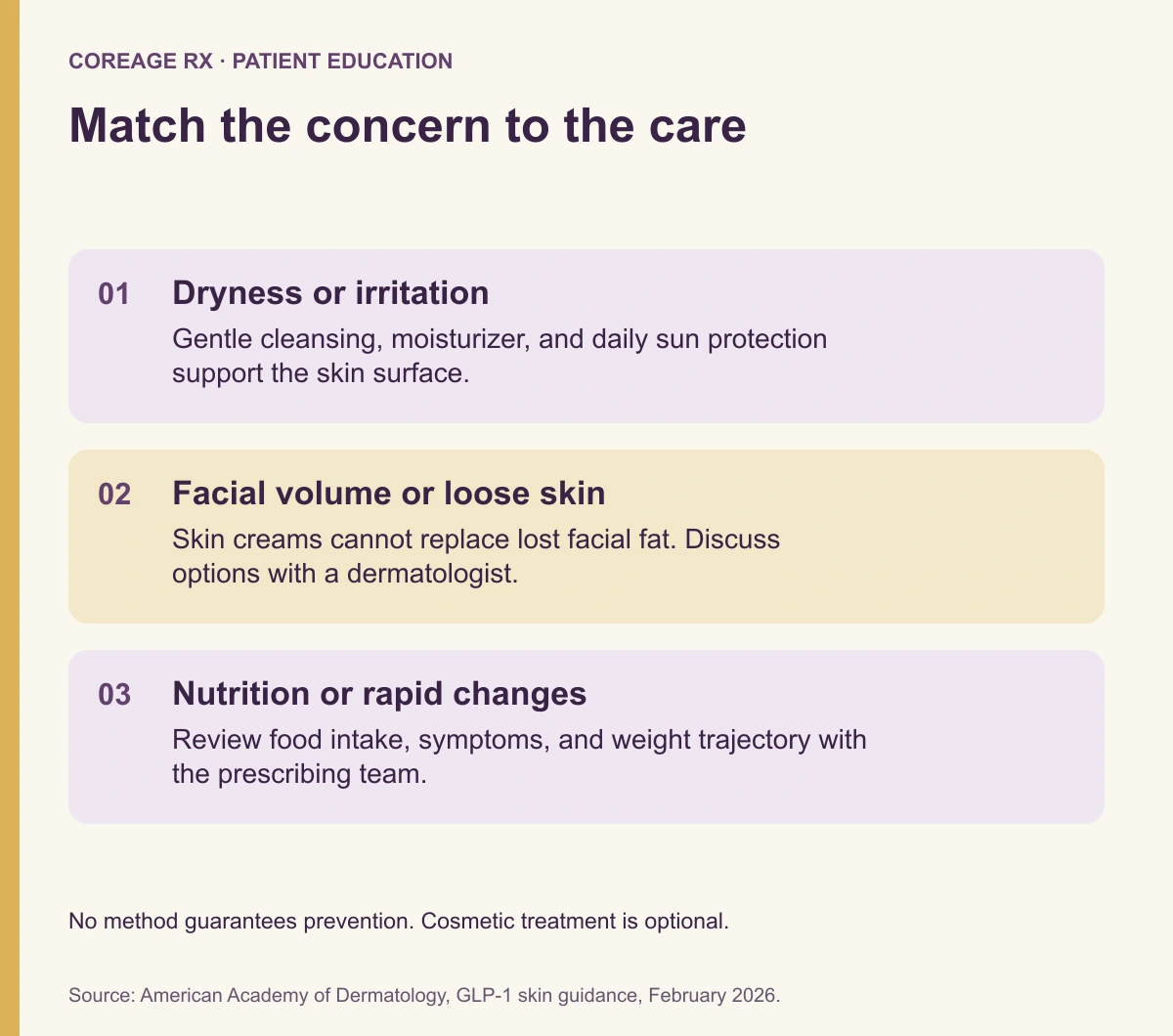
Match the treatment to the actual concern
| Main concern | A useful starting discussion | Important limit |
|---|---|---|
| Dryness, tightness, or irritation | Gentle cleansing, moisturizer, sun protection, and review of irritating products | Surface hydration does not replace lost facial fat. |
| Fine lines or uneven texture | A dermatologist can discuss evidence-based topical care and tolerance | A topical treatment is not the same as a volume-restoring procedure. |
| Loss of facial fullness | A qualified dermatologist or plastic surgeon can assess whether a procedure is appropriate | Results, risks, cost, and maintenance vary; no procedure is required. |
| Loose skin | Assessment of the degree of laxity and realistic options | A cream cannot be assumed to tighten substantial excess skin. |
| Rapid change with poor intake, weakness, or illness | Review with the prescribing team | Cosmetic treatment should not substitute for a medical assessment. |
This separation helps avoid spending money on a product that addresses a different problem from the one you actually have.
A straightforward skin-care routine
A gentle routine is often a useful place to begin when skin is dry or easily irritated. The American Academy of Dermatology recommends supportive cleansing and moisturizing, along with sun protection. Broad-spectrum, water-resistant sunscreen with SPF 30 or higher, shade, and protective clothing help limit ultraviolet damage. Source: AAD GLP-1 skin guidance.
If you already use exfoliating acids, retinoids, or several active products, review the entire routine before adding something else. More active ingredients can mean more irritation. Dryness and peeling can make texture appear worse even when the intended long-term goal is smoother skin.
Our skin-barrier recovery guide, dry versus dehydrated skin article, and tretinoin and moisturizer guide provide related education. Persistent irritation, a new rash, or a changing lesion deserves a clinician’s assessment.

Can tretinoin, copper peptides, or collagen products help?
The first question is what outcome you expect. A product used for fine lines, surface texture, or skin-barrier support should not be advertised as replacing lost facial volume.
Tretinoin is a prescription treatment with evidence for particular skin concerns, including signs of photoaging, but it can cause irritation and requires attention to pregnancy-related precautions and individual suitability. Our tretinoin fine-lines guide explains its role. If you are considering CoreAge Rx Smooth Move, discuss the complete formula and prescription plan with the clinician; it is not a treatment that restores facial fat.
Copper-peptide products also need an evidence-based discussion. Our copper-peptide skin-care guide and Bounce Back ingredient guide distinguish product ingredients from clinical outcomes. You can review Bounce Back as a skin-care option without assuming that it reverses weight-loss-related volume changes.
Likewise, a collagen supplement’s marketing language does not establish that it prevents “Ozempic Face.” Ask whether the exact product has human evidence for the outcome you want, and consider cost, dietary needs, and other ingredients. A promise to rebuild all lost facial volume is not a reasonable expectation from an ordinary supplement.
What about fillers, fat transfer, or other procedures?
A dermatologist or plastic surgeon can assess whether a procedure is appropriate for a specific concern. The AAD discusses options such as soft-tissue fillers, fat transfer, and certain skin procedures in the context of GLP-1-associated appearance changes. That list is not a recommendation that every person should have one.
Ask what the procedure is intended to change, how long the effect may last, what maintenance is likely, and what complications need urgent care. Discuss your full medical history, current medications, and whether weight is still changing. The best timing is a clinical decision, especially if the underlying change is ongoing.
Avoid selecting a procedure solely from a filtered photograph or a package discount. A consultation should leave room for choosing no treatment. Concern about appearance is valid, and so is deciding that you do not want the cost, recovery, uncertainty, or risk of a procedure.
Will stopping Ozempic make the changes disappear?
There is no guarantee. Facial appearance after stopping depends on what caused the change, subsequent weight patterns, skin characteristics, age, and other factors. Stopping a medicine can also affect glucose control or other intended health benefits.
Do not stop solely on the assumption that the face will return to a particular appearance. Discuss the concern with the prescriber and, if useful, a dermatologist. A plan might address nutrition, skin care, treatment tolerance, or cosmetic preferences while considering the medical reason for the prescription.
Our stopping semaglutide and maintenance guide explains why discontinuation deserves its own discussion. Weight regain is not a precise or risk-free cosmetic strategy.
Photos, social media, and realistic comparisons
Lighting, camera distance, facial expression, makeup, hydration, and image editing can all change how a face appears. Comparing a professionally lit photograph with an unflattering phone image is not a reliable way to measure a treatment effect.
If you want to document changes for a consultation, use consistent lighting and camera position without filters. Record approximate dates and relevant changes in weight, symptoms, skin products, or procedures. The purpose is to support a conversation, not to judge whether your face matches an online ideal.
It is also reasonable to limit appearance-focused content if it creates distress. A clinician or mental-health professional can help when worry about appearance interferes with eating, social life, or the ability to make balanced treatment decisions.

Facial changes that need prompt medical attention
Gradual changes in fullness are different from sudden facial swelling. Swelling of the lips, tongue, or throat, trouble breathing, or fainting can indicate a serious allergic reaction and requires emergency help. Stop the medicine and obtain urgent assistance. Source: Ozempic safety information.
A new one-sided facial droop, trouble speaking, or sudden weakness also needs emergency evaluation. Do not label an abrupt neurologic symptom “Ozempic Face.” Persistent vomiting, severe weakness, inability to keep fluids down, or rapid unexplained changes should be discussed promptly with the care team.
For medication-specific warning signs, read our Ozempic side-effects guide. Cosmetic terminology should never delay assessment of a potentially serious symptom.
Frequently asked questions
Does everyone taking Ozempic develop it?
No. Appearance changes vary, and the phrase has no standardized diagnostic definition. Social-media visibility does not establish how frequently a particular change occurs.
Can it happen with tirzepatide or weight loss without medicine?
Facial volume and skin appearance can change with weight loss through different approaches. That does not mean all medicines have identical effects or that a photo can identify which treatment someone used.
Does drinking more water restore lost facial fat?
Adequate hydration supports health and can help when dehydration is present, but it does not replace fat tissue. Persistent dryness and structural volume changes require different discussions.
Should I buy a skin-care bundle before starting treatment?
A gentle routine and sun protection may be sufficient. Add products to address a defined concern and your skin’s tolerance, rather than an assumption that a feared change is inevitable.
What should I ask at an appointment?
Describe the exact change, when it began, whether weight is still changing, and what you want to improve. Bring the medication and skin-care lists. Ask which options have evidence for that concern, what they cannot do, and whether observation or no cosmetic treatment is reasonable.
Educational information for adults; individual treatment decisions require a qualified clinician. Sources checked September 26, 2026. Original AI-generated article illustrations depict fictional people and objects, not patient outcomes. Other editorial images are illustrative. Graphics summarize the cited sources.