There is no firmly established best clock time for creatine. For a daily routine, the useful question is when you can take the labeled serving consistently and comfortably. Morning, lunch, and after training can all be practical choices.
What the timing studies actually compare
Research has examined creatine before versus after exercise, sometimes alongside meals or other supplements. The review of exercise-related timing found relatively few studies, with differing protocols and inconsistent findings. That makes a universal “take it within 30 minutes” rule difficult to defend.
Creatine increases stores over time. It does not work like an immediate stimulant whose main effect depends on taking it just before activity. A missed pre-workout window does not make the day’s serving useless. For the basic process, see our creatine guide.
Choose a cue you already have
Use breakfast if mornings are predictable. Pair it with lunch if you train at different times. Taking it after exercise can work if you also have a plan for non-training days. Keep the product somewhere compatible with its storage instructions, where the routine is easy to remember and children cannot reach it.
| Your schedule | A practical cue | What to check |
|---|---|---|
| Early workouts | Breakfast or the usual recovery meal | Whether eating first feels better |
| Evening workouts | Lunch or dinner | Whether a late drink disrupts your routine |
| Variable shifts | One dependable daily meal | Whether you already took that day’s serving |
These are habit suggestions, not different dosing prescriptions. Use one daily serving when that is what the label directs.

With food or without?
Some studies explore how accompanying nutrients affect uptake, but that does not establish a need for a large sugary drink. A familiar meal or beverage may be easier to tolerate and remember. If an empty-stomach serving causes discomfort, discuss a meal-based routine or another adjustment with your clinician.
The general evidence review provides context on supplementation protocols. Changing several things at once—serving size, drink, pre-workout, and meal timing—makes it harder to identify what is causing a problem.
Strong Suit in a daily schedule
Its pictured label directs one scoop mixed with 8–16 oz of cold water or a favorite beverage, once daily. It does not require a specific workout window. Use the current bottle for the final instructions and avoid adding a second serving just because the first was not near training.
Plan rest days at the same time you plan workout days. If a routine is comfortable and easy to repeat, there is little reason to keep rearranging it in pursuit of an unproven timing advantage.

Distinguish a convenient time from a proven biological advantage
A convenient time is one that fits your day and helps you remember the serving. A proven biological advantage would mean that taking the same amount at one time reliably produces better outcomes than taking it at another. Those are different claims. A routine can be excellent for adherence without being the uniquely effective time for everyone.
This distinction helps when reading an article that recommends “immediately after training.” That may be a useful habit suggestion: the person already has a recovery meal or shake at that point. It does not automatically prove that a serving at breakfast would have been ineffective. The timing literature is much less decisive than the certainty of many advertising claims suggests.
Look at what a study actually changed. Were participants taking creatine alone, combining it with protein and carbohydrate, or using different training routines? Were the groups small? Did the study assess muscle stores, strength, or body composition? A result under one arrangement should not become a universal clock-time rule without considering those details.
Build a schedule around the day you really have
For an early-morning exerciser, taking a serving after the usual breakfast may be easier than adding another task before leaving home. For someone who works rotating shifts, “with my first regular meal” may be more dependable than “at 8 a.m.” For an evening exerciser, a lunchtime serving can avoid making the supplement dependent on a workout that occasionally gets canceled.
If you prefer taking creatine after training, add a separate cue for rest days. Otherwise, a routine that looks consistent in a workout log may become inconsistent across the full week. The goal is not to force every day into the same schedule; it is to create a clear way to follow the same product directions under different schedules.
Shared routines can help, but keep intake individual. If a household prepares several shakes at once, label them and check which one contains the supplement. A planned cue should reduce uncertainty, not make it easier to take a second serving because you cannot remember what went into the first drink.
Three example routines, with tradeoffs
Breakfast routine: Mix the label-directed serving when preparing breakfast. This works well if you usually eat at home and the product can be stored appropriately nearby. It may work less well if breakfast is frequently skipped or rushed. In that case, choose a more dependable event instead of repeatedly trying to repair the morning routine.
Lunch routine: Use lunch as the cue on both workout and rest days. This separates supplement timing from a changing exercise schedule. If you take several medications with lunch, review the complete supplement list with your clinician or pharmacist rather than assuming a combined routine is suitable for every medicine.
Post-workout routine with a rest-day backup: Take the usual serving with a familiar post-workout meal or beverage, and use a regular meal on non-training days. This may feel intuitive for someone who already records workouts. The tradeoff is that there are two cues to remember, so a simple daily checkmark is useful.
These examples describe organization, not alternative doses. They do not require additional servings, a special drink, or a narrow minute-by-minute window.
Food, sugar, and the temptation to optimize everything
It is easy to turn an ordinary creatine routine into a long list of rules about insulin, carbohydrates, meal size, and exact timing. Some research examines nutrient combinations and uptake, but uptake measurements do not by themselves establish that every person needs a large sugary beverage to obtain a useful training outcome.
A familiar meal or drink can be a practical pairing. Choose it for comfort and consistency, and account for its role in your overall diet. If you already use a protein shake because it helps meet a nutrition need, adding a compatible, label-directed creatine serving may simplify the routine. If you do not need a shake, creatine does not create a requirement to buy one.
Avoid changing the serving, drink ingredients, caffeine intake, and meal timing simultaneously when trying to improve tolerance. Too many changes make it hard to know what helped or caused a problem. The mixing guide offers a simpler way to think about beverage choice.
What if the timing routine causes problems?
If an empty-stomach serving repeatedly feels uncomfortable, note that pattern and discuss an appropriate adjustment. If a late drink means waking to use the bathroom, an earlier daily cue may fit your life better. These are practical reasons to move a routine, even when there is no claim that the new time produces greater muscle growth.
Also distinguish plain creatine from a product containing stimulants. If a combination supplement disrupts sleep, its caffeine or other ingredients deserve attention. Do not assume creatine itself explains every effect of a multi-ingredient powder. Read the entire panel and count ingredients across products.
Persistent or severe symptoms call for assessment rather than repeated timing experiments. A supplement is optional; tolerating an uncomfortable routine is not a prerequisite for making progress in training.
Frequently asked questions
Is it too late if I forgot before the workout?
Missing a pre-workout cue does not make the day useless. Follow the label-directed routine without taking extra to compensate. A stable daily habit is more useful than treating every workout as a countdown to a narrow opportunity.
Is morning better for fat loss?
There is no established clock-time rule that turns creatine into a fat-loss supplement. If weight management is your goal, consider training, food intake, and the interpretation of early water changes. See creatine during weight loss for that broader discussion.
Should I change the time when I change programs?
Only if the change makes the routine easier to follow or addresses a practical issue. A new training split does not automatically require a new creatine schedule. Keep the daily amount and current bottle instructions clear while you adjust the exercise program.
Explore Strong Suit™
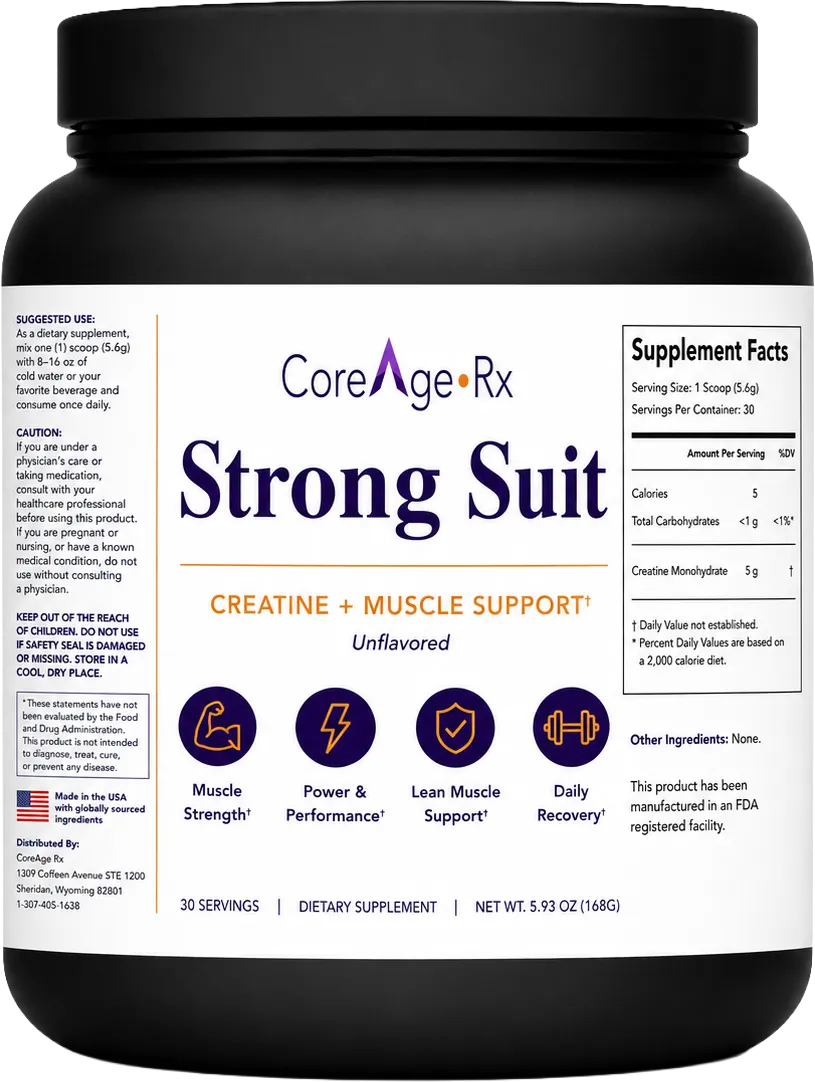
Strong Suit is CoreAge Rx’s unflavored creatine monohydrate powder. The pictured label lists 5 g creatine per scoop and 30 servings. See the current Strong Suit™ page and check the bottle you receive before use.
Related reading
- Creatine Monohydrate: Benefits, Dosing, and What to Expect
- Should You Take Creatine on Rest Days?
- How to Mix Creatine Without Overcomplicating Your Routine
- Nutrition during GLP-1 treatment
Educational information, not individualized medical advice. Product information and linked research checked September 15, 2026. Ingredient research does not establish identical effects for a finished supplement.