
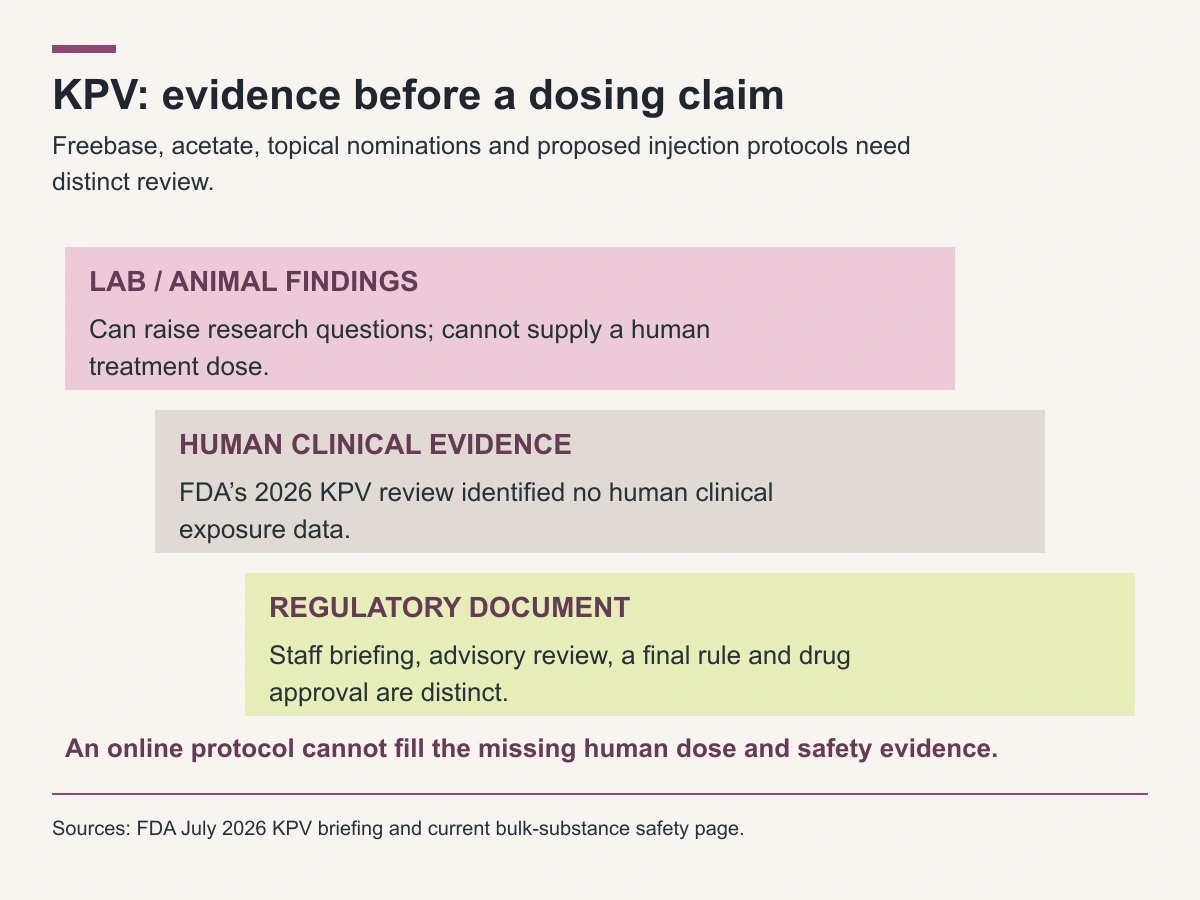
There is no validated universal human KPV dosage established by the FDA material reviewed for this guide. The agency’s 2026 evaluation did not identify human clinical studies or human exposure data that could establish how KPV should be dosed, how it behaves in people, or its clinical safety. An online protocol cannot fill those evidence gaps simply by listing a precise number.
KPV discussions often mix different substance forms, laboratory experiments, topical proposals, and injectable or oral marketing claims. Keeping those categories separate is the first step toward understanding what the evidence actually says.
This article explains the dosing question without supplying a home-use protocol, a research-powder mixing plan, or a recommendation to try an unvalidated regimen.
What is KPV?
KPV refers to a tripeptide composed of lysine, proline, and valine. The letters come from the amino acids’ one-letter abbreviations. A substance having only three amino acids does not establish that it is safe or effective as a medicine. FDA KPV briefing document.
FDA’s evaluation considered KPV free base and KPV acetate separately because they are different bulk drug substances. The submitted nomination contained inconsistent information about the intended form, and FDA evaluated both on its own initiative after the nomination was withdrawn.
Those identity questions matter before dosing can be interpreted. A product labeled “KPV” does not, by that name alone, establish its salt form, composition, manufacturing quality, formulation, or behavior in the body. A number of micrograms cannot resolve an uncertain product identity.
The briefing also states that neither evaluated form was a component of an FDA-approved drug and that there was no applicable USP or National Formulary drug-substance monograph. These are findings reported in that evaluation, not a claim that every online product has been individually tested by FDA. FDA KPV briefing document.
What did the 2026 FDA review actually consider?
The briefing prepared for the July 2026 Pharmacy Compounding Advisory Committee meeting evaluated proposed use in wound healing and inflammatory conditions. The withdrawn nomination proposed 0.1% topical cream or gel. It did not propose a validated oral, nasal, or subcutaneous treatment protocol for readers. FDA KPV briefing document, FDA meeting materials.
The 0.1% figure describes the proposed strength in that nomination. It is not a finding that the formulation works, a recommended application amount, or an FDA-approved treatment dose.
Staff concluded that the available characterization, historical-use information, and lack of human effectiveness and safety evidence weighed against adding the evaluated substances to the 503A bulk-drug-substances list. This guide cites that staff assessment. It should not be presented as a committee vote, a final regulatory rule, or approval of a drug and its dosing instructions.
These distinctions are important when a headline says KPV was “reviewed by FDA.” Review can describe the examination of a nomination and evidence. It does not, by itself, mean FDA has approved a treatment, established a dose, or verified a seller’s product.
Why the human evidence gap matters to dosage
FDA’s briefing did not identify clinical studies assessing KPV pharmacokinetics or pharmacodynamics in humans through any route. Pharmacokinetics concerns what the body does to a substance; pharmacodynamics concerns its effects on the body. Both are relevant to determining a regimen. FDA KPV briefing document.
Without suitable human evidence, a protocol cannot reliably establish how much is absorbed, how long exposure lasts, which amount is effective, what adverse effects occur, or what monitoring is appropriate. A suggested cycle length is another unanswered question, not evidence that the cycle has been tested.
The review also did not identify human safety information sufficient to assess concerns such as immunogenicity or aggregation. It described potential risks as unknown. Unknown risk is not a measured low-risk result, and a lack of identified adverse-event reports is not proof that a product is harmless.
The findings describe the evidence FDA identified for its evaluation. They do not prove that nobody anywhere has used a product sold as KPV. Use, testimonials, and an adequately designed study are different kinds of information.
Different evidence types answer different questions
| Information you may encounter | What it can contribute | What it cannot establish by itself |
|---|---|---|
| Cell or laboratory experiment | A mechanism worth investigating | A safe or effective human dose |
| Animal experiment | Findings in the studied animal model | An interchangeable regimen for people |
| Experiment using human cells or cadaver skin | Laboratory information about that material | Clinical effects in living patients |
| Compounding nomination | A proposed substance, use, and formulation | Drug approval or validated prescribing instructions |
| Customer testimonial | A person’s account of an experience | Verified product identity, causation, or reliable dosing |
| Online dosing chart | The seller’s or writer’s stated protocol | Evidence that the protocol was tested adequately |
FDA discussed nonclinical information in its evaluation but did not find clinical evidence establishing effectiveness for the nominated wound-healing or inflammatory uses. Evidence involving human-derived cells or skin remains different from administering a treatment to people and measuring clinical outcomes. FDA KPV briefing document.
The table is not a reason to dismiss laboratory research. It explains which additional evidence is needed before a research idea becomes a dependable treatment plan.

Can animal doses be converted into a human protocol?
An animal amount cannot establish a personal dose through simple body-weight arithmetic. The species, route, formulation, exposure, endpoints, and safety findings all affect interpretation. Even a carefully performed calculation would not create the missing human effectiveness and safety data.
A route change adds another problem. A result obtained through one route does not establish how an oral, topical, nasal, or injectable product behaves. Different formulations may alter exposure, and FDA’s review did not identify the human studies needed to answer those questions for KPV. FDA KPV briefing document.
Be especially cautious with a chart that combines an animal experiment, a topical nomination, and an injectable protocol as though they were successive confirmations of the same regimen. They are separate pieces of information with different purposes.
The practical answer to a human-dosage question is therefore not a converted number. It is that the cited review does not validate a general regimen to recommend.
Why a topical percentage is not an injectable dose
The proposed 0.1% cream or gel in the FDA nomination is a concentration statement for a particular proposed dosage form. It does not say how much a patient should apply, how often, over what area, or for how long. It also does not establish clinical benefit. FDA KPV briefing document.
Do not turn that percentage into an oral or injectable dose. The concentration basis, formulation, amount used, route, and clinical evidence would all need to be established. A topical nomination does not supply those details for a vial or capsule.
The same caution applies to units on an online syringe chart. Milligrams, micrograms, milliliters, and syringe markings describe different quantities. Correct arithmetic is only one part of safe medication use; it cannot make an unvalidated treatment clinically appropriate.
If a seller presents a precise conversion as the main evidence that a protocol is safe, ask where the human trial and product-specific prescribing information are. The ability to calculate a volume does not establish that the substance should be administered.
FDA categories and compounding claims need precise wording
FDA’s current safety page discusses KPV in the section for bulk substances whose nominations were withdrawn. It states that the agency had not identified human exposure data and lacked important information about whether KPV would cause harm in people. This should not be relabeled as an entry in the page’s current Category 2 table. FDA bulk-substance safety page.
A statement about compounding status is also different from drug approval. FDA explains that compounded drugs are not FDA-approved and are not verified for safety, effectiveness, and quality before marketing through the drug-approval process. Compounding remains subject to oversight and applicable requirements; “not approved” should not be rewritten as “no regulation exists.” FDA compounding questions and answers.
This article does not infer a blanket legal conclusion from a staff briefing or an online summary of a meeting. Anyone making a current regulatory claim should identify the specific official document and explain whether it is a nomination, staff recommendation, advisory action, or final agency action.
For another ingredient-specific example, our compounded GLP-1 guide explains why identifying a formulation and its approval status matters. Its discussion of semaglutide and tirzepatide is not a KPV treatment protocol.

What to ask when evaluating an online claim
Ask for information that addresses the treatment question rather than just the sales description:
- Which substance form and formulation are being discussed?
- What condition and route were studied?
- Was the evidence from living human participants?
- What outcomes, adverse effects, and follow-up were measured?
- Does the cited document actually support the stated regimen?
- Is an FDA staff review being described accurately?
- What established treatment options exist for the condition?
An ingredient certificate or purity claim cannot answer all these questions. Identity and manufacturing information are important, but they are not substitutes for clinical evidence of benefit and safety.
If you have a wound, persistent skin inflammation, or another health concern, seek a diagnosis and discussion of appropriate treatment. FDA’s briefing notes that established therapies exist for the nominated conditions. A broad promise to “reduce inflammation” does not identify what is causing your symptoms. FDA KPV briefing document.
Common questions about KPV dosage
What is the recommended KPV dose for adults?
The cited FDA evaluation does not establish a validated universal adult dose. Supplying a numerical protocol would imply an evidence base that the review did not identify.
Is there an FDA-approved KPV dosing label in the briefing?
No. The briefing states that the evaluated forms were not components of an FDA-approved drug. Its proposed topical strength and compounding assessment are not approved prescribing instructions. FDA KPV briefing document.
Does 0.1% mean the FDA recommends KPV cream?
No. It was the proposed strength in a withdrawn nomination for topical cream or gel. The evaluation did not establish clinical effectiveness or a patient application regimen.
Are oral or injectable online protocols validated by the topical proposal?
No. They involve different routes and dosing questions. The cited review did not identify human pharmacokinetic, pharmacodynamic, or clinical safety studies that would validate those protocols.
Does the lack of reported adverse events prove safety?
No. Limited exposure information and reporting gaps prevent that conclusion. FDA explicitly described the potential human safety risks as unknown. FDA KPV briefing document.
What is a useful next step if I was interested because of symptoms?
Discuss the actual symptoms and diagnosis with a qualified clinician, along with any products you have used or considered. Bring the ingredient list and the claims that prompted your interest. The priority is an appropriate treatment plan for the condition, rather than finding a number to make an uncertain protocol look established.
Educational information for adults; individual treatment decisions require a qualified clinician. Sources reviewed October 2, 2026. Original AI-generated article images depict fictional people and objects, not patient outcomes. Other editorial images are illustrative. Graphics summarize the cited sources.