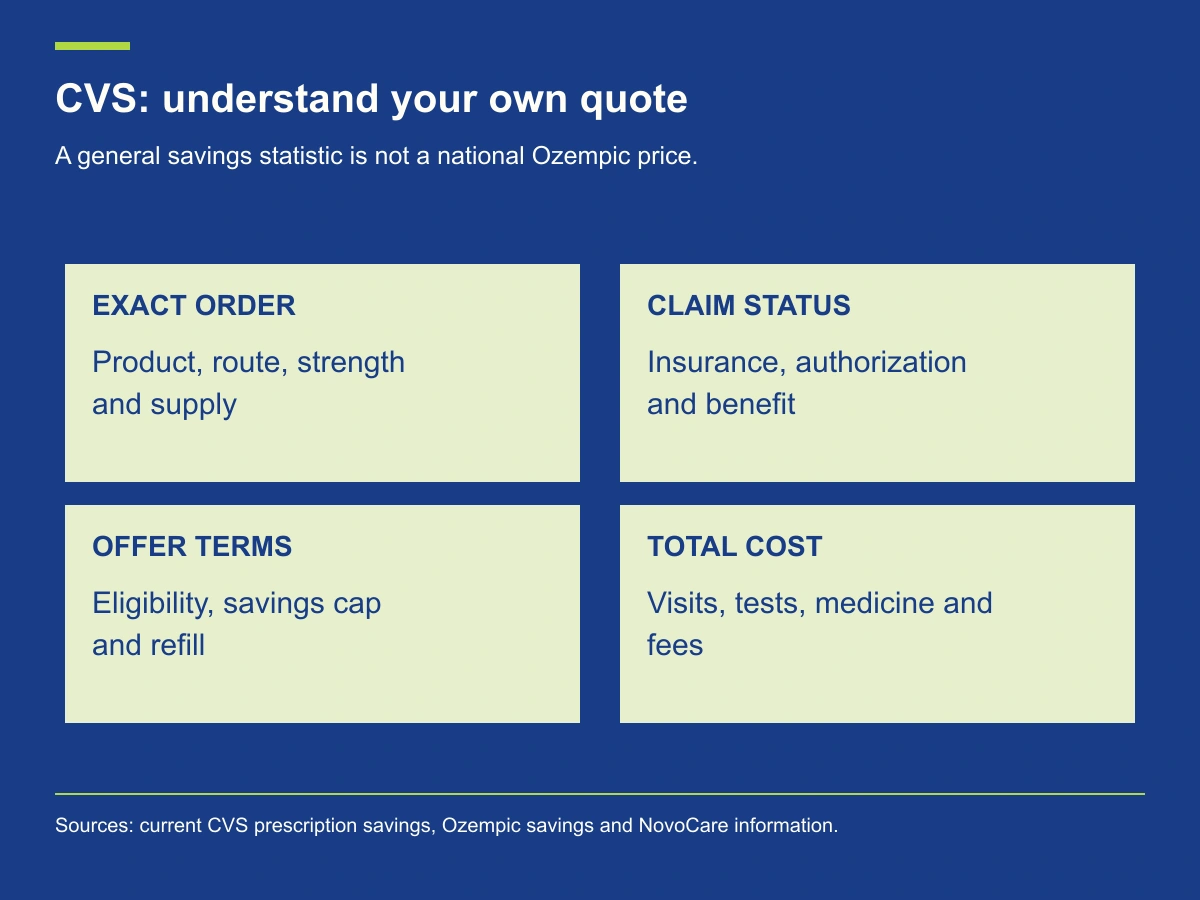
There is no single Ozempic price that every CVS customer pays. Your amount depends on the exact prescription, supply, insurance benefit, authorization status, and any savings arrangement you qualify to use. The useful answer is a current pharmacy quote for your prescription, followed by an explanation of what will happen at the next refill.
This guide helps you ask CVS the right questions, interpret savings language, and compare the complete cost of care. It does not provide a nationwide cash quote or guarantee that a particular branch has the product. Savings information was reviewed October 3, 2026; confirm terms again before filling.
What to have ready before asking for a price
Start with the medication name, route, presentation, prescribed strength, quantity, and supply. Add your prescription-benefit information and any manufacturer-offer details. If the prescription is already at CVS, ask whether the estimate reflects a processed insurance claim or a preliminary lookup.
“What does Ozempic cost?” can produce several valid answers that describe different transactions. A cash estimate without insurance is different from a copayment after approval. An introductory offer differs from the ongoing refill price. A price for one presentation should not silently become a quote for another.
Keep the quote date, branch, and supply together. If the office changes the prescription, ask for a fresh estimate. A previous authorization or quote may not carry over to a different product, formulation, or quantity.
The Ozempic cost guide explains the wider pricing landscape. Use this CVS-specific checklist alongside it rather than treating an internet price as your confirmed bill.
What CVS actually offers to help with costs
CVS describes prescription-savings assistance, manufacturer-coupon questions, estimated costs through its account tools, and use of eligible HSA or FSA funds. Its general savings page also discusses discounts and possible lower-cost alternatives. These are tools for investigating your bill, not an Ozempic-specific price guarantee. CVS prescription savings.
A pharmacist may help clarify why a claim was rejected or contact the prescriber about an alternative. A therapeutic alternative requires a clinical decision; it should not be treated as an automatic equivalent replacement. Ask whether a proposed change would require a new prescription, different monitoring, or another authorization.
CVS also publishes broad statistics about prescription costs. Those describe many medications and customers together. They do not establish that your Ozempic prescription will fall into the same low-price category. Likewise, a pharmacy rewards program is not proof of drug coverage or eligibility for a manufacturer coupon.
Understand the insurance price before comparing discounts
Insurance can change the patient payment in several ways. A deductible may leave you responsible for more early in the benefit year. Coinsurance can vary with the plan’s allowed amount. A formulary tier can affect your share. Prior authorization can determine whether the prescription benefit applies at all.
Ask the insurer which requirements apply to the exact product. The prescribing office can supply clinical records when appropriate, but a pharmacy cannot invent a diagnosis to make a claim qualify. Coverage for diabetes treatment should not be assumed to cover a different use.
| Pharmacy message or price | What it may mean | Useful next question |
|---|---|---|
| “Authorization required” | The benefit needs a review before payment | Has the office submitted it, and what is missing? |
| “Not covered” | Exclusion, formulary issue, or another rule | What is the written reason and appeal process? |
| Higher payment than last fill | Benefit, supply, offer, or prescription may have changed | Which part of the claim changed? |
| Cash quote | Insurance may not be included | What happens if the plan is processed instead? |
| Introductory savings | Conditions or duration may limit the offer | What is the expected continuing refill cost? |
The GLP-1 insurance coverage guide explains how to gather documents and ask about appeals. Record the insurer’s reference number and the office’s submission status so each team can identify the same issue.
Manufacturer savings: read the eligibility and savings cap
On the reviewed Ozempic savings page, Novo Nordisk describes an offer for commercially insured patients with coverage that may reduce the payment to as little as $25 per month, with up to $100 in monthly savings and a stated duration of up to 48 months. The savings cap matters: the headline alone does not guarantee that every eligible claim ends at $25. Verify the complete current terms and the prescribed supply with the pharmacy. Ozempic savings information.
The same page says Medicare Part D beneficiaries and patients in government programs such as Medicaid are not eligible for that particular $25 offer. It distinguishes self-pay arrangements from use of insurance; an outside-insurance purchase cannot be assumed to count toward the plan deductible or out-of-pocket limit.
Ask CVS which arrangement it can process for your exact prescription. Do not assume every manufacturer distribution route is available through every retail pharmacy. The reviewed NovoCare resource describes coverage support, assistance, and a separate pharmacy route. Check where an offer must be redeemed before transferring the prescription.

Can a discount replace insurance?
A discount may help some purchases, but it changes the transaction being compared. Ask whether insurance is being used, whether the discount can be combined with it, and whether the payment will count toward your plan’s limits. The smallest immediate number is not always the simplest long-term arrangement.
For example, compare a current insurance quote and an eligible self-pay quote for the same prescribed supply. Then check authorization renewal, refill terms, and benefit accounting. This is a comparison method, not a claim that either option is always less expensive.
If a website says a pharmacy accepts a general discount program, confirm that the exact drug and offer are included. Acceptance of a program across many prescriptions does not prove that every medication receives a discount or that every patient meets its terms.
HSA, FSA, and rewards questions
Using eligible HSA or FSA funds changes how you pay an expense; it does not create drug coverage or make an unsuitable treatment appropriate. Confirm eligibility and documentation requirements with the benefits administrator. Keep the pharmacy receipt if the account requires substantiation.
Rewards also deserve a separate line in your comparison. They may have enrollment, location, or redemption restrictions and may not reduce the prescription claim itself. Ask how a reward is issued and where it can be spent rather than subtracting an advertised reward from a medication bill without checking.
When discussing costs with a clinician, use the amount you actually pay for the medicine and care. A projected tax benefit or future retail reward is a different number. Keeping those separate makes it easier to explain why a plan is or is not affordable.
Count the complete monthly cost
Medication is one part of the budget. Add appointments, required tests, supplies, delivery charges, and any subscription. Confirm whether a service fee continues during a prescription delay or an insurance appeal. Ask about cancellation and records transfer before starting a membership.
Write a simple budget with three columns: initial costs, ordinary refill costs, and occasional costs. The initial column may include an assessment. The ordinary column includes recurring medication and membership charges. Occasional costs may include laboratory work or an extra visit. This method makes a low introductory advertisement easier to assess.
If affordability is uncertain, tell the prescribing team before running out. It may help investigate approved alternatives or assistance. Do not ration, share pens, change the dose yourself, or buy an unidentified preparation solely to reproduce an advertised price.
For comparison of service information, CoreAge Rx’s semaglutide product page is a place to review the offered care and discuss eligibility. Confirm the actual preparation and complete charges. A compounded medication is not an FDA-approved Ozempic generic; FDA’s compounding explanation describes that distinction.

Transfers, availability, and refrigerated prescriptions
Before transferring, ask the receiving CVS whether it can obtain the exact presentation and process your benefit. Confirm which pharmacy will request the transfer and whether the prescribing office needs to act. A transfer can affect the workflow even when it does not change the medication.
Ask about pickup timing and handling. For a delivery service, verify the shipping process and what to do about a warm or delayed package. The semaglutide storage and travel guide explains why the exact product matters. Do not decide usability from package temperature alone or apply one brand’s rule to a compounded preparation.
If supply interrupts treatment, contact the prescriber for a plan. The semaglutide missed-dose and restart guide explains why a longer gap deserves review. Price comparison should include reliable follow-up and refill coordination as well as the amount at checkout.
CVS and Ozempic: common questions
How much is Ozempic at CVS without insurance?
Request a current cash quote for the exact prescription and supply. This article does not have a verified nationwide CVS amount. Ask whether an eligible discount changes the quote and whether the quoted arrangement applies to subsequent fills.
Can I use the $25 manufacturer offer at CVS?
Ask the pharmacy to check the current offer, your eligibility, the covered claim, and the savings cap. The headline is conditional. Government-program rules and separate distribution arrangements may affect which offer can be used.
Why did my cost go up after the first month?
Ask the pharmacist to compare the two transactions. Possible differences include quantity, benefit status, authorization, deductible, or offer terms. Do not assume the change means the medication itself has become more expensive everywhere.
Does CVS’s low-cost prescription statistic include my Ozempic?
The aggregate statistic is not your prescription quote. Confirm your own product and claim. Broad savings language and retail rewards should not be read as a drug-specific coverage promise.
Is a 90-day prescription always cheaper?
No universal saving can be assumed. Ask about the permitted supply, plan rules, current prescription, and storage requirements. A clinician may also want to review tolerability and the treatment plan before a larger supply is appropriate.
What should I ask before agreeing to a refill?
Confirm the product, supply, payment, offer used, and next expected refill cost. Then check that you know whom to contact about symptoms, device questions, or a treatment change. An understandable quote and a clear care plan are both part of a useful pharmacy arrangement.
Educational information for adults; individual treatment decisions require a qualified clinician. Sources reviewed October 3, 2026. Original AI-generated article images depict fictional people and objects, not patient outcomes. Other editorial images are illustrative. Graphics summarize the cited sources.